
For early U.S. feasibility work, one current professional installer guide uses a broad range of:
$50–$250 per pallet positionThat spread is intentionally wide. A short selective-rack job on an empty slab is not comparable with a tall, seismic, high-density installation inside a live warehouse. Use the range to size the project; use contractor bids to price it.
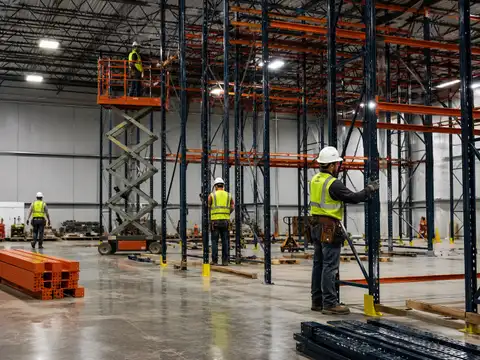
Rack installation is where a simple equipment purchase becomes a construction project. The crew has to translate a layout into actual rows, assemble uprights and beams, establish line and level, anchor the structure, install protection and accessories, and leave a system that matches the engineered configuration.
The cost is therefore driven by what installers have to do on site—not by the number of pieces on the purchase order alone. Two warehouses can buy exactly 500 pallet positions of selective rack and still receive very different labor bids because one project is an unobstructed new building and the other must be phased around inventory, forklifts and production.
Installation cost ladder
The rack gets more expensive to install as the site gets harder
Low selective rack, clear slab, normal hours, no demolition.
Traffic control, staged work, occupied aisles and restricted access.
Lifts, complex geometry, more anchoring and slower assembly.
Special details, inspections, permits and tighter coordination.
Use this only for early feasibility. A real installation quote should be built from the actual layout, rack type, building and local requirements.
Why public installation prices vary so much
Distribution X currently publishes roughly $50–$250 per pallet position as a broad ballpark for basic pallet-rack installation. The company specifically points to rack height, project complexity, labor availability and local permitting as reasons for the wide range, with automated and high-density projects tending toward the upper end.
That range is much broader than some online labor-only estimates, and that is exactly why buyers should be careful with the word installation. One source may mean assembly labor only. Another may include anchoring, lifts, supervision, permitting coordination or engineering. A useful quote states the scope instead of relying on a cost-per-position headline.
Ask whether the number includes unloading, layout marking, assembly, anchors, lifts, row spacers, guards, cleanup, inspection, permits, engineering, travel and after-hours work. A lower price can simply contain fewer tasks.
What does installation cost at 250, 500 and 1,000 positions?
| Pallet positions | At $50 / position | At $125 / position | At $250 / position |
|---|---|---|---|
| 250 | $12,500 | $31,250 | $62,500 |
| 500 | $25,000 | $62,500 | $125,000 |
| 1,000 | $50,000 | $125,000 | $250,000 |
| 2,000 | $100,000 | $250,000 | $500,000 |
These are not expected bids. They show how much the installation assumption matters. At 1,000 positions, moving from $50 to $125 per position changes the working budget by $75,000 before a single equipment price changes.
500 positions on an empty slab
A straightforward selective-rack job with ordinary height, good concrete, daytime access and no existing equipment should be easier to execute than most warehouse retrofits. If the project prices near the lower end of the broad range, the installation budget could sit in the tens of thousands rather than six figures.
The same 500 positions inside a live distribution center
Now add working forklifts, staged inventory moves, restricted aisles, night shifts and demolition of old rack. The steel count has not changed, but crew productivity can fall dramatically. Installation can move toward the middle or upper part of the range because the contractor is managing logistics as well as assembly.
Rack type changes installation productivity
Selective rack is normally the most repetitive installation. Uprights are stood, beams installed at defined levels, rows aligned, anchors drilled and accessories fitted. High-density systems add geometry and hardware.
Drive-in racks extend the structure through deep lanes. Push-back adds carts and rails. Pallet flow adds roller tracks and controls. Shuttle rack includes rails and commissioning for electromechanical equipment. The more pieces that have to be aligned and validated, the less useful a simple labor-per-position comparison becomes.
A June 2026 installation guide from Lile describes professional installation as a sequence beginning with site survey and layout, followed by upright placement, beam installation, floor anchoring, safety accessories and final inspection. The sequence matters because errors early in the layout are multiplied across every bay that follows.
Height changes the equipment and the pace of work
Rack that can be assembled from floor level is faster to install than a tall system requiring scissor lifts, boom lifts or other access equipment for beams, bracing and inspection. Height also increases the importance of line and plumb: a small error at the slab becomes more visible at the top of the frame.
Tall rack can therefore raise cost through both equipment rental and slower crew productivity. It can also interact with sprinkler clearances, building structure and permitting requirements that a low storage system might avoid.
Ask whether access equipment is included in the installer's lump sum. Rental, delivery, pickup and charging/fueling can otherwise appear as extras after the labor bid has already been accepted.
Concrete conditions matter because the rack has to be anchored
Storage rack installation is not simply placing freestanding furniture on a warehouse floor. The engineered system and manufacturer instructions determine anchorage requirements. Existing cracks, expansion joints, embedded utilities, slab deterioration or unsuitable anchor locations can complicate what looked like a routine job.
Lile's current installation guide tells project teams to evaluate the slab before installation and notes that uneven or damaged floors may require shimming or repair. For cost planning, the important point is not to copy its generic anchor dimensions into a project. The important point is that poor floor conditions consume additional labor and can require engineering decisions.
Never assume an online anchor size or torque value applies to your rack. Baseplate geometry, anchor product, slab conditions, seismic design and manufacturer requirements all matter.
Permitting can be a schedule cost even when the fee is small
Rack-permit requirements are local. American Material Handling's permitting guide notes that jurisdictions commonly review structural, fire-suppression, egress and seismic issues, but the exact threshold and submission process differ by city.
The direct permit fee may be modest compared with the rack purchase. The larger cost can be delay. If drawings are incomplete or the fire-protection design does not coordinate with the rack layout, materials and installers can sit idle while the project waits for resubmittal.
American Material Handling reports permitting lead times that can run roughly two to eight weeks depending on jurisdiction. A procurement schedule that orders steel first and asks about permits afterward can therefore create avoidable storage, remobilization or occupancy costs.
Seismic design can change both rack and installation cost
RMI states that ANSI MH16.1-2023 provides the current structural design, testing and utilization framework for industrial steel storage racks within its scope. RMI's 2024 technical explanation notes that updated seismic and stability methods can result in more robust designs in higher-seismic areas and may therefore increase rack-system cost.
The installation implication is straightforward: different frames, baseplates, anchors or bracing details take different amounts of material and labor. A national installation average cannot erase those project-specific requirements.
This is also why online content should not promise that a particular anchor pattern or baseplate is “code compliant” everywhere. The engineered drawings and local approval process govern the actual project.
Working around warehouse operations can be one of the biggest premiums
An empty warehouse gives an installer long uninterrupted rows and unrestricted access for lifts. A live building introduces forklift traffic, pedestrians, pallets, production windows and aisles that may only be released one section at a time.
Phased work usually reduces daily productivity because crews repeatedly mobilize, barricade, install, clean and hand an area back to operations. Night and weekend windows can also change labor rates and supervision needs.
A five-night installation can cost more than a two-day installation
The shorter calendar window is not always cheaper. Five separate nighttime mobilizations can require more supervision, repeated safety setup and premium hours than two uninterrupted daytime shifts in an empty building. Ask bidders to price the access plan you will actually give them.
Demolition and relocation should be separate line items
Removing existing rack can look like simple reverse installation, but the labor scope changes if components must be sorted, saved, inspected, moved to another building or recycled. Damaged anchors may need to be cut flush or removed, and old layouts can leave slab repairs or holes in locations needed by the new system.
Keep demolition separate from new installation in the quote. This makes it easier to compare bidders and prevents a contractor from hiding an expensive removal operation inside a seemingly competitive per-position rate.
Used rack can increase installation labor
Used equipment is often cheaper to buy, but it can take longer to install if components arrive unsorted, labels are missing, compatibility is unclear or damaged pieces have to be rejected during staging.
A complete new system normally arrives with a known bill of materials and a consistent manufacturer configuration. A mixed used lot can force crews to spend paid installation time identifying what fits where.
That does not make used rack a poor investment. It means the new vs used pallet racking comparison should include sorting, inspection and installation productivity, not just the steel discount.
How long does pallet rack installation take?
There is no universal positions-per-day figure because height, rack type and site conditions dominate productivity. Lile's June 2026 guide gives a rough selective-rack reference of 80–120 linear feet per day for a two-person crew under normal conditions and says complex drive-in or push-back work can progress at roughly half that rate.
Treat that as one supplier's field estimate, not an industry production standard. It is useful for understanding direction: repetitive selective rack goes faster than mechanically complex high-density rack. Your contractor's schedule should be based on the actual bill of materials and access conditions.
What a professional installation quote should contain
The best quotes are easy to audit. They separate scope enough that you know what happens if the project changes. Look for:
- rack type and total positions;
- number of rows / bays and rack height;
- normal working hours and access assumptions;
- crew labor;
- supervision;
- scissor lifts / boom lifts / forklifts;
- unloading and material staging;
- layout marking;
- anchors and hardware;
- row spacers and safety accessories;
- rack guards if included;
- demolition / relocation;
- cleanup and disposal;
- engineering / permitting support;
- inspection / punch-list work;
- travel or per diem;
- taxes and explicit exclusions.
A contractor who provides one number with no assumptions makes change orders difficult to evaluate. A transparent scope is valuable even if its starting price is slightly higher.
Five ways installation budgets go over
1. The floor is not ready
Damaged slab, old anchors, unmarked utilities and obstructions can stop drilling or require a revised layout.
2. The rack does not match the approved drawings
Late changes to beam levels, loads or row spacing can trigger engineering and permitting revisions after crews are scheduled.
3. Fire protection was treated as somebody else's problem
Rack geometry and storage height can interact with sprinkler design. Coordination should happen before the installer arrives, not after an inspector identifies a conflict.
4. Operations cannot release the space
A contractor may price uninterrupted access and then discover that only two bays can be installed at a time. Productivity assumptions collapse.
5. Necessary accessories were left outside the bid
Guards, decking, spacers, netting or signage can require additional installation hours even when the components themselves were bought from another vendor.
DIY installation is not just a labor-price question
Small, low, simple rack systems may look straightforward to assemble, particularly for an experienced facilities team. The economic comparison still needs to include internal labor, equipment rental, downtime, layout accuracy and responsibility for following the engineered configuration and manufacturer instructions.
The more the project depends on seismic details, tall frames, dynamic rack, mixed equipment or local permitting, the weaker a simple “we already have a maintenance crew” argument becomes.
Warehouse Fieldbook does not recommend a universal DIY threshold. The safe and economical decision depends on the system, site and competence available.
How to reduce installation cost without cutting necessary scope
The strongest savings usually come from improving the job rather than asking the crew to work faster:
- finalize the layout before materials arrive;
- resolve permits and fire-protection coordination early;
- clear the installation zone completely;
- stage components close to their final rows;
- give crews long uninterrupted work windows;
- bundle demolition and installation logically;
- avoid late beam-level or load changes;
- make one party responsible for scope coordination.
These steps lower handling and idle time without deleting anchorage, engineering or inspection work that the project actually needs.
Installation cost should be compared with total rack cost
Once installation is priced, combine it with the equipment budget from the main pallet racking cost guide. Keep the two numbers visible rather than merging them too early.
This lets you calculate equipment cost per position, installation cost per position and fully installed cost per position separately. If one bidder is much cheaper in only one category, you can investigate the scope difference instead of assuming the total is automatically better.
Frequently asked questions
How much does pallet rack installation cost per position?
One current U.S. professional installer guide publishes a broad ballpark of approximately $50–$250 per pallet position. Actual projects vary substantially with height, rack type, labor conditions, permitting and site complexity.
Why is pallet rack installation so expensive?
Installation can include much more than assembly: unloading, layout, lifts, anchoring, guards, demolition, supervision, engineering coordination, permits and work around warehouse operations can all contribute.
Does high-density rack cost more to install?
Generally yes. Drive-in, push-back, flow and shuttle systems contain more internal geometry or moving hardware than simple selective rack and normally require more careful assembly and alignment.
Do pallet racks need permits?
Permit requirements are local and depend on the project. U.S. material-handling permitting guides commonly identify rack height, structural/seismic design, fire-suppression interaction, egress and high-pile storage as factors that can trigger review. Check the authority having jurisdiction before work begins.
How long does rack installation take?
It depends on rack type, height and access. One June 2026 installation guide reports roughly 80–120 linear feet per day for a two-person crew on ordinary selective rack under normal conditions, with more complex rack progressing more slowly.
Should installation and equipment be purchased from the same supplier?
They do not have to be, but combining responsibility can simplify material coordination and reduce disputes over missing or incompatible parts. If they are separate, define exactly who owns unloading, shortages, damaged components, drawings and field changes.
Decking selection affects both material scope and field installation. The pallet rack decking guide explains where different deck types fit and what should be confirmed before installation.
Sources and methodology
Warehouse Fieldbook reviewed current U.S. installer guidance, a June 2026 installation process guide, current rack-permitting guidance and RMI technical information. Installation prices are kept broad because published figures do not use identical scopes. Technical details are intentionally framed as project considerations rather than universal anchor or engineering instructions.
- Distribution X — current U.S. warehouse rack installation cost guide
- Lile — June 2026 pallet-racking installation process and productivity guidance
- American Material Handling — U.S. pallet-rack permitting and project-delay guidance
- Rack Manufacturers Institute — ANSI MH16.1 seismic and stability methodology
- ANSI — overview of ANSI MH16.1-2023 for industrial steel storage racks