
For a conventional new system, a useful starting point is:
$55–$200 per pallet positionThat is an equipment planning range, not an all-in installed price. Installation, freight, engineering, anchors, decking, guards and local project requirements can materially increase the final number.
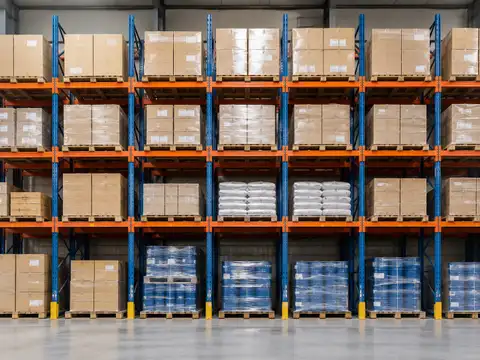
Selective pallet racking is usually the least complicated way to put palletized inventory into vertical storage while keeping direct forklift access to every storage location. It is also the pricing benchmark against which many higher-density systems are judged. When a vendor says that push-back, drive-in or pallet-flow storage carries a premium, selective rack is normally the baseline behind that comparison.
The apparent simplicity can be misleading. Two selective-rack systems with the same footprint can have very different costs because one may have taller frames, heavier beams, more storage levels, wire decking, end-of-aisle protection or a much more demanding installation. The useful question is therefore not just “what does a bay cost?” but what does the complete project cost per usable pallet position?
Selective pallet racking cost in 2026
| Budget measure | Current planning range | What it tells you |
|---|---|---|
| New single-deep rack | $55–$200 / pallet position | Best early comparison metric for storage capacity |
| New rack by bay | About $450–$675+ / bay in one current 2026 guide | Useful only after bay configuration is defined |
| Used selective rack | Often around $40–$60 / position in current used-market examples | Material-only opportunity; availability and condition matter |
| Installation / engineering | Often adds roughly 15–35% to base equipment in current 2026 guidance | Early allowance, not a contractor quote |
The $55–$200 range is supported by current U.S. supplier guidance for new selective rack. Another material-handling supplier publishes a similar $50–$200 per-position band and roughly $200–$450 per rack bay. Warehouse Cubed's current 2026 guide places new racking around $450–$675+ per bay. Those bay figures look inconsistent until you remember that a “bay” does not describe a standardized amount of storage capacity.
A bay with two beam levels and four usable pallet positions is economically different from a taller bay providing six or eight positions. Cost per bay is convenient for ordering steel; cost per usable pallet position is usually better for comparing warehouse economics.
What does selective rack cost at different project sizes?
| Usable positions | Equipment at $55 / position | Equipment at $200 / position |
|---|---|---|
| 100 | $5,500 | $20,000 |
| 250 | $13,750 | $50,000 |
| 500 | $27,500 | $100,000 |
| 1,000 | $55,000 | $200,000 |
| 2,000 | $110,000 | $400,000 |
This table is intentionally equipment-only. It demonstrates why a small difference in specification matters more as a warehouse grows. A $20 difference per position is only $2,000 across 100 positions, but it becomes $40,000 across a 2,000-position project.
Larger projects can sometimes benefit from volume purchasing and more efficient installation, but scale does not guarantee a lower final cost per position. Tall racks, unusual loads, seismic requirements, phased installation or extensive protection can move a large project toward the upper end even when the steel is bought efficiently.
Quote anatomy
Four layers of a selective-rack budget
Uprights, beams and the basic structural configuration.
Layout, anchoring, assembly and site labor.
Bulky steel makes shipment distance and phasing matter.
Decking, guards, permits, engineering and site-specific work.
A low “price per position” normally describes only part of this stack. Compare quotes after all four layers have been normalized.
Why price per pallet position is better than price per bay
A selective rack bay is normally the storage section between two upright frames, with horizontal beams creating one or more pallet-storage levels. That makes the bay a natural unit for a supplier's bill of materials. It is not always the best unit for a capital decision.
Suppose Quote A offers 100 bays for $50,000 and Quote B offers 90 bays for $52,000. The first quote appears cheaper and larger. But if Quote A produces 400 usable pallet positions while the taller configuration in Quote B produces 540, the economics reverse:
$500 per bay can still be more expensive
Quote A: $50,000 ÷ 400 positions = $125 per usable position. Quote B: $52,000 ÷ 540 positions = about $96 per usable position. The second system costs more in total and more per bay, but less for the storage capacity actually created.
This is also why the broader pallet racking cost guide uses pallet positions as its main comparison unit. A warehouse does not earn value from owning bays; it earns value from storing and moving inventory.
What is included in a selective-rack equipment price?
Upright frames
Uprights establish rack height, depth and much of the structural capacity. Current supplier guidance shows that dimensions and capacity have a major effect on frame price. Taller and heavier-duty uprights generally require more steel and may change installation and engineering requirements as well.
Load beams
Beam length and capacity determine how pallets are supported across each bay. The number of beam levels is particularly important because adding levels can add usable pallet positions without adding another aisle or another run of floor-level rack.
Anchors and basic hardware
The final structural system is more than frames leaning on a slab. Anchoring, beam connectors and required hardware form part of the installed assembly. A quote should make clear whether anchors and normal installation hardware are included or billed separately.
What may be excluded
Wire decking, pallet supports, row spacers, end-of-row guards, column protection, backstops, netting, signage and specialty accessories may appear as separate line items. Their cost can become material on a large project.
Installation can change a cheap quote quickly
One current 2026 U.S. industry guide estimates that installation and engineering often add roughly 15–35% to base equipment cost. Another supplier's guide puts installation, freight and permitting together at roughly 10–30% depending on complexity. These are useful early allowances, but they are not interchangeable with an installer quotation.
A clean greenfield warehouse with unobstructed floor space should be easier to install than a live facility where crews have to work around inventory, lifts, production schedules and existing systems. Tall structures, unusual anchoring conditions and phased work can also increase labor.
250-position small warehouse
Equipment at $55–$200 per position implies approximately $13,750–$50,000. Applying a rough 15–35% early allowance for installation/engineering produces another approximately $2,100–$17,500. Freight, guards, decking and local project requirements would still need their own allowances.
1,000-position distribution warehouse
Equipment alone implies roughly $55,000–$200,000. At this scale, a seemingly small specification decision—beam capacity, another storage level, additional guarding or a different frame height—can move the project by tens of thousands of dollars.
New vs used selective pallet racking
Selective rack has an unusually active used market because the system is common, modular and frequently removed when warehouses relocate or reconfigure. Warehouse Cubed currently gives a broad material benchmark of roughly $40–$60 per pallet position for used selective systems under typical market conditions and roughly $225–$425 per used bay in its 2026 general guide.
That can represent a meaningful discount from new equipment, but used inventory behaves more like a commodity lot than a made-to-order system. The exact upright height, beam length, capacity, connector style, quantity and condition you need may not be available at the same moment.
Used rack is therefore most attractive when the available inventory fits the desired layout. Redesigning a warehouse around whatever steel happens to be cheap can erase the savings through lower capacity, extra freight or incompatible components. The dedicated new vs used pallet racking guide compares that decision in detail.
What pushes selective rack toward $200 per position?
A simple low-rise system with ordinary pallet loads should not be budgeted the same way as a tall, heavy-duty rack project. The major price drivers include:
- greater upright height and depth;
- heavier pallet loads and higher required capacity;
- more beam levels;
- structural steel or specialized rack construction;
- high seismic design requirements;
- nonstandard beam lengths or configurations;
- wire decking and pallet supports;
- column and end-of-row protection;
- challenging installation conditions;
- long-distance freight;
- permits, engineering or modifications required by the project.
A lower price is not automatically better if it comes from a different load specification, fewer storage levels or omitted scope. The cheapest quotation only matters after the proposals have been normalized.
When selective rack is the economically strongest choice
Selective rack earns its name because every pallet can normally be accessed directly from an aisle. That high selectivity is valuable when a warehouse carries many SKUs, has relatively shallow inventory per SKU, changes product mix regularly or needs flexible slotting.
It also avoids much of the specialized hardware found in push-back or flow systems, making it comparatively straightforward to expand or reconfigure. For many conventional warehouses, that combination of low equipment complexity and direct pallet access makes selective rack the rational default.
Selective rack tends to be strongest when access flexibility matters more than maximum storage density. If aisle space is extremely expensive or the operation stores many pallets of the same SKU, a denser system can justify a higher rack price by creating more capacity inside the same building.
When cheap selective rack becomes a false economy
The weakness of conventional selective rack is floor utilization. Every rack face requires forklift access, so a large percentage of the building can become aisle rather than storage. That is acceptable when the operation needs direct access to many SKUs. It is less attractive when the warehouse is capacity constrained and inventory is naturally suited to deep storage.
Imagine a warehouse where selective rack creates 1,000 positions but a higher-density alternative could create 1,400 without expanding the building. Saving $50,000 on rack is not a victory if the business then leases overflow space, moves inventory off-site or expands years earlier than necessary.
This is why the high-density vs selective pallet racking comparison should be treated as a real-estate and operating-cost decision, not just a rack-price comparison.
How to read a selective pallet rack quote
A useful quote should let you reconstruct the project rather than present one unexplained total. At minimum, confirm:
- number of bays and usable pallet positions;
- upright height, depth and rated capacity;
- beam length, profile and rated capacity;
- number of beam/storage levels;
- anchors and hardware;
- decking or pallet supports;
- row spacers;
- rack guards and protection;
- installation labor;
- freight;
- engineering and permit scope;
- taxes;
- explicit exclusions.
Once those items are visible, calculate both installed cost per usable pallet position and total project cost. That lets you distinguish an efficient design from a quotation that merely looks inexpensive because several necessary components were left out.
Structural requirements should not be value-engineered away
The Rack Manufacturers Institute currently lists ANSI MH16.1-2023, Design, Testing, and Utilization of Industrial Storage Racks as the applicable national standard for industrial steel storage racks within its scope. RMI's mission is specifically to promote safe and effective design, manufacture, installation and use of these systems.
Warehouse Fieldbook is useful for capital planning, but it is not a structural design service. Load capacities, anchoring, seismic conditions and project-specific engineering should be established by the appropriate qualified supplier or engineer. Cutting those items to reach a target cost per position is not a legitimate saving.
A practical budget before you ask for quotes
A useful pre-quote budget can be built in four steps. First estimate the number of usable pallet positions required. Second multiply that by a broad $55–$200 equipment range. Third create a separate installation/engineering allowance rather than pretending the equipment number is installed cost. Finally add explicit lines for freight, decking, guards and other known project extras.
The resulting range will still be wide, but it will tell you whether a project is roughly a $20,000 purchase, a $100,000 capital project or a several-hundred- thousand-dollar installation. That is enough precision for early planning. Detailed accuracy should come from a layout and competing supplier quotations, not from narrowing an online average beyond what the underlying data supports.
Frequently asked questions
How much does new selective pallet racking cost per position?
Current U.S. supplier guides support a broad planning range of roughly $55–$200 per pallet position for new single-deep selective rack equipment. Configuration, height and capacity determine where a project falls inside that range.
How much does a selective pallet rack bay cost?
Public pricing guides currently show figures from roughly $200–$450 per bay in one supplier guide to about $450–$675+ for new racking in another 2026 guide. Bay pricing should not be compared without knowing the frame dimensions, beam levels and pallet positions provided by each bay.
Is selective pallet racking cheaper than drive-in or push-back?
Its equipment cost is generally lower because the structure is less specialized. Whether it is cheaper overall depends on the value of warehouse space and the storage density required. Higher-density systems can justify a premium when they prevent expansion or substantially increase usable capacity.
How much cheaper is used selective rack?
Current used-market guidance shows roughly $40–$60 per position in some typical configurations, compared with materially higher new-equipment ranges. Actual savings depend on availability, condition, freight and whether the used components fit the required layout without compromise.
Should I use cost per bay or cost per pallet position?
Use cost per pallet position for economic comparison because it normalizes the amount of storage capacity produced. Use bay pricing to understand the bill of materials once the configuration and number of storage levels are fixed.
Sources and methodology
Warehouse Fieldbook does not present a single national “average” for selective rack because public pricing varies substantially with configuration and scope. The ranges above were reviewed against current U.S. supplier and installer guidance available in August 2026, with structural context checked against RMI.
- East Coast Storage Equipment — selective rack pricing by pallet position
- Source Equipment — 2026 U.S. rack pricing and installation/engineering allowance
- Warehouse Cubed — 2026 new and used rack pricing by bay
- Warehouse Cubed — used selective rack pricing factors and examples
- IMH Group — selective rack position, bay and project-cost guidance
- Rack Manufacturers Institute — rack standards and installation resources