
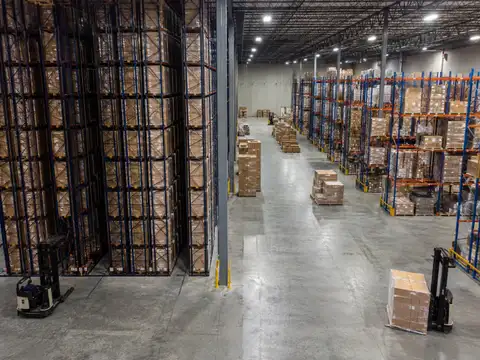
Selective rack should normally be the baseline because it gives every pallet a directly accessible location.
Pay for density when another aisle is more expensive than less selectivity.The strongest high-density projects are not those with the highest nominal pallet count. They are the ones where additional positions remain well utilized and prevent a more expensive space, labor or expansion problem.
“High-density rack” is not one product. It describes a family of storage methods that reduce access aisles or place pallets multiple positions deep. Double-deep, push-back, drive-in, pallet flow and shuttle systems all increase density in different ways, with different consequences for access, inventory flow and capital cost.
Interlake Mecalux defines the category in operational terms: high-density storage concentrates storage locations by limiting aisles, while direct-access systems preserve individual pallet access. That distinction is more useful than marketing percentages because it explains what the warehouse is actually trading.
The density ladder
Every step toward density gives something up
Every pallet directly accessible.
Fewer aisles; rear pallet requires deep reach.
Independent lanes, several pallets deep.
Maximum aisle reduction for deep inventory blocks.
The “aisle tax” is why high-density systems exist
Selective pallet rack needs an access aisle in front of every rack face. Those aisles are essential—they are what give the forklift direct access to every pallet—but they also consume a substantial share of the floor.
High-density systems reduce that aisle requirement. Double-deep places one pallet behind another. Push-back stores multiple pallets in independent deep lanes. Drive-in sends the forklift into a deep rack block. Pallet flow uses gravity lanes. Shuttle systems let a motorized carrier perform deep-lane movements.
In each case, some square footage that selective rack would dedicate to truck travel becomes storage. That reclaimed area is the economic engine behind the entire high-density category.
But every density gain has a price
The price may be literal CAPEX: more steel, rails, carts, rollers, shuttle equipment or specialized installation. It may also be operational: less direct access, LIFO restrictions, deeper retrieval travel or more complex maintenance.
This is why a warehouse should not ask “which system stores the most pallets?” before asking “which system stores the most usable pallets at the required throughput?”
1,400 nominal positions do not automatically beat 1,100 selective positions
If the high-density layout runs at 70% usable occupancy because lanes are fragmented across SKUs, 1,400 nominal positions support about 980 pallets. A selective system operating at 92% occupancy would make roughly 1,012 of 1,100 positions usable. The “smaller” system is storing more real inventory.
The percentages in that example are illustrative. The method is what matters: assign actual inventory to the layout before treating nominal pallet count as capacity.
Selective rack is difficult to beat when SKU variety is high
Interlake Mecalux specifically recommends selective pallet racks for warehouses with many SKUs and relatively few pallets per SKU. Each location is independently accessible, so a low-volume item does not reserve an entire deep channel.
That flexibility matters in businesses where inventory is volatile. Product demand changes, new SKUs appear and old ones disappear. Selective rack absorbs those changes with comparatively little physical reconfiguration because any open position can usually be assigned to another pallet.
High-density storage is less forgiving. The deeper the lane, the more inventory depth per SKU is required to keep that lane well utilized.
The first density step: double-deep
Double-deep pallet rack is the mildest move away from full selectivity. Ridg-U-Rak describes the system as two rack bays positioned back-to-back, reducing the number of aisles compared with ordinary selective rack.
The trade-off is simple: the rear pallet is no longer directly accessible. A deep-reach truck is typically required, and the front pallet can block access to the rear position.
Double-deep is useful when the warehouse wants more density without committing to the deeper inventory blocks required by drive-in or the moving hardware of push-back and flow systems.
Double-deep can appear inexpensive because the rack components remain relatively conventional. The material-handling fleet matters too: if the existing forklifts cannot reach the rear position, the rack decision can trigger a lift-truck investment.
Push-back buys density without sending the truck into the rack
Interlake Mecalux describes push-back as combining high-density storage with strong selectivity. Its cart-based configuration can hold up to five pallets deep, with a different SKU assigned to each lane.
Steel King's current SK3600 product page likewise describes two-to-five-deep storage and independent access to each lane. Steel King states that suitable push-back layouts can provide up to 90% more product storage than standard selective racking.
That 90% is a manufacturer “up to” figure, not a universal density benchmark. It demonstrates that the potential gain can be large when building geometry and inventory match the system. A real project still needs two competing layouts.
Drive-in pushes farther toward maximum density
Drive-in replaces many working aisles with deep lanes and allows the forklift to enter the rack structure. It is especially effective when the warehouse holds many pallets of relatively few SKUs.
Steel King publishes an “up to 75% more pallets than selective” figure for drive-in in its cold-storage guidance. Again, that is a manufacturer maximum-style comparison rather than a general rule for every building.
The more important difference is operational: the system exchanges pallet-level access for lane-level access. A deep lane works efficiently only when the inventory can occupy it without excessive empty positions or retrieval conflicts.
Pallet flow adds FIFO to the density equation
Pallet-flow rack uses gravity rollers and separate loading and retrieval faces to move pallets through a deep lane. That normally supports first-in, first-out inventory flow.
The system can therefore justify a higher capital cost where inventory rotation has real value—food, beverage and other date-sensitive products are obvious examples. Density alone is not the return; automated stock rotation can be part of it.
This is one reason grouping every high-density system into one “price per position” table is misleading. Push-back and pallet flow can occupy similar floor area but solve different inventory-flow problems.
Pallet shuttle changes the throughput trade-off
Semi-automated pallet shuttle takes deep-lane storage another step by using a motorized carrier to move pallets inside each channel. The forklift can remain at the lane face instead of traveling the full depth.
This can support extremely deep channels and reduce vehicle interaction inside the rack, but now the project has an equipment fleet, batteries, controls and a throughput-design problem. The number of shuttles becomes as important as the number of pallet positions.
High density has therefore moved from a rack decision toward an automation decision.
There is no single “high-density premium”
Warehouse Fieldbook's current cost guides show why. Selective rack sits toward the lower end of pallet-rack equipment cost. Push-back, pallet flow and shuttle add progressively more specialized hardware, while drive-in can span a very wide range depending on depth and construction.
The useful financial question is not whether high-density rack costs 20%, 50% or 100% more in some generic market comparison. It is:
How much are you paying for each incremental usable position?
Selective layout: $150,000 installed and 1,000 usable positions.
High-density layout: $250,000 installed and 1,500 usable positions.
Premium: $100,000 for 500 added positions =$200 per incremental usable position.
Once the premium is expressed that way, it can be compared with the cost of the alternative: more warehouse space.
Expansion deferral is often the biggest source of ROI
Imagine the warehouse is effectively full at 1,000 pallets and demand is expected to reach 1,300. Selective rack might force the company into overflow storage or a building expansion. A high-density retrofit that creates 1,500 usable positions could defer both.
In that situation, a six-figure rack premium can be rational even if it generates no direct labor saving. The investment is purchasing time inside the existing building.
This is the core reason Steel King's 2026 warehouse-racking guidance discusses conversion from selective to push-back, pallet flow or drive-in when facilities run out of pallet positions. Density is valuable when it solves a space constraint, not simply because the layout drawing looks fuller.
Calculate the value of one additional pallet position
A useful planning metric is the annual occupancy cost associated with one pallet position in the alternative space. That may include rent, common-area charges, utilities, handling between buildings, transportation to overflow storage and duplicate supervision.
If overflow storage effectively costs $300 per pallet position per year and a high-density retrofit adds positions for $200 each in one-time rack CAPEX, the economics can be extremely favorable. If spare warehouse space already exists, the same rack premium has little space-saving value.
Lease rates, cold-storage economics and overflow handling costs vary too much for a generic national number to be credible. Use the facility's own costs in the high-density business case.
Cold storage changes the mathematics
Cooler and freezer capacity is expensive because the business pays for the conditioned building envelope as well as the floor. That is why high-density racking appears so frequently in cold-storage manufacturer literature.
Steel King's cold-storage guide frames the decision directly around facility density and the possibility of avoiding expansion. The value is not limited to more pallets per square foot; reducing the cubic volume devoted to aisles can improve the economics of refrigerated space.
Inventory rotation still matters. A freezer with many low-volume SKUs can prefer more selective storage even though density is expensive. A freezer with deep homogeneous product blocks is a much stronger high-density candidate.
Throughput can undo a space-saving decision
High-density systems change how pallets move. Interlake Mecalux's storage-system comparison places drive-in among the slower pallet-storage methods and selective among the more dynamic options, with push-back, flow and shuttle systems occupying different points between those extremes.
A warehouse can therefore save 20,000 square feet and still create an expensive operating problem if pallets cannot move through the dense system fast enough at peak.
Do not save an aisle and buy another forklift by accident
If deeper retrieval increases cycle time enough to require another operator and truck every shift, that annual operating cost belongs in the density model. High-density storage should solve more cost than it creates.
SKU fragmentation is the most common modeling mistake
A CAD layout can count every possible pallet opening. Inventory cannot always use every opening. Deep lanes are often dedicated to one SKU, lot or product family, leaving empty positions trapped behind partial inventory.
This is why storage utilization should be modeled from a pallet-on-hand distribution, not simply an average SKU depth. An operation averaging five pallets per SKU might actually contain hundreds of one-pallet SKUs and a small number of 50-pallet SKUs. Those two groups need different storage media.
Segmenting inventory usually produces a stronger answer than applying one high-density system to the whole building.
A hybrid warehouse is often better than either extreme
Selective versus high density does not have to be a binary architectural decision. A facility can dedicate deep storage to products that consistently fill it and preserve selective rack for fragmented inventory.
That approach reduces honeycombing while still reclaiming aisle area where the inventory supports it. It also makes future assortment changes less disruptive because the selective zone absorbs volatility.
30% of SKUs can justify 60% of the pallets
Suppose a small group of high-volume SKUs accounts for most pallet inventory. Those products can occupy drive-in, push-back or shuttle lanes while the long tail remains selective. The project captures much of the density benefit without forcing shallow SKUs into deep channels.
The forklift fleet can change with the rack
Selective rack can work with conventional counterbalance trucks at wider aisles or reach trucks at narrower aisles. Double-deep normally requires deep-reach capability. Drive-in requires trucks and loads that can maneuver inside the lane. Very narrow aisle selective systems can require specialized turret or VNA equipment.
High-density rack CAPEX should therefore never be compared in isolation from material-handling equipment. A seemingly inexpensive density upgrade can require a substantial fleet change; a more expensive rack system can sometimes avoid it.
Do not forget vertical density
Reducing aisles is only one way to create capacity. A selective layout that uses clear height efficiently can outperform a low high-density block that leaves vertical cube unused.
Before replacing selective rack, check whether additional beam levels, a different lift truck, better slotting or another layout change could create the required positions at lower cost.
Density should be optimized in three dimensions: floor area, clear height and actual inventory utilization.
Six calculations to run before approving high density
1. Selective baseline capacity
Build the best realistic selective layout first. A high-density system should not be compared against a deliberately weak baseline.
2. High-density nominal capacity
Count all designed storage positions in the proposed alternative.
3. Expected usable capacity
Assign real SKU quantities to lanes and estimate fragmentation.
4. Incremental installed cost
Include rack, installation, protection, freight, handling equipment and controls where relevant.
5. Annual operating-cost change
Include labor, forklift time, maintenance, energy and any throughput constraint.
6. Space cost avoided
Quantify expansion, overflow storage or occupied refrigerated space that can actually be deferred.
A five-year example
Assume a high-density retrofit costs $180,000 more than the best selective alternative and adds 600 usable pallet positions. The business expects to need 450 of those positions over the next five years.
The density premium costs $400 per needed position
$180,000 ÷ 450 positions actually needed =$400 per required incremental position. If the five-year cost of providing those positions through overflow or expansion is materially above $400 each, density has a strong space case before labor effects.
Notice that the denominator is 450 positions the business expects to use, not all 600 positions the layout is technically capable of creating. That keeps projected growth from receiving free credit in the ROI calculation.
When selective is still the rational answer
Stay close to selective when most of these are true:
- SKU count is high relative to pallet count;
- many SKUs have only one or two pallets on hand;
- direct access to individual pallets has high value;
- demand and assortment change frequently;
- the building has spare floor or vertical capacity;
- peak throughput matters more than maximum storage density;
- the existing forklift fleet fits selective operation well.
When high density deserves serious engineering
Model high-density alternatives when several of these are true:
- the warehouse is genuinely capacity constrained;
- large pallet quantities are concentrated in relatively few SKUs;
- overflow space or expansion is expensive;
- cold-storage cube has high value;
- inventory rotation is compatible with the proposed system;
- throughput can be maintained at the required level;
- the added capacity is expected to be used within the investment horizon.
Which high-density system should be shortlisted?
| Inventory / operating problem | First system to investigate |
|---|---|
| Need modest density with familiar rack | Double-deep |
| 2–5 pallets deep, more independent SKU lanes | Push-back |
| Very deep homogeneous reserve inventory | Drive-in |
| Deep storage + FIFO | Pallet flow |
| Very deep lanes + higher throughput | Pallet shuttle |
| Need every pallet directly accessible | Stay selective |
Structural requirements do not disappear in a financial model
RMI currently lists ANSI MH16.1-2023 as the standard specifying minimum requirements for structural design, testing and utilization of industrial steel storage racks within its scope, including certain rack-supported and automated-storage applications.
High-density layouts can change rack geometry, bracing, loads and anchoring. The economic analysis can identify which concept deserves engineering; it cannot establish structural capacity or seismic compliance.
The practical recommendation
Treat selective rack as the control group. Design it well, count its usable positions and establish its installed cost. Then make each high-density alternative prove that the positions it adds are genuinely usable and financially valuable.
If the warehouse has a real space problem and deep inventory, high density can be one of the highest-return infrastructure investments available because it changes the economics of the building itself. If the inventory is fragmented, the same investment can turn expensive floor space into empty positions hidden inside deep lanes.
The goal is not maximum density. It is the lowest long-term cost for the capacity and throughput the operation actually needs.
Frequently asked questions
What is high-density pallet racking?
It is a category of pallet-storage systems that increase storage concentration by reducing access aisles or storing pallets multiple positions deep. Common examples include double-deep, push-back, drive-in, pallet flow and pallet shuttle.
Is high-density rack better than selective rack?
Only when the added capacity is usable and valuable. Selective is generally stronger for many SKUs and direct pallet access; high-density systems are stronger when inventory is deep enough to fill lanes and warehouse space is constrained.
How much more storage can high-density rack create?
There is no universal percentage. Steel King publishes “up to” examples of 90% more product storage for suitable push-back layouts and 75% more pallets for suitable drive-in layouts versus selective. Actual gains require a building-specific layout.
What is the cheapest high-density option?
There is no universal cheapest choice because forklift requirements, lane depth, installation and usable capacity differ. Double-deep and drive-in use less moving hardware than push-back, flow or shuttle systems, but the lowest equipment price is not always the lowest warehouse cost.
Which system is best for many SKUs?
Selective rack is usually the strongest baseline. Push-back can add density while retaining more independent SKU lanes than deep drive-in storage.
Which system is best for cold storage?
High-density systems deserve serious consideration because refrigerated cube is expensive. The inventory profile still decides which one: deep homogeneous stock can suit drive-in, moderate-depth SKU variety can suit push-back, and FIFO requirements can favor pallet flow.
Should I replace selective rack before expanding the warehouse?
Model both options. If a high-density retrofit creates enough usable positions to defer expansion at a lower total cost, it can be financially compelling. If inventory fragmentation or throughput erodes the benefit, expansion or another optimization may be stronger.
Use the related-guides section below for the individual cost and comparison articles. This page focuses on the portfolio-level capacity decision rather than repeating every system's detailed pricing methodology.
Sources and methodology
Warehouse Fieldbook reviewed current manufacturer documentation for selective, double-deep, push-back and drive-in operating characteristics plus current RMI standards information. Manufacturer “up to” density claims are identified as manufacturer claims and are not used as universal planning assumptions. All financial scenarios above are original illustrations of the decision method.
- Interlake Mecalux — high-density storage definition and system categories
- Interlake Mecalux — selective rack fit for many SKUs and shallow inventory
- Interlake Mecalux — push-back depth, lane independence and selectivity
- Interlake Mecalux — comparative operating dynamism across pallet-storage systems
- Ridg-U-Rak — double-deep density, access and lift-truck implications
- Steel King — push-back configuration and up-to-90% storage claim
- Steel King — cold-storage drive-in comparison and up-to-75% storage claim
- Steel King — 2026 warehouse capacity and higher-density retrofit guidance
- Rack Manufacturers Institute / MHI — ANSI MH16.1-2023