
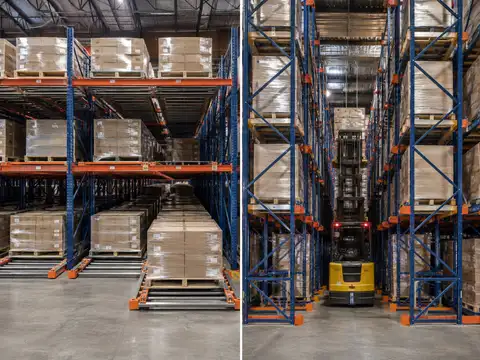
Choose push-back when you need high density but still want many independent SKU lanes accessible from the aisle.
Choose drive-in when maximum bulk density matters more than lane selectivity.Both are normally LIFO systems. Push-back generally costs more mechanically; drive-in generally asks more of the forklift operation.
Push-back and drive-in rack are often grouped together as high-density storage, which makes them sound more similar than they are. Both remove aisles compared with ordinary selective rack, and both normally store several pallets of the same SKU behind one another. The important difference is what happens after the forklift reaches the lane.
With push-back, the truck stays in the aisle. Pallets ride on nested carts or rails and move backward as the operator loads the lane. With drive-in, the forklift itself travels between the uprights and deposits pallets on support rails deeper inside the rack. One system buys selectivity with moving hardware; the other keeps the hardware simpler by moving the forklift farther.
Inventory pattern test
The deciding variable is how inventory fills a lane
Independent lanes make moderate SKU depth easier to use.
Deeper homogeneous blocks make aisle elimination more valuable.
Start with the SKU profile
Ridg-U-Rak describes push-back as offering storage density similar to drive-in while improving selectivity and accessibility across a range of SKUs. Its current push-back system is offered roughly two to six pallets deep. Interlake Mecalux similarly identifies push-back as a strong fit for medium-turnover goods with two or more pallets per SKU.
Drive-in is more specialized around deep homogeneous inventory. Ridg-U-Rak describes it as an economical high-density solution where selectivity is low and many pallets of relatively few SKUs are stored.
The practical dividing line is therefore not “three pallets deep means push-back, six means drive-in.” The real question is whether the operation benefits from having many independent lanes or from making each lane as deep and structurally simple as possible.
80 SKUs, usually three to five pallets each
Push-back deserves the stronger first look. Independent lanes can keep many SKUs accessible from one aisle while still storing several pallets deep. A very deep drive-in layout risks creating empty capacity whenever an SKU does not have enough pallets to fill its lane.
12 SKUs, dozens of pallets each
Drive-in becomes much more attractive. Large homogeneous blocks can fill deep lanes reliably, so the warehouse can exploit density without paying for carts on every level or sacrificing much useful SKU selectivity.
Push-back usually costs more per pallet position
Warehouse Fieldbook's current 2026 planning range for push-back rack is roughly $150–$400 per pallet position. Drive-in is more dispersed, with a broad planning range of roughly $115–$500 per position depending on depth, height, design and what the published figure includes.
Those ranges overlap too much to support the claim that one system is always cheaper. The more useful observation is structural: push-back adds carts or moving rails to each lane, while drive-in relies on simpler pallet support rails but a deeper rack geometry built for forklift entry.
| Cost driver | Push-back | Drive-in |
|---|---|---|
| Moving lane hardware | Higher | Lower |
| Deep structural lanes | Moderate | High |
| Installation alignment | Carts / rails must operate correctly | Deep frames / rails must remain clear for trucks |
| Forklift travel inside rack | No | Yes |
| Potential maintenance exposure | Moving components | More vehicle interaction with rack structure |
The initial quotation therefore tells only part of the story. Push-back has more mechanical parts to buy and maintain. Drive-in can require more operator time per deep pallet movement and places forklifts closer to structural components.
The biggest difference is lane selectivity
Interlake Mecalux states that each push-back lane is independent, allowing a different SKU to be stored in each lane and at each level. That independence makes push-back much more forgiving when inventory depth varies across products.
Drive-in lanes are less selective because the forklift has to enter the rack and pallets are stored one behind another. The system is strongest when an entire lane can be dedicated to the same SKU or product lot.
If a warehouse constantly leaves deep drive-in lanes partially empty because SKU quantities are uneven, a more expensive push-back system can create more usable capacity from fewer nominal positions.
Nominal capacity is not utilization
High-density rack is especially vulnerable to a phenomenon often called honeycombing: empty positions become trapped inside partially used deep lanes because a different SKU cannot simply occupy the space behind the current one.
Ridg-U-Rak publishes a useful manufacturer example in its push-back literature. It uses a typical utilization factor of about 60% for drive-in and says correctly applied push-back can exceed 90%. In the example, storing 1,000 pallets could require roughly 1,600 drive-in positions versus around 1,100 push-back positions.
Those percentages are not universal warehouse benchmarks. They come from a manufacturer explaining one application advantage, and actual utilization depends heavily on the SKU profile. The example is valuable because it highlights the right calculation: usable positions can matter more than nominal rack density.
1,200 nominal positions can hold fewer pallets than 1,000 better-matched positions
A drive-in layout with 1,200 nominal positions operating at 70% actual utilization holds about 840 pallets. A push-back layout with only 1,000 nominal positions operating at 90% holds about 900 pallets. The smaller layout has become the larger usable system.
Push-back keeps the forklift in the aisle
This is its most visible operational advantage. The truck deposits a new pallet at the face and uses that load to push the existing pallets deeper into the lane. On retrieval, gravity brings the next cart or pallet forward.
Ridg-U-Rak explicitly markets the system as providing drive-in-style density with better SKU access. Interlake Mecalux describes the same operating principle: pallets are loaded and unloaded from one side without the truck entering the rack.
This can reduce travel distance per storage task and lowers direct vehicle exposure inside the structural lane. It does not eliminate forklift impact risk at rack faces, and it adds carts and rails that need inspection and maintenance.
Drive-in asks the forklift to do the deep-lane work
Ridg-U-Rak's drive-in design uses continuous support rails with narrow storage lanes perpendicular to the working aisle. The lift truck enters the structure to place and retrieve loads.
That keeps the storage mechanism comparatively simple, but deeper positions require more truck travel. Interlake Mecalux's broader storage-system comparison ranks drive-in as slower and less dynamic than push-back for pallet operations.
This matters most in high-throughput warehouses. A reserve-storage area with relatively few pallet moves may not care. A busy distribution center can care a great deal.
Throughput can justify push-back even when density is similar
Imagine both systems fit 800 usable pallets. Drive-in costs $125,000 and push-back costs $165,000. On rack price alone, drive-in wins by $40,000.
What is the $40,000 premium buying?
If push-back materially shortens pallet cycles, reduces rack impacts and allows more SKUs to share the same footprint, the premium is buying operating flexibility. If the warehouse performs only a few reserve-stock moves per hour, those benefits may not recover $40,000. The answer depends on actual workload.
Do not convert a general statement such as “push-back is faster” into a fixed labor-saving percentage. Measure travel and cycle time in the proposed layout.
Drive-in can go deeper economically
Push-back systems commonly operate a few pallets deep because each extra depth adds moving hardware. Ridg-U-Rak currently describes two-to-six-deep push-back configurations. Interlake Mecalux's standard push-back configuration uses carts through five pallets deep.
Drive-in does not need a cart stack at every lane, so it can remain attractive for much deeper homogeneous product blocks. When inventory routinely runs eight, ten or more pallets deep per SKU, drive-in deserves serious analysis before the warehouse pays for a more mechanically complex system.
If the operation needs both very deep storage and higher throughput, pallet shuttle can enter the comparison because it moves the pallet inside the lane without requiring the forklift to travel the full depth.
The related-guides section below includes the Pallet Shuttle System Cost guide. It is worth comparing when drive-in provides the right density but forklift travel becomes the operating bottleneck.
Both systems are normally LIFO
Push-back loads and unloads from the same aisle side. The most recently loaded pallet is therefore the next pallet available for retrieval.
Single-entry drive-in uses the same logic: loading and retrieval happen from one side, making it LIFO. Interlake Mecalux distinguishes this from drive-through, where access from both ends can support FIFO flow.
If strict FIFO is central to the operation, neither conventional push-back nor single-entry drive-in should be selected merely because it is dense. Drive-through or pallet-flow designs may fit the inventory rule better.
Cold storage makes both systems more attractive
Freezer and refrigerated space is expensive to build and condition, so aisle reduction has high economic value. Both manufacturers explicitly identify high-density rack as relevant to cold-storage applications.
The choice then depends on inventory pattern. Few deep product blocks can favor drive-in. A freezer holding more SKU variety in moderate quantities may recover the push-back premium through better lane utilization and faster aisle-face access.
Capacity is expensive; empty deep lanes are even more expensive
A freezer should not maximize nominal positions at the expense of utilization. Paying to refrigerate rack positions that remain stranded by SKU fragmentation can undermine the apparent density advantage of the cheaper system.
Rack damage risk is different, not absent
Drive-in requires the forklift to operate inside the storage structure, placing vehicle traffic close to uprights and support rails. Push-back keeps deep travel out of the rack but still exposes the front structure to normal aisle impacts.
Push-back also introduces moving components whose condition matters to reliable operation. The ownership comparison should therefore distinguish structural impact exposure from mechanical maintenance rather than declaring one system universally “lower maintenance.”
Maintenance strategy
| Maintenance concern | Push-back | Drive-in |
|---|---|---|
| Upright impact | Primarily at aisle face | Also inside rack lanes |
| Moving hardware | Carts / rails require attention | Minimal |
| Lane alignment | Important for cart movement | Important for truck clearance |
| Operator behavior | Load/unload at aisle face | Truck maneuvering inside rack |
The better maintenance profile depends on the facility. An operation with repeated drive-in impacts may benefit from keeping forklifts outside the rack. An operation with very low throughput may prefer the mechanical simplicity of drive-in.
The financial comparison should use five numbers
1. Installed CAPEX
Include rack, moving hardware, installation, protection, freight, engineering and other project-specific work.
2. Nominal pallet positions
Count every designed storage position before inventory is assigned.
3. Expected utilization
Model actual SKU quantities against lane depth to estimate how many positions are likely to be usable on a normal day.
4. Pallet moves per labor hour
Test whether forklift travel inside drive-in lanes materially changes handling productivity compared with push-back.
5. Annual space cost avoided
Value the overflow rent, expansion or refrigerated volume that either high-density layout avoids compared with a more selective system.
With those five figures, the warehouse can compare installed cost per usable position and then decide whether push-back's extra access is worth its mechanical premium.
A decision model for 1,000 pallets
Assume the business needs to store 1,000 pallets on an average day. A drive-in layout costs $200,000 and contains 1,350 nominal positions. A push-back layout costs $250,000 and contains 1,150 nominal positions.
Drive-in wins only if the lanes stay full enough
At 80% utilization, 1,350 drive-in positions provide about 1,080 usable positions. At 92% utilization, 1,150 push-back positions provide about 1,058 usable positions. Drive-in still creates slightly more usable capacity and costs $50,000 less.
If drive-in utilization falls to 70%, usable capacity drops to about 945 positions—no longer enough for the requirement. In that case the apparently more expensive push-back system can be the only layout that actually solves the storage problem.
The utilization assumptions above are illustrative. The point is the method: do not select rack from nominal pallet count alone.
When push-back is usually the better fit
- many SKUs have two to six pallets on hand;
- high-density storage is needed but SKU access still matters;
- the warehouse has meaningful pallet throughput;
- forklift travel inside deep rack lanes is undesirable;
- lane-level utilization is more valuable than maximum theoretical depth;
- LIFO inventory flow is acceptable.
When drive-in is usually the better fit
- the operation holds very deep inventory blocks;
- SKU count is relatively low;
- throughput is moderate enough that deep forklift travel is acceptable;
- mechanical simplicity has high value;
- the project needs maximum storage density at lower equipment complexity;
- LIFO inventory flow is acceptable.
When neither one is ideal
If every pallet needs independent access, selective rack may remain the better system despite lower density. If FIFO is critical, pallet flow or a drive-through configuration may fit better. If lanes are extremely deep and throughput is high, pallet shuttle can remove forklift travel from the channel.
High-density rack selection works best when the inventory is segmented first. A warehouse can also combine systems: drive-in for the deepest reserve blocks, push-back for moderate-depth SKUs and selective rack for shallow inventory.
Structural design remains project-specific
Both push-back and drive-in systems fall within the broader category of industrial steel storage racks. RMI currently lists ANSI MH16.1-2023 as the standard specifying minimum structural design, testing and utilization requirements for industrial steel storage racks within its scope.
Online comparisons should therefore stop at system economics and operating logic. Load capacity, anchoring, seismic requirements, rail details and structural configuration belong to the manufacturer or qualified project engineer.
The practical recommendation
Drive-in should be the economic baseline when inventory is deep and homogeneous because it obtains density with comparatively simple hardware. Push-back should earn its premium by proving that independent lanes and aisle-face handling create enough additional usable capacity or operating productivity.
If both layouts hold the required inventory comfortably, the lower-cost drive-in solution can be difficult to beat for reserve storage. If drive-in's deeper lanes create honeycombing, slower handling or too little SKU flexibility, push-back can be worth more precisely because it is less extreme.
The best design is not the system with the highest published density. It is the one that produces the lowest total cost for the number of pallets the warehouse can actually store and move.
Frequently asked questions
Is push-back racking better than drive-in?
It is usually better for operations that need high density plus more independent SKU lanes and faster aisle-face access. Drive-in can be stronger for very deep homogeneous inventory where selectivity is less important.
Which system stores more pallets?
Drive-in can create extremely dense layouts because it uses deep lanes without carts on every level. Push-back can sometimes achieve higher real utilization when SKU quantities are too fragmented to keep those deep lanes full.
Which is cheaper?
Drive-in often has lower mechanical complexity, while push-back adds carts or rails. Current public cost ranges overlap substantially, so the project should compare installed cost and usable capacity rather than assume a fixed price gap.
Which system is faster to operate?
Push-back normally avoids deep forklift travel because pallets move within the lane while the truck stays in the aisle. Interlake Mecalux's system-selection guidance ranks drive-in as less dynamic than push-back for pallet operations.
Are both systems LIFO?
Conventional push-back and single-entry drive-in are both normally LIFO. Drive-through rack can support FIFO by providing access from opposite ends.
Which is better for cold storage?
Both can be strong because reducing aisles increases capacity inside expensive refrigerated space. Deep homogeneous inventory favors drive-in; more varied moderate-depth inventory can favor push-back.
How deep is push-back rack?
Current major systems commonly operate a few pallets deep. Ridg-U-Rak describes two-to-six-deep configurations, while Interlake Mecalux's cart-based system is offered through five pallets deep.
Sources and methodology
Warehouse Fieldbook reviewed current manufacturer documentation for operating characteristics, lane depth and system selection, plus current RMI standards information. Manufacturer utilization examples are identified as manufacturer examples rather than universal benchmarks. Financial scenarios in this guide are original illustrations of the comparison method, not project quotes.
- Ridg-U-Rak — current push-back system depth and selectivity characteristics
- Ridg-U-Rak — current drive-in system application and operating characteristics
- Ridg-U-Rak — push-back utilization comparison example
- Interlake Mecalux — push-back lane independence, LIFO and application guidance
- Interlake Mecalux — drive-in / drive-through LIFO and FIFO operation
- Interlake Mecalux — comparative operating dynamism across storage systems
- Rack Manufacturers Institute / MHI — ANSI MH16.1-2023