
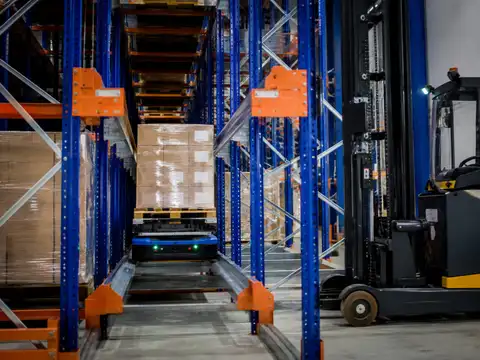
For early feasibility work, one current U.S. warehouse-automation provider publishes a broad pallet-shuttle range of:
$350–$1,200 per pallet positionTreat that as an order-of-magnitude planning range, not a national average. Pallet shuttle projects are engineered systems: the rack depth determines capacity, while the number of shuttle units and integration level determines how much throughput the system can deliver.
Pallet shuttle sits between conventional high-density racking and a fully automated AS/RS. The rack still stores pallets in deep channels, but forklifts no longer drive all the way into those channels. Instead, the lift truck places a motorized shuttle on the rails and presents a pallet at the lane face. The shuttle carries the load to the next available position and returns for another task.
That changes the economics in two ways. First, lanes can run far deeper than many practical forklift-served drive-in layouts. Second, the forklift can leave the lane face while the shuttle is moving. The project is therefore buying density and simultaneous work, not merely another type of rack.
Project cost anatomy
The shuttle is only one part of the investment
Pallet-shuttle pricing is driven by the interaction between storage capacity and throughput. A deeper rack adds positions; more simultaneous movements may require additional shuttle units.
Frames, beams, shuttle rails, anchors and protection.
Motorized carriers, batteries, controls and remote interfaces.
Layout, structural installation, commissioning and operator training.
Optional WMS connectivity, charging infrastructure and automation interfaces.
What does a pallet shuttle system cost in 2026?
Raymond Storage Concepts currently states that pallet shuttle projects generally range from about $350 to $1,200 per pallet position. It identifies storage density, FIFO versus LIFO operation and automation level as important pricing variables. That range is much wider than the ranges used for selective or ordinary drive-in rack because a shuttle project includes electromechanical equipment as well as storage steel.
Spacemaker, a U.S. warehouse-automation integrator, does not publish a fixed price list. It says project cost varies with project size, lane count, shuttle count and integration scope. That is the more useful way to think about the system. A 1,000-position warehouse operating with two shuttles is economically different from a 1,000-position warehouse that needs ten shuttles working at once.
| Project variable | What it changes | Why it affects cost |
|---|---|---|
| Pallet positions | Rack quantity | More frames, rails and structural storage capacity |
| Lane depth | Density / rail length | Deeper channels need longer shuttle tracks |
| Shuttle count | Throughput | More simultaneous lane operations require more carriers |
| FIFO / LIFO | Building layout | FIFO normally requires access from both lane ends |
| WMS integration | Control layer | Software and controls can expand beyond simple remote operation |
| Cold storage | Equipment specification | Batteries, electronics and operating environment must suit low temperatures |
How much would a 500-position shuttle system cost?
Applying the broad $350–$1,200 planning range to 500 positions produces approximately $175,000–$600,000. That range is too broad for procurement, but it is useful before engineering begins because it establishes that pallet shuttle is a substantial capital project rather than an incremental rack upgrade.
500 positions, moderate throughput
At $350 per position, the project-level planning figure is about $175,000. At $700 it becomes $350,000; at $1,200 it reaches $600,000. The next step is not choosing a number inside the range. It is determining lane geometry and the number of shuttle units required to meet the real inbound and outbound workload.
At 1,000 positions, the throughput design matters as much as rack cost
| Positions | $350 / position | $700 / position | $1,200 / position |
|---|---|---|---|
| 250 | $87,500 | $175,000 | $300,000 |
| 500 | $175,000 | $350,000 | $600,000 |
| 1,000 | $350,000 | $700,000 | $1,200,000 |
| 2,000 | $700,000 | $1,400,000 | $2,400,000 |
These figures demonstrate scale, not expected bids. A large deep-lane project can have a lower effective rack cost per position but a much higher controls and shuttle budget. Conversely, an operation with relatively modest throughput may use fewer shuttles across a large storage field and achieve a very different cost structure.
Pallet shuttle is one of the cases where cost per position becomes less reliable as the project becomes more sophisticated. Capacity is measured in pallet positions; performance is measured in pallet movements. Both have to be designed.
The most important cost question: how many shuttles?
A semi-automated system does not necessarily need one shuttle for every lane. The operator can move a shuttle between channels using a forklift. This is one reason pallet shuttle can offer automation without the capital intensity of a fully automatic AS/RS.
But sharing a small number of shuttles creates a throughput limit. If several lanes need simultaneous loading or retrieval, operators may wait for a carrier to become available or spend time moving shuttles between levels.
The correct shuttle count therefore comes from the workload. A warehouse with slow reserve storage may tolerate extensive sharing. A beverage distributor cycling pallets continuously may need many carriers operating at once.
24 shuttles serving lanes up to 40 pallets deep
Spacemaker documents a beverage-distribution installation in Zephyrhills, Florida using 24 two-way pallet shuttles with lanes up to 40 pallets deep. That project illustrates why “one shuttle system” is not a useful cost description: large operations can deploy an entire fleet of carriers to meet cycle-time requirements.
Lane depth is where the capacity advantage becomes obvious
Interlake Mecalux currently describes its semi-automated Pallet Shuttle as capable of deep storage in channels extending beyond 131 feet. Stow's Atlas documentation describes lane depth as effectively unlimited within the engineered application. In practice, the useful depth is constrained by the building, inventory profile and required cycle time rather than by a forklift's ability to travel safely into the lane.
That is a major difference from drive-in racking. A forklift-served lane becomes slower and more exposed to impact as depth increases. With a shuttle, the lift truck handles the load at the lane face while the carrier performs the deep movement.
Deeper is not automatically better. If a warehouse has too many SKUs with only a few pallets each, deep channels can create partially empty lanes. Pallet shuttle improves SKU flexibility compared with classic drive-in because each channel can hold a different item, but the inventory still needs enough depth per SKU to use the rack efficiently.
Why shuttle can beat drive-in even with much higher CAPEX
Drive-in rack is mechanically simpler and normally cheaper. Its forklift, however, has to enter the storage lane. That consumes operator time and exposes rack components to vehicle impacts.
In a pallet-shuttle system, the forklift places or retrieves the pallet at the channel entrance. While the shuttle performs the deep move, the operator can collect another pallet. Interlake Mecalux explicitly describes this overlapping work pattern as a productivity advantage.
| Factor | Drive-in | Semi-automated pallet shuttle |
|---|---|---|
| Initial investment | Lower | Higher |
| Deep-lane movement | Forklift/operator | Motorized shuttle |
| Forklift inside rack | Yes | No |
| Practical lane depth | More constrained | Can be very deep |
| Rack impact exposure | Higher | Lower inside lanes |
| Throughput scaling | Add operators / trucks | Add or redistribute shuttles |
The dedicated drive-in pallet racking cost guide shows why drive-in remains attractive when density is needed but automation does not create enough operating value to justify the premium.
A retrofit can be more interesting than a new building
Pallet shuttle often makes the strongest financial case when the alternative is expanding the warehouse. Spacemaker documents its Florida beverage project as a retrofit of existing drive-in storage, completed without increasing the building footprint.
Interlake Mecalux's U.S. case study for Islandaire shows the same type of problem. After comparing drive-in, push-back and other options, the integrator installed a 12-deep pallet-shuttle system with 720 pallet positions in approximately 5,000 square feet. The value proposition was storage capacity inside an existing distribution center rather than simply reducing rack price.
When a $300,000 premium can still be cheaper
Suppose a drive-in solution costs $300,000 and shuttle storage costs $600,000. The shuttle appears twice as expensive. If it creates enough usable capacity to avoid a warehouse expansion costing $1 million or several years of overflow rent, the higher rack CAPEX may still be the less expensive business decision.
FIFO and LIFO change the building layout
Semi-automated pallet shuttle can work in both inventory modes, but the rack arrangement is different. Interlake Mecalux states that its shuttles can operate in FIFO or LIFO. AR Racking likewise describes both methods.
For LIFO, pallets can be loaded and retrieved from the same side. That is compact because the system needs one working face. For true FIFO, the first pallet loaded must be retrieved from the opposite end, so the lane requires access from both sides.
FIFO can therefore reduce some of the maximum density advantage because an additional working aisle or access face is required. The trade can still be worthwhile where stock rotation has operational or product-value consequences.
Cold storage is one of pallet shuttle's strongest cases
High-density storage has unusual value in freezers because every cubic foot of building volume has to be refrigerated. Shuttle systems also reduce the amount of time operators and forklifts spend deep inside cold rack aisles.
Current manufacturer specifications are designed for this environment. Interlake Mecalux lists an operating temperature range down to -22°F for its Pallet Shuttle. Stow Atlas lists operation down to -30°C (-22°F), with up to ten hours of battery autonomy.
Spacemaker says roughly half of its installed shuttle base operates in cold storage. That does not prove a universal ROI, but it is a useful market signal: freezer and cold-chain economics repeatedly create the conditions in which dense semi-automation can justify its higher capital cost.
Batteries and charging are part of the operating model
A semi-automated shuttle is battery powered. The buyer therefore needs to consider battery autonomy, charging time, spare-battery strategy and what happens to throughput while a unit is unavailable.
Stow's current Atlas 4.0 specification lists up to 10 hours of autonomy and approximately 2 hours to recharge. Interlake Mecalux provides its own warranty terms for shuttle operation and batteries. Those details matter because a shuttle fleet is not passive steel; it has an equipment lifecycle.
A shuttle business case should include service, battery replacement strategy, spare parts and downtime assumptions. A lower acquisition price is less valuable if one unavailable carrier becomes a bottleneck during peak operations.
WMS integration can move the system toward automation
At the simplest level, an operator sends commands to the shuttle using a remote or tablet. Current stow Atlas equipment can also communicate through standardized network/Wi-Fi interfaces, and Interlake Mecalux offers higher levels of automation that combine shuttles with stacker cranes, transfer cars or multidirectional systems.
That distinction matters for cost. A semi-automatic rack where forklifts move shuttles between channels belongs in this article. A fully automated system with elevators, conveyors, WMS/WES/WCS controls and fleets of four-way vehicles belongs in the AS/RS cost guide.
Buyers should make sure proposals use the same terminology. “Pallet shuttle” can describe very different levels of automation, and the price difference between them can be enormous.
How many shuttle units should a warehouse buy?
There is no safe rule such as “one shuttle per 500 pallet positions.” The correct number depends on how quickly pallets enter and leave the system, how many channels need to be active simultaneously, how long each lane cycle takes and how much time is spent moving shuttles between levels.
A practical design process starts with peak pallet moves per hour. Then the integrator models shuttle travel time, forklift handoffs and lane assignments. The shuttle count should meet the required peak with an allowance for charging and maintenance.
A calculator would create false precision here. Without cycle-time and layout data, a “shuttles required” tool would produce unjustified precision.
What a useful pallet-shuttle quote should show
Before comparing two proposals, confirm that each one states:
- total usable pallet positions;
- number of storage channels;
- pallets deep per channel;
- number of levels;
- pallet dimensions and maximum weight;
- number and model of shuttle units;
- battery and charging package;
- remote controls or tablet interfaces;
- FIFO or LIFO configuration;
- rack protection;
- structural engineering;
- installation and commissioning;
- operator training;
- software / WMS integration;
- freight, tax and permits;
- warranty and ongoing service scope.
Then compare installed cost per usable pallet position and the system's target pallet moves per hour. A cheaper system with too few shuttles can create an expensive throughput bottleneck; a heavily over-equipped system can lock capital into carriers that spend most of the shift idle.
What does payback look like?
Spacemaker states that its high-throughput pallet-shuttle projects typically model payback around three to five years, driven by labor reduction, density gains that delay expansion and lower rack/product damage. That is the integrator's experience, not a universal industry guarantee.
A warehouse should build its own model around four cash-flow categories:
- building space avoided or deferred;
- forklift/operator time reduced per pallet move;
- damage and maintenance differences;
- incremental maintenance, battery and automation costs.
If those savings do not materially exceed the shuttle premium, a simpler drive-in or push-back system can be the stronger investment.
When pallet shuttle is probably worth pricing
Semi-automated shuttle deserves serious consideration when several conditions occur together:
- deep storage lanes fit the SKU profile;
- the warehouse is constrained by floor space;
- pallet throughput is high enough that forklift travel inside lanes is costly;
- rack impact and product damage are meaningful operating problems;
- cold-storage space has high occupancy and energy value;
- the operation wants more flexibility than classic drive-in;
- full AS/RS automation is unnecessary or too expensive.
It is less attractive when every SKU needs direct access, inventory is shallow, pallet movement is infrequent or warehouse space is plentiful and inexpensive. The expensive part of a shuttle project is not difficult to buy; the challenge is making sure the operation actually uses what it paid for.
Frequently asked questions
How much does a pallet shuttle system cost per pallet position?
One current U.S. warehouse-automation provider publishes a general range of approximately $350–$1,200 per pallet position. The final figure depends heavily on storage density, automation level, FIFO/LIFO configuration, shuttle count and integration scope.
Is pallet shuttle more expensive than drive-in racking?
Yes, normally by a substantial margin because the system adds motorized carriers, controls, batteries and specialized rails. The premium can be justified when deeper lanes, faster pallet handling, lower rack impacts or delayed building expansion have enough value.
Does every pallet lane need its own shuttle?
No. In a semi-automated system, forklifts can reposition shuttle units between channels. The required number is mainly a throughput decision: more simultaneous lane activity can require more shuttles.
Can pallet shuttle operate FIFO?
Yes. Current systems from manufacturers including Interlake Mecalux and AR Racking support FIFO and LIFO. True FIFO normally uses access from opposite ends of the storage channel.
How deep can pallet shuttle lanes be?
They can be much deeper than conventional forklift-entered lanes. Interlake Mecalux describes channels extending beyond 131 feet, while stow Atlas describes effectively unlimited lane depth within the engineered application.
Can pallet shuttle work in a freezer?
Yes. Current major systems are offered for cold and freezer environments; both Interlake Mecalux and stow publish operating capability down to approximately -22°F / -30°C for relevant shuttle products.
Is pallet shuttle the same as a fully automated AS/RS?
Not necessarily. A conventional semi-automated pallet shuttle still relies on a forklift operator to move the shuttle between channels and present pallets at the lane face. Fully automated shuttle systems add automated aisle/level movement, elevators, conveyors and warehouse-control software.
Sources and methodology
Warehouse Fieldbook reviewed current U.S. integrator pricing guidance and current manufacturer specifications in August 2026. The published $350–$1,200 range is retained as a broad feasibility benchmark rather than converted into a false national average. Manufacturer sources are used for operating characteristics, lane depth, temperature capability and system architecture.
- Raymond Storage Concepts — current U.S. pallet-shuttle cost and density guidance
- Spacemaker — U.S. beverage shuttle deployment, cost drivers and payback guidance
- Interlake Mecalux — semi-automated Pallet Shuttle specifications and operation
- Interlake Mecalux — Islandaire U.S. Pallet Shuttle case study
- stow — Atlas shuttle performance, battery, temperature and lane-depth specifications
- AR Racking — shuttle FIFO/LIFO operation and system architecture