
For a new U.S. pallet-flow project, a sensible early range is:
$200–$500 per pallet positionOne current U.S. supplier quotes roughly $220–$350 per position including rack, freight and installation. Wider public guides reach $500 because lane depth, pallet type, controls, load weight and project scope vary substantially.
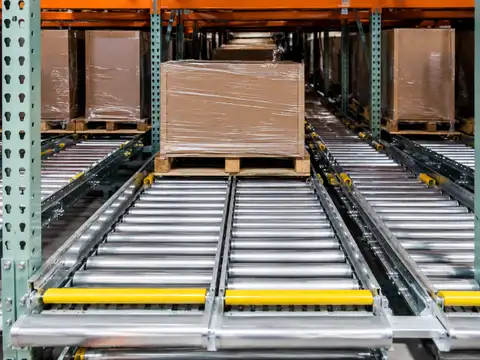
Pallet flow is expensive for a good reason: it turns the rack itself into part of the material-handling process. Pallets are loaded at the high end of a sloped lane, move forward on rollers under gravity and are removed from the opposite aisle. As one pallet leaves, the next one advances to the pick face.
That gives the system something push-back and ordinary drive-in rack do not naturally provide: high-density storage with first-in, first-out inventory rotation. For food, beverage, pharmaceutical and other date-sensitive operations, FIFO can be the feature that makes the premium worthwhile rather than an optional convenience.
Where the premium goes
Pallet flow buys more than density
Continuous tracks carry each pallet through the storage channel.
Brake rollers and retainers control pallet movement and separation.
Loading and retrieval happen from opposite aisles.
Long lanes can replace multiple conventional access aisles.
High-turnover inventory where FIFO has measurable value and expensive warehouse space makes deep storage worthwhile.
Current pallet flow rack pricing
Conesco's 2026 U.S. pallet-racking guide places new pallet flow at $200–$500 per pallet position and used systems around $120–$300. Rack & Shelf publishes a narrower all-in range of approximately $220–$350 per pallet position, explicitly stating that its figure includes rack, freight and installation.
Those ranges should not be averaged into one supposedly precise national number. A six-deep standard-pallet lane serving a dry warehouse is not the same product as a 20-deep lane handling heavy loads in cold storage. The useful takeaway is the order of magnitude: pallet flow normally sits at the expensive end of conventional pallet-rack systems.
| Budget reference | Current public range | Scope |
|---|---|---|
| New pallet flow | $200–$500 / position | Broad 2026 equipment market range |
| Installed supplier example | $220–$350 / position | Rack + freight + installation |
| Used pallet flow | $120–$300 / position | Used-market planning range |
If one quotation says $260 per position and another says $340, first check whether freight, installation, brake rollers, pallet separators, guarding, engineering and commissioning are included. Pallet-flow quotations are particularly easy to miscompare because the moving lane hardware can be specified very differently.
How much would 500 pallet positions cost?
The broad $200–$500 planning range turns 500 positions into a $100,000–$250,000 project range before resolving the exact scope. Using the narrower $220–$350 installed example produces approximately $110,000–$175,000.
500 positions in a medium-size distribution operation
At $220 per position, the working budget is about $110,000. At $350, it becomes $175,000. A difference of $130 per position moves a 500-position project by $65,000, which is why pallet specification, lane depth and included scope should be resolved early rather than after bids arrive.
At 1,000 positions, small assumptions become six-figure decisions
| Positions | $200 / position | $350 / position | $500 / position |
|---|---|---|---|
| 250 | $50,000 | $87,500 | $125,000 |
| 500 | $100,000 | $175,000 | $250,000 |
| 1,000 | $200,000 | $350,000 | $500,000 |
| 2,000 | $400,000 | $700,000 | $1,000,000 |
This is where buying pallet flow as if it were simply “premium rack” becomes dangerous. A 2,000-position system can represent several hundred thousand dollars of additional capital compared with a simpler rack configuration. The business case should therefore quantify what FIFO, density and faster replenishment are worth.
What makes pallet flow expensive?
Rollers run through the storage channel
Pallet flow adds components that selective rack simply does not need. Mecalux describes channels built with steel rollers whose spacing and diameter vary according to pallet type and weight. Those tracks extend through the lane, so a deeper lane means materially more moving hardware.
Speed has to be controlled
A heavy pallet cannot simply accelerate freely down an inclined rack lane. Flow systems use brake rollers and other speed-control components to regulate movement. Retainers and stops also manage separation at the discharge side so the front pallet can be removed safely.
The pallet matters more than buyers expect
A gravity system depends on the interface between pallet and rollers. Pallet dimensions, runner orientation, deck condition, load distribution and total weight influence track selection and spacing. A warehouse that receives inconsistent or damaged pallets may require a more conservative design than one handling a tightly controlled pallet pool.
Two working aisles change the layout
Conventional FIFO pallet flow is loaded from one side and unloaded from the other. That separation eliminates the need for a forklift to enter the rack and can prevent loading and picking traffic from interfering with one another, but the building layout must support those two faces.
Lane depth can be much greater than push-back
One reason pallet flow can create substantial density is that the channels can be very deep. Mecalux states that its pallet-flow channels can accommodate up to 30 pallets in depth. Mallard describes systems scalable from two pallets to more than 20 per SKU lane.
That does not mean 30-deep is automatically economical. Mecalux also notes that very deep channels can reduce vertical capacity because the system requires an approximate 4% slope. As the lane gets longer, the elevation difference between loading and unloading ends increases.
More pallets deep can mean fewer levels high
If a deeper lane requires noticeably more vertical drop from entry to exit, the rack may lose some usable height. The correct comparison is therefore total usable positions in the building—not simply “pallets deep per lane.”
FIFO is where pallet flow can justify the premium
In conventional pallet flow, the first pallet loaded is the first one presented at the discharge side. That makes the system naturally suited to product rotation. Mecalux specifically identifies perishable goods and inventory with expiry dates as important applications.
This matters economically because poor rotation has a cost. Spoilage, expiry, obsolete stock and manual lot management consume real money. If FIFO automation reduces those losses, comparing pallet flow with push-back using rack price alone misses part of the return.
The opposite is also true. If the inventory has no meaningful age or lot-rotation requirement, paying a substantial premium for FIFO may produce little return. A push-back or drive-in system can sometimes deliver sufficient density at lower capital cost.
Pallet flow vs push-back: not just FIFO vs LIFO
| Factor | Pallet flow | Push-back |
|---|---|---|
| Typical inventory logic | FIFO | LIFO |
| Working aisles | Separate load / unload faces | Single aisle face |
| Lane hardware | Continuous rollers + controls | Carts / rails or roller arrangement |
| Potential depth | Very deep lanes possible | Usually shallower |
| Upfront price | Usually higher | Usually lower |
| Strongest use case | High-turnover FIFO inventory | High density where LIFO is acceptable |
If you are already considering push-back, read the push-back cost guide alongside this one. The price gap only makes sense after the inventory-rotation benefit has been valued.
A simple FIFO payback example
Assume a push-back alternative costs $180,000 and pallet flow costs $250,000. The pallet-flow premium is $70,000. If the operation estimates that better stock rotation, fewer pallet moves and reduced spoilage save $35,000 per year, the simple payback on the premium is about two years.
Do not claim savings you cannot measure
The $35,000 figure above is illustrative, not a benchmark. A real business case should use the warehouse's own spoilage, labor, handling and occupancy data. Pallet flow is too expensive to justify with vague claims that it is “more efficient.”
Cold storage can strengthen the business case
Refrigerated and frozen facilities place unusual value on storage density because conditioned cubic space is expensive to build and operate. Mecalux specifically notes that pallet flow in low-temperature facilities can reduce energy consumption because a denser system reduces the volume that has to be cooled.
The combination of density and FIFO also lines up naturally with many food operations. That can make pallet flow especially compelling where dated inventory and refrigeration economics both matter.
Again, the rack should not receive credit for savings that the layout cannot actually produce. A proper comparison should model usable pallet positions, refrigeration volume, product rotation and throughput using the proposed building.
Used pallet flow can be much cheaper—but is harder to reuse well
Conesco's current 2026 guide places used pallet-flow systems around $120–$300 per pallet position, versus $200–$500 new. That discount is significant at scale.
Reusing dynamic rack is more complicated than buying a pile of selective uprights and beams. Roller tracks, brakes, separators and lane dimensions need to match the intended pallet and load. A system designed around one pallet population may not be a sensible fit for another operation without modification.
Used pallet flow should therefore be evaluated as a complete engineered system, not simply discounted components. The savings are real only if the equipment can be inspected, documented, configured and installed for the new application without consuming the discount in rework.
What to give a supplier before requesting a quote
Pallet flow benefits from better input data than most rack systems. A useful request for proposal should include:
- pallet dimensions and construction;
- minimum and maximum pallet weight;
- load overhang, if any;
- SKU count and pallets on hand by SKU;
- required FIFO or lot-rotation rules;
- desired lane depth;
- warehouse clear height;
- forklift type and lift height;
- daily or hourly pallet throughput;
- temperature range;
- known seismic or building constraints;
- whether the project is installed in an operating facility.
Mallard's own sales guidance asks buyers for application-specific information rather than treating pallet flow like ordinary “stick rack.” That is the right mindset: the lane needs to work with the actual pallet, not an abstract pallet position.
Test lanes are worth discussing
Because pallet construction and load behavior matter, dynamic-rack suppliers may validate the proposed roller configuration with representative pallets. That becomes particularly important with nonstandard pallets, variable loads or deep channels.
A test that catches poor tracking or inconsistent flow before hundreds of lanes are installed is not an unnecessary expense. On a large project, fixing a bad assumption after commissioning can be far more costly than validating the lane early.
How to normalize pallet-flow quotes
Before comparing total price, confirm that each proposal includes the same:
- number of usable pallet positions;
- lane depth and number of lanes;
- pallet specification and design load;
- roller-track type and spacing;
- brake rollers or speed controllers;
- pallet separators and end stops;
- rack frames and beams;
- guards and protection;
- installation;
- freight;
- engineering;
- testing / commissioning;
- permits and taxes;
- explicit exclusions.
Then compare three numbers: total installed project cost, installed cost per usable position and incremental cost versus the best lower-cost alternative. If FIFO is part of the justification, add the expected annual operating savings separately instead of hiding them inside a subjective score.
Structural and operating safety still require professional design
RMI identifies ANSI MH16.1-2023 as the current standard specifying minimum structural design, testing and utilization requirements for industrial steel storage racks within its scope. RMI also notes that the International Building Code references the standard for steel storage-rack design and installation.
Dynamic storage adds another layer because pallets move inside the rack. Manufacturers provide system-specific instructions for operation, inspection and maintenance. Warehouse Fieldbook's cost ranges can support budgeting; they do not determine roller spacing, safe speed, structural capacity or seismic design.
When pallet flow is probably worth pricing
The system deserves a serious quote when several of these conditions are true:
- FIFO inventory rotation has measurable operational value;
- many pallets are stored per SKU;
- warehouse floor space is constrained or expensive;
- high pallet throughput makes shorter forklift travel valuable;
- loading and picking can benefit from separate working aisles;
- cold-storage density has energy or expansion value;
- the alternative is additional building space or overflow storage.
It is less convincing when most SKUs are only one or two pallets deep, FIFO is not important and the building has ample inexpensive space. In that situation, simpler rack can preserve flexibility without paying for dynamic hardware that the operation does not need.
Frequently asked questions
How much does pallet flow rack cost per pallet position?
Current 2026 U.S. public pricing supports roughly $200–$500 per pallet position for new systems. One supplier currently publishes about $220–$350 per position including rack, freight and installation.
Why is pallet flow rack so expensive?
In addition to normal rack frames and beams, each lane requires gravity-flow tracks, rollers and speed-control components. The system also needs to be configured around the pallet and load so that movement remains controlled.
Is pallet flow FIFO?
Conventional pallet flow uses separate loading and unloading aisles, so the first pallet placed in the lane is normally the first one removed. That makes it particularly useful for inventory where age, lot or expiration rotation matters.
How deep can pallet flow rack be?
Manufacturer designs can be very deep. Mecalux states that its channels can accommodate up to 30 pallets in depth, while Mallard describes systems extending beyond 20 pallets per SKU lane. Practical depth should be based on inventory, building height and throughput rather than the maximum hardware capability.
Is pallet flow more expensive than push-back?
Usually yes, because flow lanes use a more continuous roller system and additional control components. Whether the premium is justified depends largely on the value of FIFO, lane depth and throughput.
Can pallet flow be used in cold storage?
Yes. High-density gravity storage is commonly used in refrigerated environments, particularly where reducing cooled volume and maintaining FIFO inventory rotation have economic value.
Sources and methodology
Warehouse Fieldbook reviewed current U.S. supplier pricing and current manufacturer system documentation in August 2026. Pricing is kept as a range because public sources describe different lane depths and scopes. Manufacturer documentation is used for operating characteristics; supplier price guides are used only as planning references rather than exact national averages.
- Conesco — 2026 new and used pallet-flow cost per position
- Rack & Shelf — installed pallet-flow pricing and application considerations
- Mallard Manufacturing — pallet-flow lane depth and system characteristics
- Mecalux — FIFO operation, components, cold storage and lane depth
- Rack Manufacturers Institute — ANSI MH16.1-2023 rack standard overview