
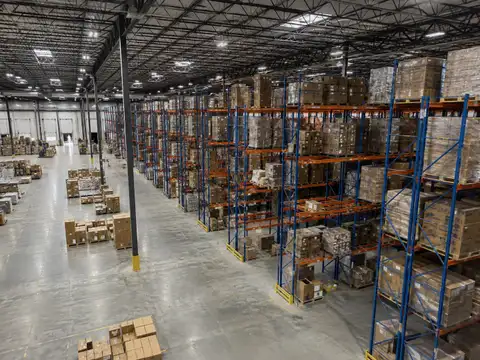
A practical 2026 planning range for new pallet racking is roughly:
$55–$200 per pallet position for selective rackHigh-density systems usually cost more. Installation commonly adds tens of dollars per position and can climb materially for tall, constrained or technically complex projects.
Pallet-rack pricing looks simple until two warehouse quotes with the same number of pallet positions arrive tens of thousands of dollars apart. The reason is that a pallet position is a useful budgeting unit, but it is not a complete specification. Rack type, upright height, beam capacity, seismic design, installation conditions, decking, protection, freight and the shape of the layout all change the final project price.
For an early budget, cost per pallet position is still the most useful place to start. Current U.S. supplier and installer guides show selective rack toward the low end of the market, while push-back and pallet-flow systems command substantial premiums because they use more steel, rails, carts or rollers to create higher storage density.
2026 pallet racking cost by system
| Rack system | Planning range / pallet position | Typical reason to choose it |
|---|---|---|
| Selective | $55–$200 | Lowest-complexity access to every pallet |
| Double-deep | $85–$300 | More density with fewer aisles |
| Drive-in | $100–$250 | High-density storage for fewer SKUs |
| Push-back | $150–$400 | Dense multi-deep storage with faster access than drive-in |
| Pallet flow | $200–$450 | FIFO storage and high throughput |
These are broad budgeting bands rather than bids. East Coast Storage Equipment currently publishes roughly $55–$200 per position for single-deep rack and $85–$300 for double-deep. Other 2026 installer guides place push-back around $150–$400 and pallet flow around $200–$450 per position. The fact that published ranges overlap so widely is itself useful: system type is only the first variable in a rack quote.
Planning tool
Pallet Rack Cost Estimator
Estimate a rough U.S. planning range for rack equipment plus installation. Use this for early budgeting, not as an engineered quotation.
Excludes freight, tax, permits, engineering, seismic work, decking, fire-protection modifications, floor repair and special accessories.
The calculator estimates rack equipment and installation only. A real project can also include freight, tax, permits, stamped engineering, seismic requirements, floor repairs, fire-protection changes, rack guards, wire decking, labels and demolition of existing systems.
What does a 500-position pallet rack project cost?
Consider a distribution warehouse that needs 500 new pallet positions. If the operation can use conventional selective rack, equipment alone could fall roughly between $27,500 and $100,000 using the planning range above. Add a standard installation allowance and the working budget moves higher before freight and accessories.
500 selective pallet positions
At $55–$200 per position, rack equipment suggests approximately $27,500–$100,000. If installation is budgeted at roughly $35–$70 per position, add another $17,500–$35,000. A sensible early project allowance is therefore about $45,000–$135,000 before freight, engineering, accessories and site-specific work.
That range is deliberately wide. A low, repetitive layout on a clear slab is not the same installation as tall rack built around columns, sprinklers, dock traffic and an operating warehouse. Cost planning becomes more useful when each major variable is separated instead of hiding everything inside one cost-per-position number.
The seven variables that move a pallet-rack quote
1. Rack type and storage density
Selective rack is mechanically simple: uprights, beams and accessories create single-deep positions that a forklift can access directly. High-density systems remove aisles or store pallets multiple positions deep, which can increase capacity substantially but require more specialized components.
Push-back systems use carts or rails to store pallets several deep. Pallet flow adds gravity rollers or wheels. Drive-in rack needs a structure designed around forklifts entering storage lanes. The extra density may be worth far more than the additional rack cost when warehouse space is expensive, but it should be justified by SKU profile and throughput rather than purchased simply because it stores more pallets.
2. Upright height and load capacity
Taller uprights and heavier beam capacities require more steel and can add engineering complexity. A warehouse storing lightweight packaged consumer goods has a different structural requirement from one storing dense raw materials or unusually heavy pallets.
Do not compare quotes only by bay count. Ask whether the proposed systems have the same clear opening, beam length, upright depth, frame capacity, number of storage levels and design loads. A cheaper quote with a materially different specification is not actually cheaper.
3. Number of pallet levels
More vertical storage levels can improve the economics of the building because each aisle serves more pallet positions. But additional beams, decking and taller uprights change rack cost, and the forklift must be able to reach the required lift height with appropriate residual capacity.
4. Installation conditions
Installation is inexpensive only when the job is uncomplicated. Cost rises when installers must work around live operations, restricted access, floor irregularities, unusually tall structures, phased schedules or extensive anchoring and layout work.
Current installation guides publish very broad figures. Basic work may be budgeted in the tens of dollars per position, while complex jobs can move above $100 per position. This is why installation should appear as its own line on a budget.
5. Freight
Pallet rack is bulky steel. Distance from the manufacturing or distribution point matters, as do fuel prices, full-truckload efficiency and whether the project arrives in one shipment or several phases. Freight can make two nominally similar equipment quotes materially different.
6. Accessories and protection
Wire decking, row spacers, pallet supports, end-of-aisle guards, column protectors, backstops, safety netting, labels and signage can turn a stripped-down equipment quote into a much larger completed project. Some of these are operational choices; others may be driven by the actual rack design, stored product or safety strategy.
7. Engineering, seismic and building conditions
Rack is structural equipment. The applicable design requirements depend on the system and project. The Rack Manufacturers Institute lists ANSI MH16.1-2023 as the current standard covering minimum structural design, testing and utilization requirements for many industrial steel storage racks.
That does not mean every warehouse should perform its own structural calculation from an online guide. A qualified rack supplier or engineer should establish the project-specific design, particularly when loads, building conditions or seismic requirements are significant.
New vs used pallet racking
Used rack can cut the equipment bill substantially. Current market guides show used selective roll-formed rack beginning around the low tens of dollars per pallet position in some inventories, while other published comparisons place typical used selective systems around $25–$75 per position.
But used rack should not be evaluated purely as “new price minus a discount.” The real questions are whether the exact components are available in the quantities needed, whether the beam and frame capacities are documented, whether components are compatible, what condition the steel is in, and how much freight or reconfiguration is required.
Used equipment makes the most economic sense when a standard configuration is available in the right quantity and condition. Savings disappear quickly if the project needs mixed components, extensive repair, extra freight or a layout compromised simply to fit the inventory that happened to be available.
When the cheapest rack costs more
A selective system may have the lowest equipment cost per position and still be the more expensive warehouse decision. Rack cost must be considered alongside the floor area consumed by aisles, the value of the building, forklift requirements and throughput.
Imagine that a high-density system costs $100 more per pallet position but adds hundreds of positions without leasing another 10,000 square feet. The additional rack investment may have a short payback. Conversely, paying a premium for high-density storage is a bad decision if the operation has many low-volume SKUs that need direct access and the configuration creates excessive pallet moves.
The relevant metric is usually total cost per usable pallet position at the required throughput, not just the headline steel price.
How to compare pallet-racking quotes
Before comparing the totals, normalize the scope. Ask each bidder to identify the same basic quantities and assumptions:
- total usable pallet positions;
- rack type and depth;
- upright height, depth and rated capacity;
- beam length and beam capacity;
- number of storage levels;
- decking and pallet-support scope;
- guards and protection;
- anchors and installation labor;
- freight;
- engineering or permit-related work;
- demolition or relocation;
- taxes and exclusions.
Then calculate three figures: equipment cost per pallet position, installed cost per pallet position and total project cost per usable pallet position. Those figures make it much easier to understand whether one bidder is genuinely cheaper or has simply excluded more work.
Safety belongs in the budget
OSHA's general-industry material-storage rule, 29 CFR 1910.176, requires sufficient safe clearances where mechanical handling equipment is used and requires stored material to remain stable and secure against sliding or collapse. The practical purchasing lesson is simple: storage economics cannot be separated from safe operation.
Three budgeting scenarios
Small 150-position selective-rack project
Equipment at $55–$200 per position suggests approximately $8,250–$30,000. A straightforward installation allowance of $20–$45 per position adds roughly $3,000–$6,750. Small projects can have a relatively high cost per position because freight, mobilization and engineering are spread across fewer positions.
1,000-position push-back project
A $150–$400 equipment range produces approximately $150,000–$400,000 before installation and project extras. That premium only makes sense if the added storage density or operational benefit has enough value to justify it.
1,500-position pallet-flow project
At roughly $200–$450 per position, rack equipment alone can imply a $300,000–$675,000 planning range. Pallet flow is therefore normally an operational investment—often tied to FIFO, throughput or cold storage economics—not simply a way to buy more rack.
How much should you budget before requesting quotes?
For an early capital plan, start with the number of usable pallet positions required and the storage system that matches the SKU and inventory profile. Apply a broad per-position equipment range, add installation as a separate line and then create explicit allowances for freight, engineering and accessories instead of hiding them inside a contingency percentage.
Once a preliminary layout exists, replace those allowances with supplier quotes. At that stage, the budget should move away from generic cost per position and toward the actual bill of materials and installation scope.
Frequently asked questions
How much is selective pallet racking per pallet position?
A useful 2026 U.S. planning range is roughly $55–$200 per pallet position for new selective rack equipment. The installed project cost will be higher once labor, freight, accessories and site-specific requirements are included.
How much does pallet-rack installation cost?
Basic installation is often budgeted in the tens of dollars per position. Treat public figures only as early allowances because height, layout, anchoring, working conditions and geography can change labor substantially.
Is used pallet racking worth it?
It can be, particularly for standard selective configurations where matching components are available in sufficient quantity and documented condition. Compare the complete installed project, not only the used steel price.
What is the cheapest type of pallet racking?
Conventional selective rack is usually the lowest-cost mainstream option and offers direct access to every pallet. It is not automatically the cheapest warehouse solution because it uses more aisle space than high-density systems.
Should I budget pallet rack by bay or by pallet position?
Use pallet positions for early comparisons because position count connects the investment to actual storage capacity. Once you have a layout, use the supplier bill of materials as the primary budget and retain cost per usable position as a comparison metric.
Rack cost is not complete until the load-support surface is specified. Compare wire, wood, steel and other options in the pallet rack decking types guide before finalizing the bay configuration.
Standard pallet rack is not the right baseline for every load. Long products such as lumber, pipe or bar stock should be compared with the dedicated cantilever racking cost guide.
Sources and methodology
Warehouse Fieldbook uses ranges rather than a single average because pallet-rack projects vary too much for one national price to be credible. This guide was reviewed against current public U.S. supplier and installer pricing plus primary safety and industry-standard sources in August 2026.
- East Coast Storage Equipment — pallet-racking cost ranges
- Conesco — pallet-racking and used-rack pricing guide
- Hammerhead — pallet-racking cost by system type
- Distribution X — warehouse rack installation cost guide
- OSHA — 29 CFR 1910.176, Handling materials — general
- Rack Manufacturers Institute / MHI — ANSI MH16.1-2023 and related rack standards