
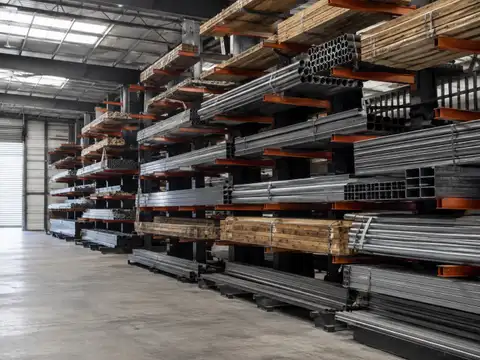
For early U.S. budgeting, conventional industrial cantilever rack often lands in these orders of magnitude:
$1,100–$5,300+ per heavy-duty rack unitAnother current U.S. industry reference uses roughly $100–$200 per arm level for new systems. Specialized crank-out, very tall, outdoor or unusually high-capacity systems can cost much more.
Cantilever rack solves a problem that ordinary pallet rack handles badly: storing long material without front columns blocking access. Lumber, pipe, tubing, bar stock, furniture, carpet, sheet goods and structural products can rest on horizontal arms that project from a central upright.
That geometry changes how the system should be budgeted. There is no standardized “pallet position” because a storage level may hold a bundle of pipe, several pieces of lumber, a stack of furniture or another irregular load. The meaningful cost drivers are how many uprights you need, how many arm levels are installed, how long the arms are and how much weight each level must carry.
How cantilever is priced
Think in arm levels, not pallet positions
One storage face
Two storage faces
A “rack price” is only comparable when height, arm count, arm length, capacity and number of storage faces are the same.
Current cantilever rack pricing in 2026
Public prices span a broad range because “cantilever rack” covers everything from relatively modest long-goods storage to engineered structural systems. A current 2026 pricing guide reports heavy-duty racks from approximately $1,100 to $5,300 or more, with specialized crank-out systems beginning around $16,000. It also lists individual arms beginning around $55.
Hammerhead's current U.S. material-handling guide takes a different approach, estimating roughly $100–$200 per arm level for new systems, depending on arm length, capacity and upright height. That measure is often more useful for comparing two layouts because it ties the cost to the number of actual load-support levels.
| Budget reference | Current public range | Best use |
|---|---|---|
| New arm level | About $100–$200 | Early layout comparison |
| Heavy-duty rack / kit | About $1,100–$5,300+ | Order-of-magnitude equipment budget |
| Individual arm | From roughly $55 in current retail examples | Replacement / expansion component reference |
| Crank-out systems | From about $16,000 in one 2026 guide | Specialized high-access / tooling applications |
Cantilever rack does not have a universal pallet position. For lumber or pipe, compare installed cost per usable arm level, per linear foot of storage or per ton of supported inventory—whichever best matches the operation.
Single-sided vs double-sided cost
A single-sided row stores product from one face and is often placed against a wall or along a perimeter. A double-sided row uses arms on both sides of the central column and can create storage on two faces from one structural line.
Double-sided equipment costs more because it needs bases and arms on both sides, but it can reduce the number of uprights and bases needed for the amount of storage created. The correct comparison is therefore not “which rack is cheaper?” but how much usable storage each configuration provides within the aisle plan.
Current retail pricing illustrates the difference. Action Wholesale Products lists heavy-duty double-sided eight-foot units starting around $1,607 and 12-foot units around $2,123 in some configurations, while other single- and double-sided products vary according to arm count and capacity.
Perimeter storage vs center-row storage
A warehouse storing steel tube along an exterior wall may get no value from a second storage face, making single-sided rack the rational choice. A free-standing center row accessed by forklifts from both sides can make double-sided cantilever considerably more efficient because one column line serves two aisles.
Arm count can move the budget faster than upright count
The column is only part of the system. Every storage level needs one arm on each supporting upright. A long run with several vertical levels can therefore contain dozens or hundreds of arms.
Suppose a run uses 10 uprights with four storage levels. If each level uses an arm on every upright, the run needs 40 arms. Double-sided storage at the same four levels can require roughly 80 arms. If a particular arm specification costs even $100 more than another, that choice alone moves the equipment budget by several thousand dollars.
10 uprights, four levels, single-sided
Forty arm locations at a planning range of $100–$200 per arm level imply approximately $4,000–$8,000 for the arm-level portion of the rack budget. Uprights, bases, bracing, freight, installation and other project items still need to be included separately.
Arm length changes both cost and structural demand
A shallow arm carrying short bundles is not the same structural problem as an eight-foot arm supporting heavy material far from the column. Steel King currently offers cantilever configurations with freestanding heights up to 30 feet and arm lengths up to eight feet, illustrating how broad the product category can become.
As arm length grows, the load acts farther from the upright. Capacity therefore cannot be inferred from appearance or from another rack that happens to use the same steel profile. The required arm should be selected from manufacturer or engineered capacity data for the actual load.
Load capacity is one of the largest hidden variables
Cantilever is often chosen precisely because the inventory is heavy or awkward. SJF notes that structural cantilever is generally preferred for heavier loads and describes structural systems as stronger and more impact-resistant than lighter roll-formed alternatives.
The key is to distinguish arm capacity from upright capacity. A row may contain arms individually capable of supporting a given load, but the total load placed across all levels still has to remain within the capacity of the column and base system.
Do not use the cheapest arm that appears to support one bundle. The design has to account for the full rack configuration. Heavy-duty steel, larger bases and stronger columns may raise the initial price but are part of the actual structural requirement, not optional upgrades.
Roll-formed vs structural cantilever
Roll-formed equipment can be appropriate for light and medium-duty applications where lower weight and easier adjustment are priorities. Structural rack uses hot-rolled steel sections and is generally chosen for heavier industrial duty, outdoor applications and environments with higher impact exposure.
| Factor | Roll-formed | Structural |
|---|---|---|
| Typical duty | Light to medium | Heavy industrial |
| Equipment weight | Lower | Higher |
| Impact resistance | Lower | Generally stronger |
| Outdoor / harsh use | Application-dependent | Common choice |
| Price | Usually lower | Usually higher |
Paying for structural steel where it is unnecessary can waste capital. Using lighter rack simply to reach a price target can be worse. The load and operating environment should decide the construction method before the procurement team compares totals.
Outdoor cantilever racks cost more to do properly
Lumber yards, steel service centers and building-material operations often need cantilever storage outside. That introduces weather exposure, wind, corrosion and sometimes roof or canopy systems.
Galvanized or otherwise protected steel can increase material cost but may lower lifecycle maintenance in an exposed environment. Outdoor systems may also require different engineering from an indoor rack because wind and environmental loads become relevant to the structure.
The cheapest indoor catalog unit should therefore not be used as the benchmark for an outdoor yard project. The two installations are solving different structural and durability problems.
What does a small cantilever installation cost?
Imagine a fabrication shop that needs several single-sided heavy-duty rack sections for steel tubing. If each rack unit falls around the lower end of the current $1,100–$5,300+ heavy-duty range, even a modest installation can quickly become a five-figure equipment purchase after multiple sections, additional arms and installation.
Six heavy-duty sections
Six $2,000 rack sections represent $12,000 before any extra arms, freight, anchors or installation. If the actual specification pushes the sections to $4,000 each, the equipment subtotal becomes $24,000. This is why a per-unit retail price is useful for orientation but weak for a completed warehouse budget.
Large runs should be budgeted from the storage requirement backward
For a larger facility, start with the inventory rather than the catalog. Measure product length, bundle dimensions, maximum weight, quantity on hand and how many vertical storage levels can be used safely within the clear height.
Then determine the number of arms required to support each load without excessive overhang. That arm count determines how many uprights and bays are needed along the run. The layout should only be priced after those quantities are known.
This approach prevents a common mistake: purchasing a rack that looks inexpensive per section but requires many more sections because each arm level supports less material than the alternative.
How many arms should support a load?
This is not something Warehouse Fieldbook should turn into a generic online calculator. The number and spacing of supports depend on the material's length, stiffness, weight distribution and the manufacturer's system design.
Flexible material can sag if supports are too far apart. Heavy material can overload an individual arm. Long loads can also become unstable if their center of gravity is poorly supported. The supplier or engineer should establish the required arm spacing for the actual product.
That is why a generic “cantilever capacity calculator” would be misleading. A cost estimator could create false confidence about a structural variable that needs product-specific engineering.
Installation and anchors belong in the budget
Cantilever uprights are normally connected to bases that are anchored to the floor. RMI describes industrial cantilevered racks as freestanding columns connected to fixed bases, with load-bearing arms projecting from those columns.
Installation therefore includes more than assembling steel. Layout, anchoring, leveling, aisle coordination and sometimes difficult material handling all contribute. Large structural components can also require more equipment to unload and position than ordinary light-duty rack.
Freight deserves its own allowance as well. Heavy structural steel and long components are expensive to move, so shipping distance can materially change the apparent advantage of a low equipment price.
When cantilever is cheaper than trying to force long loads into pallet rack
Standard pallet rack can sometimes store long items, but front uprights interrupt horizontal access. That can lead to awkward loading, wasted bays, special decking or inefficient product orientation.
Cantilever removes those front columns. For pipe, tube, lumber and similar products, the ability to place and retrieve a long bundle directly from the aisle can be worth more than any nominal difference in rack cost.
The financial comparison should include forklift handling time, damaged product, wasted cube and the number of storage locations required—not merely the steel cost.
Common quote mistakes
Comparing a starter bay with a complete run
Catalog pricing may describe a starter unit with a particular number of arms. A full warehouse run can share bracing or use add-on configurations differently. Make sure each quote describes the same amount of usable storage.
Ignoring single vs double-sided construction
A price that looks suspiciously low may be for one storage face. If the layout needs two-sided access, normalize the hardware before comparing bidders.
Comparing arm capacity but not column capacity
The rack is a system. Confirm both individual arm ratings and the capacity of the upright under the proposed number of loaded levels.
Leaving freight until the end
Long and heavy steel components can make freight significant. Ask for a delivered figure early enough that shipping does not turn the preferred supplier into the most expensive proposal.
Buying around a temporary inventory profile
Cantilever is modular, but arm length, capacity and spacing still constrain future products. If the business expects material sizes to change, include that uncertainty in the specification rather than optimizing every dimension to today's inventory.
The cantilever standard changed in 2026
This is one area where current information matters. RMI announced in January 2026 the revised ANSI MH16.3-2025, Specification for the Design, Testing, and Utilization of Industrial Steel Cantilevered Storage Racks. The new edition supersedes the earlier 2016 standard and provides the current engineering framework for these systems.
RMI also updated its R-Mark certification program for cantilever rack in March 2026 to align with the latest standard. For a new project, that is a better reference point than older articles still citing MH16.3-2016 as if it were current.
A cheap online rack price is not proof that a completed system is suitable for a particular building or load. Current structural requirements, anchorage and project engineering can affect the specification and therefore the budget.
What to send a cantilever supplier for a useful quote
- material type;
- maximum load length;
- bundle or unit dimensions;
- maximum weight per storage level;
- desired number of vertical levels;
- clear height;
- single- or double-sided preference;
- indoor or outdoor installation;
- forklift or handling-equipment type;
- available aisle width;
- building location for seismic design;
- future load sizes the system may need to accommodate.
A vendor can price a meaningful system from that information. “I need 20 racks for pipe” is not enough because the structural demand can vary dramatically from one pipe inventory to another.
When cantilever rack is usually the right economic choice
Cantilever should be shortlisted when the inventory is long, bulky or irregular enough that conventional shelving or pallet rack wastes access and space. It is especially natural for:
- lumber and building materials;
- steel bar, tube and pipe;
- PVC and conduit;
- carpet and rolled goods;
- furniture;
- sheet products;
- long tooling or fabricated components.
For standard palletized inventory, ordinary pallet rack remains the more natural comparison. Cantilever earns its keep when removing front columns materially improves how the product can be stored and handled.
Frequently asked questions
How much does heavy-duty cantilever racking cost?
Current 2026 public pricing puts many heavy-duty rack units or kits around $1,100–$5,300+, with much higher prices for specialized systems. Complete project cost depends on uprights, arm count, load capacity, freight, installation and engineering.
How much does a cantilever arm cost?
Current retail references show some arms beginning around $55, while a broader U.S. planning guide uses about $100–$200 per new arm level depending on length, capacity and upright height.
Is double-sided cantilever rack more expensive?
The equipment price is normally higher because the column serves arms on both sides and requires a suitable base configuration. It can still reduce cost per usable storage face when a center row can be accessed from two aisles.
Is structural cantilever rack more expensive than roll-formed?
Generally yes. Structural rack uses heavier hot-rolled steel and is intended for more demanding loads and operating environments. The premium should be evaluated against the actual capacity and durability required.
Can cantilever rack be installed outdoors?
Yes, but outdoor use can introduce corrosion protection, wind exposure and other engineering requirements that do not apply to a simple indoor catalog installation.
What standard applies to cantilever rack in 2026?
RMI released ANSI MH16.3-2025 in January 2026 as the revised specification for design, testing and utilization of industrial steel cantilevered storage racks.
Sources and methodology
Warehouse Fieldbook reviewed current 2026 price references alongside current manufacturer specifications and the latest RMI standard information. Cantilever pricing is expressed using several units because no single national “cost per position” accurately describes long-load storage.
- T-Racking — 2026 cantilever rack pricing examples
- Hammerhead — U.S. cantilever planning cost per arm level
- Action Wholesale Products — current structural cantilever retail pricing
- Steel King — structural cantilever heights, arm lengths and applications
- SJF Material Handling — structural vs roll-formed cantilever guidance
- Rack Manufacturers Institute — revised ANSI MH16.3-2025 release
- Rack Manufacturers Institute — 2026 cantilever R-Mark update