
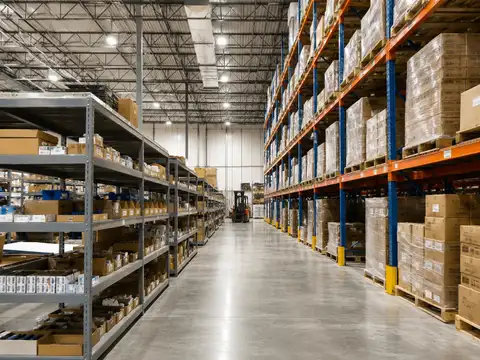
Use industrial shelving when employees need direct hand access to cartons, bins, components, tools or individual items.
Use pallet rack when the storage unit is the pallet.If the operation picks eaches or cartons but replenishes from pallets, the strongest answer is often a hybrid: palletized reserve storage plus shelving or another pick medium at floor level.
Warehouses often compare shelving and pallet rack too late. The discussion starts with equipment prices, even though the decisive question is usually operational: is a person expected to reach the product directly, or is a lift truck expected to place and retrieve the load as a unit?
Cisco-Eagle describes the distinction neatly: most shelving is loaded and accessed by hand, while most rack is loaded and accessed by machinery. There are exceptions, but that rule is a much better starting point than trying to decide from weight alone.
The first question
Who touches the load: a person or a forklift?
Optimize reach, pick face and shelf capacity.
Optimize pallet positions, lift access and vertical cube.
Pallet rack for reserve inventory above or behind the operation; shelving for hand-pick inventory at the working face.
Do not compare the purchase prices as if the units were equivalent
Industrial shelving is commonly sold as a complete upright-and-shelf unit. Pallet rack is commonly priced as starter or add-on bays, frames, beams and accessories. A $300 shelving unit and a $600 pallet-rack starter are therefore not two prices for the same amount of storage.
Current U.S. retail listings illustrate the scale without providing a national average. Global Industrial currently lists examples of heavy-duty steel shelving around $190 to $460 per unit, depending on size, gauge and shelf count. Uline currently lists 96-inch-high pallet-rack starter units beginning around $495 and moving through the $500s, $600s and $700s as width and depth increase.
| Current retail snapshot | Illustrative price | What is being purchased |
|---|---|---|
| Heavy-duty steel shelving | About $190 | Small 3-shelf industrial unit in one current listing |
| Open steel shelving | About $240–$316 | Current examples with 4–6 shelves |
| Extra-heavy-duty shelving | About $460 | Large heavy-gauge 4-shelf unit in one current listing |
| Pallet-rack starter unit | About $495–$790+ | 96-inch-high starter examples varying by width/depth |
These figures are snapshots from current retailer pages in August 2026, not project budgets. They demonstrate why “shelving is cheaper” is too simplistic: the shelving unit stores hand-pick inventory; the pallet rack creates locations for unit loads that may weigh thousands of pounds.
For shelving, that may be cost per pick face or cubic foot of hand-accessible inventory. For pallet rack, it is often installed cost per usable pallet position. A single dollar-per-bay comparison hides what each system actually does.
The load unit decides more than the total weight
A 600-pound load can belong on either kind of system depending on what the load actually is. Six hundred pounds spread across dozens of small parts on multiple shelves is a different handling problem from one 600-pound pallet.
Industrial shelving is designed to create horizontal pick surfaces. The operator can access individual cartons, bins and components without moving the entire inventory unit. Pallet rack creates clear vertical openings sized for unit loads placed by material-handling equipment.
That is why selecting purely from “pounds per shelf” is weak warehouse design. The handling method and frequency of access need to be considered alongside capacity.
When industrial shelving is the stronger choice
Shelving is usually better when inventory is:
- picked by hand;
- stored in cartons, totes or bins;
- made up of many small SKUs;
- accessed frequently at the item or case level;
- light enough to be handled safely without a lift truck;
- better organized across many narrow shelf locations than a few pallet positions.
Global Industrial describes steel shelving as a durable option for warehouses, manufacturing plants and stockrooms, with heavy-duty variants intended for tools, dies, fixtures and similar industrial inventory. The important point is that “industrial shelving” can be genuinely heavy duty while remaining a hand-access system.
MRO parts room
A maintenance department stores bearings, fasteners, motors, tools and spare components across hundreds of SKUs. Pallet rack could carry the weight, but it would create large openings and poor small-item organization. Shelving creates far more usable pick faces inside the same room.
When pallet rack is the stronger choice
Pallet rack is usually better when inventory is:
- received and stored on pallets;
- moved by forklift, reach truck or other powered equipment;
- heavy enough that manual handling is inappropriate;
- stored several levels high;
- held as reserve inventory before case or each picking;
- more economically measured in pallet positions than shelf locations.
Current Uline heavy-duty pallet-rack listings illustrate the intended industrial context: the company markets the systems for machine shops, manufacturing plants and industrial facilities, with welded steel frames and adjustable beams.
Inbound reserve inventory
A distributor receives full pallets of packaged product and stores them for several weeks before replenishing the pick area. Industrial shelving would require the pallet to be broken down too early. Pallet rack keeps the reserve inventory intact and uses vertical warehouse cube more efficiently.
Capacity should be expressed in the unit the operation actually uses
Pallet rack capacity is normally discussed per beam level, pallet position or upright/frame system. Shelving capacity is normally expressed per shelf or per unit. Those ratings should not be combined or converted casually.
If a shelving system has six levels rated for a certain uniformly distributed load, that does not mean it can safely accept one concentrated pallet load. Likewise, a pallet-rack beam rating does not turn the beam level into an ergonomic hand-picking shelf.
Use the manufacturer's published capacities and configuration requirements for the exact system being installed. Warehouse Fieldbook does not convert one manufacturer's shelf rating into another system's safe load.
The ergonomics can reverse the apparent space saving
A warehouse can physically store cartons on a pallet rack beam level, but the question is whether employees can reach them efficiently and safely. Deep pallet rack creates storage cube, not necessarily good pick access.
Shelving can place inventory at more useful hand heights and use shallower depths, which reduces reaching and lets many SKUs sit close to the aisle face. For a high-frequency parts operation, those ergonomic benefits can be worth more than squeezing another pallet into the room.
Conversely, asking employees to manually handle heavy cases just because they technically fit on shelving can create an equally poor design. Storage and handling method have to be designed together.
Forklift aisles are a major pallet-rack cost
Pallet rack does not only consume the footprint of its frames. It also requires aisle space appropriate to the handling equipment. Shelving served on foot or with carts can often use materially narrower working aisles.
That can make shelving surprisingly space-efficient for small items. A room designed around hand picking may fit many more SKU faces than the same room divided into pallet-rack rows and forklift aisles.
The opposite happens for bulk inventory: manually accessed shelving cannot exploit warehouse height the way a reach truck serving tall pallet rack can.
Vertical cube is where pallet rack usually wins
Warehouses often have much more height than people can access safely from the floor. Pallet rack lets powered equipment convert that vertical volume into reserve storage.
This is especially important in expensive distribution space. A 28-foot clear building used only for seven-foot shelving can leave a large portion of paid cubic capacity unused unless another system takes advantage of the upper volume.
Eight feet of picking, twenty feet of unused air
A facility with hand shelving throughout may feel organized while still wasting most of its clear height. If the inventory arrives on pallets, reserve rack above or in a nearby high-bay zone can capture that cube without forcing pickers to work from elevated shelving.
This is why hybrid storage is so common
The warehouse does not have to choose one system for every unit of inventory. A common design separates reserve storage from forward picking.
Full pallets stay in pallet rack until the pick location needs replenishment. Fast-moving cases, parts or eaches are stored in shelving, carton flow or bins where employees can reach them efficiently.
This approach lets each system perform the job it is good at: pallet rack uses vertical cube and handles unit loads; shelving creates dense, accessible pick faces.
The related-guides section below includes the Reserve Storage vs Forward Picking guide. That article develops the replenishment logic behind a hybrid rack-and-shelving layout.
Can shelving be installed inside pallet rack?
In some operations, yes. Rack bays can be configured with decking or shelf surfaces for hand picking at lower levels while upper levels hold reserve pallets. Cisco-Eagle notes that racks can be hand-accessed in some applications, which is one of the gray areas between the categories.
The key is to treat the configuration as a designed storage system rather than an improvised shelf. Load support, decking, clearances, fall protection, sprinkler interaction and the intended picking method need to be considered.
A rack beam with a loose board placed across it is not the same thing as an engineered shelf level.
Bulk shelving fills the middle ground
Heavy-duty bulk shelving is useful when individual items or cartons are too large for ordinary stockroom shelving but do not need to remain on pallets. Cisco-Eagle notes that some bulk shelving can carry loads over 1,000 pounds.
This middle category is important because warehouse design is not binary. Bulky dies, motors, cases or fabrication components may need heavy shelf capacity but still benefit from direct hand or cart access.
When inventory lives in that gray area, compare handling method first, then dimensions and capacity. Do not jump to pallet rack merely because a product is heavy.
Labor can outweigh the equipment-price difference
Imagine one system costs $20,000 more but reduces each pick by ten seconds. In a low-volume stockroom, the premium may never pay back. In an operation performing thousands of picks per day, it can be recovered quickly.
The same logic applies to pallet handling. Breaking every inbound pallet into shelving immediately creates labor that could be avoided by holding reserve inventory intact until replenishment is necessary.
Do not optimize steel and ignore touches
If a shelving-only design requires workers to break down 80 inbound pallets every day, while a hybrid design lets 60 of those pallets remain intact in reserve rack, the labor difference can be worth more than the equipment-price gap. Count inventory touches, not just storage locations.
Five questions that usually decide the system
1. What is the normal storage unit?
Pallet, carton, tote, bin, loose part, bundle or something else?
2. Who retrieves it?
A person, cart, forklift, order picker, reach truck or automated system?
3. How frequently is it accessed?
Reserve inventory and high-frequency pick inventory should not automatically share the same storage medium.
4. How valuable is vertical cube?
High clear height favors systems that can use powered access safely and economically.
5. How many pick faces are required?
Hundreds of shallow SKUs often need more accessible locations than pallet rack provides efficiently.
Safety requirements do not disappear because the system is shelving
OSHA's general-industry material-storage rule, 29 CFR 1910.176, requires stored material to remain stable and secure against sliding or collapse and requires sufficient safe clearances where mechanical handling equipment is used.
That is a general storage requirement rather than a detailed design standard for either shelving or rack. The practical implication is that neither system should be overloaded, improvised or arranged in a way that creates unstable storage or unsafe access.
Pallet rack has its own industry structural standards and engineered load requirements. Industrial shelving has manufacturer-specific capacities and assembly rules. Use the correct technical information for the exact equipment rather than assuming one storage category's rules apply to the other.
A simple decision matrix
| If this describes the inventory... | Usually investigate first |
|---|---|
| Full pallets moved by forklift | Pallet rack |
| Small parts picked by hand | Industrial shelving |
| Heavy individual items picked manually or by cart | Heavy-duty / bulk shelving |
| Pallet reserve + case picking | Hybrid |
| Many SKUs, shallow inventory | Shelving / pick system |
| High clear height + palletized reserve | Pallet rack |
| Long pipe, lumber or bar stock | Cantilever, not either by default |
When shelving is a false economy
Shelving can look cheap because individual units cost less than pallet-rack bays. It becomes expensive when employees repeatedly break pallets, handle heavy goods manually or when a low shelving height wastes a high-bay warehouse.
If the inventory naturally moves by pallet, forcing it into hand storage usually adds labor before it adds value.
When pallet rack is a false economy
Pallet rack can look “more industrial” and therefore feel like the safer warehouse purchase. It becomes inefficient when most items are small, workers spend time reaching into deep bays or one pallet opening is subdivided informally into dozens of poorly organized SKUs.
A structurally stronger system is not automatically a better picking system. Use rack because the load and handling method justify rack—not because the building is called a warehouse.
The practical recommendation
Start with inventory movement rather than equipment. If product is normally handled as a pallet, design pallet storage. If it is normally handled as an individual carton, bin or part, design a pick face around the person doing that work.
Then ask whether reserve and forward inventory should be separated. In many warehouses, that produces the strongest answer: pallet rack in the vertical reserve zone and shelving or another picking medium where employees actually touch product.
That approach avoids buying one storage system and forcing it to perform two incompatible jobs.
Frequently asked questions
Is industrial shelving cheaper than pallet racking?
Individual shelving units are often cheaper than pallet-rack starter bays, but the systems perform different jobs. Current retail examples show industrial steel shelving from roughly $190–$460 per unit and pallet-rack starter examples beginning around $495, but project economics should be compared by useful storage function, not unit price.
What is the main difference between shelving and pallet rack?
Shelving is primarily designed for direct access to items, cartons, bins and parts. Pallet rack is primarily designed to store unit loads that are placed and retrieved with material-handling equipment.
Can pallet rack be used for hand picking?
Yes, certain rack configurations can support hand picking, particularly at lower levels with appropriate decking or shelf systems. The configuration still needs to be designed for the load and access method rather than improvised.
Can industrial shelving hold more than 1,000 pounds?
Some heavy-duty and bulk shelving systems can. Cisco-Eagle notes that certain bulk shelving can support loads over 1,000 pounds. Capacity is product-specific, so use the manufacturer's rating for the exact configuration.
Which system uses warehouse height better?
Pallet rack generally has the advantage for high-bay palletized storage because lift trucks can access levels far above normal hand-picking height.
Can a warehouse use shelving and pallet rack together?
Yes. Combining pallet reserve storage with shelving-based forward picking is a common and often economically strong arrangement because it separates unit-load storage from hand-pick access.
What if my products are long rather than palletized?
Cantilever rack may be the more appropriate comparison for lumber, pipe, tube, bar stock and other long materials because it removes front columns that interfere with horizontal loading.
Sources and methodology
Warehouse Fieldbook reviewed current storage-system guidance and current U.S. retailer listings in August 2026. Retail prices are used only as current market snapshots because shelving and pallet-rack units are not standardized or directly equivalent. Safety context comes from OSHA's general material-storage requirements.
- Cisco-Eagle — rack vs shelving access and application differences
- Global Industrial — industrial shelving types and applications
- Global Industrial — current extra-heavy-duty shelving retail example
- Global Industrial — current six-shelf steel shelving retail example
- Uline — current U.S. pallet-rack starter and add-on pricing examples
- OSHA — 29 CFR 1910.176, Handling materials — general