
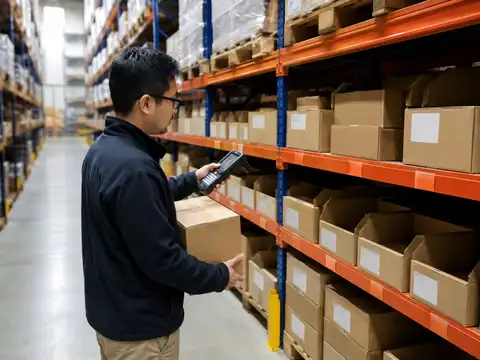
Put each SKU where it creates the least total warehouse work—not simply where the nearest empty slot happens to be.
Slotting should first eliminate locations that are physically, operationally or ergonomically wrong for the SKU. Among the feasible locations, prioritize the placement that reduces pick travel, replenishment travel, congestion and handling effort while preserving enough capacity for the SKU's working stock.
SKU location decision map
Velocity is important—but it should not be the first filter.
The slotting sequence below protects hard constraints first, then optimizes travel and replenishment. A fast SKU in the wrong physical or ergonomic location is still badly slotted.
Dimensions, weight, compatibility, storage medium, equipment and handling restrictions.
Each, inner, case, layer or pallet; manual versus mechanical handling.
Order lines, picks, units, seasonality and peak-period velocity.
Pick frequency, weight, reach, bend, lift and presentation height.
Affinity, replenishment source, route sequence and congestion.
Promotions, seasonality, SKU churn, packaging change and updated velocity.
What warehouse slotting actually means
Slotting is the process of assigning products to storage or picking locations based on how the operation handles those products.
Interlake Mecalux describes warehouse slotting as location management intended to improve both:
- storage-capacity use;
- operational efficiency.
Its SKU-velocity guidance also makes an important point:
velocity is one factor in SKU profiling, together with size, accessibility requirements and other characteristics.
That is the correct way to think about slotting.
It is not only ABC classification.
Do not start with A, B and C
ABC analysis can be useful for ranking demand.
But a product can be:
- fast but too heavy for a manual pick shelf;
- fast but oversized;
- slow but hazardous or segregated;
- high-volume but better picked directly from a pallet;
- frequently co-ordered with another SKU that should be nearby.
Therefore classify hard constraints before velocity.
Filter 1: physical and storage compatibility
Record item, case and pallet dimensions, orientation, overhang and required access space.
Consider rack/shelf rating, equipment capacity and manual handling exposure.
The same SKU can require different locations for reserve, case pick and each pick.
Temperature, security, damage sensitivity, lot/date rules and other product requirements can override travel optimization.
Filter 2: choose the metric that represents work
Ranking SKUs by units shipped can be misleading.
Example:
- SKU A ships 10,000 eaches in 100 order lines;
- SKU B ships 3,000 eaches in 1,500 order lines.
SKU B can create far more picker location visits even though it ships fewer units.
For picker-to-parts operations, useful slotting demand measures can include:
- order lines per SKU;
- location visits;
- picks;
- units picked;
- cases picked.
Choose the measure that most closely represents the labor or equipment movement you are trying to reduce.
SKU velocity should use a consistent time interval
Interlake Mecalux defines SKU velocity as how frequently an SKU is picked over a period of time and recommends comparing products over the same interval.
The interval might be:
- day;
- week;
- four weeks;
- another period appropriate to the operation.
The important point is comparability.
Do not let annual averages hide seasonality
Interlake Mecalux specifically recommends analyzing SKU turnover at different times of year and considering:
- peak demand periods;
- seasonality;
- promotions;
- sales events.
A SKU that is C-class for nine months and extremely fast for a holiday quarter may deserve temporary prime placement during that peak.
Use multiple velocity windows
A practical slotting file can carry:
- last 7 days;
- last 28 days;
- same season last year;
- forecast peak;
- promotion flag.
This helps distinguish:
- stable fast movers;
- newly accelerating SKUs;
- temporary promotions;
- declining products.
ABC is a ranking tool—not a universal location map
A common approach groups:
- A = fastest/highest-work SKUs;
- B = medium activity;
- C = slow activity.
But there is no universal requirement that:
- A must equal exactly 20% of SKUs;
- B must equal exactly 30%;
- C must equal exactly 50%.
Those cutoffs should be chosen from the actual activity distribution and the number of premium locations available.
If 8% of SKUs generate 70% of location visits, forcing the top 20% into an “A” class can dilute the prime-location strategy. Plot the cumulative workload first, then decide where meaningful breaks occur for your operation.
Use a workload curve before assigning classes
Sort SKUs from highest to lowest by the chosen work metric.
Then calculate:
Plot:
- cumulative % of SKUs;
- cumulative % of picks/location visits.
This tells you how concentrated the workload really is.
Filter 3: combine velocity with cube
Two equally fast SKUs can consume very different forward-pick space.
A small fast-moving item can be inexpensive to keep near the picker.
A bulky fast-moving carton can consume:
- many linear shelf feet;
- a full pallet position;
- a large floor location.
Useful questions include:
- How much cube does one replenishment quantity consume?
- How many picks does that cube support?
- How often will the location be replenished?
Cube velocity can expose high-value pick space
Higher values indicate that a small amount of space supports many pick touches.
Lower values can indicate:
- bulky fast movers;
- oversized forward quantities;
- slow inventory occupying premium space.
Do not use the metric without checking ergonomics and replenishment.
Filter 4: ergonomics can override proximity
OSHA's current Warehousing Hazards and Solutions guidance recommends placing high-volume items near standing elbow height for item-picking operations.
OSHA's manual-material-handling guidance also recommends placing manually lifted materials in the “power zone,” described as approximately:
mid-thigh to mid-chest.
The ergonomic principle is clear:
frequent manual interactions should avoid repeated deep bending, high reaching and extended reaches where practical.
Weight and frequency should be evaluated together
OSHA explains that lifting risk is not determined by weight alone.
Other factors include:
- frequency;
- bending or twisting;
- lift height;
- origin below knuckle height;
- distance of the load from the body;
- duration.
Therefore:
a moderate-weight SKU picked hundreds of times can deserve more ergonomic attention than a heavier SKU touched once per shift.
Do not put the heaviest fast movers automatically at floor level
Floor-level placement can reduce fall risk for dense loads in some applications, but repeated manual picking from very low locations can increase bending and reaching exposure.
If the SKU is manually handled:
- evaluate pick height;
- consider pallet positioners/lifts where suitable;
- consider flow rack or raised presentation;
- separate pallet storage height from manual pick presentation.
The exact solution depends on the load and process.
Use a slotting matrix instead of one-dimensional ABC
Minimize travel and reaches; size face around replenishment capability.
Preserve access without using the most valuable locations.
Direct pick from reserve may be reasonable if travel impact is low.
May justify pallet/case direct pick or mechanized ergonomic assistance.
Avoid consuming excessive premium pick-face cube.
Optimize space while preserving safe handling and access.
Filter 5: use affinity when products are frequently ordered together
Product affinity asks:
which SKUs appear together in the same orders?
Placing frequently co-ordered products near each other can reduce:
- walking;
- cart travel;
- zone transitions;
- order-completion time.
But affinity should not create one congested hot spot.
Very high-volume correlated SKUs may need to be deliberately separated across:
- aisles;
- zones;
- pick faces
so many workers do not converge on the same few feet of aisle.
Affinity and congestion can point in opposite directions
If two high-volume SKUs are usually ordered together:
putting them adjacent minimizes travel.
But if both attract constant picking and replenishment:
separating them slightly can reduce queueing.
Slotting therefore optimizes system travel and traffic concentration, not distance alone.
Filter 6: include replenishment travel in the decision
The Reserve Storage vs Forward Picking guide shows why every forward location creates replenishment work.
For each SKU, consider:
- forward-face capacity;
- reserve source;
- replenishment unit;
- replenishment frequency;
- distance reserve → forward;
- traffic interaction with active picking.
A fast SKU with a tiny forward slot can save picker travel but create excessive replenishment travel.
Slot the forward and reserve locations as a pair
A forward location near packing can be attractive.
But if its reserve stock sits at the far opposite corner of the building and replenishes many times per shift, the total travel result can be poor.
For very fast movers, consider:
- reserve directly above or behind the pick face;
- nearby pallet reserve;
- flow-through replenishment;
- automated replenishment.
Filter 7: protect the pick route from heavy replenishment
A good SKU location can still create a bad traffic pattern.
Check whether replenishment:
- enters the same aisle as active pickers;
- requires forklift turns across pedestrian routes;
- blocks neighboring fast movers;
- creates queueing at aisle ends.
The pallet rack layout guide should be used to verify the physical flow around any concentrated high-velocity zone.
Fast movers belong near the relevant point of work—not automatically near shipping
Interlake Mecalux notes that in manual picking, high-velocity SKUs are often positioned close to dispatch to reduce picker travel.
That is a useful pattern, not a universal command.
The correct anchor can instead be:
- a packing station;
- a conveyor induction point;
- a pick-module entrance;
- a goods-to-person workstation;
- a replenishment source;
- an outbound staging flow.
Place the SKU relative to the actual work path.
Slotting in a pallet warehouse is different from each picking
Full-pallet handling prioritizes:
- pallet travel;
- forklift access;
- pallets per SKU;
- rack/lane compatibility;
- load weight and dimensions.
Each-pick slotting prioritizes:
- order-line frequency;
- human reach;
- pick-face cube;
- walking;
- replenishment.
Do not use one slotting algorithm for both unless it explicitly models their different handling costs.
Reserve-pallet slotting should consider lane depth
In deep storage, a high-velocity SKU can benefit from deeper lanes if:
- enough pallets of the SKU are normally available;
- lot/date rules permit the lane;
- replenishment/picking pattern matches the storage system.
A slow SKU with only one or two pallets may waste deep-lane locations.
The Warehouse Storage Density Guide explains why physical density and usable density are not always the same.
Warehouse space planning and slotting should be connected
The warehouse space requirements guide separates reserve storage, picking and operating zones.
Slotting determines how much of those zones is actually productive.
Poor slotting can create apparent space shortages through:
- oversized forward faces;
- underused deep locations;
- too much prime space assigned to slow movers;
- excess reserve fragmentation.
Re-slotting can sometimes delay the need for more building area.
Do not move SKUs just because software recommends a slightly better slot
Every re-slot has a cost:
- physical movement;
- inventory transaction;
- label/location update;
- temporary disruption;
- risk of error.
A re-slotting program should therefore require:
expected benefit > move cost + disruption risk.
Use a minimum benefit threshold for re-slotting
The exact value can be expressed in:
- labor minutes;
- forklift travel;
- dollars;
- congestion reduction.
This prevents slot churn caused by tiny day-to-day demand changes.
Dematic's 2026 SKU-proliferation guidance reinforces dynamic slotting
Dematic notes that modern warehouses face changing SKU mixes and that:
- slotting rules;
- travel-path optimization;
- replenishment triggers;
- workload balancing
increasingly depend on software orchestration.
That does not eliminate the fundamentals.
The software still needs:
- good item master data;
- accurate location dimensions;
- correct weights;
- reliable demand history;
- clear business constraints.
Bad master data produces bad slotting
Before optimizing locations, audit:
- each dimensions;
- case dimensions;
- pallet dimensions;
- weight;
- units/case;
- cases/pallet;
- handling unit conversions;
- hazard/temperature/security flags;
- velocity history.
A WMS cannot correctly size a slot if the cube data is wrong.
Re-measure high-impact SKUs before a major re-slot
Prioritize physical verification for:
- top-volume SKUs;
- bulky SKUs;
- heavy SKUs;
- items with frequent damage;
- items whose packaging has changed.
The most frequently touched products have the largest recurring cost when the slot dimensions or location are wrong.
Example: velocity alone gives the wrong answer
SKU A may fit an ergonomic prime shelf with many units in little cube.
SKU B may require:
- mechanical assistance;
- pallet/case-level picking;
- a lower-access location;
- a different pick method entirely.
The fact that both are A-class does not make their locations interchangeable.
Signals that a SKU is badly slotted
Frequent emergency replenishment
The forward face may be too small, the trigger too late or the reserve too far away.
Picker queueing at one aisle
Too many high-frequency locations may be concentrated in the same physical zone.
Repeated bending/reaching on high-volume picks
The location may optimize distance while creating unnecessary ergonomic exposure.
Slow stock fills prime forward space
Velocity may have changed since the last re-slot or the face is oversized.
Reserve locations fragment across the building
Putaway logic may be optimizing empty slots rather than replenishment efficiency.
Create a SKU location passport
For each important SKU, store:
- SKU ID;
- description;
- handling unit;
- dimensions/cube;
- weight;
- picks/order lines by time window;
- peak-period velocity;
- forward-face capacity;
- reserve quantity;
- replenishment frequency;
- ergonomic handling flag;
- compatibility constraints;
- affinity group;
- current location;
- recommended location;
- expected benefit of moving.
This makes slotting auditable instead of intuitive.
Location data needs the same discipline
For each location, store:
- location ID;
- zone;
- storage medium;
- width/depth/height;
- weight capacity;
- pick accessibility;
- replenishment accessibility;
- distance or travel cost to key process nodes;
- special restrictions;
- ergonomic presentation characteristics.
Slotting is matching SKU passports to location passports.
Dynamic slotting does not mean moving everything every night
Dynamic slotting can mean:
- frequent recommendation generation;
- selective re-slotting of high-benefit SKUs;
- temporary promotion slots;
- seasonal zone changes;
- real-time putaway decisions in reserve.
The physical cost of moving inventory should remain part of the decision.
Use event-driven re-slotting
Re-run slotting after:
- major SKU launches;
- packaging changes;
- seasonal transitions;
- promotional events;
- large assortment changes;
- new storage equipment;
- significant demand shifts.
Also run a periodic review so gradual drift is not missed.
Measure slotting with operational outcomes
Useful before/after KPIs include:
- picker travel distance/time;
- lines picked per labor hour;
- replenishment moves;
- emergency replenishments;
- forward stockouts;
- congestion/queue time;
- forward-space utilization;
- reserve fragmentation;
- ergonomic observations/incidents.
A re-slot is successful when the operating workload improves—not when the heatmap merely looks cleaner.
Warehouse slotting audit
- Correct SKU dimensions and weight.
- Correct packaging/handling-unit conversions.
- Storage and compatibility restrictions.
- Order lines/picks by SKU.
- Peak-period velocity.
- Seasonality/promotion flags.
- Forward-pick eligibility.
- Forward-face capacity.
- Reserve quantity and source locations.
- Replenishment frequency.
- Pick and replenishment travel.
- Affinity/co-order information.
- Location dimensions and weight limits.
- Ergonomic presentation requirements.
- Congestion around current hot spots.
- Expected benefit of each proposed re-slot.
- Physical cost to execute the move.
- Post-change KPI review date.
Why slotting needs operational data
A universal slotting calculator would require arbitrary weights such as:
- 40% velocity;
- 20% cube;
- 20% ergonomics;
- 20% replenishment.
Those weights would have no universal technical basis.
More importantly, some variables are hard constraints rather than scores.
A location that cannot safely support a load should not become acceptable because velocity points are high.
Warehouse Fieldbook therefore uses a decision sequence instead of manufacturing a fake precision score.
The decision rule
Slot products in two stages. First eliminate every location that fails physical, handling, safety or ergonomic requirements. Then optimize among the feasible locations using workload, cube, picker travel, replenishment, affinity and congestion. Re-slot only when the recurring benefit is large enough to justify the move. Velocity matters—but a high-velocity SKU in the wrong handling environment is still in the wrong slot.
Frequently asked questions
What is warehouse slotting?
Warehouse slotting is the process of assigning SKUs to storage and picking locations based on product characteristics and operating demand so handling, picking, replenishment and space use improve.
What data do I need for warehouse slotting?
At minimum: SKU dimensions, weight, handling unit, velocity/order lines, peak demand, forward capacity, replenishment data, location dimensions, storage restrictions and ergonomic requirements.
Should fast-moving SKUs always be closest to shipping?
No. High velocity often deserves shorter travel, but the relevant point of work can be packing, a conveyor, a pick-module entrance or another process node. Congestion and replenishment also matter.
What is SKU velocity?
It is a measure of how frequently an SKU moves or is picked over a defined period. Use a consistent interval when comparing SKUs.
What is ABC warehouse slotting?
ABC groups products by activity or another chosen measure, often into high, medium and low classes. It is useful for ranking demand but should not replace physical, ergonomic and replenishment constraints.
What percentage of SKUs should be A items?
There is no universal percentage. Plot the actual cumulative workload distribution and choose class breaks that correspond to meaningful differences and available prime locations.
What is cube velocity?
It relates activity to the amount of location space allocated. A concept metric is picks or order lines divided by cubic feet of forward location.
Where should heavy fast-moving items be slotted?
In a location and handling method that supports the load safely while minimizing repeated awkward handling. Manual-pick ergonomics can override a simple nearest-location rule.
What does OSHA recommend for high-volume manual picks?
OSHA's warehousing guidance recommends placing high-volume items near standing elbow height for item picking and its materials-handling guidance emphasizes reducing awkward reaches and positioning manual lifts in a more favorable mid-thigh-to-mid-chest “power zone” where practical.
How often should warehouse slotting be reviewed?
Review it periodically and after material demand, assortment, packaging or process changes. Seasonal and promotional SKUs may require more frequent review.
Should products frequently ordered together be stored together?
Often this can reduce travel, but very high-volume co-ordered SKUs can create congestion if concentrated too tightly. Test both affinity and traffic.
Does WMS software replace manual slotting analysis?
No. Software can automate analysis and recommendations, but it still depends on accurate product/location data and correct operational constraints.
Sources and methodology
Warehouse Fieldbook treats slotting as a constrained optimization problem rather than an ABC-only exercise. Interlake Mecalux's SKU-velocity guidance supplies the current definition of velocity, its use in SKU profiling and the need to consider seasonality, promotions, size and accessibility. OSHA's current warehousing and ergonomics materials supply the ergonomic boundary: high-volume item picks should be presented near standing elbow height where practical, while manual material handling should minimize awkward movement, long reaches and unfavorable lift height. Dematic's 2026 SKU-proliferation discussion is used to illustrate the growing role of slotting rules, travel-path optimization, replenishment triggers and software orchestration as SKU mixes change.
- Interlake Mecalux — SKU velocity and efficient warehouse slotting
- Interlake Mecalux — warehouse slotting, accessibility and high-pick product placement
- Interlake Mecalux — replenishment strategies and WMS-directed execution
- OSHA — warehousing hazards and ergonomic solutions for item/case picking
- OSHA — Technical Manual ergonomics and manual-material-handling controls
- OSHA — factors affecting manual-lifting risk
- Dematic — 2026 SKU proliferation, slotting, replenishment and travel-path optimization
- Dematic — case picking, dynamic slotting and pick-system options