
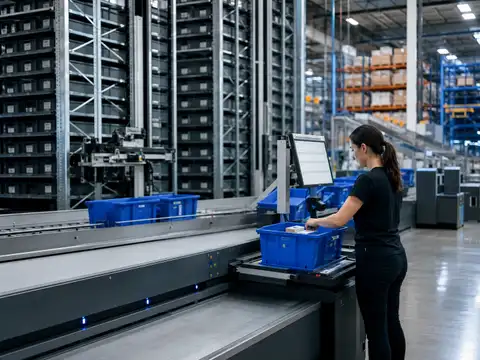
A goods-to-person system can cost about $95,000—or several million dollars—because “GTP” describes the workflow, not the storage machine.
A standalone VLM can present goods directly to one operator. A large GTP installation can use mini-load cranes, shuttles, a robotic cube grid or fleets of mobile robots feeding several workstations. Compare systems at the same required storage capacity and sustainable order-line throughput.
Workstation economics board
Price the supply engine by what the workstation must receive.
One or several vertical machines present trays or totes directly to an operator.
$95k+ / $180k+ public starting anchorsRack, crane or shuttle, lifts and conveyor feed one or more picking stations.
$750k+ public starting anchorRobots retrieve inventory bins from a dense grid and feed ports/workstations.
$1.5M+ public starting anchorMobile robots bring bins or shelving to stations without a fixed storage crane.
Quote-based systemGoods-to-person is an operating method
Swisslog's current definition is useful because it avoids treating GTP as one proprietary machine.
In goods-to-person fulfillment:
- an automated storage or transport system retrieves the required inventory;
- the inventory is delivered to a stationary workstation;
- the operator picks from a source container into an order container or shipping carton;
- the remaining inventory returns to storage or another process.
Swisslog lists several possible engines behind that workflow:
- shuttle systems;
- AutoStore;
- automated small-parts AS/RS;
- CarryPick/mobile-rack systems.
Vertical Lift Modules and similar automated storage machines can implement the same principle at a smaller scale.
Current GTP-related technology starting prices
Compact machine-side GTP
One VLM automatically retrieves trays and presents inventory at an ergonomic pick window. It can operate standalone or integrate with software, batching stations, conveyor and robots.
Compact tote-based GTP
A VBM queues and presents totes and can connect multiple units to remote picking stations through conveyor.
Crane-based tote/carton GTP
Rack, crane, conveyor and workstations create a structural GTP system for larger tote/carton inventories and higher integration requirements.
Grid + robots + ports
Robots retrieve bins from a dense grid and deliver them to dedicated workstations/ports. Robot and port counts can scale separately from bin capacity.
Mobile robot GTP
Robots retrieve totes or mobile shelving and bring them to workstations. Dematic currently markets bin-to-picker and shelf-to-picker architectures as scalable GTP solutions.
Saying “goods-to-person costs $95,000 to $1.5 million” is technically true only as a list of technology starting anchors. It is not a national installed cost range because the systems perform different storage and throughput jobs.
The workstation—not the robot—is the economic interface
A GTP project exists to turn operator time from:
- walking;
- searching;
- traveling between pick faces
into:
- identifying;
- picking;
- confirming;
- placing product into orders.
If the storage system can deliver 600 bins/hour but the operator/process can sustainably complete only 250 order lines/hour, the workstation/process is the relevant throughput constraint.
Do not confuse four different throughput metrics
Number of source bins or totes physically delivered to a station.
Number of times an operator/robot removes inventory from a source container.
Number of order-line requirements completed. One presentation can support several lines in batching strategies.
Quantity of physical items processed. One line can require multiple units.
AutoStore's fastest current workstation illustrates the distinction
AutoStore currently rates RelayPort at up to 650 bins/hour with all six Tab modules installed.
The published minimum bin exchange time is 2.5 seconds.
That is machine handling capacity.
It does not mean one operator will complete 650 order lines/hour with every SKU, package and order profile.
Even within one AutoStore platform, port capacity changes by workstation
AutoStore currently publishes:
- RelayPort: up to 650 bins/hour;
- CarouselPort: up to 400 bins/hour at floor level and 500 bins/hour at mezzanine level.
Swisslog's 2025 AutoStore selection guidance has also described different pick rates across ConveyorPort, CarouselPort and FusionPort architectures.
Workstation selection is therefore a capacity decision—not a decorative accessory to the grid.
Dematic publishes a useful current GTP workstation performance band
Current supplier guidance for a complete GTP process
lines per hour per workstation depending on fulfillment process
supplier expected result excluding human error
supplier expected result excluding human error
supplier says as little as this depending on solution size
These are Dematic supplier expectations for its specific bin-to-picker solution.
They are useful design references.
They are not universal guarantees for every GTP system.
Size workstations from sustainable throughput
The word sustainable matters.
Do not use:
- one operator's record hour;
- a marketing maximum;
- a bin-exchange rate;
- a perfect SKU mix
as the design production rate.
Illustrative workstation example
Suppose the operation needs:
- 1,200 order lines/hour at peak;
- 300 sustainable order lines/hour per station in the modeled SKU/order mix.
The fully busy requirement is:
1,200 ÷ 300 = 4 workstations.
Four stations leave no allowance for:
- operator variation;
- replenishment/exception work;
- station downtime;
- short-term bursts.
If engineering uses an illustrative 80% planned station utilization:
The 80% factor is an example—not an industry standard.
Then prove the storage engine can feed those stations
Five workstations rated for the required human throughput are useless if:
- the grid cannot retrieve bins quickly enough;
- the shuttle lifts bottleneck;
- the mini-load crane cannot sustain the required cycles;
- AMRs queue at the station;
- conveyor cannot clear returned totes.
The GTP system must balance:
storage retrieval capacity → presentation capacity → operator capacity → order takeaway.
Useful picks per presentation can change system cost dramatically
If one source tote presentation supports:
- one order line → presentation demand is high;
- four batched order lines → presentation demand can be much lower.
This affects:
- robot/shuttle count;
- port count;
- conveyor flow;
- station utilization.
Batch picking can move the bottleneck downstream
Batch strategies can improve source-container efficiency by picking one SKU into multiple orders during one presentation.
But the workflow may then require:
- put walls;
- put-to-light;
- order totes;
- sortation;
- additional accumulation;
- more software logic.
Faster source picking can therefore add cost after the GTP workstation.
The storage engine and the picking method are separate choices
VLM, VBM, mini-load crane, shuttle, robotic cube, shelf AMR or bin-to-picker AMR.
Single-order pick, batch pick, put-to-light, pick-to-light, robotic picking, direct-to-carton, order consolidation or replenishment.
Compact VLM goods-to-person: the low-capital end
Kardex currently places a standard VLM baseline around $95,000.
Its December 2025 U.S. cost guide also gives approximately $6,000–$8,000 per vertical foot as a starting planning basis.
Kardex says standard VLM systems can present items at roughly 125–350 items/hour in its broader AS/RS technology guide, with higher rates possible through:
- batching;
- light-directed picking;
- additional machines;
- automation integration.
This can be a strong fit for:
- MRO;
- parts distribution;
- manufacturing components;
- moderate order volume;
- high-value inventory;
- space-constrained small warehouses.
VLM can become a multi-machine workstation system
One operator can work with:
- multiple VLMs;
- batching stations;
- light guidance;
- conveyor takeaway.
The project cost then moves away from the single-machine baseline.
Price:
- machine quantity;
- workstation/batching hardware;
- software;
- integration;
- delivery/installation;
- inventory move.
Vertical Buffer Module: a bridge between one machine and structural GTP
Kardex currently places VBM around $180,000+.
Its architecture is especially useful because:
- the machine can work ahead of the operator;
- totes can queue;
- multiple units can connect through conveyor;
- remote picking stations are possible;
- replenishment can continue alongside picking.
This starts to separate the storage machine physically from the workstation.
Mini-load: structural GTP begins around $750,000+
Kardex's current public starting anchor for crane-based mini-load AS/RS is $750,000+.
That architecture introduces:
- rack aisles;
- cranes;
- load-handling devices;
- conveyor;
- workstations;
- software/control integration.
Kardex also gives a fully integrated mini-load example handling more than 80,000 SKUs at $3 million+.
That example is not a price-per-SKU benchmark.
It proves that integration and scale can move far above the category starting anchor.
Shuttle GTP can add throughput through concurrency
A shuttle architecture can operate:
- multiple vehicles;
- multiple levels;
- multiple lifts;
- multiple workstations
concurrently.
This can raise throughput without forcing every tote through one crane.
The cost moves with:
- shuttle quantity;
- lift quantity;
- aisles;
- rack depth;
- station count;
- conveyor;
- software.
Robotic cube: the ports are part of the production capacity
Kardex currently places robotic cube storage around $1.5 million+ as a category starting anchor.
AutoStore describes its core architecture around:
- Grid;
- Bins;
- Robots;
- Ports;
- Controller/software.
Storage capacity is mainly driven by:
- grid size;
- bin count.
Throughput can be changed through:
- robot count;
- port type;
- port count;
- software/operating logic.
This separation is economically useful because the warehouse can sometimes add throughput without rebuilding all storage capacity.
Do not buy robots without enough ports
Additional retrieval robots can increase the rate at which bins arrive near a station.
They cannot force an already-saturated workstation to pick faster.
Conversely, installing more workstations without enough robot/grid capacity can leave operators waiting for product.
Balance:
robot capacity ↔ port capacity ↔ human/robot pick capacity.
AMR GTP trades fixed storage machinery for mobile concurrency
Dematic's current Bin-to-Picker solution uses:
- D50 masted tote shuttle AMRs for storage/retrieval;
- D30 tote movers for station transport;
- double-deep storage up to seven meters in its stated configuration;
- software/simulation for fleet and material-flow optimization.
This changes the capital structure.
Capacity can be added with:
- more robots;
- more rack;
- more stations
subject to route, charger and traffic capacity.
Shelf-to-picker AMRs solve a different inventory problem
Instead of retrieving one tote, shelf-to-picker robots move an entire rack/shelf of SKUs to the operator.
This can reduce:
- fixed conveyor;
- tote handling;
- structural AS/RS machinery.
But it can create:
- robot traffic;
- larger mobile-load footprints;
- different storage-density limits;
- different workstation geometry.
Compare the handling unit before comparing price.
Current IKEA case: a useful scale example without a published project price
high-demand items in automated storage
compact grid
current project description
supplier says 10× manual 20 items/h baseline
This case is valuable because it shows a relatively compact GTP deployment in a live retail environment.
It does not publish total project cost.
Do not back-solve a price from robot count.
The biggest cost mistake is buying peak technology for average demand
If the warehouse usually needs 250 lines/hour but experiences 1,000 lines/hour for ten December days:
a system sized permanently for 1,000 can leave capital idle most of the year.
Alternatives can include:
- additional seasonal labor;
- temporary manual overflow;
- batching;
- later robot additions;
- future ports added when volume arrives.
Design peak capacity and expansion capacity separately.
But sizing only to average can destroy service
A GTP system feeding e-commerce or store replenishment may have:
- carrier cutoffs;
- same-day commitments;
- short replenishment windows.
If the system cannot process peak demand before cutoff, average daily capacity is irrelevant.
Use the peak-hour order profile
Collect:
- order lines/hour;
- units/line;
- lines/order;
- SKU velocity;
- useful picks/source presentation;
- replenishment demand;
- returns;
- cutoff times.
GTP cannot be sized from annual order volume alone.
The cost stack for a production GTP system
Workstations can be one of the easiest scope lines to underbudget
A workstation is not just a table.
It can include:
- source-bin presentation;
- target/order positions;
- HMI;
- scanner;
- lights;
- printer;
- scale;
- carton handling;
- ergonomic adjustment;
- guarding;
- conveyor or port mechanism.
More stations also add:
- operators;
- floor/mezzanine space;
- order-container flow;
- software endpoints;
- maintenance points.
One faster workstation may be cheaper than two slower ones
If higher-capacity port technology lets one operator station replace two:
the comparison must include:
- port premium;
- operator labor;
- station space;
- order takeaway;
- robot/grid demand;
- availability risk.
Do not assume highest-throughput hardware is automatically lowest TCO.
Two stations can also provide useful redundancy
One ultra-high-speed workstation can create a concentrated failure point.
Multiple stations can:
- share peak demand;
- allow maintenance;
- separate replenishment and picking;
- serve different order types.
Capacity architecture is also a resilience decision.
Software can determine whether the hardware reaches its design rate
GTP software may control:
- which source bin is retrieved;
- bin sequencing;
- batch formation;
- station balancing;
- replenishment priority;
- order urgency;
- robot/shuttle allocation;
- exception recovery.
A theoretically fast storage system can underperform if:
- orders are sequenced poorly;
- stations wait for source inventory;
- hot SKUs create repeated dig/retrieval work;
- replenishment competes with picking at the wrong time.
Measure the bottleneck chain
Can inventory be retrieved fast enough?
Crane, shuttle, robot or lift capacity before products reach the workstation.
Can the operator complete the pick?
SKU recognition, quantity, item handling, scan/confirmation and target placement.
Can completed orders leave the station?
Conveyor, put wall, sortation, packing and completed-order buffering.
Can hot inventory enter fast enough?
Decant, inbound tote creation and replenishment must sustain source stock.
Labor savings come mainly from eliminating travel and search
Swisslog emphasizes that GTP minimizes walking because items come to a stationary workstation.
Measure the manual baseline:
- walking minutes/order;
- search time;
- cart travel;
- replenishment labor;
- pick-confirmation time;
- training time;
- errors/rework.
Then identify which paid hours actually disappear or become useful capacity.
Higher productivity is not automatically payroll reduction
If four manual pickers become two GTP pickers but the business keeps all four employees to handle growth:
the value is:
- headcount avoidance;
- additional throughput;
- less overtime;
- less temporary labor
rather than necessarily two salaries removed immediately.
Current Dematic claims show why labor should be modeled carefully
Dematic's piece-picking material currently cites large labor and footprint improvements versus person-to-goods configurations in some solution categories.
Treat vendor percentage claims as screening evidence.
Build your own case from:
- actual staffing;
- actual wages;
- actual shift schedule;
- actual peak labor;
- actual forecast growth.
Space savings matter when they avoid a real cost
GTP storage engines such as:
- VLM;
- mini-load;
- shuttle;
- robotic cube
can use storage volume more densely than broad manual shelving aisles.
But the financial value exists only when density:
- avoids another lease;
- avoids expansion;
- removes overflow storage;
- frees productive warehouse capacity.
Empty floor does not automatically equal annual cash savings.
The current Douglas Pharmaceuticals case demonstrates the space/throughput mechanism
Kardex's current AutoStore case reports:
- pick performance rising from 50 to 200 order lines/hour;
- 30% more storage capacity;
- the automated solution occupying roughly 10% of the previous warehouse-space context described in the case.
This is one project, not a universal performance multiplier.
It is useful evidence that labor throughput and density can contribute to the same GTP business case.
Accuracy value should be priced from actual error cost
GTP stations can add:
- scanning;
- light guidance;
- controlled source presentation;
- software confirmation.
Convert accuracy improvement into:
- re-pick labor;
- reshipment;
- returns;
- customer credits;
- expedited freight;
- inventory adjustment.
Do not insert a generic “2% accuracy saving” into ROI.
Ergonomics can be a real operating benefit
Swisslog emphasizes ergonomic GTP stations because operators:
- do not walk long distances;
- can work at controlled pick heights;
- avoid some bending/reaching.
If the facility has documented:
- workers' compensation claims;
- lost-time incidents;
- turnover linked to physically demanding picking
those costs can be evaluated.
If not, keep ergonomics as a qualitative benefit rather than inventing dollars.
Inventory migration is an easy project cost to forget
A new GTP system can require:
- decanting products into new totes;
- labeling;
- master-data cleanup;
- dimension/weight capture;
- cycle counting;
- moving old inventory;
- temporary dual operations.
This can require significant labor even when the automation installation itself is complete.
Containers are part of capital
Tote/bin-based GTP may require thousands or tens of thousands of standardized containers.
Budget:
- initial bins/totes;
- dividers;
- labels/RFID;
- spares;
- cleaning;
- damaged-container replacement.
A project quoted without the required container population is not fully scoped.
Fire protection can change structural GTP cost
Dense:
- rack;
- tote;
- grid
storage can require fire-protection engineering that differs from manual shelving.
Confirm:
- commodity classification;
- container material;
- storage height;
- sprinkler strategy;
- local code/authority requirements
before design freeze.
Lifecycle cost depends heavily on the chosen GTP engine
A VLM has:
- one main retrieval mechanism;
- machine controls;
- trays;
- doors/access opening.
A cube system can have:
- many robots;
- ports;
- grid infrastructure;
- chargers;
- controller/software.
A shuttle system can have:
- shuttles;
- lifts;
- conveyor;
- rack;
- WCS/WES.
Do not apply one annual maintenance percentage to every GTP architecture.
Price the failure boundary
Ask:
- If one machine stops, how many SKUs become inaccessible?
- If one port stops, can orders move to another station?
- If one robot fails, can the fleet continue?
- If one lift fails, which levels stop?
- Can the warehouse pick manually during outage?
Redundancy is part of TCO.
High throughput can require more redundancy, not just faster hardware
A warehouse requiring 99% of design capacity every hour has little operational margin.
Better designs can use:
- multiple ports;
- multiple retrieval machines;
- cross-serving inventory;
- manual fallback;
- buffering.
The cheapest CAPEX configuration can be expensive if one failure stops all fulfillment.
Compare GTP proposals with four normalized metrics
These metrics do not replace ROI.
They force different architectures into comparable operational units.
Do not compare VLM and AutoStore by price alone
A $95,000 VLM may be excellent if the warehouse needs:
- one operator;
- moderate throughput;
- compact parts storage.
It can be completely unsuitable for:
- 3,000 lines/hour;
- tens of thousands of active totes;
- many simultaneous stations.
A $1.5M+ robotic cube project can be overbuilt for the first scenario and rational for the second.
Do not compare headline pick rates without the order profile
A station handling:
- small identical parts;
- one-unit picks;
- well-presented target positions
can work faster than a station handling:
- large apparel;
- fragile items;
- quantity counts;
- serial-number capture;
- complex packing.
Benchmark the real item-handling process.
RFQ data that determines GTP cost
Provide:
- SKU count;
- inventory quantity by SKU;
- item/tote dimensions and weights;
- orders/day;
- lines/order;
- units/line;
- peak lines/hour;
- SKU velocity;
- seasonality;
- replenishment volume;
- returns volume;
- facility clear height;
- available footprint;
- future growth;
- required operating hours;
- shipping cutoffs;
- WMS/ERP environment.
Force every vendor to quote the same boundary
Require explicit pricing for:
- storage structure;
- retrieval robots/cranes/shuttles;
- bins/totes;
- workstations/ports;
- conveyor/lifts/AMRs;
- pick-to-light/put-to-light;
- software licenses;
- WMS/ERP integration;
- servers/cloud;
- facility/electrical/network work;
- fire protection scope;
- installation;
- commissioning;
- inventory migration;
- training;
- initial spares;
- annual service/software support.
Require a sustained performance guarantee
The proposal should define:
- order profile used in the test;
- station count;
- operator assumptions;
- source presentations/hour;
- order lines/hour;
- replenishment running concurrently or not;
- availability;
- exception rate;
- peak duration.
“Up to 650 bins/hour” is not the same contractual statement as “the system sustains 1,500 order lines/hour for two hours using five staffed stations under the agreed SKU mix.”
The practical recommendation
Start with the workstation demand.
Define:
- peak order lines/hour;
- sustainable lines/hour per station;
- required station count;
- source presentations required to feed those stations;
- storage capacity;
- growth horizon.
Then choose the lowest-risk GTP architecture capable of delivering both:
- the required storage;
- the required sustained station supply rate.
The cost rule
Goods-to-person is not priced by robot count, rack size or workstation count alone. The real asset is a balanced fulfillment loop: storage + retrieval + presentation + picking + order takeaway + replenishment. Buy that complete capacity, not the most impressive machine in the loop.
Frequently asked questions
How much does a goods-to-person system cost?
It varies by architecture. Current Kardex public starting anchors include about $95,000+ for a VLM, $180,000+ for a VBM, $750,000+ for mini-load AS/RS and $1.5 million+ for robotic cube storage. Complete installed GTP projects can cost materially more.
Why is the goods-to-person cost range so wide?
Goods-to-person describes the picking method rather than one machine. A single vertical storage machine and a multi-million-dollar robotic grid can both deliver inventory to stationary operators.
How much does a VLM goods-to-person system cost?
Kardex currently gives a standard VLM baseline around $95,000 and roughly $6,000–$8,000 per vertical foot as a starting planning basis. Integration and options can increase cost.
How much does mini-load goods-to-person cost?
Kardex currently publishes $750,000+ as a mini-load AS/RS starting anchor. A fully integrated large system can reach several million dollars.
How much does robotic cube goods-to-person cost?
Kardex currently uses $1.5 million+ as a robotic-cube-storage starting anchor. Grid, bins, robots, ports, software and integration determine the configured project.
How fast is goods-to-person picking?
It depends on technology and order profile. Dematic currently publishes 250–500 lines/hour per workstation for its Bin-to-Picker AMR solution. AutoStore's RelayPort can mechanically handle up to 650 bins/hour, which is a different metric from human order-line throughput.
How many GTP workstations do I need?
Start with peak required order lines/hour divided by the sustainable lines/hour per workstation under the real order mix, then add appropriate capacity for variability, availability and peak-duration requirements.
Does more robots mean more GTP throughput?
Only until another constraint becomes limiting. More robots cannot increase throughput indefinitely if ports, operators, lifts, conveyor or order takeaway are already saturated.
Is goods-to-person always faster than manual picking?
It usually removes significant walking/search time, but final throughput depends on item handling, order profile, workstation design, replenishment and downstream capacity.
Does GTP eliminate warehouse labor?
No. It reduces travel and can reduce picker requirements, but work remains in picking, replenishment, decanting, packing, maintenance, exceptions and system support.
Is AutoStore a goods-to-person system?
Yes. Robots retrieve inventory bins from the grid and deliver them to ports/workstations where operators or picking robots remove the required items.
Can AMRs be used for goods-to-person?
Yes. Current Dematic solutions include bin-to-picker and shelf-to-picker AMR architectures that transport inventory to stationary fulfillment workstations.
What is the biggest GTP cost driver?
There is no single one. Storage capacity, required throughput, retrieval-machine count, workstation count, software/integration, facility work and lifecycle requirements can each dominate in different projects.
What should I compare between GTP quotes?
Compare usable storage capacity, guaranteed sustained order-line throughput, staffed workstations, source presentations, availability, complete installed CAPEX, annual lifecycle cost, expansion increments and the exact integration boundary.
Goods-to-person is not the only architecture for increasing pick density and throughput. Multi-level operations should also compare the warehouse pick module cost guide.
Sources and methodology
Warehouse Fieldbook treats goods-to-person as a fulfillment operating principle rather than one equipment category. Swisslog's current U.S. goods-to-person page provides the workflow definition and identifies shuttle, AutoStore, automated small-parts storage and CarryPick as GTP supply engines. Kardex's current U.S. AS/RS cost guide supplies the $95,000+ VLM, $180,000+ VBM, $750,000+ mini-load and $1.5 million+ robotic-cube starting anchors. Its December 2025 VLM guide supplies the $6,000–$8,000 per vertical-foot planning reference. AutoStore's current RelayPort and CarouselPort pages supply current bin-handling capacity examples. Dematic's current U.S. Bin-to-Picker AMR page supplies the 250–500 lines/hour per workstation, 98%+ availability, 99%+ accuracy and 1.5-year supplier ROI statements. Swisslog's May 2026 IKEA case supplies the 12-robot, 10,000-bin, 3,000-product and 200-items/hour project example. Kardex's current Douglas Pharmaceuticals case supplies the 50-to-200 lines/hour and storage-space case evidence. Supplier performance and ROI claims are identified as such and are not treated as universal project guarantees.
- Swisslog — current U.S. goods-to-person workflow and technology architectures
- Kardex — current U.S. AS/RS starting costs and cost drivers
- Kardex — December 2025 VLM price and implementation considerations
- Kardex — current GTP/ASRS technology throughput and architecture examples
- AutoStore — current RelayPort 650-bin/hour workstation specification
- AutoStore — current CarouselPort throughput specifications
- AutoStore — current goods-to-person workflow overview
- Dematic — current U.S. Bin-to-Picker AMR performance and scalability guidance
- Dematic — current U.S. Shelf-to-Picker AMR goods-to-person architecture
- Swisslog — May 2026 IKEA retail GTP project and throughput example
- Kardex — current Douglas Pharmaceuticals GTP throughput and storage case