
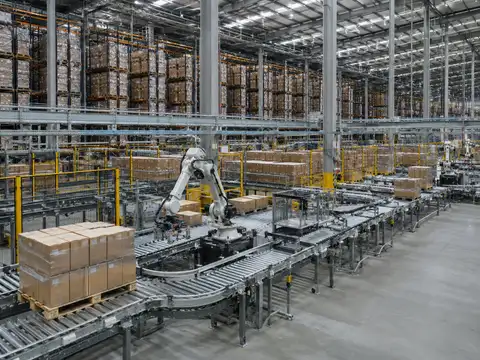
Warehouse automation can mean one robot, one process—or the operating architecture of the entire building.
Price the constraint you are automating and the complete system required to remove it. Do not apply a “fully automated warehouse” price range to a targeted transport or picking project.
Automation capital blueprint
The equipment is only one layer of the automation budget.
Service, spares, software updates, monitoring, training and future expansion.
FAT/SAT, throughput tests, exception handling, ramp-up and go-live support.
Power, network, slab, steel, fire protection, guarding, access and work areas.
WMS/WES/WCS interfaces, PLC logic, scanners, controls and process redesign.
Fleet control, orchestration, host interfaces, licenses, analytics and support.
AMRs, conveyors, sorters, AS/RS, shuttles, robots, workstations and storage.
There is no useful single warehouse automation cost range
“Warehouse automation” can describe:
- one AMR moving totes between two departments;
- a powered conveyor route;
- a robotic palletizer;
- a goods-to-person picking cell;
- an automated sortation system;
- a cube-storage system;
- a pallet AS/RS;
- a fully orchestrated distribution center.
These are different capital projects.
Current public supplier data already spans from a single industrial AMR beginning at €45,000 to fixed sortation systems measured in millions of dollars.
That spread is too wide to collapse into one credible “average warehouse automation cost.”
Current 2026 cost anchors
One autonomous mobile robot
KNAPP currently says one Open Shuttle begins at €45,000. Software, infrastructure, engineering, integration, startup and ongoing service remain separate parts of total cost.
Fixed straight-line sorter
Tompkins Robotics currently places linear sorters in an investment range of approximately $750,000–$4 million with typical implementation around 8–12 months.
Crossbelt, tilt-tray and related fixed systems
Tompkins currently places loop-sorter investment around $2–$10 million depending on capacity, with a 12–18 month implementation range in its broader sorter guide.
Storage + movement + picking + sortation + software
Public turnkey pricing is generally quote-based because the number of storage positions, robots, workstations, routes, building changes and software interfaces are project-specific.
Exchange rates change. This guide leaves KNAPP's current Open Shuttle starting price in euros rather than presenting a stale USD conversion as if it were a U.S. list price.
The automation budget has six layers
Robots, conveyor, rack/grid, lifts, shuttles, sorters, stations and end effectors.
Fleet software, WCS/WES, licenses, analytics and local control platforms.
WMS/ERP interfaces, PLC logic, scanner data, routing, exceptions and process design.
Power, Wi-Fi/network, slab, fire protection, steel, guarding and maintenance access.
FAT, SAT, loaded tests, rate validation, training, ramp-up and cutover.
Service, spares, software updates, monitoring, maintenance and future expansion.
KNAPP's 2026 AMR cost model uses the same layered logic
KNAPP breaks AMR cost into three broad areas:
- purchase and infrastructure;
- integration and startup;
- operation and maintenance.
Its purchase/infrastructure category includes:
- the robot;
- fleet-control software;
- charging / loading infrastructure;
- connections to existing systems;
- project engineering and planning.
Integration/startup includes:
- installation;
- process integration;
- employee training;
- startup.
Lifecycle cost includes:
- service;
- maintenance;
- software updates;
- adaptations;
- wear parts;
- energy;
- fleet expansion.
That framework is useful far beyond AMRs.
Hardware-only budgets understate automation cost
Imagine a warehouse purchases ten robots using KNAPP's €45,000 starting hardware anchor.
Ten × €45,000 = €450,000 before considering the actual configured project.
The fleet may still need:
- charging strategy;
- fleet software;
- Wi-Fi/network verification;
- WMS interface;
- traffic rules;
- pickup/drop stations;
- training;
- commissioning;
- spares / support.
This is why robot count × robot list price is not a turnkey estimate.
Software is part of the machine
Dematic currently describes its warehouse software as the layer connecting:
- operations;
- maintenance;
- analytics;
- manual processes;
- automated processes.
In an automated facility, software can:
- release work;
- prioritize orders;
- route inventory;
- coordinate humans and machines;
- log faults;
- provide maintenance data.
Buying automation hardware without defining software responsibility creates a budget and accountability gap.
Integration complexity changes cost faster than equipment count
Ten identical AMRs running a simple point-to-point route can be easier to integrate than three robots that must coordinate with:
- AS/RS;
- conveyor;
- robotic picking;
- automatic doors;
- elevators;
- WMS;
- production machines.
Dematic's current robotics guidance explicitly identifies system interoperability and integration with WMS/WES and existing operations as key ROI and implementation factors.
Automation cost should be scoped around the bottleneck
What problem is expensive enough to automate?
Employees or forklifts spend meaningful hours moving material rather than processing it.
The existing building is full and expansion or external storage has measurable cost.
A known process constrains orders, production or carrier cutoff.
Required staffing cannot be reliably recruited or retained at the needed volume.
Errors create measurable rework, returns, penalties or inventory problems.
The process creates a material risk or repetitive handling burden that should be engineered out.
Do not automate the entire warehouse because one process is weak
If the constraint is long-distance tote transport, an AMR deployment may solve the problem without changing storage.
If the constraint is storage density, AS/RS or cube storage may matter more than AMRs.
If the constraint is shipping sortation, a sorter may provide more value than robotic picking.
If the constraint is palletizing, a robotic cell may be enough.
The lowest-risk capital strategy is usually:
identify constraint → automate constraint → validate result → expand where economics remain strong.
Phased automation can reduce capital risk
Dematic currently describes phased approaches as a way to minimize operational disruption when robotics are introduced.
Its brownfield guidance also positions upgrades to existing facilities as a faster and potentially more cost-effective alternative to a full greenfield project.
Phasing can allow a warehouse to:
- prove product handling;
- verify integration;
- measure labor capture;
- train maintenance;
- observe peak behavior;
- delay later CAPEX until demand appears.
Phasing is not automatically cheaper
Multiple phases can duplicate:
- mobilization;
- engineering;
- temporary interfaces;
- commissioning;
- shutdowns.
The value is reduced risk and better timing—not guaranteed lower total dollars.
Modular systems can defer capacity CAPEX
Dematic's November 2025 AutoStore hospital project illustrates modular scaling.
The planned system has capacity for more than 12,000 bins, but the first phase starts with:
- 6,000 bins;
- 3 workstations;
- 11 robots.
The design can later add bins, robots and workstations.
The case does not publish project price.
Its value here is architectural: automation can be designed so capital is added as demand grows.
Fixed automation commits more capital to one building
Tompkins' current sorter comparison makes this trade-off especially clear.
Linear sorters require fixed infrastructure and currently fall around $750,000–$4 million in its planning framework.
Loop sorters require heavier fixed infrastructure and currently fall around $2–$10 million depending on capacity.
These systems can be excellent when:
- volume is high;
- volume is stable;
- the building commitment is long;
- the process is unlikely to move.
Their risk rises when future volume or facility strategy is uncertain.
Mobile automation shifts the capital profile
Tompkins currently describes AMR-based sortation as starting 40–50% below fixed sorter investment in its own comparison framework.
Treat that as a vendor claim about its technology category—not a universal AMR discount.
The underlying mechanism is credible:
- fewer fixed paths;
- less structural work;
- capacity added by robot count;
- software-defined destinations;
- greater relocatability.
Kmart provides a real robotic-sortation scaling example
AMR-based sortation fleet
store/replenishment sort locations
published sorts-per-hour capacity
installation to go-live in the vendor case
Tompkins reports approximately 50% lower capital investment in that case versus traditional tilt-tray or crossbelt alternatives and more than 60% footprint reduction.
Those are case-study results from the supplier.
They should not be entered into another warehouse's ROI model as guaranteed savings.
Automation is usually a flow system, not a collection of machines
Tompkins' January 2026 AS/RS guidance illustrates the systems problem.
It says AS/RS can present 500+ items/hour while manual sortation may handle only 200–300 items per worker/hour.
If downstream sortation is not designed with the AS/RS, the automated storage system can operate below its potential because product has nowhere to go.
This is one of the most important automation-budget lessons:
buying a faster subsystem can simply move the bottleneck.
Budget interfaces before equipment
For each automation module, define:
- what arrives;
- at what rate;
- in what container;
- how identity is known;
- what happens if downstream is blocked;
- where exceptions go;
- which system owns the routing decision.
Every unclear interface can become:
- extra conveyor;
- extra buffering;
- extra software;
- extra labor;
- a commissioning delay.
Building readiness is a real automation cost bucket
Depending on technology, the facility may need:
- new electrical capacity;
- charging infrastructure;
- industrial Wi-Fi;
- network switches;
- floor repairs / flatness verification;
- structural steel;
- sprinkler modifications;
- fire-protection review;
- machine guarding;
- maintenance platforms;
- fencing or controlled access.
Do not assume “robot requires no fixed track” means “building work = $0.”
AS/RS can make the building itself part of the machine
Dematic's current storage-density guidance positions AS/RS, cube storage and miniload systems around vertical space and dense storage.
High-density automation can affect:
- clear height;
- structural loads;
- fire protection;
- maintenance access;
- infeed/outfeed design.
The AS/RS cost guide treats AS/RS as its own project category rather than burying those costs in a generic automation range.
Robotic picking has its own throughput economics
Dematic currently states its robotic piece-picking modules typically handle around 400–600 items/hour, depending on configuration.
That number alone does not determine ROI.
The cell needs:
- product presentation;
- vision;
- end-of-arm tooling;
- exception handling;
- source/destination containers;
- upstream replenishment;
- downstream removal.
A robot that can pick 600 items/hour is useful only if the rest of the flow can continuously present and remove those items.
Automation CAPEX should be normalized by delivered capacity
This can be expressed as:
- installed $ per sustained unit/hour;
- installed $ per pallet position;
- installed $ per useful pick station;
- installed $ per usable sort destination.
Use metrics appropriate to the project.
Do not compare an AS/RS by robot count with a sorter by conveyor length.
Guaranteed throughput is more valuable than theoretical speed
Procurement should distinguish:
- maximum machine speed;
- design rate;
- guaranteed sustained system rate;
- availability assumption;
- product mix used in acceptance testing.
The cost per unit of usable capacity should use the rate the integrator will actually stand behind.
Availability belongs in the capital decision
A system capable of 10,000 units/hour but available 85% of the required time may produce less annual capacity than a slower architecture with stronger uptime.
Model:
- planned maintenance;
- unplanned downtime;
- mean time to repair;
- critical spares;
- support response;
- redundancy / bypass.
Maintenance must be designed at the same time as automation
Dematic's robotics guidance treats preventive maintenance, spare parts, software updates and lifecycle support as part of total automation economics.
A high-throughput automated system can require:
- trained controls technicians;
- robot/AMR spares;
- remote support;
- software backups;
- preventive maintenance windows;
- vendor SLAs.
If the warehouse does not currently have that capability, include training or service cost in the automation plan.
Commissioning is a project phase, not a button press
A serious automated system should be tested for:
- normal product;
- minimum / maximum product;
- peak rate;
- blocked downstream;
- sensor faults;
- robot unavailable;
- communications loss;
- power interruption;
- restart;
- manual recovery;
- exception handling.
Budget engineering time for proving these behaviors.
Ramp-up capacity is different from final capacity
An automated project can be mechanically complete while:
- operators are learning workstations;
- software is being tuned;
- maintenance is learning diagnostics;
- exception rules are being refined.
Kmart's Tompkins case reports go-live in under five months with full ramp-up achieved within weeks.
That ramp period should exist in the operating and financial plan.
Brownfield automation adds cutover cost
Existing warehouses can require:
- temporary workflows;
- night/weekend work;
- phased installation;
- legacy WMS integration;
- old conveyor interfaces;
- production-area protection;
- short shutdown windows.
A greenfield project may have more freedom.
A brownfield project may avoid an entire new building.
The correct comparison is total business cost, not installation convenience.
Greenfield automation can be cheaper to install and more expensive to justify
An empty building simplifies:
- layout;
- power;
- structural work;
- installation sequence.
But the company may also be paying for:
- new building;
- land;
- utilities;
- relocation;
- dual operations during transition.
Dematic's current brownfield guidance explicitly frames reinvestment in existing infrastructure as an alternative to a new greenfield build.
Automation financing can change timing, not project economics
KNAPP currently lists:
- purchase;
- lease/rent;
- pay per use
as common AMR financing models.
Leasing or pay-per-use can reduce the initial capital requirement.
It does not remove:
- integration;
- process risk;
- operating cost;
- performance requirements.
The RaaS-versus-buying guide compares Robotics-as-a-Service with buying robots in detail.
Start with the smallest automation unit that solves the constraint
Measure the constraint
Labor hours, travel, queue time, throughput, errors, space and peak variability.
Automate one bounded flow
AMR route, conveyor segment, robotic cell, small goods-to-person zone or another targeted process.
Validate actual performance
Compare labor, throughput, downtime, accuracy and maintenance with the approved baseline.
Scale only where the economics repeat
Add robots, stations, storage capacity or adjacent automated processes when demand and integration support it.
But design the future architecture before buying phase one
A pilot can become expensive if it cannot scale.
Before phase one, define:
- future robot fleet;
- network capacity;
- WMS/WES architecture;
- future storage system;
- downstream sortation;
- building expansion limits.
Buy small.
Architect large.
Use total installed cost in the business case
Then keep lifecycle cost separate
This gives the ROI model a clean distinction between:
- one-time capital;
- new annual operating cost;
- annual operating benefits.
Do not forget decommissioning or salvage in replacement projects
Automation can replace:
- old conveyor;
- rack;
- forklift routes;
- manual workstations.
Include:
- demolition;
- disposal;
- resale / salvage;
- temporary operation during changeover.
Automation should be judged against the manual alternative over the same horizon
Compare:
- automation CAPEX;
- automation OPEX;
- manual labor growth;
- manual equipment;
- space requirement;
- error/rework cost;
- expected throughput;
- risk / flexibility.
If the manual process requires a second shift, more external storage and 20 additional hires over the next three years, that future manual cost belongs in the comparison.
Do not automate unstable process rules
Automation becomes expensive when the operating process is not defined.
Before design freeze, stabilize:
- SKU data;
- container standards;
- order profiles;
- exception rules;
- replenishment logic;
- inventory accuracy.
Software can automate a bad process very consistently.
Use representative data, not an average day
Automation sizing should include:
- normal day;
- peak hour;
- peak day;
- seasonality;
- SKU growth;
- future volume;
- returns;
- product exceptions.
A system sized only from annual average volume can fail exactly when the business most needs it.
Do not buy five-year peak capacity unless the architecture requires it
Fixed automation can require capacity decisions early.
Modular automation can sometimes add:
- robots;
- ports;
- bins;
- stations
later.
Value that scalability when demand uncertainty is high.
RFQ checklist for warehouse automation
Require vendors to state:
- design and guaranteed sustained throughput;
- product/SKU envelope;
- storage or destination capacity;
- availability assumptions;
- equipment quantity;
- software included;
- host interfaces;
- building modifications;
- electrical/network scope;
- installation;
- commissioning and SAT;
- training;
- spares;
- warranty;
- annual service/software cost;
- future expansion unit costs.
Normalize automation quotes by scope before price
Vendor A can look cheaper because it excludes:
- WMS interface;
- electrical work;
- guarding;
- network;
- acceptance testing.
Vendor B can look expensive because those items are included.
Build a line-by-line scope matrix before comparing totals.
The practical recommendation
Do not begin a warehouse automation project by asking: “How much does a fully automated warehouse cost?”
Begin with:
which operational constraint are we paying to remove, what technology removes it, and what complete installed system is required for that technology to deliver?
Use public prices such as KNAPP's €45,000 Open Shuttle and Tompkins' $750,000–$4 million linear-sorter / $2–$10 million loop-sorter ranges as scale anchors—not as shortcuts around project engineering.
The strongest automation budgets make equipment only one line in the capital plan.
The cost rule
Price the complete flow, not the robot. Automation cost is the equipment plus everything required to make it receive work, execute work, recover from exceptions and stay available after go-live.
Frequently asked questions
How much does warehouse automation cost?
There is no useful single range. Current public anchors span from an industrial AMR starting at €45,000 to fixed sortation systems in the $750,000–$10 million range depending on architecture and capacity. Full automation programs are generally quote-based.
How much does a warehouse AMR cost?
KNAPP currently states that one Open Shuttle autonomous mobile robot begins at €45,000. Software, infrastructure, integration, training and lifecycle cost remain additional considerations.
How much does automated warehouse sortation cost?
Tompkins Robotics currently places fixed linear sorters around $750,000–$4 million and fixed loop sorters around $2–$10 million, depending on capacity and architecture.
What costs are usually excluded from warehouse automation equipment prices?
Common additional scope can include engineering, software, WMS/WES/WCS integration, electrical/network work, structural changes, installation, commissioning, training, spares and annual service.
Is warehouse automation cheaper in an existing building?
Not automatically. Brownfield projects can avoid a new facility but may require phased cutovers, legacy-system integration and off-hours work. Dematic currently positions brownfield automation as a faster and potentially more cost-effective alternative in suitable cases.
Is an AMR cheaper than fixed conveyor automation?
It depends on the process. AMRs generally require less fixed path infrastructure, while conveyor can deliver very efficient high-throughput transport on stable routes. Compare total installed cost and required throughput, not robot count vs conveyor length.
Can warehouse automation be installed in phases?
Yes. Phased automation can reduce implementation risk and defer capacity spending, though multiple phases can duplicate engineering, mobilization and commissioning cost.
What is the biggest hidden warehouse automation cost?
Integration is often underestimated because equipment must exchange work, identity, status and exceptions with WMS/WES/WCS, controls and adjacent processes. Building readiness and commissioning can also be material.
Does warehouse automation require new software?
Often yes. Depending on architecture, projects may require fleet management, PLC controls, WCS/WES, host interfaces, analytics or software licenses.
How should warehouse automation ROI be calculated?
Use total installed CAPEX, annual operating benefits that can actually be captured, and new annual maintenance/service/software costs. Do not calculate payback from hardware price alone.
Should a warehouse automate everything at once?
Usually not by default. Start with the constraint producing the clearest measurable operational value, but design phase one so the architecture can support future expansion.
What should be guaranteed in an automation contract?
Define sustained throughput, product mix, availability assumptions, functional behavior, exception handling, safety, software interfaces, acceptance testing and scope responsibility.
End-of-line automation can become a material subproject within a broader warehouse program. Use the automated palletizing system cost guide to separate robot, gripper, conveyor, guarding, integration and pallet-handling scope.
Sources and methodology
Warehouse Fieldbook does not publish one warehouse-automation price range because current supplier evidence spans fundamentally different project classes. KNAPP's February 2026 AMR cost guide supplies a current €45,000 starting price for one Open Shuttle and separates purchase/infrastructure, integration/startup and operating/maintenance costs. Tompkins Robotics supplies current fixed linear- and loop-sorter investment and implementation ranges; its Kmart case is used only as a supplier-reported example of AMR sortation scale and deployment. Dematic's current U.S. material describes phased robotics, brownfield automation, software integration, storage-density systems and lifecycle requirements. Public supplier performance claims and customer-case outcomes are identified as such and are not treated as guaranteed U.S. market averages.
- KNAPP — February 2026 AMR cost, integration, lifecycle and financing guidance
- Tompkins Robotics — current linear, loop and AMR sortation investment / implementation guidance
- Tompkins Robotics — January 2026 AS/RS and downstream sortation bottleneck guidance
- Tompkins Robotics — Kmart tSort deployment case
- Tompkins Robotics — July 2026 fixed loop vs AMR sortation comparison
- Dematic — current robotic picking, phased automation, integration and lifecycle guidance
- Dematic — current U.S. brownfield automation guidance
- Dematic — current warehouse automation software and orchestration architecture
- Dematic — current AS/RS, AutoStore and storage-density automation guidance
- Dematic — modular AutoStore deployment example with phased bins, robots and workstations
- OSHA — current warehousing equipment, conveyor and workplace hazard guidance
- OSHA — 29 CFR 1910.212 machine guarding
- OSHA — hazardous-energy / lockout-tagout requirements