
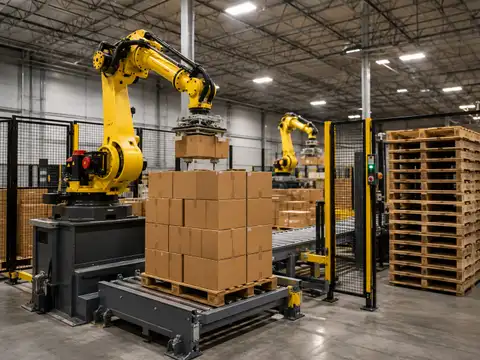
A standardized cobot palletizer now starts around $85,000–$100,000 before complex end-of-line additions.
Robotiq currently publishes an Americas starting price of $85,000 for Lean Palletizing. Vention published a roughly $97,500 starting point for its Rapid Series. Industrial high-throughput palletizers are more commonly configured and quoted, especially where payload, multi-pick, conveyors, fencing or multi-line logic increase scope.
End-of-line cost boundary
The palletizing robot is only one asset inside the production cell.
Conveyor, case spacing, product stop, accumulation and line handoff.
Orientation, barcode/recipe logic, sensors and product-present validation.
Cobot or industrial arm, pedestal/elevator, vacuum/mechanical EOAT and controls.
One or more pallets, pallet dispenser, slip sheets, pallet staging and alignment.
Forklift exchange, pallet conveyor, wrapper, labeler or finished-pallet transfer.
The price of the robot is not the price of palletizing
A production palletizing system can require:
- robot or cobot arm;
- pedestal or vertical lift/elevator;
- end-of-arm tooling;
- infeed conveyor;
- case stops and sensors;
- one or more pallet stations;
- safety scanners or guarding;
- PLC/HMI and recipes;
- pallet dispenser or slip-sheet handling;
- finished-pallet takeaway;
- installation and commissioning;
- training and support.
The complete boundary is what should appear in the capital request.
Current public price anchors
Robotiq currently states that palletizing starts at $85,000 in the Americas. Exact price varies by region, throughput, layout and application.
Vention published this starting price in May 2025 for a ready-to-deploy palletizer. Current final configuration remains application-specific.
Current FANUC and Vention industrial palletizing platforms are configured around payload, cycle rate, tooling, line layout and safeguarding rather than one universal complete-cell list price.
Do not convert an $85,000 standardized cobot starting price into a claimed average for all robotic palletizers. A high-speed industrial multi-line cell can have a completely different robot, gripper, fencing, conveyor and pallet handling scope.
There are four practical palletizer classes
Compact, standardized cell
Pre-engineered system for moderate rates, frequent SKU changes and factories that want fast deployment with limited custom engineering.
More tooling and layout flexibility
Collaborative robot combined with custom conveyor, gripper, pallet stations, lifting axis, scanning or line interfaces.
Higher rate and heavier payload
Traditional industrial robot, fencing/guarding and more substantial infeed/pallet handling for high-duty applications.
Multiple lines / very high throughput
Engineered cell receiving product from several lines, often with accumulation, lane management, multi-pick tooling and pallet conveyor.
Throughput is the first technology gate
Different cells target very different end-of-line rates.
vision-enabled mobile palletizer; up to 50-lb products in the current configuration
single-pick cobot system; up to 30 kg / 66 lb
current maximum supplier capability for relevant standardized configurations
FANUC general current guidance depending on robot and application
These numbers are not directly interchangeable.
“Pick,” “cycle” and “case” can differ depending on:
- single-pick vs multi-pick gripper;
- case dimensions;
- robot travel distance;
- pallet pattern;
- layer transitions;
- slip sheets;
- pallet exchange.
Multi-pick can multiply cases/minute without multiplying robot cycles
If a gripper handles:
- one case per robot cycle → 10 cycles/min = 10 cases/min;
- two cases per cycle → 10 cycles/min can theoretically move 20 cases/min.
That arithmetic works only if:
- cases can be grouped safely;
- infeed presents them correctly;
- pallet pattern accepts the grouped placement;
- gripper payload remains within limits.
Multi-pick therefore adds both throughput and tooling/infeed complexity.
Payload is the second technology gate
Current standardized cobot palletizers cover increasingly heavy cases.
Robotiq's current Lean Palletizing workcells list payload up to 35 kg / 77 lb.
Vention's current Rapid Series lists up to 30 kg / 66 lb.
FANUC's current CAPS-30F also handles up to 30 kg.
Above this, or where multi-pick tooling becomes heavy, industrial robot architectures become increasingly relevant.
Industrial palletizing moves into another payload class
Vention's current Industrial Palletizer publishes:
- up to 300 lb maximum payload;
- up to 12 picks/minute;
- up to 140-inch pallet height.
FANUC's current general palletizing material says industrial palletizing robots can handle payloads up to 800 kg depending on model/application.
That extra payload enables:
- heavy bags;
- pails;
- drums;
- large cases;
- multi-case grippers;
- full-layer tooling.
Do not size from case weight alone
Robot payload includes:
- product;
- gripper;
- brackets;
- sensors;
- vacuum manifold;
- multi-pick load.
Use the robot manufacturer's allowable payload across the required reach and motion—not only the nominal headline payload.
The gripper can determine whether the project works
Cases and flat sealed surfaces
Common and compact. Vacuum generation, porous cardboard, damaged cartons, dust and box sealing quality affect performance.
Bags, pails and difficult surfaces
Clamping, fork, finger or custom tooling can handle loads that do not provide a reliable vacuum surface.
Several cases per cycle
Can increase cases/minute materially when product geometry and pallet pattern support grouped picking/placement.
Whole or partial pallet layers
High-throughput industrial systems can build and transfer larger groups of cases, but layer-forming conveyors and tooling expand the cell scope.
Pallet height is the third technology gate
Standard robot reach can become a constraint when:
- pallets stack high;
- boxes are tall;
- multiple pallet positions are required;
- robot pedestal geometry is constrained.
Current examples show how manufacturers solve this:
- Robotiq PAL Series: up to 3,000 mm / 118 in stack height in current guidance;
- Vention Rapid Series: up to 136 in pallet height;
- Vention Industrial Palletizer: up to 140 in.
Systems can use:
- fixed pedestal;
- vertical axis/elevator;
- long-reach arm;
- different pallet geometry.
The infeed conveyor is part of robot performance
The robot can only palletize cases that arrive:
- at a predictable position;
- at the required spacing;
- with sufficient accumulation;
- in the correct orientation.
A palletizer running faster than the upstream packaging line creates no extra finished throughput.
Size the cell from the real production line rate
Then test:
- normal case;
- largest case;
- heaviest case;
- most complex pallet pattern;
- pallet exchange;
- slip-sheet insertion if required.
The fastest SKU is usually not the design problem.
Pallet exchange can become the hidden cycle-time loss
A robot can palletize continuously only if full pallets are removed and empty pallets become available without starving the cell.
Options include:
- manual forklift exchange;
- two pallet positions;
- pallet dispenser;
- pallet conveyor;
- AGV/AMR pickup;
- integrated stretch wrapper/takeaway.
The more automated the exchange, the larger the project boundary becomes.
Two pallet positions can be cheaper than automatic pallet handling
In a moderate-rate cobot cell:
- the robot builds pallet A;
- an operator/forklift exchanges completed pallet B;
- the robot switches when A is full.
This can maintain production without:
- pallet dispensers;
- powered pallet conveyor;
- automatic finished-pallet transfer.
The trade-off is continued manual/forklift interaction.
High-volume cells often automate the entire pallet flow
Industrial installations can add:
- empty-pallet dispensers;
- pallet conveyor;
- layer sheets;
- stretch wrapping;
- label application;
- finished-pallet accumulation;
- forklift/AGV interfaces.
The palletizer becomes one machine within an integrated end-of-line.
Cost the whole cell explicitly
Cobot does not automatically mean no guarding
Collaborative robots can support applications where humans work near the cell.
But the complete palletizing application includes:
- robot motion;
- product;
- gripper;
- pallets;
- potential falling objects;
- conveyor;
- forklift/pallet exchange.
A risk assessment determines whether:
- area scanners;
- speed reduction;
- safe stop;
- guarding;
- fencing;
- interlocked access
are required.
Current FANUC cobot cells show the practical safety architecture
FANUC's current BA Palletizer uses a CRX-25iA, area scanners and a compact portable base. It is rated for up to 8 cycles/minute in the published configuration.
FANUC's current MOD-PAL uses a CRX-30iA and area-scanner safety to enable open operator access while maintaining defined palletizing zones.
These examples show that “fenceless” still includes engineered safety hardware.
Industrial robot cells typically need a different safety boundary
High-speed, heavy-payload industrial robots may require:
- fencing;
- interlocked gates;
- light curtains/scanners;
- safety PLC;
- guarded pallet exchange;
- controlled maintenance access.
This affects:
- CAPEX;
- footprint;
- layout;
- operator access;
- changeover procedure.
Footprint can decide between cobot and industrial automation
Robotiq's November 2025 Lean Palletizing guidance says PAL Ready occupies roughly half a pallet footprint in its core hardware context.
But the real working area still includes:
- infeed;
- pallet positions;
- safety fields;
- operator/forklift access;
- maintenance access.
Never compare robot-base footprint only.
Current FANUC RIG example: 9 ft 2 in × 12 ft 3 in
FANUC's current RIG Palletizer publishes:
- layout approximately 9 ft 2 in × 12 ft 3 in;
- up to 60-in stack height;
- 6+ picks/minute with vision;
- 120V single-phase, 15A power;
- two days on-site integration;
- palletizing on day one of integration;
- operator/maintenance training included.
This is a strong example of a pre-engineered cell designed to reduce installation scope.
Pre-engineered cells reduce custom engineering—but do not remove fit checks
Validate:
- case range;
- product weight;
- pallet dimensions;
- stack height;
- required rate;
- infeed height;
- available floor space;
- electrical/air;
- pallet exchange process.
A pre-engineered palletizer outside its application envelope becomes a custom project.
SKU count affects programming and changeover economics
Modern standardized palletizers emphasize:
- recipe storage;
- graphical pattern setup;
- no-code/low-code operation;
- fast changeovers.
Robotiq currently states its Lean Palletizing workcells can handle an unlimited number of SKUs from the software perspective.
Vention likewise emphasizes multiple product formats and recipe flexibility.
Physical feasibility still depends on:
- case dimensions;
- gripper;
- payload;
- pallet pattern;
- stack height.
High mix favors flexibility; high rate favors specialization
A high-mix operation may value:
- simple recipe changes;
- mobile cell;
- no-code pattern creation;
- one gripper serving many cases.
A high-volume dedicated line may value:
- multi-pick tooling;
- fixed high-speed robot;
- layer forming;
- automatic pallet exchange;
- full fencing and dedicated flow.
The lowest-cost architecture depends on production profile.
Manual palletizing cost should be measured by line and shift
Record:
- employees assigned;
- hours/shift;
- shifts/day;
- overtime;
- temporary labor;
- relief coverage;
- turnover/training;
- downtime caused by absent palletizers;
- documented injury/claim cost where available.
Then identify which costs automation actually removes or avoids.
Do not count one operator as one full FTE saving automatically
A palletizer can still require human work for:
- empty pallet supply;
- full pallet removal;
- film/slip sheets;
- case jams;
- changeovers;
- quality checks;
- maintenance.
If these duties are absorbed by existing nearby staff, the cell may remove a dedicated palletizing assignment.
If not, residual labor belongs in ROI.
Current Robotiq ROI guidance: typically 1–2 years for Lean Palletizing customers
Robotiq's December 2025 FAQ says most Lean Palletizing customers recover their investment in roughly 1–2 years.
It cites Glenhaven Foods at 13 months.
These are supplier results, not a guaranteed payback.
Build the business case from facility-specific labor and production.
Universal Robots publishes a sub-one-year customer example
customer-case result
two-shift use
per palletizing cell in published case context
customer-case result
Universal Robots also says the cells freed eight valued workers per day in the published operation.
Again:
use this as evidence that rapid payback is possible under high utilization, not as a default model assumption.
Current Bob's Red Mill example: 14 cases/minute
Universal Robots' November 2025 North American food-and-beverage article says Bob's Red Mill deployed a UR20-based miniPAL+ solution that:
- handles 20-kg loads;
- stacks to 81-in pallet height;
- processes 14 cases/minute;
- freed four operators in the described operation.
This is a specific customer application.
It is useful evidence that modern cobot-based palletizing can reach rates that previously pushed more facilities toward conventional industrial cells.
But current industrial systems can go far beyond cobot-scale rates
FANUC's general palletizing guidance currently says industrial palletizing applications can handle up to 30 cases/minute depending on robot and application.
Its M-410 family is also used in highly engineered multi-pick cells with much higher case-flow examples.
Do not infer that every industrial robot automatically achieves these rates.
Rate comes from the entire cell:
- infeed;
- gripper;
- robot motion;
- pallet pattern;
- multi-pick logic;
- pallet exchange.
Line balance matters more than maximum robot speed
If packaging produces:
- 8 cases/minute average;
- 10 cases/minute peak
then a 30-case/minute palletizer may add no production value unless:
- several lines feed it;
- future expansion needs the reserve;
- it performs additional tasks.
Capacity you never use can lengthen payback.
Centralized versus end-of-line changes the capital structure
End-of-line palletizer:
- one production line;
- short infeed;
- simple product ownership;
- clear downtime boundary.
Centralized palletizer:
- multiple packaging lines;
- conveyor merge/routing;
- SKU tracking;
- accumulation;
- multiple pallet destinations;
- greater shared-system dependency.
Centralization can reduce robot count while increasing conveyor/control complexity.
Compare total line CAPEX, not robot count
One architecture can use fewer robots while costing more overall because of material handling.
Changeover labor belongs in TCO
Measure:
- new SKU setup;
- gripper change;
- recipe change;
- pallet-pattern creation;
- validation;
- line restart.
A highly flexible standardized cell can justify a higher purchase price if it avoids repeated engineering service.
Remote support can reduce downtime but creates recurring dependency
Current Vention and pre-engineered palletizer platforms increasingly include:
- remote support;
- analytics;
- connected troubleshooting;
- software interfaces.
Ask:
- what is included during warranty;
- what becomes subscription/service cost;
- what support SLA applies;
- whether the cell can run if cloud connectivity fails.
Wear parts are small but operationally important
Budget:
- vacuum cups;
- filters;
- hoses;
- gripper seals;
- sensor replacements;
- conveyor rollers/belts;
- safety hardware spares.
A $20 wear part can stop a six-figure cell if no spare exists.
Availability should be defined at the line level
Ask:
- Does a palletizer failure stop packaging?
- Can cases accumulate temporarily?
- Can employees palletize manually during outage?
- Is there a bypass?
- Can another robot/cell accept the SKU?
The cost of downtime depends on the fallback.
Do not automate unstable packaging before stabilizing it
Palletizers perform best when incoming cases are consistent.
Fix recurring:
- poor carton sealing;
- crushed boxes;
- variable case orientation;
- unpredictable spacing;
- unstable bags;
- incorrect product data
before designing the robot around those failures.
RFQ data that determines automated palletizing cost
Provide:
- case/bag/pail dimensions by SKU;
- weight by SKU;
- cases/minute average and peak;
- SKU change frequency;
- pallet dimensions/types;
- required pallet height;
- pallet patterns;
- slip-sheet requirements;
- infeed height/direction;
- available footprint;
- number of lines;
- empty/full pallet process;
- electrical and compressed air;
- shift schedule;
- required availability;
- future SKUs/throughput.
Force every bidder to quote the same boundary
Require explicit line items for:
- robot/cobot;
- pedestal/elevator;
- gripper;
- vacuum supply;
- infeed conveyor;
- product stops/sensors;
- pallet stations;
- pallet dispenser;
- slip-sheet hardware;
- pallet takeaway;
- safety system;
- PLC/HMI;
- robot recipes/software;
- upstream/downstream interfaces;
- installation;
- programming;
- FAT/SAT;
- training;
- initial spares;
- warranty;
- annual service/software.
Require a production-rate acceptance test
Acceptance should use:
- actual heaviest/slowest SKU;
- real cases;
- real pallet pattern;
- full required stack height;
- real infeed rate;
- normal pallet exchange;
- defined sustained test duration.
A robot cycling empty in a demo does not prove palletizing capacity.
Normalize competing quotes by useful capacity
This helps expose when:
- a cheap cell lacks needed rate;
- a more expensive cell includes materially more capacity;
- one quote excludes conveyor or pallet handling.
Then evaluate ROI separately.
Lifecycle cost should include change and support
Compare that with:
- manual palletizing labor;
- overtime/temp labor;
- training/turnover;
- documented injury costs;
- lost production from staffing constraints.
The practical recommendation
Use a standardized cobot palletizer when:
- rate fits roughly the current moderate-throughput class;
- case weight fits payload;
- SKU mix changes;
- space is tight;
- fast deployment is valuable.
Move toward industrial palletizing when:
- case rate is high;
- product is heavy;
- multi-pick/layer handling is required;
- several lines share one cell;
- 24/7 high-duty operation dominates.
In both cases, budget the whole end-of-line system rather than the robot arm.
The cost rule
The useful price is not “how much is the robot?” It is “how much does the installed cell cost to palletize the real product at the required sustained line rate, with safe pallet exchange and acceptable lifecycle support?”
Frequently asked questions
How much does an automated palletizing system cost?
Robotiq currently publishes palletizing starting at $85,000 in the Americas. Vention published a roughly $97,500 starting point for its Rapid Series. More complex industrial systems are typically quote-based and can cost materially more.
How much does a cobot palletizer cost?
A current public manufacturer anchor is $85,000+ from Robotiq in the Americas. Final cost depends on payload, pallet height, gripper, conveyor, pallet stations, safety, software and integration.
How much does a Vention palletizer cost?
Vention published a starting point of around $97,500 for its Rapid Series in May 2025. Current configured systems should be quoted directly because options and line scope vary.
How fast is a cobot palletizer?
Current standardized systems commonly publish capabilities in the single digits to low teens of picks/cycles per minute. Robotiq and Vention currently publish up to 13 cycles/picks per minute for relevant configurations.
How fast is an industrial palletizer?
FANUC currently says industrial robotic palletizing can handle up to 30 cases/minute depending on robot and application. Engineered multi-pick systems can achieve higher case rates in specific configurations.
How much weight can a cobot palletizer lift?
Current standardized examples include Robotiq up to 35 kg / 77 lb and Vention Rapid Series up to 30 kg / 66 lb. Complete application payload includes tooling as well as product.
How much weight can an industrial palletizing robot lift?
FANUC's current general palletizing guidance includes industrial robots with payloads up to 800 kg depending on model and application. Vention's current industrial palletizer publishes up to 300 lb.
Does a palletizing cobot need a safety fence?
Not always, but the complete application still requires a risk assessment. Current FANUC cobot palletizer examples use area scanners to enable fenceless operation in their designed configurations.
What else is needed besides the robot?
Usually a gripper, infeed conveyor, sensors, pallet positions, safety hardware, PLC/HMI, pallet-pattern software, installation, commissioning and a method for empty/full pallet exchange.
Does a palletizer need compressed air?
Many vacuum or pneumatic grippers do, but requirements depend on end-of-arm tooling. Some cells use electrically generated vacuum or other gripping methods.
How many cases per minute should I specify?
Use the production line's measured peak rate plus a justified operating margin, then test the slowest/heaviest SKU, full pallet height and normal pallet exchange.
What is a typical palletizing ROI?
Robotiq currently says most Lean Palletizing customers recover their investment in roughly 1–2 years. Universal Robots publishes customer examples below one year. Treat these as supplier/customer cases, not universal guarantees.
Should I buy a cobot or industrial palletizer?
Cobot systems are strong for moderate rates, high mix, compact footprints and fast deployment. Industrial systems are stronger where high throughput, heavy payload, multi-pick or centralized multi-line operation dominate.
Can one palletizer serve multiple production lines?
Yes, but centralized palletizing adds conveyor routing, accumulation, SKU tracking and shared-system dependency. Compare total installed architecture, not just the number of robots.
What should be included in a palletizer RFQ?
Include product envelope, weight, line rate, pallet patterns, stack height, infeed, robot/tooling, conveyor, pallet handling, safety, controls, integration, installation, acceptance testing, training, spares, warranty and annual support.
Sources and methodology
Warehouse Fieldbook uses current or recent primary manufacturer sources and keeps standardized cobot starting prices separate from quote-based industrial systems. Robotiq's current Lean Palletizing page supplies the $85,000 Americas starting price, current 35-kg payload and 13-cycle/minute capability. Its December 2025 FAQ supplies current palletizer category rates and 1–2 year supplier payback guidance. Vention's May 2025 article supplies the approximately $97,500 Rapid Series starting price, while its current Rapid and Industrial Palletizer pages supply present payload, rate and stack-height specifications. FANUC supplies current collaborative-cell and industrial palletizing capability examples. Universal Robots supplies the Bob's Red Mill and Napco customer cases. Supplier ROI, throughput maxima and customer results are identified as such and are not treated as universal project guarantees.
- Robotiq — current Lean Palletizing price, payload and throughput
- Robotiq — December 2025 palletizer categories, throughput and supplier ROI guidance
- Robotiq — November 2025 PAL Series payload, throughput, stack height and footprint
- Vention — May 2025 Rapid Series starting-price reference
- Vention — current Rapid Series payload, rate and pallet-height specifications
- Vention — current Industrial Palletizer payload, rate and pallet-height specifications
- FANUC America — current industrial palletizing payload and rate guidance
- FANUC America — current RIG Palletizer footprint, rate, payload and integration scope
- FANUC CRX — current CAPS-30F payload, rate and stack-height specifications
- FANUC CRX — current BA Palletizer rate and scanner-based safety configuration
- FANUC CRX — current MOD-PAL 30PRO configuration, conveyor and safety scope
- Universal Robots — November 2025 Bob's Red Mill palletizing case
- Universal Robots — Napco Brands palletizing payback and production case