
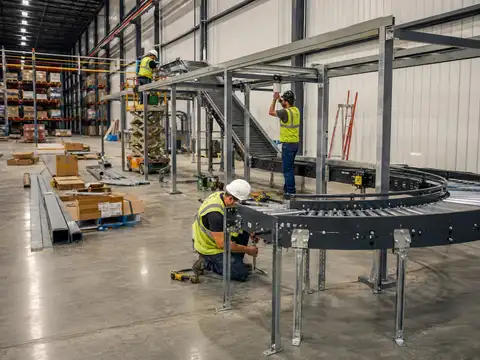
Price the work packages. Do not multiply equipment by a generic percentage.
Mechanical setting, electrical work, controls, guarding, site modifications and commissioning can behave very differently from one conveyor project to another.
Field installation map
Conveyor installation cost is built in work packages, not one percentage.
Unload, inspect freight, sequence sections, protect operating space.
Centerline, supports, elevations, splices, anchors, alignment.
Power, disconnects, conduit, panels, low-voltage distribution.
Sensors, I/O, PLC/WCS logic, networks, device addressing.
Guarding, e-stops, work access, crossings, LOTO points.
Dry run, loaded testing, faults, rate test, training, handoff.
There is no reliable universal conveyor installation percentage
Conveyor projects differ too much for a defensible single multiplier.
A 20-foot floor-mounted gravity line can require little more than:
- unloading;
- legs;
- leveling;
- bolting sections together;
- anchoring.
A 500-foot automated system can require:
- rigging;
- hundreds of supports;
- multiple drives;
- power distribution;
- industrial network;
- PLC and WCS commissioning;
- machine guarding;
- weekend shutdowns;
- throughput acceptance testing.
The equipment price can therefore have only a weak relationship with installation labor.
Hytrol separates installation into mechanical, electrical and controls
Hytrol's current TCO guidance explicitly lists:
- mechanical installation;
- electrical installation;
- controls
inside the initial conveyor-system cost structure.
This is the right budgeting framework.
A mechanical conveyor quote should not silently be treated as a fully commissioned system.
Set conveyor, supports, elevations, splice sections, align, level and anchor.
Forklifts, scissor lifts, telehandlers, cranes, hoists, riggers and restricted access.
Panels, branch power, disconnects, conduit, cable tray, drops, terminations and testing.
Sensors, I/O, device addressing, PLC/HMI/WCS interfaces, network and logic commissioning.
Guarding, e-stops, gates, crossings, platforms, safe maintenance access and energy isolation.
Dry run, loaded product test, fault recovery, rate test, training and acceptance.
The first cost driver is how much assembly arrives at the building
Hytrol's TCO guidance says installation can be cheaper when conveyor arrives more fully assembled rather than as loose components.
It also notes that shipping sections in the sequence they will be installed can shorten installation time.
This is easy to underestimate.
A trailer containing the correct first section at the back of the load can reduce material handling.
A trailer loaded in random installation order can force crews to:
- unload everything;
- sort modules;
- restage them;
- move equipment twice.
Installation begins before the truck arrives
Verify building and route
Field-measure columns, slab, clear height, doors, electrical panels, sprinklers, lighting, rack, workstations and equipment interfaces.
Receive in installation sequence
Inspect freight damage, verify sections against drawings and stage modules so crews do not spend paid field time searching for equipment.
Establish centerline and elevation
Current Hytrol installation procedures use floor centerlines, supports, vibration pads and planned conveyor elevations as early setup steps.
Energize in controlled stages
Complete power, I/O, sensors and communications before treating the line as ready for production.
Test faults, not only forward movement
Verify product flow, e-stops, downstream blockages, sensor failures, restart behavior and representative throughput.
Close documentation and training
Deliver drawings, backups, manuals, spare parts and operating/maintenance training before the project team leaves the site.
Mechanical installation is much more than bolting sections together
Hytrol's January 2026 ProSort LP installation manual provides a useful example of normal field setup.
Its conveyor setup begins by:
- marking a chalk centerline on the floor;
- attaching supports and vibration pads;
- positioning conveyor sections;
- establishing the proper elevation;
- joining and aligning equipment.
A simple warehouse conveyor may use fewer steps. A sorter or heavily integrated line can require far more.
Centerline errors propagate through the entire system
A conveyor installed one inch off location can create:
- bad machine transfers;
- column conflicts;
- poor aisle clearance;
- misaligned curves;
- guarding conflicts;
- insufficient service access.
Survey and layout labor is cheaper than field modification after modules are anchored.
Floor-level conveyor is usually the easiest installation class
Lower field complexity
- Floor-mounted
- One elevation
- Empty building
- Modular preassembled sections
- Nearby power
- No software integration
- Normal weekday access
Higher field complexity
- Overhead / elevated
- Multiple levels
- Active production
- Custom steel
- Long electrical runs
- WCS/WMS integration
- Night / weekend cutover
Overhead conveyor is the clearest example of why percentages fail
Ultimation currently says simple hand-push overhead systems can have basic equipment cost around $10–$30 per foot before installation.
The same supplier says overhead installation can in some cases cost as much as the conveyor equipment itself because the system is mounted above the production area.
Ultimation currently places simple motorized overhead conveyor around $100–$400 per foot and power-and-free systems above $500 per foot.
These are supplier planning figures, not U.S. installed averages.
They show that structural access and field labor can be a major share of an overhead project.
“Installation can equal equipment cost” is Ultimation's guidance for overhead conveyor in some cases. It is not a rule for floor-mounted roller, belt or MDR systems.
Overhead support method changes the project
Ultimation's power-and-free guidance notes that conveyor can be:
- floor-supported from columns;
- supported from above.
When it crosses occupied production space, falling-parts protection may also be required.
Structural support can therefore require:
- engineering;
- steel fabrication;
- roof / structure coordination;
- lifts or cranes;
- work-area barricading;
- additional guarding.
Low-voltage MDR can reduce field installation complexity
Hytrol's current TCO guidance specifically identifies 24V conveyor as an installation-cost opportunity.
Hytrol explains that low-voltage conveyor can reduce installation difficulty because it can be more plug-and-play and avoid some of the belt installation, tensioning and tracking work associated with traditional belt-driven live roller.
Hytrol also notes that low-voltage systems can remove compressed-air cost in applicable designs.
This does not mean every 24V conveyor is cheap to install.
A large MDR network still needs:
- power supplies;
- zone controllers;
- sensors;
- network / I/O;
- supports;
- commissioning.
Interroll's 2026 MCP PLAY shows how commissioning technology can lower project effort
Interroll's March 2026 material-handling update says MCP PLAY simplifies system implementation by configuring layout and flow rather than relying on traditional zone-by-zone PLC programming for every function.
Interroll says the platform reduces programming and commissioning effort and reports a system-integrator customer experiencing significant planning and commissioning time reductions.
Treat this as manufacturer and customer-case evidence, not a universal savings percentage.
The economic principle is still important: controls architecture can influence installation labor just as much as mechanical design.
Pre-wired modular systems can move labor from the site to the factory
Interroll's current Light Conveyor Platform uses:
- preassembled components;
- pre-routed cables;
- pre-tensioned belts;
- preconfigured plug-and-play elements.
Interroll explicitly positions these features around faster installation and commissioning.
The site still pays for the value somewhere: preassembly can increase factory scope while reducing field hours.
Field hours are often more expensive and riskier than controlled factory assembly, especially during short shutdown windows.
Electrical installation can be bigger than expected
A powered conveyor project may need:
- new panel capacity;
- branch circuits;
- motor disconnects;
- VFDs;
- 24V/48V power supplies;
- conduit;
- cable tray;
- field cables;
- network drops;
- device terminations;
- testing and labeling.
Ask the conveyor vendor where its electrical responsibility stops.
The demarcation point should be written into the quote
A typical scope ambiguity is:
“Customer provides power.”
That phrase can mean:
- power available in the building;
- power available at the control panel;
- power wired to every conveyor disconnect;
- customer electrician does all field wiring.
These are not equivalent obligations.
The quote should define the exact electrical handoff point.
Controls installation begins after mechanical placement—but controls design begins earlier
Sensors need physical locations.
Panels need wall or floor space.
Network switches need cabinets.
Scanner tunnels need clearances.
If controls are designed after conveyor steel is fixed, the installation can require unnecessary brackets, conduit and rework.
Controls field labor can include much more than PLC programming
Budget:
- device mounting;
- sensor alignment;
- I/O checkout;
- network addressing;
- motor rotation checks;
- VFD parameter setup;
- PLC download;
- HMI setup;
- WCS/WMS communications;
- fault testing;
- production tuning.
Commissioning can be more expensive than expected because faults must be tested
A conveyor that moves one box from start to finish has passed only a basic dry run.
A meaningful commissioning program should test relevant states such as:
- downstream blocked;
- sensor no-read;
- full accumulation;
- emergency stop;
- power interruption;
- restart;
- jam;
- motor fault;
- communications loss;
- manual mode.
Loaded testing is different from empty testing
Product can reveal:
- belt tracking changes;
- insufficient motor torque;
- bad roller centers;
- transfer gaps;
- unstable cartons;
- scanner problems;
- unexpected accumulation behavior.
Commission with representative minimum, maximum and awkward products.
Site Acceptance Test should be budgeted as project work
A useful SAT can require:
- test product;
- operators;
- maintenance staff;
- controls engineers;
- integrator technicians;
- WMS/WCS support;
- multiple hours at target rate.
If SAT occurs on a weekend to avoid production disruption, premium labor may apply.
Brownfield installation is expensive because every hour competes with production
Existing facilities can impose:
- night work;
- weekend work;
- short shutdown windows;
- temporary conveyor bypasses;
- partial cutovers;
- dust / noise restrictions;
- occupied work areas;
- forklift traffic;
- legacy interfaces.
These conditions can increase labor hours and reduce crew productivity.
Greenfield installation has fewer operational conflicts
An empty building can allow:
- unrestricted access;
- daytime work;
- large staging zones;
- multiple lifts working simultaneously;
- faster anchoring and electrical installation.
But greenfield projects can still suffer from coordination conflicts with:
- rack installation;
- sprinklers;
- lighting;
- mezzanine;
- dock equipment;
- other trades.
Trade stacking can destroy installation productivity
A conveyor crew working in the same aisle as:
- rack installers;
- electricians;
- sprinkler contractors;
- floor stripers;
- IT crews
may spend significant paid time waiting for access.
The project schedule should define work zones and trade sequence.
Rigging is a separate budget item
Heavy pallet conveyor, elevated conveyor and sortation equipment can require:
- forklifts;
- telehandlers;
- scissor lifts;
- boom lifts;
- cranes;
- specialized riggers.
Include:
- rental;
- delivery / pickup;
- fuel / charging;
- certified operators where applicable;
- off-hours access.
Anchoring should not be treated as free labor
Hundreds of conveyor supports can mean hundreds of:
- layout points;
- holes;
- anchors;
- level adjustments.
Concrete quality, reinforcing steel, embedded utilities and slab joints can slow the work.
Coordinate floor scanning or drawings where hidden utilities create risk.
Elevated conveyor adds work-at-height cost and safety planning
OSHA's warehousing guidance states that workers on unprotected walking-working surfaces with sides or edges four feet or more above a lower level require fall protection under the applicable general-industry requirements.
Elevated conveyor installation may therefore require:
- approved lifts or platforms;
- fall-protection systems;
- training;
- barricades below;
- falling-object controls.
These are project conditions, not optional installer conveniences.
Machine guarding should be installed before production handoff
OSHA's warehousing guidance tells employers to:
- inspect conveyors regularly;
- adequately guard pinch points;
- develop conveyor lockout procedures where necessary;
- provide proper lighting and working surfaces around conveyor.
Guarding should be included in the installed scope and acceptance punch list.
LOTO design should be finished before the installer leaves
OSHA 29 CFR 1910.147 requires a hazardous-energy-control program for covered servicing and maintenance activities.
OSHA's warehousing guidance says the program includes:
- energy control procedures;
- employee training;
- periodic inspections.
Conveyor installation should therefore deliver clear:
- energy-isolation points;
- disconnect identification;
- drawings;
- maintenance access.
Interconnected equipment creates a specific LOTO risk
OSHA's lockout/tagout eTool warns that a conveyor can have a separate energy isolation point from the adjacent motor or connected equipment.
Locking out one device may not isolate the entire hazardous system.
Commissioning and handoff should document the real energy boundaries.
Shutdown cost is not installation labor—but it belongs in the business case
A conveyor retrofit may stop:
- shipping;
- receiving;
- production;
- packing;
- sortation.
If the project requires an eight-hour outage, operational impact can be material even when contractor labor is modest.
Separate installation invoice cost from business interruption cost.
Phased cutover can reduce outage risk and increase labor
A phased project may install:
- new conveyor offline;
- temporary bypass;
- new controls in parallel;
- one short final connection during shutdown.
This can protect operations.
It may also duplicate temporary equipment and controls work.
Compare shutdown value with additional project labor.
Travel and mobilization can matter on small projects
A specialized integrator may need to send:
- mechanical supervisor;
- controls engineer;
- commissioning technician
from another state.
On a $2 million system, travel may be a small percentage.
On a $20,000 retrofit, flights, hotels, rental cars and travel time can be material.
Small projects suffer from minimum mobilization
A four-hour field task can still require:
- dispatch;
- travel;
- safety orientation;
- tools;
- site access;
- cleanup.
This is why short conveyor projects can have high installation dollars per foot.
Use labor hours, not arbitrary percentages, for an early estimate
Build separate lines for:
- mechanical installers;
- riggers;
- electricians;
- controls engineers;
- commissioning technicians.
Then add equipment rental, travel and site materials.
Example: do not confuse crew-hours with clock-hours
A four-person crew working two ten-hour shifts generates:
80 labor-hours.
The installation lasts 20 clock-hours but consumes 80 paid field labor-hours before supervision, travel or equipment rental.
This distinction matters when comparing installation schedules.
Overtime can make a shorter schedule more expensive
Two possible plans:
- five weekday shifts at normal labor conditions;
- one weekend shutdown with long premium shifts.
The weekend plan may reduce production disruption while increasing contractor cost.
Choose from total business impact, not installer invoice alone.
Installation contingency should follow uncertainty
Higher contingency is rational when:
- field dimensions are incomplete;
- building drawings are old;
- existing controls are poorly documented;
- electrical capacity is unknown;
- hidden steel / utilities exist;
- shutdown windows are tight.
Lower uncertainty is possible after:
- site survey;
- final drawings;
- electrical verification;
- controls I/O definition;
- agreed work schedule.
Do not present a conceptual budget with contract-level precision.
What belongs in a conveyor installation quote?
Ask for exclusions as aggressively as inclusions
Look for phrases such as:
- “power by others”;
- “network by customer”;
- “permits excluded”;
- “structural engineering excluded”;
- “fire protection modifications by others”;
- “night/weekend premium excluded”;
- “customer provides lifts”;
- “WMS interface excluded.”
An inexpensive quote with five major exclusions can become the expensive project.
Who should install conveyor?
Short modular gravity sections can often be installed by competent in-house maintenance personnel when the manufacturer instructions, site requirements and safety obligations are within their capability.
Professional integrator installation becomes increasingly valuable when the project has:
- powered equipment;
- large elevation changes;
- overhead conveyor;
- structural steel;
- complex controls;
- sortation;
- AS/RS interfaces;
- production-critical cutover;
- high throughput acceptance requirements.
DIY installation can affect warranty and accountability
Before using internal labor, confirm:
- manufacturer installation requirements;
- electrical licensing requirements;
- local permits;
- warranty conditions;
- commissioning responsibility;
- who owns performance if the system misses rate.
Saving installation labor can be poor economics if no party remains accountable for system performance.
Commissioning ownership should never be ambiguous
One party should be responsible for coordinating:
- mechanical readiness;
- electrical readiness;
- controls readiness;
- host-system interface;
- SAT;
- punch-list closure.
Otherwise mechanical installers can blame controls, controls can blame network, and IT can blame the conveyor vendor.
Closeout has economic value
Before final payment, obtain:
- as-built drawings;
- electrical schematics;
- PLC/HMI backups;
- network documentation;
- manuals;
- parts list;
- spare-parts package;
- training records;
- warranty contacts.
Missing documentation converts future maintenance into troubleshooting labor.
The best installation design reduces the hours that must occur on site
Hytrol and Interroll both support the same general principle from different angles:
- preassemble more before shipment;
- ship in installation sequence;
- use modular interfaces;
- pre-wire where practical;
- reduce custom field programming;
- test before site arrival.
Every hour moved from a chaotic brownfield site into a controlled factory environment can reduce schedule risk.
The practical budgeting rule
Do not ask, “What percentage should I add for conveyor installation?”
Ask how many mechanical, electrical, controls, rigging and commissioning work packages the actual project contains—and where each party's scope begins and ends.
Use the overhead-conveyor “installation can equal equipment” example only as proof that field conditions can dominate a project, not as a universal multiplier.
Frequently asked questions
How much does conveyor installation cost?
There is no reliable universal percentage. Installation depends on mechanical assembly, supports, rigging, electrical work, controls, guarding, building conditions, shutdown restrictions and commissioning.
What percentage of conveyor cost should installation be?
Avoid using one percentage across all conveyor types. Ultimation currently says overhead-conveyor installation can in some cases cost as much as the equipment itself, but that is specifically an overhead application and should not be generalized to floor-mounted conveyor.
Why is overhead conveyor expensive to install?
It can require structural support, lifts or cranes, work at height, overhead guarding / falling-part protection and installation above active production areas.
What is included in conveyor mechanical installation?
Typical work includes unloading/staging, setting centerline, supports, elevation, joining sections, leveling, alignment, anchoring, drive setup and mechanical adjustments.
Is electrical installation included with conveyor?
Not automatically. Quotes should define who provides panel power, branch circuits, disconnects, conduit, low-voltage distribution, controls wiring and network drops.
Does 24V conveyor cost less to install?
Hytrol's current TCO guidance says low-voltage conveyor can reduce installation time and expense because it can be more plug-and-play and avoid some traditional belt installation and compressed-air requirements. Actual savings depend on the design.
What is conveyor commissioning?
Commissioning verifies mechanical operation, sensors, drives, controls, safety functions, product flow, fault behavior and interfaces before production handoff.
What is SAT for a conveyor system?
Site Acceptance Test verifies the installed system at the customer's facility against agreed operating, safety, throughput and functional acceptance criteria.
Can our maintenance team install conveyor?
It may be practical for simple modular equipment if the team is competent and manufacturer, electrical, safety and warranty requirements are satisfied. Complex automated, elevated or production-critical systems generally warrant professional integration and commissioning.
Why does brownfield conveyor installation cost more?
Active operations can require night/weekend work, phased cutovers, limited staging, temporary bypasses, legacy interfaces and work around existing rack, utilities and traffic.
What should I ask a conveyor installer before awarding the job?
Ask for included/excluded scope, crew assumptions, schedule, work hours, rigging, electrical demarcation, controls responsibility, guarding, shutdowns, testing, training, documentation and change-order rates.
How can conveyor installation cost be reduced?
Field-verify the building early, preassemble and prewire equipment where practical, sequence shipments by installation order, standardize modules, define interfaces before site work and minimize production-area rework.
Sources and methodology
Warehouse Fieldbook does not publish a universal conveyor-installation percentage because current manufacturer guidance does not support one. Ultimation provides a specific overhead-conveyor example where installation can in some cases equal equipment cost and explains why support method affects installed cost. Hytrol separates mechanical installation, electrical installation and controls in conveyor TCO and explains how preassembly, shipment sequencing and 24V architecture can reduce field effort. Hytrol's January 2026 ProSort LP manual provides current field-setup examples. Interroll's March 2026 MCP PLAY release and current LCP documentation provide current evidence for modular/preconfigured systems reducing commissioning and installation effort. OSHA supplies current warehousing, machine-guarding, fall-protection and hazardous-energy context.
- Ultimation Industries — current overhead conveyor cost and installation guidance
- Ultimation Industries — power-and-free support structure and installed-cost context
- Hytrol — conveyor TCO, mechanical/electrical installation, preassembly and 24V installation guidance
- Hytrol — current installation and maintenance manual library
- Hytrol — January 2026 ProSort LP installation and maintenance manual
- Interroll — March 2026 MCP PLAY planning and commissioning guidance
- Interroll — current preassembled, prewired plug-and-play LCP installation guidance
- Interroll — current MCP PLAY planning, installation and commissioning platform
- OSHA — current warehousing conveyor, working-surface and LOTO guidance
- OSHA — 29 CFR 1910.147 control of hazardous energy
- OSHA — current lockout/tagout overview
- OSHA — interconnected conveyor / multiple-energy-source LOTO example
- OSHA — 29 CFR 1910.212 machine guarding