
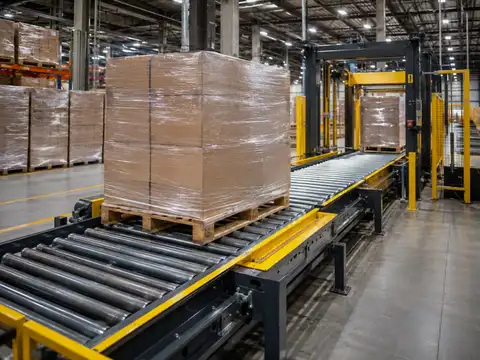
Current public hardware examples put ordinary pallet conveyor in very different capital classes:
Gravity: ~$113–$224/ft · Powered CDLR: ~$575–$830/ft · Heavy chain: ~$515–$1,062/ft in cited configurationsThese figures are derived from specific current Ultimation modules and are not national averages. Transfers, turntables, controls, guarding, installation and vertical movement can add far more than the straight conveyor itself.
Pallet conveyor is not simply “roller conveyor, but wider.”
A pallet can weigh 40 lb empty or several thousand pounds loaded. It can have three bottom boards, full runners, plastic feet, steel skids or a damaged underside. Those differences determine whether the load should ride on rollers, chains or another support surface.
The cheapest conveyor architecture is therefore the one that safely supports the real pallet bottom and required load without adding unnecessary mechanical complexity.
Pallet conveyor architecture
The pallet decides the conveyor before the price does
Best when the pallet bottom is compatible and powered transport is unnecessary.
Heavy rollers plus chain drive for controlled transport and robust duty.
Two- or three-strand chain supports loads that do not convey well on rollers.
Modules connect pallet flow to storage, production, AS/RS and other elevations.
Pallet orientation, transfers, turntables, accumulation, vertical movement, controls, guarding and integration can determine more of the final CAPEX than the nominal linear footage.
Current pallet conveyor price examples
Ultimation currently publishes several pallet-capable conveyor modules with enough specification detail to create useful hardware benchmarks.
| Current public example | Configuration | Current price | Derived hardware $/ft |
|---|---|---|---|
| Heavy gravity pallet roller | 51 in overall × 10 ft, 2.5 in rollers, 6 in centers | $1,125.75 | $112.58/ft |
| Heavy gravity pallet roller | 51 in overall × 10 ft, 2.5 in rollers, 3 in centers, supports included | $2,239.95 | $224.00/ft |
| Powered CDLR | 44 in effective width × 10 ft, motor and legs | $5,749 | $574.90/ft |
| Powered CDLR | 48 in effective width × 5 ft, motor and legs | $4,149 | $829.80/ft |
| 2-strand chain conveyor | 44 in chain centers × 10 ft, fixed 30 FPM, supports | $5,148 | $514.80/ft |
| 2-strand chain conveyor | 44 in chain centers × 5 ft, variable 8–30 FPM, supports | $5,312 | $1,062.40/ft |
| Vertical pallet conveyor | Qimarox ProRunner MK9 basic model | $19,880 | Not a linear-foot product |
The figures above are current product snapshots, not project budgets.
They are useful because they show the actual scale difference between gravity, powered roller, chain and vertical pallet movement.
The equipment performs different functions and includes different scopes. Compare like-for-like modules, then add the transfers, controls and site work required by the real layout.
Gravity pallet conveyor is the lowest-cost hardware architecture
Ultimation's current 51-inch-wide heavy gravity pallet conveyor with 48 inches between frames, 10-foot length, 2.5-inch rollers and 6-inch centers is listed at $1,125.75.
That derives to approximately $112.58 per foot.
The same product family is intended for shipping, warehousing and distribution.
Because there is no drive, the hardware avoids:
- motor and gearbox;
- chain drive between powered rollers;
- motor controls;
- field power for the straight section;
- powered accumulation logic.
Gravity can still be structurally serious equipment
The cited 6-inch-center gravity pallet conveyor currently publishes a maximum load of 373 lb per roller.
Ultimation lists load capacity per 5-foot section of approximately:
- 3,730 lb at 6-inch centers;
- 5,222 lb at 4.5-inch centers;
- 7,460 lb at 3-inch centers.
These are product-specific published ratings, not pallet-load recommendations for every installation.
Closer roller centers can nearly double hardware cost
The current 10-foot heavy gravity configuration with 3-inch roller centers and three floor supports is listed at $2,239.95.
That is approximately $224 per foot.
The 6-inch-center configuration is approximately $113/ft.
The difference is not cosmetic: closer centers put many more 2.5-inch rollers underneath the pallet.
6-in centers vs 3-in centers
10 ft at 6-in centers: $1,125.75.
10 ft at 3-in centers with supports: $2,239.95.
Select centers from pallet-bottom geometry and load support, not from the cheaper product listing.
The pallet bottom determines whether gravity rollers work at all
Roller conveyor works best when the pallet presents enough continuous bottom structure to remain supported.
Check:
- runner orientation;
- bottom-board spacing;
- broken or missing boards;
- plastic pallet feet;
- skid dimensions;
- pallet sag;
- load overhang.
A pallet that works when traveling stringer-first may not work when rotated ninety degrees.
Pallet orientation is a conveyor specification
A standard 48 × 40 pallet has different structural support depending on whether its 48-inch or 40-inch dimension leads the direction of travel.
That changes:
- roller contact;
- conveyor width;
- transfer geometry;
- turntable need;
- rack / ASRS interface.
Define pallet orientation before requesting a quote.
Gravity works only when something moves the pallet
Gravity conveyor can rely on:
- a designed slope;
- manual push;
- forklift placement and retrieval;
- another powered conveyor feeding the line.
If employees must repeatedly push 2,500-lb pallets, the low equipment price does not make the process operationally sensible.
Powered conveyor becomes relevant when controlled movement is required.
CDLR is one of the standard powered pallet-conveyor architectures
Chain-driven live roller uses a chain to positively drive the rollers.
Hytrol currently positions CDLR for pallet and other unit-load transport and notes that it can be integrated with transfers for angled movement.
Ultimation currently describes its CDLR product as suitable for heavy loads including pallets, drums and crates.
Current 10-ft CDLR pricing starts around the mid-$5,000s in cited modules
Ultimation's current 44-inch effective-width, 10-foot CDLR with motor and legs is listed at $5,749.
That derives to approximately $574.90 per foot.
The current 48-inch, 5-foot version is $4,149, or approximately $829.80 per foot.
Short powered sections have high $/ft because the motor and fixed hardware are concentrated over fewer feet.
5 ft vs 10 ft
48-in × 5-ft module: ~$830/ft.
44-in × 10-ft module: ~$575/ft.
Do not multiply a short-module rate across a long straight line without a purpose-designed quote.
CDLR can also support accumulation in suitable designs
Ultimation notes that pallet CDLR systems can use loose slip sleeves over rollers so pallets can remain stationary while powered rollers continue turning.
Hytrol also offers pallet-handling CDLR configurations with accumulation controls.
Accumulation changes the system because the project may need:
- zones;
- sensors;
- stops;
- logic;
- controlled release;
- downstream interlocks.
Price accumulation as a functional requirement, not as “more straight conveyor.”
Drag chain solves pallets that do not behave well on rollers
Hytrol's current drag-chain pallet conveyor uses strands of chain to directly support and move the load.
Hytrol describes the architecture as useful for pallets with difficult or uneven bottoms and publishes load capability up to 6,000 lb for its heavy-duty drag-chain family.
Ultimation likewise positions chain conveyor for pallets, racks and frames that are not ideal on ordinary rollers.
Current 10-ft two-strand chain hardware is about $5,148 in one configuration
Ultimation currently lists its 44-inch-center, 10-foot, two-strand chain conveyor at $5,148.
The product includes structural supports and a 1 HP three-phase motor and is configured for 30 FPM fixed speed.
Current published capacity for this configuration includes:
- 500 lb maximum load per foot;
- approximately 3,350–3,380 lb maximum drive capacity.
That derives to approximately $514.80 per foot before a larger system's transfers, controls and installation.
Variable speed can dominate the price of a short chain section
Ultimation's current 5-foot, 44-inch-center, two-strand variable-speed chain conveyor is listed at $5,312.
The current package includes an AC variable-speed controller and structural supports.
That derives to approximately $1,062.40 per foot.
Again, the per-foot number is high because a motor, VFD/control package and structural support system are packaged into only five feet.
Another two-strand pallet chain product is currently $7,890
Ultimation currently lists its UDC60-2 two-strand pallet conveyor at $7,890.
The product uses heavy-duty continuous chain on a common drive shaft and is manufactured to order.
The public page does not provide a simple length suitable for a responsible $/ft calculation in the source excerpt, so this guide treats $7,890 only as a current configured equipment price rather than forcing a linear-foot number.
If a public product page does not support a reliable length or included scope, keep the price as a product snapshot and request the actual configuration from the supplier.
Chain conveyors cannot turn a pallet around a curve like roller conveyor
Ultimation's current chain-conveyor guidance says a chain line does not carry product around ordinary curves and recommends a 90-degree transfer when product must move onto another chain conveyor.
This is one of the hidden reasons a cheap straight-chain price can become a more expensive system layout.
Transfers are central to pallet-conveyor cost
Pallet systems frequently need:
- roller-to-chain transfer;
- chain-to-roller transfer;
- 90-degree directional change;
- AS/RS infeed;
- palletizer interface;
- stretch-wrapper interface;
- forklift handoff.
A pop-up transfer typically lifts the pallet above one conveying surface and moves it sideways onto another.
That requires an additional lifting mechanism, drive, sensors and controls.
Interroll treats transfers as their own pallet modules
Interroll's current Modular Pallet Platform includes roller conveyors, chain conveyors, chain transfers, turntables and specialized pallet modules.
The current PM 9730 chain transfer is specifically intended for a 90-degree change of direction for full and empty pallets.
This is a better way to budget an integrated system: count the required modules rather than multiplying total route length by one rate.
Turntables add orientation without a large conveyor intersection
Interroll's current MPP lineup includes roller and chain turntables as distinct pallet-handling modules.
Turntables can be useful when:
- pallet orientation must change;
- the load must rotate 90/180/270 degrees;
- the process must preserve a specific leading edge;
- a transfer alone cannot provide the required orientation.
Rotation should be treated as a functional module in the CAPEX model.
Do not rotate a pallet unless the process needs the orientation change
Every turntable adds:
- mechanical equipment;
- cycle time;
- controls;
- maintenance;
- potential bottleneck risk.
Sometimes the simpler solution is to redesign upstream pallet orientation so the pallet enters the conveyor correctly in the first place.
Interroll MPP shows the capacity range of modern modular pallet systems
Interroll's current MPP product family includes equipment for pallet weights up to approximately 500 kg, 1,200 kg and 1,500 kg depending on module.
Its current PM 9712 low-voltage roller conveyor uses 24V or 48V RollerDrive and handles pallets up to 500 kg per zone.
Interroll states that the module can implement zero-pressure accumulation in combination with MultiControl.
Low-voltage pallet conveyor can be useful for lighter pallet classes
A 500-kg zone is approximately 1,100 lb.
That can fit:
- light manufacturing pallets;
- empty pallets;
- half pallets;
- lighter retail/warehouse loads.
It is not a substitute for a 3,000-lb pallet conveyor if the real unit loads exceed the published module rating.
Interroll's current infeed module extends to 1,200 kg
The current PM 9740 infeed roller conveyor is published at 1,200 kg per storage slot.
Interroll specifically positions it for horizontal infeed/delivery of full and empty pallets, including hand-pallet-truck or electric-pallet-truck interface.
The integrated Pallet Drive avoids a laterally projecting motor, which can save space in dense track layouts.
Integrated pallet systems can reach 1,500 kg
Interroll's current MPP filter lists pallet modules up to 1,500 kg.
The company's 2026 product overview describes MPP as a combination of roller and chain pallet conveyors with transfers and turntables for the full flow of pallets through manufacturing and distribution facilities.
This system view is more useful than treating every heavy load as one generic conveyor product.
Vertical pallet movement is a separate capital class
Horizontal conveyor pricing should stop when the pallet must move between floors or mezzanine levels.
Vertical movement can require:
- vertical reciprocating conveyor;
- continuous pallet lift;
- stacker crane;
- pallet elevator integrated with AS/RS.
These are machines with their own structures, drives, guarding and controls.
Current vertical pallet conveyor example: $19,880 basic model
Ultimation currently lists the Qimarox ProRunner MK9 at $19,880.
The page explicitly states that this is a basic model price using minimum speed and height specifications.
It also explicitly excludes:
- arms;
- connecting conveyors;
- shipping;
- installation.
The system can handle loads around 3,300 lb and is described for lift heights up to roughly 33 ft depending on configuration.
$19,880 is not the installed lift project
Treat the listed amount as a base machine reference.
A usable warehouse installation still needs the correct pallet interface, guarding, controls, support/site work, shipping and installation.
Vertical throughput is another specification
Ultimation's current ProRunner MK9 page publishes capability up to approximately 60 pallets per hour depending on configuration.
The required lift should be sized from:
- average pallets/hour;
- peak pallets/hour;
- vertical travel distance;
- infeed/outfeed cycle;
- number of levels;
- buffering around the lift.
One vertical machine can become the bottleneck of an otherwise high-capacity horizontal conveyor network.
Pallet conveyor should be sized from pallet quality, not ideal CAD pallets
Real warehouses receive:
- broken deck boards;
- protruding nails;
- warped pallets;
- missing blocks;
- plastic pallets with different feet;
- CHEP-style rental pallets;
- one-way export pallets;
- steel skids.
A conveyor that works only with perfect pallets can create large exception handling cost.
Add a pallet-quality gate before expensive automation
High-automation pallet systems often benefit from:
- pallet inspection;
- dimension check;
- load overhang check;
- weight check;
- broken-board rejection;
- barcode / identity verification.
The objective is to keep malformed pallets from entering a system where clearing a jam is difficult.
Weighing and load-profile checks can be part of conveyor CAPEX
If downstream equipment has hard capacity or geometry limits, the conveyor may need to verify:
- pallet weight;
- height;
- width;
- length;
- load stability;
- overhang.
These functions add sensors, mechanical stations, controls and exception lanes.
Pallet accumulation requires more floor space than carton accumulation
One pallet may occupy 4 feet or more of conveyor length including clearances.
A ten-pallet buffer can therefore require tens of feet of conveyor.
Approximate straight buffer length
pallets required × pallet pitch along conveyor
Pallet pitch includes the pallet length in direction of travel plus any required operating gap.
Example: 12-pallet accumulation buffer
48-in pitch plus 6-in operating gap
54 in × 12 pallets = 648 inches, or 54 feet.
This is simple layout arithmetic. Real zone lengths, stops, transfers and pallet orientation can change the final conveyor length.
Accumulation is often cheaper than letting production stop
A pallet buffer can decouple:
- production line from warehouse;
- palletizer from stretch wrapper;
- AS/RS from shipping;
- receiving from putaway;
- conveyor from robotic cell.
The business value is not the conveyor itself. It is the ability of one process to continue when the adjacent process pauses.
But accumulation can become expensive inventory parking
Do not build a 100-pallet conveyor buffer simply because floor space exists.
Define:
- normal queue;
- peak queue;
- required recovery time;
- downstream failure duration;
- acceptable WIP.
Buffer capacity should solve a measurable variability problem.
Throughput should be measured as pallet cycles, not conveyor speed alone
A conveyor moving at 30 FPM does not necessarily process one pallet every two seconds.
Pallet throughput depends on:
- pallet pitch;
- stops;
- transfers;
- turntables;
- scan time;
- load/unload interfaces;
- downstream availability.
Conceptual straight-line pallet throughput
Maximum transport-only pitch rate
conveyor feet/minute ÷ pallet pitch in feet × 60
This is only a conceptual straight transport rate. Real system throughput must be validated from full cycle logic.
Transfers can become the throughput bottleneck
A 90-degree pop-up transfer requires a sequence:
- pallet arrives;
- pallet stops in position;
- transfer mechanism rises;
- cross conveyor runs;
- pallet exits;
- transfer lowers;
- next pallet is released.
That cycle can be slower than straight transport.
Count transfer cycles/hour before finalizing system throughput.
Forklift interface changes conveyor height and guarding
A forklift loading pallets directly onto conveyor requires:
- appropriate conveyor elevation;
- impact-resistant first section;
- fork clearance where needed;
- pallet stop / alignment;
- safe operator visibility;
- guarding that does not interfere with fork access.
The first five feet of conveyor may need to be more robust than the rest of the line.
Pallet-jack interface is a different geometry
Interroll's current PM 9740 is designed so hand or electric pallet trucks can handle pallet infeed/delivery.
That requires a low, accessible infeed architecture that differs from a waist-height powered conveyor intended only for automated transfers.
Define the loading device before the conveyor.
AS/RS interface increases precision requirements
A stacker crane or shuttle expects the pallet to arrive:
- in the correct orientation;
- within position tolerance;
- inside weight limits;
- inside dimensional limits;
- with a stable load;
- at the correct time.
Conveyor serving AS/RS may need more sensing and alignment than ordinary forklift-to-forklift transport.
Pallet conveyor is often part of the automation boundary
In an automated warehouse, pallet conveyor can connect:
- receiving;
- inspection;
- AS/RS;
- pallet flow;
- robotic palletizer;
- stretch wrapper;
- labeling;
- shipping staging.
The conveyor quote should clearly identify which vendor owns each interface.
Controls can be small on one powered lane and large on a network
A simple powered chain line may need:
- motor starter or VFD;
- photo-eye;
- start/stop controls;
- emergency stop.
An integrated pallet network can add:
- PLC;
- HMI;
- distributed I/O;
- barcode/RFID;
- WCS/WMS interface;
- route logic;
- zone tracking;
- AS/RS handshakes;
- fault recovery.
Software and controls should therefore be their own budget line.
Electrical power can materially affect project cost
The current 10-foot Ultimation two-strand chain example uses a three-phase 208-230/460V motor.
A warehouse without nearby three-phase distribution may need:
- new branch circuits;
- disconnects;
- conduit;
- panel capacity;
- transformers or other site power work.
Confirm electrical requirements before treating an online hardware price as deployable cost.
Low-voltage MPP changes the electrical architecture
Interroll's current PM 9712 uses 24V or 48V RollerDrive for pallet loads up to 500 kg per zone.
Low-voltage decentralized drive can reduce the need for laterally mounted gearmotors in some layouts.
It still requires power supplies, controls and electrical distribution.
Installation cost depends on pallet conveyor mass
Heavy pallet conveyor is physically substantial equipment.
Current Ultimation product weights illustrate this: the 5-foot variable two-strand chain conveyor is listed around 643 lb.
Installation may need:
- forklift / telehandler;
- rigging;
- anchors;
- alignment;
- field wiring;
- guarding;
- commissioning.
A 100-foot pallet line is not installed like a lightweight carton conveyor.
Floor condition matters
Heavy conveyor frames can require:
- adequate slab capacity;
- leveling;
- anchoring;
- avoidance of joints/cracks;
- coordination with embedded utilities.
An uneven slab can create alignment problems at transfers and between conveyor modules.
Guarding needs increase with chain and powered pallet equipment
Pallet conveyors can create hazards around:
- chains;
- sprockets;
- nip points;
- pop-up transfers;
- turntables;
- vertical lifts;
- moving heavy pallets.
OSHA's general-industry machine-guarding rule requires protection from hazards such as ingoing nip points and rotating parts.
Guarding belongs in the project scope.
Heavy pallets also create crushing and impact risk
Conveyor zones where people can enter should be reviewed for:
- unexpected pallet movement;
- pinch/crush points;
- falling loads;
- forklift interaction;
- maintenance access;
- emergency stop access.
A pallet moving slowly can still carry very high kinetic and crushing energy.
Lockout/tagout is central to maintenance
Chain tension, rollers, transfers and vertical equipment expose technicians to electrical, mechanical and stored energy.
OSHA's hazardous-energy requirements apply where servicing could expose workers to unexpected energization or release of stored energy.
Design:
- disconnect locations;
- zone isolation;
- mechanical blocking;
- vertical-load control;
- safe access;
- restart logic.
Maintenance differs by architecture
Gravity roller focuses on:
- rollers;
- bearings;
- frames;
- supports;
- alignment.
CDLR adds:
- chains;
- sprockets;
- motors;
- gearboxes;
- lubrication / tension requirements.
Drag chain adds its own chain rails, wear surfaces and drive components.
Vertical equipment adds lift mechanisms and safety systems.
Chain conveyor can be mechanically simple and still need disciplined maintenance
Ultimation positions chain conveyors as rugged and relatively easy to maintain.
That does not mean maintenance-free.
Inspect:
- chain tension;
- wear;
- sprocket condition;
- guides;
- bearings;
- guards;
- motor/gearbox;
- alignment.
Critical spares should be selected from downtime consequence
A mission-critical pallet conveyor may justify stocking:
- chain;
- sprockets;
- rollers;
- bearings;
- photo-eyes;
- motor/VFD;
- transfer components;
- controls hardware.
A noncritical gravity lane may need only spare rollers and bearings.
Used pallet conveyor can be attractive—but freight matters
Heavy conveyor steel is expensive to move.
A used line should be evaluated for:
- purchase price;
- dismantling;
- freight;
- rigging;
- missing supports;
- frame damage;
- controls obsolescence;
- site modification;
- reinstallation.
A $20,000 used system can be more expensive than a $30,000 new one if relocation and retrofit are poor fits.
Gravity pallet conveyor is the easiest used-equipment category to inspect
The absence of drives and controls simplifies the evaluation.
Verify:
- roller capacity;
- roller centers;
- between-frame width;
- frame straightness;
- bearing condition;
- support completeness;
- pallet orientation.
If dimensions match, the equipment can remain useful for many years.
Used powered pallet conveyor needs a stronger controls check
Investigate:
- motor/gearbox age;
- VFD support;
- PLC support;
- sensor availability;
- chain/roller wear;
- electrical drawings;
- safety circuit;
- software access.
Good steel with obsolete controls can still be a viable retrofit, but price the controls modernization explicitly.
How much would 40 ft of gravity pallet conveyor cost?
Using four current 10-foot, 6-inch-center Ultimation gravity sections:
40 ft of current gravity pallet sections
4 × $1,125.75 = $4,503.
This is section-level equipment arithmetic only. Confirm supports, freight, installation, pallet stops and interface hardware.
How much would 40 ft of cited CDLR hardware cost?
Using four current 10-foot 44-inch CDLR modules:
40 ft of current powered CDLR modules
4 × $5,749 = $22,996.
The cited modules include motor and legs, but a continuous system still needs the correct controls architecture, power, safety and commissioning.
How much would 40 ft of cited chain conveyor cost?
Using four current 10-foot fixed-speed two-strand chain modules:
40 ft of current chain modules
4 × $5,148 = $20,592.
Real system engineering may use fewer drives or different module lengths, so this is hardware context—not a final design.
Gravity, CDLR and chain can all be correct at the same warehouse
One facility may use:
- gravity accumulation at shipping;
- CDLR for powered pallet transport;
- drag chain for 90-degree transfer interfaces;
- vertical lift between floor and mezzanine;
- low-voltage roller modules at an automated storage interface.
The goal is not to standardize every pallet route onto one conveyor type.
The goal is to standardize components where the application permits it.
Standardization can reduce lifecycle cost
Fewer:
- motor types;
- roller types;
- chain sizes;
- sensors;
- VFDs;
- control platforms
can reduce spare inventory and technician training.
Do not force standardization when it compromises the load requirement.
Pallet conveyor vs forklifts is a route-stability decision
Conveyor becomes attractive when:
- origin and destination are stable;
- pallet flow is frequent;
- the route is repetitive;
- forklift traffic is constrained;
- buffering is valuable;
- automation interfaces exist.
Forklifts remain strong when:
- routes change;
- destinations are numerous;
- volume is low;
- pallet quality varies;
- future layout is uncertain.
Do not compare conveyor CAPEX with one forklift purchase price
Compare:
- forklift chassis;
- operator labor;
- energy/fuel;
- maintenance;
- traffic space;
- damage;
- required fleet count;
- conveyor maintenance;
- conveyor flexibility;
- throughput and availability.
Conveyor can be a large capital project and still have stronger long-run economics on a dense fixed route.
Simple pallet-conveyor ROI framework
Annual net pallet-conveyor benefit
verified forklift/labor value avoided + damage reduction + throughput value where supportable + space/traffic value where measurable − conveyor energy − maintenance − added operating cost
Simple payback
total installed pallet-conveyor project cost ÷ annual net benefit
Do not use equipment-only price in the numerator.
Total installed cost should include the entire pallet route
Include:
- straight conveyor;
- supports;
- transfers;
- turntables;
- stops;
- vertical movement;
- controls;
- software interface;
- electrical;
- guarding;
- installation;
- commissioning;
- training;
- critical spares;
- freight;
- site modifications.
Normalize vendor quotes by system function
| Quote bucket | What to confirm |
|---|---|
| Pallet definition | Size, orientation, bottom, max weight |
| Straight conveyor | Gravity, CDLR, chain, length, capacity |
| Transfers | Quantity, 90-degree logic, lift mechanism |
| Turntables | Rotation requirement and cycle |
| Accumulation | Number of pallets / zones |
| Vertical | Lift machine, levels, throughput |
| Controls | PLC/HMI, sensors, routing, WCS/WMS |
| Electrical | Voltage, panels, field power, disconnects |
| Safety | Guarding, e-stops, access, LOTO |
| Installation | Rigging, anchors, field labor, alignment |
| Commissioning | Product testing, cycle testing, recovery |
| Spares/support | Critical parts, warranty, response time |
A practical pallet conveyor RFQ
Give the integrator:
- all pallet types;
- orientation;
- minimum and maximum loaded weight;
- load dimensions and overhang;
- pallet-bottom photos/drawings;
- average pallets/hour;
- peak pallets/hour;
- required buffer quantity;
- origin and destination elevations;
- forklift/pallet-jack interfaces;
- AS/RS/palletizer/wrapper interfaces;
- route CAD;
- electrical standard;
- environment;
- required availability;
- future expansion.
When gravity pallet conveyor is usually strongest
- short route;
- pallet bottom is roller-compatible;
- powered transport is unnecessary;
- temporary or flexible layout matters;
- lowest maintenance complexity is valuable.
When CDLR is usually strongest
- powered pallet transport is required;
- loads are heavy;
- positive roller drive is useful;
- dirty/oily environment exists;
- transfers and controlled pallet routing are part of the system.
When drag chain is usually strongest
- pallet/skid bottom does not convey well on rollers;
- high load requires direct chain support;
- route is straight between transfers;
- rugged industrial duty is more important than accumulation flexibility.
When a vertical pallet conveyor is justified
- mezzanine or second floor;
- vertical connection to automation;
- fixed high-volume elevation change;
- floor space is too valuable for a long incline;
- repeated forklift elevator use is inefficient.
When pallet conveyor may be the wrong technology
Conveyor can be weak when:
- pallet routes change often;
- volume is low;
- many destinations require frequent reconfiguration;
- pallet quality is uncontrolled;
- floor space for fixed lanes is unavailable;
- the facility expects major layout change soon.
Forklifts, AMRs or AGVs may preserve more flexibility.
The practical recommendation
Start with the pallet, not the conveyor catalog.
Define:
pallet bottom + orientation + maximum weight + required throughput + route.
If the pallet rolls cleanly and movement can be passive, gravity is the low-cost starting point.
If powered movement is required, evaluate CDLR.
If the pallet bottom needs direct support or the load is poorly suited to rollers, evaluate drag chain.
Then price every directional change, buffer, lift and interface as a separate functional module.
The straight conveyor price is useful—but the total system architecture is what determines the real warehouse investment.
Frequently asked questions
How much does pallet conveyor cost per foot?
Current Ultimation examples derive to about $113–$224/ft for cited heavy gravity modules, about $575–$830/ft for cited powered CDLR modules, and about $515–$1,062/ft for cited two-strand chain modules. These are specific hardware examples, not installed national averages.
How much does gravity pallet conveyor cost?
One current 51-inch-wide, 10-foot Ultimation heavy gravity pallet conveyor is listed at $1,125.75. A current 10-foot 3-inch-center configuration with supports is $2,239.95.
How much does powered pallet roller conveyor cost?
One current 44-inch, 10-foot Ultimation CDLR module with motor and legs is $5,749. A current 48-inch, 5-foot module is $4,149.
How much does pallet chain conveyor cost?
A current Ultimation 44-inch-center, 10-foot two-strand fixed-speed chain conveyor is $5,148. A current 5-foot variable-speed version is $5,312.
How much does a vertical pallet conveyor cost?
Ultimation currently lists a basic Qimarox ProRunner MK9 at $19,880. The published price excludes arms, connecting conveyors, shipping and installation.
Should pallets use roller or chain conveyor?
Use rollers when the pallet bottom provides stable roller contact and the required load fits the conveyor rating. Chain is useful when skids or pallet bottoms do not convey well on rollers or when the application needs direct chain support.
What is CDLR pallet conveyor?
Chain-driven live roller conveyor uses chain-connected powered rollers to move heavy unit loads such as pallets, drums and crates.
Can pallet conveyor accumulate pallets?
Yes, with suitable architecture. CDLR can be configured for accumulation, Interroll's current low-voltage PM 9712 supports zero-pressure accumulation for pallets up to 500 kg per zone, and dedicated stops/zones can be used in broader systems.
How much weight can pallet conveyor carry?
It varies enormously. Interroll's current MPP family includes modules from 500 kg up to 1,500 kg. Hytrol's heavy drag-chain family reaches 6,000 lb. Ultimation's chain-conveyor family can be engineered for still heavier industrial loads. Use the exact module rating.
Why do pallet conveyor transfers cost so much?
A transfer adds a lifting or crossing mechanism, another drive, sensors, sequencing logic and guarding. It is a separate machine function, not simply another few feet of straight conveyor.
Is pallet conveyor cheaper than using forklifts?
It can be on stable high-volume routes because it can reduce truck travel, operator labor and traffic. Forklifts remain more flexible for changing routes and low-volume multi-destination work. Compare lifecycle process cost.
What should be included in a pallet conveyor quote?
Straight modules, supports, transfers, turntables, accumulation, vertical movement, controls, electrical work, guarding, installation, commissioning, spares, freight and all interfaces should be clearly included or excluded.
Sources and methodology
Warehouse Fieldbook uses current public Ultimation product prices as hardware snapshots and calculates $/ft only where both price and conveyor length are explicitly available. Interroll provides current MPP architecture and published pallet-weight capacities for modular roller, chain, transfer and infeed modules. Hytrol provides current pallet-handling application guidance for gravity, CDLR and drag-chain systems. OSHA is used for current general-industry machine guarding and hazardous-energy context. No universal installation multiplier, transfer price or national-average pallet-conveyor rate is invented where public evidence does not support one.
- Ultimation Industries — current 10-ft heavy gravity pallet conveyor price and load ratings
- Ultimation Industries — current 10-ft heavy gravity 3-in-center conveyor with supports
- Ultimation Industries — current CDLR pallet-conveyor architecture and accumulation context
- Ultimation Industries — current 44-in × 10-ft CDLR price
- Ultimation Industries — current 48-in × 5-ft CDLR price
- Ultimation Industries — current chain-conveyor pallet application guidance
- Ultimation Industries — current 10-ft two-strand chain conveyor price and capacity
- Ultimation Industries — current 5-ft variable-speed two-strand chain conveyor price
- Ultimation Industries — current UDC60-2 pallet conveyor price
- Ultimation Industries — current Qimarox ProRunner MK9 base price and exclusions
- Interroll — current Modular Pallet Platform architecture and pallet-weight classes
- Interroll — current 500-kg/zone low-voltage pallet roller conveyor with ZPA
- Interroll — current 90-degree pallet chain-transfer module
- Interroll — current 1,200-kg pallet infeed conveyor
- Hytrol — current pallet-handling conveyor architectures
- Hytrol — current pallet CDLR application guidance
- Hytrol — current heavy drag-chain pallet conveyor and 6,000-lb capacity context
- Hytrol — current gravity pallet conveyor application guidance
- OSHA — 29 CFR 1910.212 general machine guarding
- OSHA — current hazardous-energy / lockout-tagout requirements