
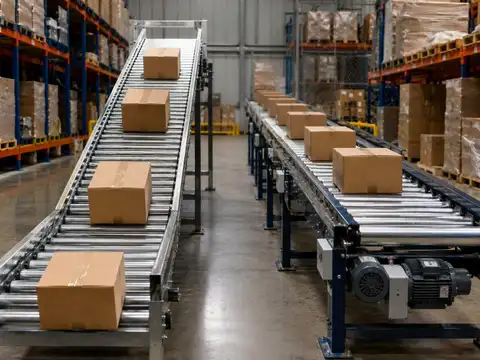
Gravity is cheaper to buy. Powered roller is cheaper only when control, labor or throughput earns back the extra machine.
The decision should not start with “powered is better.” It should start with whether the product genuinely needs powered movement after it enters the line.
Decision board
The same carton can justify two completely different conveyor economics.
Gravity buys steel and rollers. Powered MDR buys controlled movement, sensing and zone-by-zone behavior. The correct choice depends on what the process needs the conveyor to do after the product arrives.
- No conveyor motor
- No powered zone logic
- Legs sold separately in cited example
- Manual force or slope moves product
- Motorized conveyor zones
- Photo-eye start / stop
- Power supply included
- Automatic controlled movement
The powered module is about 12× the listed gravity section price. This is not an installed-system comparison: included scope differs and gravity supports are excluded.
The current purchase gap can be roughly 12× on comparable-size short modules
Ultimation currently lists an 18-inch-wide, 15-inch-between-frame, 5-foot medium-duty gravity conveyor with 1.9-inch rollers and 6-inch centers at $137.50.
Its current 18-inch-wide, 15-inch-between-frame, 5-foot 24V MDR powered conveyor starts at $1,649.75 and includes a mounted 120V power supply.
The arithmetic difference is $1,512.25.
The powered product is almost exactly 12 times the listed gravity price.
This is still not a perfect installed apples-to-apples comparison: the gravity product sells its legs separately, while the powered product includes a power supply and much more embedded hardware.
It is nevertheless a useful illustration of the economic hurdle powered conveyor needs to clear.
The 10-ft comparison tells the same story
Ultimation currently lists an 18-inch-wide, 10-foot medium-duty gravity conveyor from $269.95.
The current 18-inch-wide, 10-foot MDR powered conveyor starts at $1,932.50.
The listed hardware gap is therefore $1,662.55.
As length increases, the powered premium per foot falls because the fixed power/control hardware is spread across more conveyor.
Four decision gates settle most gravity-vs-powered questions
Can the product move without a motor?
Gravity conveyor needs slope, manual push or another external force. Hytrol currently defines gravity conveyor as a non-powered transport solution using gravity or external force to move products.
Does product need to stop automatically?
Powered MDR can start and stop zones from photo-eye signals. Ultimation's current MDR modules move products one zone at a time and automatically start/stop as required.
Does the line need controlled accumulation?
Interroll's current RollerDrive EC5000 is designed for straight conveyor and zero-pressure accumulation in 24V or 48V DC architectures. Gravity can queue product, but not with the same independent zone control.
Is manual product movement already inexpensive?
If employees are already beside the line and a light push takes almost no incremental labor, spending thousands on powered transport may have little economic return.
Gravity conveyor is not “primitive conveyor”
Hytrol's current product catalog continues to treat gravity as a normal transportation architecture, not a temporary substitute for real automation.
Gravity can be the right engineered solution for:
- packing benches;
- shipping takeaway;
- short workstation transfers;
- manual assembly flow;
- temporary warehouse lanes;
- carton staging;
- declines where product speed can be safely controlled.
The lack of a motor is a feature when the process does not need one.
Powered roller is not simply gravity conveyor plus one motor
Modern MDR uses distributed drives.
Ultimation's current powered module uses individual 24V motorized roller zones with photo-eye sensors.
Hytrol's current E24 conveyor uses a decentralized drive architecture with a motor in each accumulation zone.
Interroll's current RollerDrive EC5000 is available in 24V and 48V DC and is specifically designed to integrate with zone controls for zero-pressure accumulation.
Powered conveyor therefore buys:
- propulsion;
- zone control;
- automatic start/stop;
- product sensing;
- controlled release;
- interfaces with upstream/downstream machines.
Gravity creates value by removing machine complexity
- No conveyor drive energy
- Few electrical failure points
- Simple relocation
- Low parts count
- Very low commissioning complexity
Powered creates value by removing process uncertainty
- Consistent movement
- Automatic accumulation
- Predictable release
- Machine-to-machine flow
- Less manual pushing / walking
Gravity wins acquisition cost by a very large margin
The cited 5-foot gravity product has:
- steel frame;
- 1.9-inch rollers;
- 6-inch roller centers.
It does not include a powered drive or sensing system.
The powered 5-foot module includes:
- 24V motorized roller zones;
- photo-eye sensing;
- automatic start/stop behavior;
- mounted 120V power supply.
The purchase-price difference is therefore buying real functionality, not merely a motor.
The correct question is whether the functionality pays
Powered conveyor earns its premium through one or more of:
- manual labor avoided;
- higher throughput;
- controlled buffering;
- fewer product collisions;
- less operator intervention;
- machine synchronization;
- more reliable flow.
If none of those has meaningful value, gravity is difficult to beat financially.
Use the current 5-ft hardware gap only as a demonstration. Assume powered conveyor must justify an extra $1,512.25 and the relevant loaded labor value is $30/hour.
Across 250 operating days, 50.4 hours is roughly 12 minutes per day.
That sounds like an easy hurdle.
But the example is intentionally incomplete: it does not include powered-conveyor supports, field installation, electricity, maintenance or controls beyond the cited product.
It also assumes saved employee time is truly economically useful.
Do not claim a labor saving if the operator remains in the same job with no measurable throughput, overtime or staffing effect.
Manual push is not automatically expensive
Imagine a packing employee seals a carton and pushes it three feet onto a gravity lane without leaving the workstation.
The incremental labor may be a second or two.
Replacing that movement with powered conveyor may improve ergonomics or flow, but the labor ROI can be weak.
Now change the process: the same employee has to walk 40 feet and push cartons repeatedly to shipping.
Powered conveyor can eliminate meaningful travel.
The conveyor technology did not change. The process economics did.
Gravity is strongest when people already own the product
At a manual workstation, an employee may already:
- pick up the carton;
- inspect it;
- label it;
- pack it;
- push it to the next position.
If the push is naturally part of the work cycle, the gravity line can transfer product with almost no dedicated machine cost.
Powered is strongest when no person should own the travel
Powered roller is more compelling when cartons should move automatically:
- between departments;
- from picking to packing;
- from packing to sortation;
- from production to warehouse;
- through long tunnels or inaccessible areas.
In these routes, manual travel is not a tiny part of another job. It is the transport task itself.
Accumulation is the strongest technical reason to choose powered roller
A gravity line can physically queue cartons.
But cartons on a slope can:
- contact each other;
- build back pressure;
- accelerate;
- require brakes or stops;
- be difficult to release individually.
Powered zero-pressure accumulation creates independently controlled zones so products can stop without pressing into one another.
Hytrol and Interroll both treat ZPA as a powered control architecture
Hytrol's current E24 line uses decentralized 24V drives in accumulation zones.
Interroll's current RollerDrive EC5000 pairs with zone control for zero-pressure accumulation and 24V/48V operation.
Interroll also offers ZoneControl logic that can build a stand-alone ZPA line without requiring higher-level PLC control for the basic accumulation behavior.
This matters for cost: powered accumulation can be sophisticated without automatically requiring a large central PLC project.
Zone count matters more than powered-conveyor length
A 40-foot powered conveyor with eight five-foot zones is a different machine from a 40-foot conveyor with twenty two-foot zones.
More zones can mean:
- denser accumulation;
- more precise release;
- more sensors;
- more driven rollers;
- more control points.
Compare zone architecture, not only total length.
Product damage can justify powered accumulation
Zero-pressure accumulation can be valuable for:
- fragile cartons;
- electronics;
- products with cosmetic packaging;
- unstable stacked contents;
- items that should not experience back pressure.
If gravity accumulation creates measurable damage, the powered-conveyor business case should include verified damage reduction.
Do not invent damage savings where the line already works
A well-designed horizontal gravity lane with occasional manual movement may have essentially no product damage.
In that case, zero-pressure accumulation should not be justified by hypothetical damage that does not exist.
Powered roller creates throughput consistency
Gravity speed depends on:
- slope;
- product weight;
- roller condition;
- bottom friction;
- manual pushing force.
Two cartons of different weights can behave differently on the same decline.
Powered conveyor can control travel speed much more deliberately.
But product spacing still determines real throughput
A powered conveyor moving fast with large gaps may process fewer cartons per hour than a slower line with tighter, controlled spacing.
Model:
conveyor speed ÷ product pitch × 60
only as a conceptual transport-rate calculation.
Actual throughput remains constrained by induction, accumulation, transfers and downstream processing.
Gravity uses no drive electricity
Hytrol's current gravity guidance defines the equipment as non-powered.
That means there is no conveyor-drive electricity on the gravity sections.
It does not mean the whole process uses zero energy: employees, forklifts or upstream powered equipment may be moving the product.
Powered MDR can reduce wasted run time
MDR zones can operate on demand rather than running one central drive continuously.
Interroll's current EC5000 platform is designed around efficient decentralized drives, and Hytrol's E24 architecture similarly distributes 24V motors by zone.
That makes MDR especially attractive for intermittent flow.
The energy comparison should still use actual measured kWh after installation.
Gravity maintenance is exceptionally simple
Main wear points include:
- rollers;
- bearings;
- frames;
- supports;
- stops / brakes where used.
There are no conveyor drive motors, gearboxes or powered zone controls.
Powered MDR adds higher-value components
Powered roller maintenance can include:
- motorized rollers;
- photo-eyes;
- controllers;
- power supplies;
- drive belts between rollers;
- network / I/O where integrated.
The upside is that modern motorized rollers are designed as modular replaceable units.
Interroll's current EC5000 drive is maintenance-free internally
Interroll's current technical documentation describes the RollerDrive EC5000 as using internal commutation electronics without routine internal maintenance and includes overload protection against overtemperature or blockage.
The surrounding conveyor still needs ordinary inspection and maintenance.
Powered roller can improve ergonomics
Repeated pushing can become material when products are:
- heavy;
- frequent;
- moving long distances;
- handled from awkward positions.
Powered transport can remove repetitive force.
Ergonomic value should be evaluated from the real task rather than assuming every gravity conveyor creates a manual-handling problem.
Gravity can improve flexibility
Because gravity sections can have no electrical connection, they can be easier to:
- move;
- reconfigure;
- extend;
- store;
- deploy temporarily.
Ultimation currently describes gravity conveyor as suitable for both permanent and temporary warehouse lines.
Powered modules can also be modular—but power and controls create dependencies
Modern 24V MDR can be physically modular.
Reconfiguration still needs:
- power;
- sensor setup;
- zone-control connection;
- possibly PLC/network changes.
If the warehouse changes layout every few months, value this difference.
Gravity needs slope discipline
A gravity decline that is too flat may stall light cartons.
A decline that is too steep can create:
- excessive speed;
- collisions;
- unsafe product exit;
- damage;
- manual restraint.
Product weight and bottom condition matter.
Gravity conveyor should be tested with the lightest and heaviest representative products rather than one average carton.
Powered roller reduces dependence on slope
Powered roller can move product horizontally and can maintain transport without relying on gravitational potential.
This can preserve floor-level layouts and avoid creating elevated gravity starts.
If the gravity alternative requires structural elevation, compare that structural cost with powered conveyor before declaring gravity cheaper.
The cheapest gravity hardware can require expensive building geometry
A long gravity decline needs enough height difference to keep products moving.
That can require:
- elevated supports;
- platforms;
- guarding;
- conveyor crossovers;
- additional headroom.
Powered horizontal conveyor may have higher machine CAPEX but lower structural complexity.
Curves are possible in both architectures
Ultimation's gravity family offers curves and spurs.
Powered roller also uses dedicated powered curve modules.
Curves should be priced as configured modules rather than using straight-conveyor $/ft.
Powered becomes more valuable near automated machinery
An automated labeler, scanner, case sealer, sorter or robot usually needs:
- known product arrival;
- controlled release;
- interlocks;
- fault stop;
- restart logic.
Powered conveyor can communicate with the machine.
Gravity conveyor cannot independently decide when to release the next carton without adding stops or powered devices.
A hybrid line is often better than choosing one technology everywhere
A warehouse can use:
- powered MDR for long transport;
- gravity for final pack-out lanes;
- powered accumulation before a machine;
- gravity takeaway after manual workstations.
Do not turn “gravity vs powered” into an architecture religion.
Place power only where it creates control or removes meaningful labor.
Hybrid design can cut CAPEX without sacrificing control
If 70% of a route only needs passive takeaway and 30% needs accumulation, powering the entire route may be unnecessary.
Separate:
- transport zones;
- buffer zones;
- manual zones;
- automated interfaces.
Then choose conveyor technology by zone.
Current comparison scorecard
Choose gravity when these conditions are true
- the product rolls reliably;
- manual push or safe slope is available;
- distance is short;
- automatic stopping is unnecessary;
- product contact while queued is acceptable;
- the process changes often;
- lowest capital and maintenance complexity matter.
Choose powered roller when these conditions are true
- product should move without employees;
- transport is long or frequent;
- automatic start/stop matters;
- zero-pressure accumulation matters;
- flow must synchronize with another machine;
- controlled release matters;
- manual pushing/walking is measurable;
- throughput consistency is important.
Choose a hybrid when the line has both process types
Many warehouse systems have:
- one long powered trunk line;
- gravity spurs;
- powered buffers;
- gravity workstation takeaway.
This can preserve powered control where it matters while avoiding motorized hardware where passive flow already works.
What to measure before spending the powered premium
Record one week of:
- cartons moved/day;
- manual push/walk minutes;
- queue time;
- collisions / damage;
- downstream stoppages;
- employee interventions;
- peak throughput;
- overtime caused by transport constraints.
The powered investment should remove one or more of these measurable costs.
RFQ both options with the same product definition
Provide:
- minimum and maximum dimensions;
- minimum and maximum weight;
- product-bottom condition;
- required width;
- route length;
- elevation;
- peak units/hour;
- required accumulation quantity;
- environment;
- supports;
- installation scope.
For powered conveyor also define:
- zone length;
- start/stop behavior;
- power supply;
- PLC / standalone zone control;
- upstream/downstream interfaces;
- field electrical scope.
The decision in one sentence
Use gravity when the process already has a cheap, safe force moving the product. Pay for powered roller when automatic movement, accumulation or control removes enough labor, variability or throughput constraint to recover the premium.
Frequently asked questions
Is gravity conveyor cheaper than powered roller conveyor?
Yes, usually by a large margin at the hardware level. Current Ultimation 18-in × 5-ft examples are $137.50 for gravity versus $1,649.75 for MDR powered roller. Included scope differs, so this is not a complete installed comparison.
When is powered roller conveyor worth the extra cost?
When automatic transport, controlled accumulation, machine synchronization, reduced manual travel or higher throughput creates measurable annual value.
Does gravity roller conveyor use electricity?
The gravity conveyor itself is non-powered. Product moves through slope, manual force or another external force.
What is MDR conveyor?
Motor-driven roller conveyor uses motorized rollers to power individual zones. Current systems commonly combine those drives with photo-eyes and zone controls.
What is zero-pressure accumulation?
It is powered zone control that allows products to queue without pressing against one another. Interroll's current RollerDrive and Hytrol's E24 platforms support this style of accumulation.
Can gravity conveyor accumulate cartons?
It can physically queue cartons, but it does not independently control each product zone. On a slope, queued cartons can create back pressure unless stops, brakes or other controls are added.
Which has lower maintenance?
Gravity normally has lower mechanical/electrical maintenance because it has no conveyor drive. Powered MDR adds motorized rollers, sensors, controllers and power supplies.
Which uses less energy?
Gravity uses no conveyor-drive electricity. MDR requires power, although modern zone-controlled systems can run only the zones that need to move product rather than driving an entire line continuously.
Can I mix gravity and powered roller conveyor?
Yes. Hybrid systems are often economical: powered transport or accumulation can feed gravity spurs, packing lanes or manual workstation takeaway.
Is gravity conveyor good for long distances?
It can be if sufficient controlled slope is available, but long gravity routes can create elevation, speed-control and building-geometry problems. Horizontal powered conveyor is often easier to control.
Which is better for temporary warehouse layouts?
Gravity often has the advantage because sections can be moved without relocating electrical power or changing control logic.
Does powered conveyor always save labor?
No. It only saves labor when it removes a real transport task, overtime or staffing requirement, or creates measurable additional productive capacity.
Sources and methodology
Warehouse Fieldbook compares current products with the same nominal 18-in width, 15-in between-frame dimension and 5-ft length where possible, but explicitly identifies scope differences: the cited gravity section sells legs separately, while the cited MDR module includes a mounted power supply and powered-zone hardware. Hytrol provides current definitions of gravity, live roller and 24V decentralized accumulation. Interroll provides current RollerDrive 24V/48V and zero-pressure-accumulation specifications. Current product prices are snapshots, not national averages or turnkey project quotes. The break-even example is illustrative arithmetic, not a promised ROI.
- Ultimation — current 18-in × 5-ft medium-duty gravity conveyor price
- Ultimation — current 18-in × 5-ft MDR powered roller price and included power supply
- Ultimation — current 18-in × 10-ft medium-duty gravity conveyor price
- Ultimation — current 18-in × 10-ft MDR powered roller price and zone architecture
- Ultimation — current gravity conveyor design and temporary/permanent use guidance
- Hytrol — current gravity conveyor definition and applications
- Hytrol — current powered live roller conveyor definition
- Hytrol — current E24 decentralized 24V accumulation architecture
- Interroll — current EC5000 RollerDrive 24V/48V and ZPA application
- Interroll — ZoneControl stand-alone zero-pressure accumulation architecture
- OSHA — current warehousing conveyor hazards and guarding context
- OSHA — current hazardous-energy / lockout-tagout requirements