
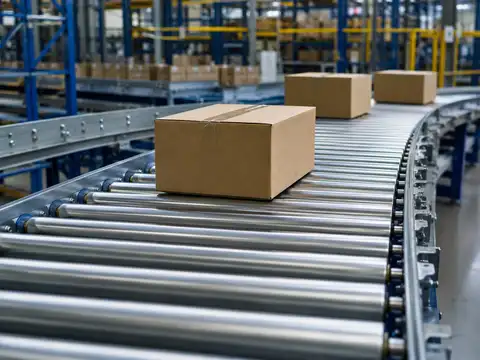
Roller conveyor hardware currently spans from roughly $15–$50 per foot for many light/medium gravity examples to roughly $190–$215 per foot for current 18–24 in MDR examples and approximately $575–$730 per foot for several current 44–52 in heavy CDLR examples.
Roller type + width + centers + load + controls determine the priceThose derived $/ft figures come from specific current Ultimation product configurations. Supports are excluded from some gravity prices but included with the cited CDLR sections, so compare complete configurations rather than the headline cost per foot.
“Roller conveyor” describes several very different machines.
A non-powered gravity rack for cartons, a 24V zone-controlled MDR line and a chain-driven conveyor carrying 3,000-lb pallets all use rollers. Their structures, drives, controls and prices have little in common.
A useful cost estimate therefore begins by deciding which roller architecture the load actually needs.
Current hardware spectrum
Roller conveyor cost changes by multiples as the load and control logic increase
12 in wide, 1.5 in rollers, supports sold separately.
30 in wide, 1.9 in rollers, supports sold separately.
18 in powered roller line with supply and zone controls.
48 in powered chain-driven live roller with motor and legs.
Width, roller centers, load rating, support spacing, drives, accumulation zones, curves, controls and installation determine the real project price.
Current roller conveyor hardware prices
Ultimation's current U.S. catalog provides a useful cross-section of online roller-conveyor pricing.
| Current product example | Configuration | Price | Approx. hardware $/ft |
|---|---|---|---|
| Light gravity roller | 12 in wide × 5 ft, 1.5 in rollers, 6 in centers | $78.50 | $15.70/ft |
| Medium gravity roller | 30 in wide × 10 ft, 1.9 in rollers, 6 in centers | $489.95 | $49.00/ft |
| Heavy gravity set | 51 in wide × 10 ft, 2.5 in rollers, 6 in centers, supports included | $1,499.95 | $150.00/ft |
| 18 in MDR | 10 ft powered 24V roller conveyor, power supply included | From $1,932.50 | $193.25/ft |
| 24 in MDR | 10 ft powered 24V roller conveyor, power supply included | From $2,148.75 | $214.88/ft |
| 44 in CDLR | 10 ft chain-driven live roller, motor and legs included | $5,749 | $574.90/ft |
| 48 in CDLR | 10 ft chain-driven live roller, motor and legs included | $5,979 | $597.90/ft |
| 52 in CDLR | 10 ft chain-driven live roller, motor and legs included | $7,284 | $728.40/ft |
These are market snapshots from one manufacturer and supplier. They are particularly useful because the dimensions and included components are visible, but they should not be averaged into a universal U.S. roller-conveyor rate.
The cheapest current example is about $15.70 per foot
Ultimation's current 12-inch-wide, 5-foot light-duty gravity section is listed at $78.50 and uses 1.5-inch rollers on 6-inch centers.
That works out to approximately $15.70 per foot.
The listing explicitly says leg supports are sold separately.
The low price is possible because this conveyor has no:
- drive motor;
- power supply;
- photo-eyes;
- zone controller;
- PLC;
- powered accumulation logic.
Gravity conveyor cost rises quickly with width and load rating
A current medium-duty Ultimation section measuring 30 inches wide and 10 feet long uses 1.9-inch rollers and is listed at $489.95.
That is approximately $49 per foot before floor supports.
The heavier frame, wider rollers and greater material content explain why the price is more than three times the light 12-inch example on a per-foot basis.
Heavy gravity conveyor can already reach roughly $150–$224 per foot
Ultimation currently lists a 51-inch-wide heavy-duty 10-foot gravity set with 2.5-inch rollers on 6-inch centers and supports at $1,499.95.
A comparable 51-inch-wide 10-foot heavy-duty set using closer 3-inch roller centers is currently $2,239.95.
Those configurations derive to approximately $150/ft and $224/ft respectively.
This is an important cost lesson: gravity does not automatically mean inexpensive once the system becomes wide, dense with rollers and structurally heavy.
Same 51-in width, different roller centers
6-in centers: $1,499.95 / 10 ft.
3-in centers: $2,239.95 / 10 ft.
More rollers per section increase load support and the amount of hardware purchased. The exact required center spacing should follow the conveyed product.
Roller center spacing is a cost variable and a product-fit variable
Ultimation's current heavy-duty guidance uses a practical rule of thumb: the conveyed item should remain supported by at least three rollers at a time.
The company's current gravity lines offer typical roller centers such as:
- 3 inches;
- 4.5 inches;
- 6 inches.
Closer centers mean more rollers, which generally increases:
- hardware cost;
- weight;
- replacement-part count;
- support for short or heavy products.
Do not choose 6-inch centers because they are cheaper
If the shortest carton cannot remain adequately supported, the conveyor can experience:
- stalled packages;
- tipping;
- product snagging;
- impact at transitions;
- manual intervention.
The money saved on fewer rollers can become operating labor.
An average carton can hide the short product that actually determines roller spacing. Include the minimum product length and bottom condition in the RFQ.
Uneven bottoms need more conservative support
Ultimation explicitly notes that uneven-bottom loads may need more than the three-roller rule of thumb.
Problematic bottoms can include:
- ribbed totes;
- damaged cartons;
- soft bags;
- feet or runners;
- open-bottom trays;
- irregular containers.
If the product does not present a stable roller-contact surface, belt conveyor may be a stronger technology.
Roller diameter changes load capability
Ultimation currently uses:
- approximately 1.5-inch rollers for light-duty products;
- approximately 1.9-inch rollers for medium-duty work;
- 2.5-inch and larger rollers for heavy-duty applications.
Larger rollers can provide stronger load capacity but require more steel and heavier frames.
Do not specify roller diameter independently from:
- product weight;
- roller length;
- roller centers;
- support spacing;
- impact loading.
Conveyor width is not the same as package width
Ultimation product descriptions distinguish overall conveyor width from between-frame dimensions.
The useful dimension for product support is typically the available roller width between frames.
When budgeting, verify:
- minimum package width;
- maximum package width;
- desired lateral clearance;
- side guides;
- between-frame dimension;
- overall frame width.
A wider conveyor may also consume materially more building space across long runs.
Supports are often excluded from gravity-section pricing
The light and medium gravity listings cited above state that floor supports are sold separately.
Ultimation currently lists one light-duty adjustable floor support around $32.95.
A 5-foot conveyor-and-leg set in another current configuration is approximately $137.95.
Those examples show why two gravity quotes should identify whether supports are included.
Support spacing changes both price and structural capacity
Ultimation's current heavy-duty guidance recommends selecting support spacing deliberately and notes that 5-foot support intervals can increase load capacity compared with longer spans.
More supports add:
- material cost;
- anchors;
- installation labor;
- floor penetrations;
- obstructions beneath the line.
But undersupporting a heavy line is not an acceptable cost reduction.
Gravity conveyor operating cost is low because there is no motor
Hytrol's current gravity-conveyor guidance emphasizes that gravity systems use gravity or manual force rather than motors or power sources.
That usually reduces:
- electrical infrastructure;
- energy consumption;
- motor maintenance;
- control-system maintenance;
- commissioning complexity.
The trade-off is less control over product movement.
Gravity is cheap when the process naturally supports it
Strong gravity applications include:
- manual pack-out lanes;
- short carton transfer;
- workstation infeed/outfeed;
- flow-rack takeaway;
- temporary shipping lines;
- declines where speed can be controlled safely.
Gravity becomes weaker when product needs precise spacing, automatic buffering or independent release.
Powered live roller adds continuous transport
Hytrol currently describes live roller conveyor as electrically powered roller equipment for moving boxed or palletized products.
Traditional powered roller can use:
- central AC motors;
- belts;
- chains;
- line shafts;
- other power-transmission methods.
It can provide reliable transport across longer fixed routes without employees pushing product.
MDR changes powered roller into a zone-based system
Ultimation's current MDR conveyor uses 24V DC motorized rollers with individual zones, photo-eyes and automatic start/stop behavior.
Its current 18-inch-wide, 10-foot model starts at $1,932.50.
Its current 24-inch-wide, 10-foot model starts at $2,148.75.
These derive to approximately $193/ft and $215/ft respectively before treating them as a complete installed line.
Why a 5-foot MDR costs more per foot than a 10-foot MDR
Ultimation currently lists the 18-inch 5-foot MDR from $1,649.75.
That is approximately $330/ft.
The 10-foot version is approximately $193/ft because fixed hardware such as power/control components is spread across twice the length.
Short conveyor sections should therefore not be priced by multiplying the 10-foot per-foot rate.
Powered curves can cost more than straight sections
Ultimation currently shows a 24-inch powered MDR 90-degree curve at approximately $3,278 on its advertised sale price.
A curve has:
- special geometry;
- tapered or controlled rollers;
- drive components;
- guiding requirements;
- more complex fabrication.
Price curves as modules rather than as their centerline feet multiplied by a straight-conveyor rate.
Interroll shows what a modern MDR zone contains
Interroll's current RM 8310 uses:
- a RollerDrive EC5000 in each driven zone;
- slave rollers;
- PolyVee belts;
- 24/48V DC architecture;
- MultiControl for zero-pressure accumulation;
- pre-wired modular construction.
Current published load capacity is up to 50 kg per zone at relevant speed configurations.
This illustrates why MDR pricing reflects much more than a frame full of rollers.
Zone length changes the controls budget
A 100-foot MDR line divided into 5-foot zones has fewer control points than the same line divided into 2-foot zones.
Shorter zones can improve:
- buffer density;
- product separation;
- release precision;
- routing control.
They also increase the number of sensors, powered zones and control objects.
Zero-pressure accumulation is a different purchase from simple transport
Hytrol currently defines zero-pressure accumulation as a system that creates space between products and prevents them from touching while accumulated.
This can reduce:
- carton compression;
- fragile-product contact;
- back-pressure jams;
- manual clearing.
It requires zone sensing and release logic.
Hytrol's current E24 uses decentralized 24V drives by zone
Hytrol's E24 architecture places a 24V motor in each accumulation zone instead of using one centralized drive for the entire conveyor.
Hytrol positions the system around:
- individual zone speed control;
- energy efficiency;
- flexibility;
- precise acceleration;
- accumulation.
The company contrasts this architecture with conventional systems where one centralized motor can power long conveyor runs.
More zone motors can mean easier reconfiguration
Hytrol's comparison of conventional accumulation and E24 notes that decentralized drives make turns and layout changes more flexible because power is distributed by zone.
That architecture can also reduce large mechanical power-transmission systems.
The trade-off is a larger count of distributed electrical/electronic components.
Chain-driven live roller is the heavy end of roller conveyor
Current Ultimation CDLR examples make the price step visible.
A 48-inch-wide, 5-foot CDLR module with motor and legs is currently advertised at $4,149.
The 10-foot version is currently $5,979.
The 10-foot configuration therefore costs less per foot because the motor and other fixed components are shared across the longer section.
5 ft vs 10 ft
5 ft: $4,149 → ~$830/ft.
10 ft: $5,979 → ~$598/ft.
This is another example of why short powered modules can have much higher cost per foot than longer straight runs.
CDLR pricing belongs partly in the pallet-conveyor conversation
Ultimation positions its current CDLR equipment for heavy and large products including:
- pallets;
- drums;
- crates;
- other heavy unit loads.
The dedicated pallet-conveyor article will evaluate those heavy-load systems in more detail.
For roller-conveyor budgeting, the key point is that heavy-duty powered roller can cost several times more per foot than carton MDR.
The “roller conveyor cost per foot” question needs at least six specifications
Before asking for a useful rate, define:
- powered or gravity;
- between-frame width;
- roller diameter;
- roller centers;
- maximum unit weight;
- transport only or accumulation.
Without those inputs, a per-foot answer can easily be wrong by an order of magnitude.
Add the minimum and maximum product dimensions
A conveyor handling only one carton is straightforward.
A distribution center can handle:
- 8-inch small cartons;
- 24-inch cases;
- 36-inch totes;
- long narrow packages;
- poly-bags that should not be on rollers at all.
The shortest and least stable package can control the roller specification.
Product weight affects more than roller strength
Heavier products can require:
- larger rollers;
- closer centers;
- stronger frames;
- closer support spacing;
- larger motors;
- different drive architecture;
- more substantial stops/transfers.
A conveyor designed for 35-lb cartons should not be priced for 400-lb loads by changing only the roller diameter.
Product speed is another cost driver
Higher conveyor speed can demand:
- stronger drives;
- better product gapping;
- more precise sensing;
- controlled acceleration/deceleration;
- better merge logic;
- stronger guarding and risk controls.
Do not specify maximum speed without defining the required throughput.
Throughput and conveyor speed are not the same
A fast conveyor can carry few products per hour if gaps are large.
A slower conveyor can carry high throughput if product pitch is tight and flow is continuous.
Conceptual unit throughput
conveyor feet/minute ÷ product pitch in feet × 60
This is only a conceptual transport calculation. Real throughput must account for merges, accumulation, induction, controls and downstream bottlenecks.
Accumulation capacity should be measured in products
If downstream packing stops for three minutes, how many units must the conveyor hold?
That requirement determines:
- buffer length;
- zone count;
- product spacing;
- control logic.
A line sized only for transport may fail operationally because it has nowhere to store product during short stops.
Example: buffer requirement
600 cartons/hour and a four-minute recovery target
600/hour = 10 cartons/minute.
10 × 4 minutes = 40 cartons.
The roller system should have enough accumulation capacity for roughly 40 representative cartons if the business wants to absorb that stoppage without backing upstream. Actual conveyor length depends on carton dimensions and required gaps.
Curves add cost and can change roller technology
Interroll's current RM 8320 driven curve uses tapered rollers to preserve product orientation through the turn.
Its current architecture includes:
- RollerDrive;
- round-belt slave-roller drive;
- zero-pressure controls;
- pre-wired modular construction.
A curve is therefore a dedicated engineered module, not a straight frame bent around a corner.
Spurs, merges and diverts change the project from transport to flow control
A straight roller line can be inexpensive.
Once product needs to:
- merge from two sources;
- divert to two destinations;
- queue before a machine;
- change direction;
- stop at a workstation
the project needs sensors, actuators and logic.
Price these functions separately.
PLC controls can be a large fixed cost on a short MDR system
Ultimation's current related MDR products include a PLC panel package listed around $6,918.
That does not mean every MDR installation needs this exact panel.
It does demonstrate that on a short automated line, controls can cost more than several conveyor sections.
Do not compare a self-contained MDR section with a fully integrated controls quote
Normalize:
- power supply;
- zone sensors;
- local controllers;
- PLC;
- HMI;
- network;
- scanner interfaces;
- WCS/WMS signals;
- field wiring;
- commissioning.
A low mechanical quote can become the high total project.
Replacement rollers are inexpensive relative to complete systems
Ultimation currently lists individual 1.9-inch galvanized replacement rollers in several lengths for roughly low double-digit prices.
One current 21-inch-between-frame 1.9-inch gravity roller is approximately $11.50.
A current 15-inch grooved roller is around $13.30.
A 27-inch-between-frame 1.9-inch replacement roller is around $20.95.
This helps explain why simple gravity roller conveyor can have low parts cost.
A motorized roller can cost an order of magnitude more than a gravity roller
Ultimation currently lists one Itoh Denki 1.9-inch motorized conveyor roller around $193.50.
That is not comparable with an ordinary $11–$20 gravity replacement roller: the motorized unit contains the drive function for its conveyor zone.
MDR maintenance therefore has fewer central mechanical transmission components but more expensive powered rollers and controls at distributed points.
Run-on-demand can reduce energy and noise
Ultimation describes its current Itoh Denki motorized rollers as run-on-demand: they operate when needed rather than continuously.
Hytrol also positions 24V zone conveyor around decentralized, efficient operation.
The economic value depends on:
- conveyor idle time;
- number of zones;
- electricity price;
- duty cycle;
- maintenance avoided.
Do not apply a generic percentage savings without measuring the actual baseline.
Conventional live roller can still be economical on long simple runs
Hytrol's current comparison notes that conventional centralized drives can power long conveyor runs.
That can be attractive where:
- transport is continuous;
- routing is simple;
- product does not need many independent zones;
- the line is long;
- centralized maintenance is preferred.
MDR is not automatically the lowest-cost architecture for every powered roller line.
Washdown can eliminate common 24V roller options
Hytrol's May 2025 environmental-selection guidance states that it does not recommend EZLogic-equipped or E24 conveyor in washdown environments and notes that O-ring-driven rollers are also unsuitable where water causes drive loss.
Hytrol says certain chain-driven and minimum-pressure conveyors can be quoted in stainless steel for washdown duty.
Environmental specification can therefore change both roller technology and price.
Hytrol specifically notes that galvanized conveyor should not automatically be considered washdown equipment. Food, beverage and wet-process applications need the correct environmental specification.
Cold storage can support MDR—but only with the correct product
Interroll's current RM 8310 is specified for ambient temperatures from approximately -30°C to +40°C.
Its current driven curve has the same published ambient range.
Freezer projects still need:
- temperature-rated controls;
- cabling;
- sensors;
- lubricants;
- condensation planning;
- maintenance procedures.
Do not assume every online MDR listing has the same cold-storage rating.
Roller conveyor installation cost depends on whether the line is truly modular
A short gravity line can be installed with:
- sections;
- legs;
- bolts;
- anchors;
- leveling.
A powered line can add:
- power distribution;
- sensors;
- controls;
- field wiring;
- network;
- guarding;
- commissioning.
The dedicated conveyor-installation guide will price those scopes separately.
Do not use one installation percentage for every roller system
A 30-foot floor-level gravity line and a 300-foot MDR system above workstations have completely different installation risk.
Quote field labor from:
- layout;
- elevation;
- support count;
- electrical scope;
- operating-shutdown constraints;
- controls complexity.
Guarding cost increases with powered roller
Powered roller conveyor introduces:
- drive components;
- nip points;
- powered transfers;
- chains/belts on some designs;
- stored energy.
OSHA's warehousing guidance tells employers to inspect conveyors regularly and adequately guard pinch points.
Machine guarding should be in the base project, not added after commissioning.
Lockout/tagout belongs in the maintenance design
OSHA's hazardous-energy rule applies to servicing and maintenance where unexpected energization or stored energy can injure workers.
Powered roller projects should identify:
- disconnects;
- zone isolation;
- electrical energy;
- pneumatic devices;
- gravity/stored mechanical energy;
- maintenance access.
A conveyor that is easy to isolate is usually easier to maintain.
Gravity conveyor still has ergonomic and pinch hazards
Non-powered does not mean hazard-free.
Risks can include:
- hands between rollers;
- uncontrolled product on slopes;
- manual pushing;
- heavy-product handling;
- falling product;
- poorly secured sections.
Safety review should follow the actual installation.
How much would 40 ft of gravity roller conveyor cost?
Using the current 30-inch-wide medium-duty example strictly as a hardware basis:
Four current 10-ft medium-duty sections
4 × $489.95 = $1,959.80 for the conveyor sections.
Supports, curves, freight, anchoring and labor remain separate unless the selected configuration explicitly includes them.
How much would 100 ft of simple 18-in MDR hardware cost?
Using ten current 10-foot Ultimation sections:
Ten 10-ft MDR sections
10 × $1,932.50 = $19,325 of section-level hardware at the current starting configuration.
A real 100-ft system can still require curves, supports, integration, panel/PLC controls, field power, guarding and commissioning.
The $19,325 concept is not a turnkey 100-ft system quote
The section multiplication is useful only for answering:
“What order of magnitude is the straight MDR hardware?”
It does not answer:
- how many accumulation zones are needed;
- whether one or several supplies/controllers are required;
- what the controls architecture costs;
- whether the line has curves or transfers;
- how much electrical work is required;
- what installation costs.
How much would 40 ft of heavy 48-in CDLR cost?
Using four current 10-foot modules:
Four current 48-in CDLR modules
4 × $5,979 = $23,916.
The cited modules include motor and legs, but the complete heavy-load line can still require controls, transitions, safety devices, transfers, field power and installation.
Heavy roller cost can exceed light MDR cost even without sophisticated logic
The 40-foot CDLR hardware example above is already higher than the 100-foot 18-inch MDR section arithmetic.
This illustrates that:
load class can matter as much as automation class.
Moving a 3,000-lb pallet safely requires a fundamentally different machine from moving a 25-lb carton.
Used roller conveyor can be economical when the dimensions match
Used conveyor has relatively simple inspection points compared with complex automation.
Check:
- frame straightness;
- roller damage;
- bearing condition;
- roller centers;
- between-frame width;
- support availability;
- drive components;
- controls obsolescence;
- spare-parts availability;
- freight and dismantling.
A cheap used line with the wrong width or centers can be expensive to modify.
Gravity conveyor is especially reusable
Simple gravity sections are often:
- modular;
- easy to relocate;
- free of software dependency;
- easy to inspect;
- supported by generic replacement rollers.
This can make used or repurposed gravity conveyor attractive for temporary warehouse processes.
Powered conveyor needs a stronger obsolescence check
A used MDR system can include:
- obsolete motorized rollers;
- discontinued controllers;
- old photo-eyes;
- legacy PLC hardware;
- unsupported software;
- proprietary cabling.
The steel may have 20 years of life remaining while the controls are already economically obsolete.
Roller conveyor vs belt conveyor is usually a product-bottom decision first
Roller conveyor is attractive when the product is:
- rigid;
- flat-bottomed;
- large enough for the selected roller centers;
- stable across several rollers.
Belt is stronger when the product is:
- very small;
- soft;
- bagged;
- irregular underneath;
- likely to snag between rollers.
The dedicated belt-conveyor cost guide is next in this cluster.
Do not select roller conveyor only because it is cheaper
A low-cost roller system that requires employees to repeatedly rescue small packages can have worse lifecycle economics than a more expensive belt system.
Product compatibility comes before equipment price.
Gravity vs powered roller is a flow-control decision
Choose gravity when:
- product can move safely without powered transport;
- throughput is modest;
- automatic spacing is unnecessary;
- manual intervention is acceptable;
- lowest equipment/energy complexity matters.
Choose powered roller when:
- distance is meaningful;
- flow must be continuous;
- manual pushing is expensive;
- automatic release/accumulation matters;
- routing or process synchronization is needed.
MDR vs conventional powered roller is a controls architecture decision
MDR is particularly attractive when:
- zero-pressure accumulation is valuable;
- independent zones matter;
- energy use during idle periods matters;
- quiet operation matters;
- layout flexibility matters.
Conventional centralized live roller can remain strong when:
- the run is long and simple;
- continuous transport dominates;
- few independent zones are required;
- centralized drive maintenance is preferred.
CDLR is the heavy-duty choice when loads demand it
Chain-driven live roller becomes appropriate when ordinary carton MDR cannot provide the:
- unit-load capacity;
- roller strength;
- drive torque;
- frame strength
required for heavy drums, crates or pallets.
Do not pay the heavy-duty premium for 20-lb cartons.
A practical roller conveyor RFQ
Send the supplier:
- minimum/maximum product dimensions;
- minimum/maximum unit weight;
- bottom-surface description;
- required line length;
- required between-frame width;
- desired top-of-roller height;
- average/peak units per hour;
- transport or accumulation requirement;
- required buffer quantity;
- curves / transfers;
- temperature / washdown;
- hours per day;
- electrical standard;
- controls interface;
- installation scope.
Normalize quotes by included scope
| Quote item | Check |
|---|---|
| Conveyor sections | Length, width, roller diameter, centers |
| Supports | Included or separate, spacing, top-of-roller height |
| Drives | Central AC, MDR, CDLR, quantity |
| Accumulation | Zone length, sensors, controls |
| Curves | Powered/gravity, radius, orientation |
| Transfers | Quantity and actuation |
| Controls | PLC, panels, HMI, zone controllers |
| Electrical | Power supplies, field wiring, disconnects |
| Safety | Guarding, e-stops, access |
| Installation | Anchors, labor, lifts, commissioning |
| Spares | Rollers, motorized rollers, sensors, controls |
The practical recommendation
Use current online pricing to establish the equipment class:
light gravity can be measured in tens of dollars per foot; powered carton MDR often in low hundreds per foot; heavy powered roller can move into several hundred dollars per foot.
Then stop comparing by foot.
Specify the actual:
product + load + roller centers + width + supports + drive + accumulation + controls
and compare delivered systems with the same scope.
The correct roller conveyor is the least complex roller architecture that can reliably support the smallest product, survive the heaviest load and deliver the required flow without creating manual intervention.
Frequently asked questions
How much does roller conveyor cost per foot?
Current Ultimation examples range from approximately $15.70/ft for a small light-duty gravity section to approximately $193–$215/ft for current 10-ft MDR examples and around $575–$730/ft for several current heavy CDLR examples. Configuration and included supports/controls differ materially.
How much does gravity roller conveyor cost?
Ultimation's broad current planning guidance places low-cost gravity conveyor around $13–$40 per foot, while its larger medium/heavy current products can exceed that range substantially as width, roller density and load capability increase.
How much does MDR conveyor cost?
Ultimation currently lists a 10-ft, 18-in MDR section from $1,932.50 and a 10-ft, 24-in section from $2,148.75. Complete installed systems can add supports, curves, PLC/control hardware, electrical work and commissioning.
How much does chain-driven live roller conveyor cost?
Current Ultimation 10-ft heavy CDLR examples are approximately $5,749–$7,284 across several 44–52-in configurations with motor and legs included. These are current product snapshots rather than national market averages.
Why does roller conveyor price vary so much?
Width, roller diameter, roller centers, product weight, support spacing, powered vs gravity operation, zone controls, accumulation, curves and heavy-duty construction all change the equipment.
How many rollers should support a carton?
Ultimation's current guidance uses at least three rollers beneath the product as a rule of thumb and recommends more support for uneven-bottom products.
Are conveyor supports included?
Sometimes. The cited light and medium Ultimation gravity sections sell supports separately, while several cited heavy gravity/CDLR sets explicitly include supports. Confirm scope before comparing $/ft.
What is zero-pressure accumulation?
Hytrol defines it as controlled accumulation where products are held in zones without touching one another, reducing back pressure and product contact.
What is an MDR conveyor?
Motor-driven roller conveyor uses motorized rollers to power conveyor zones. Modern systems combine the powered roller with sensors and decentralized controls for transport and accumulation.
Is gravity or powered roller conveyor cheaper?
Gravity is normally much cheaper to purchase and has minimal energy/drive maintenance. Powered roller can become economically stronger when it removes repeated manual pushing, controls flow or provides automatic accumulation.
Can roller conveyor be used in a freezer?
Yes with properly rated equipment. Interroll currently specifies its RM 8310 MDR module for approximately -30°C to +40°C, but not every roller conveyor or control package carries that rating.
Can MDR conveyor be used in washdown?
Not every system. Hytrol currently says it does not recommend its EZLogic/E24 configurations in washdown environments and distinguishes washdown-rated equipment from ordinary galvanized conveyor.
Sources and methodology
Warehouse Fieldbook uses current Ultimation online product prices as transparent hardware snapshots and calculates $/ft by dividing the listed section price by listed length. Prices with excluded supports are identified separately from products that include legs/supports. Hytrol and Interroll provide current manufacturer guidance on gravity, live roller, 24V MDR, zero-pressure accumulation, environmental suitability and zone architecture. OSHA provides current general-industry warehousing, guarding and hazardous-energy context. No current product listing is represented as a national average or complete installed-system quote.
- Ultimation — current 12-in × 5-ft light gravity roller price
- Ultimation — current 30-in × 10-ft medium gravity roller price
- Ultimation — current 51-in × 10-ft heavy gravity set, supports included
- Ultimation — current heavy gravity 3-in-center price example
- Ultimation — current gravity roller design, width, diameter and pricing guidance
- Ultimation — current three-roller product-support rule of thumb
- Ultimation — current 18-in × 10-ft 24V MDR price and controls
- Ultimation — current 24-in × 10-ft MDR price
- Ultimation — current 18-in × 5-ft MDR price
- Ultimation — current 44-in × 10-ft CDLR price
- Ultimation — current 48-in × 10-ft CDLR price
- Ultimation — current 52-in × 10-ft CDLR price
- Ultimation — current replacement gravity/grooved roller prices
- Ultimation — current Itoh Denki motorized roller price
- Hytrol — current gravity conveyor operating characteristics
- Hytrol — current live roller conveyor application
- Hytrol — current E24 decentralized 24V conveyor architecture
- Hytrol — current zero-pressure accumulation definition
- Hytrol — current washdown/environment conveyor selection guidance
- Interroll — current RM 8310 MDR/ZPA technical data
- Interroll — current powered roller curve technical data
- OSHA — warehousing conveyor inspection and guarding guidance
- OSHA — 29 CFR 1910.212 general machine guarding
- OSHA — control of hazardous energy / lockout-tagout