
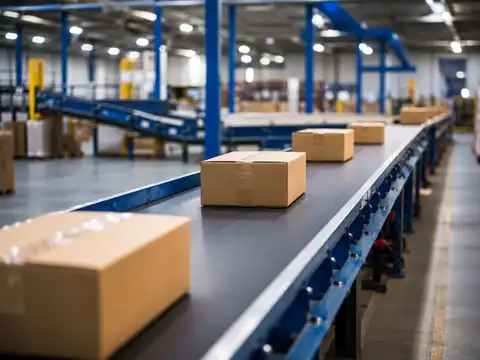
For conceptual budgeting, Ultimation currently places simple motorized belt conveyor in roughly the $150–$400 per linear foot category.
Current hardware examples: about $1,560 to $5,300 for several 5–16 ft standard belt configurationsThat range does not include every possible support, curve, incline, guide, control panel, sensor, guarding item, electrical scope or installation requirement. Sanitary, heavy-duty and highly customized systems can belong in a different cost class.
Belt conveyor is one of the simplest ways to create powered A-to-B material flow.
Two pulleys drive a continuous belt, giving the product a solid support surface instead of asking it to bridge gaps between rollers.
That makes belt conveyor especially useful for small, irregular, bagged or unstable-bottom products that are poor candidates for roller conveyor.
The apparent simplicity can make budgeting look equally simple. It is not.
A warehouse can buy a short plug-in conveyor for a few thousand dollars or engineer a long, inclined, controlled, sanitary belt system whose cost is driven far more by the application than by its linear footage.
Current belt-conveyor cost ladder
A simple belt line can be inexpensive. The application around the belt is what raises the budget.
Current 18 in × 5 ft variable-speed Ultimation hardware example.
Current 18 in × 10 ft example, approximately $191.85/ft.
Current 18 in belt × 11 ft Ultimation industrial configuration.
Current 24 in belt × 16 ft Ultimation configuration.
Slider bed vs roller bed, belt material, incline, cleats, guides, speed, motor/VFD, supports, guarding, controls, washdown requirements and field installation can change the real project cost substantially.
Current belt conveyor prices
Ultimation currently publishes several complete belt-conveyor products online, making it possible to anchor a 2026 budget in actual hardware pricing rather than invented market averages.
| Current product | Configuration | Current price | Derived hardware $/ft |
|---|---|---|---|
| Roller-bed belt conveyor | 18 in wide × 5 ft | $1,559.50 | $311.90/ft |
| Roller-bed belt conveyor | 18 in wide × 10 ft | $1,918.50 | $191.85/ft |
| Industrial belt conveyor | 12 in belt × 6 ft | $3,039 | $506.50/ft |
| Industrial belt conveyor | 12 in belt × 11 ft | $3,873 | $352.09/ft |
| Industrial belt conveyor | 18 in belt × 11 ft | $4,238 | $385.27/ft |
| Industrial belt conveyor | 20 in belt × 11 ft | $4,357 | $396.09/ft |
| Industrial belt conveyor | 24 in belt × 11 ft | $4,599 | $418.09/ft |
| Industrial belt conveyor | 20 in belt × 16 ft | $4,993 | $312.06/ft |
| Industrial belt conveyor | 24 in belt × 16 ft | $5,314 | $332.13/ft |
Every $/ft number above is simple arithmetic from one listed conveyor price and its listed length.
The values are useful for understanding scale. They are not a claim that one belt width or bed design always costs a fixed amount per foot.
The product families, dimensions, drive packages and included features differ. Use them as public hardware anchors and obtain a project-specific quote for the actual system.
Why the 5-ft belt conveyor costs more per foot than the 10-ft version
Ultimation currently lists its 18-inch-wide 5-foot roller-bed belt conveyor at $1,559.50.
The corresponding 10-foot product is $1,918.50.
The line becomes twice as long while price rises by only about $359.
That happens because a short powered conveyor still needs:
- a drive;
- pulleys;
- belt tensioning;
- controls;
- power connection;
- end hardware.
Fixed equipment cost is spread across more feet as the straight section gets longer.
5 ft vs 10 ft of the same current roller-bed family
5 ft: $1,559.50 → $311.90/ft.
10 ft: $1,918.50 → $191.85/ft.
This is why short powered conveyor should not be priced by multiplying a long-line per-foot estimate.
Width increases cost—but length can dilute the width premium
Current Ultimation 11-foot industrial models are listed at:
- 12-inch belt: $3,873;
- 18-inch belt: $4,238;
- 20-inch belt: $4,357;
- 24-inch belt: $4,599.
The wider conveyor requires:
- a wider belt;
- wider pulleys;
- wider bed/frame;
- larger supports;
- more material.
But the drive and much of the end hardware may remain one system. This is why width does not multiply the entire conveyor price proportionally.
Current 16-ft examples show the same pattern
Ultimation currently lists:
20-inch belt × 16 ft at $4,993 and 24-inch belt × 16 ft at $5,314.
That is only a $321 difference in these two current configurations.
The implication is useful for layout design: selecting the narrowest possible conveyor solely to save capital may produce little benefit if a few additional belt inches materially improve product stability.
Use belt width from product geometry, not from price
Define:
- minimum product width;
- maximum product width;
- product orientation;
- side-guide clearance;
- future product size;
- transfer requirements.
A belt that is too narrow can create more product contact with side guides and more instability.
A belt that is unnecessarily wide consumes capital, floor space and energy.
Simple belt conveyor sits around $150–$400/ft in current supplier planning guidance
Ultimation's current general conveyor-pricing page places simple motorized belt conveyor and motor-driven roller conveyor at approximately $150–$400 per foot.
The current 18-inch × 10-foot belt example at approximately $192/ft fits inside that range.
Several of the larger industrial configurations sit around $300–$420/ft.
Shorter/custom configurations can exceed the range on a per-foot basis because fixed components are concentrated over fewer feet.
Do not extrapolate the broad range into a turnkey project
A conceptual calculation such as:
100 ft × $150–$400/ft = $15,000–$40,000
can be useful for rough simple-hardware context.
It should not be presented as the installed cost of a 100-foot system containing:
- inclines;
- multiple drives;
- curves;
- transfers;
- scanners;
- PLC logic;
- guarding;
- field electrical;
- structural supports;
- installation labor.
Slider-bed belt conveyor is the simplest basic architecture
Ultimation describes slider-bed conveyor as the simplest belt-conveyor style.
The belt slides across a continuous supporting bed.
This creates a stable support surface and relatively straightforward construction.
It can be a strong fit for:
- cartons;
- bags;
- small products;
- irregular-bottom packages;
- bundled items.
Roller-bed belt conveyor reduces sliding support friction
In a roller-bed belt conveyor, rollers support the belt instead of one continuous sliding bed.
The architecture can be useful when:
- the conveyor is longer;
- loads are heavier;
- belt drag becomes important;
- drive power needs to be controlled.
The correct bed design depends on load, length, belt and manufacturer engineering.
Do not confuse roller-bed belt conveyor with roller conveyor
A roller-bed belt conveyor still has a continuous belt carrying the product.
The rollers are underneath the belt.
In ordinary roller conveyor, the product itself rests directly on the rollers.
This distinction matters because product compatibility is different.
Belt conveyor is often better for products that roller conveyor dislikes
Ultimation currently describes belt systems as suitable for regular and irregular shapes, packaged goods, totes, bulk boxes and bundled items.
Interroll's current BM 8350 belt conveyor is specifically designed for small goods and products unsuitable for roller tracks.
That makes belt attractive for:
- small cartons;
- poly mailers;
- soft packages;
- odd-shaped items;
- items with unstable bottoms;
- products smaller than practical roller spacing.
Product compatibility can justify a higher conveyor price
Suppose a roller system costs less but 5% of the product mix repeatedly:
- stalls;
- falls between rollers;
- requires trays;
- needs manual rescue;
- arrives misoriented downstream.
Belt conveyor can have better lifecycle economics even if mechanical hardware is more expensive.
Belt material changes the application and the cost
Dorner's current belt portfolio includes:
- fabric belts;
- modular plastic belts;
- specialty belt surfaces;
- sanitary configurations.
Belt selection can be driven by:
- friction;
- temperature;
- food contact;
- oil resistance;
- cut resistance;
- static control;
- release properties;
- cleanability.
The correct belt is an engineering consumable, not an upholstery choice.
Fabric belt is common for general warehouse transport
Fabric belts can provide:
- continuous support;
- many surface/friction options;
- relatively simple tracking;
- high-speed capability depending on design.
Dorner's 2200 and 3200 platforms currently offer fabric-belt configurations across small/medium parts handling and heavier industrial work.
Modular plastic belt can justify a premium where cleanability or configuration matters
Dorner currently positions modular plastic belts as useful where:
- cleaning matters;
- belt repair by module is valuable;
- curves or specialty layouts are required;
- food/sanitary requirements apply;
- positive engagement is useful.
A modular belt should be evaluated from total application economics rather than assuming fabric belt is always the lower-cost answer.
Sanitary belt conveyor belongs in a different cost category
Dorner's current AquaGard and AquaPruf families use sanitary stainless-steel architecture designed around contamination control and washdown.
Dorner's May 2026 hygienic-design guidance distinguishes:
- AquaGard for dry wipe-down and lower-pressure wash applications;
- AquaPruf for high-pressure and chemical washdown;
- AquaPruf Ultimate variants for especially high-sanitation raw-food environments.
These systems can require:
- stainless frames;
- sanitary welds;
- washdown motors;
- food-grade materials;
- tool-less access;
- open-frame drainage;
- more demanding cleanability.
Do not use standard warehouse conveyor $/ft to budget a sanitary process line.
A food-grade belt installed on a non-sanitary frame does not automatically create a sanitary conveyor. Frame geometry, access, drainage, fasteners, bearings, motors and cleaning method matter too.
Incline belt conveyor adds another design layer
Belt conveyor is commonly used to move product up or down an incline because the continuous surface creates product contact unavailable from gravity rollers.
Ultimation explicitly lists incline/decline movement as a common belt-conveyor application.
Interroll's current BM 8350 supports modest incline/decline operation and lists approximately 4 degrees as its standard maximum, with other configurations available on request.
More aggressive elevation changes can require a different conveyor or belt design.
Incline angle cannot be selected independently from the product
The maximum workable angle depends on:
- belt friction;
- package bottom;
- weight;
- center of gravity;
- acceleration;
- cleats;
- side guides;
- whether product is moving up or down.
A belt that reliably lifts a rough cardboard carton may allow a smooth plastic tote to slide backward at the same angle.
Cleated belt cost should be compared with the elevation problem it solves
Cleats can mechanically prevent products from sliding backward.
They can also create:
- special belt fabrication;
- cleaning challenges;
- transfer limitations at the ends;
- product-spacing constraints;
- replacement-belt complexity.
Quote the complete cleated conveyor rather than adding an arbitrary cleat percentage to a flat-belt price.
Z-frame conveyor combines horizontal and inclined sections
Dorner's current product families include Z-frame and incline/decline configurations for routing product between elevations while controlling the footprint.
Compared with a straight conveyor, a Z-frame can add:
- transition geometry;
- additional support structure;
- belt-tracking complexity;
- cleat requirements;
- higher frame fabrication cost.
It should be priced as a configured machine.
Belt curves are also specialized modules
Interroll currently offers belt-curve conveyor modules inside its modular conveyor platform.
A belt curve must manage:
- belt geometry through the radius;
- product orientation;
- tension;
- guiding;
- drive behavior.
A 90-degree belt curve is not priced from straight-conveyor centerline footage.
Variable speed can be standard or a meaningful upgrade depending on the product family
Ultimation's current 18-inch roller-bed examples are sold as variable-speed conveyors.
A separate current Ultimation 12-inch × 11-foot industrial variable-speed package with controller, drive and adjustable legs is listed at $3,999.
This is another reminder to compare included scope.
One listing may already include variable speed while another may require a separate VFD/control package.
Why variable speed has value
Speed control can help:
- balance upstream/downstream processes;
- reduce product impact;
- adjust production rate;
- control manual workstation pace;
- tune transfers;
- support multiple product types.
The correct speed is the lowest practical speed that still meets throughput and process requirements.
Do not buy belt speed before calculating throughput
Conceptual belt throughput
belt speed in ft/min ÷ product pitch in ft × 60
Product pitch means product length plus required gap.
Real system throughput can still be constrained by:
- induction;
- operators;
- scanners;
- transfers;
- downstream machines;
- accumulation;
- sortation.
High speed belongs in a different engineering discussion
Dorner currently states that its 3200 Precision Move conveyor can regularly achieve approximately 500 ft/min.
That type of performance is far removed from an ordinary warehouse package-moving line.
High speed can require:
- precision tracking;
- better transfers;
- controlled acceleration;
- more guarding;
- higher-spec drives;
- more precise controls.
Do not pay for 500 ft/min when the process needs 60.
Interroll's BM 8350 shows the modern low-voltage belt-conveyor alternative
Interroll's current BM 8350 is a driven belt conveyor integrated into its modular conveyor platform.
Current specifications include:
- up to 50 kg/m per zone;
- up to 0.8 m/s conveyor speed;
- 24/48V drive;
- zero-pressure accumulation with MultiControl;
- fully assembled, pre-wired delivery.
This is a different architecture from one long AC-motor belt line.
Zone-based belt conveyor is useful when small products also need accumulation
Roller-based ZPA works well when products are stable on rollers.
Belt-based zones can extend controlled accumulation to smaller or less roller-friendly goods.
The trade-off is:
- more distributed drives;
- more zones;
- more sensors;
- more control logic.
Price it as an accumulation system, not a simple belt run.
Continuous belt conveyor can still be the cheaper architecture for simple transport
Ultimation emphasizes belt conveyor simplicity as one reason it can achieve economical cost per foot.
If the process is:
- one origin;
- one destination;
- continuous flow;
- no independent zones;
- no routing;
- no buffering
one conventional drive can be economically attractive.
Controls cost rises when the belt has to make decisions
A simple conveyor can need little more than:
- motor starter or VFD;
- local controls;
- emergency stop;
- power connection.
A controlled material-flow line can add:
- photo-eyes;
- encoders;
- PLC;
- HMI;
- barcode scanning;
- WCS logic;
- network communication;
- downstream interlocks.
The belt itself can remain identical while the project cost changes materially.
Supports and elevation need to be normalized in every quote
Ultimation's current roller-bed product tells the customer to attach conveyor supports and plug the unit into 110V power.
Other current product configurations explicitly include adjustable legs.
Compare:
- support quantity;
- support height;
- casters vs fixed legs;
- floor anchors;
- cross-bracing;
- elevated support steel.
A support package can be trivial on a 5-foot floor conveyor and major on a long elevated line.
Portable belt conveyor changes the value proposition
Adding casters or adjustable stands can let a conveyor move between:
- packing lines;
- dock doors;
- temporary production cells;
- seasonal operations.
Mobility can avoid buying several permanently installed conveyors.
It can also require:
- stable locking casters;
- safe flexible power;
- repeatable alignment;
- operator setup procedures.
Electrical cost is small on a plug-in unit and large on an integrated line
The cited short Ultimation roller-bed conveyors can plug into a standard 110V wall outlet.
A large industrial project can require:
- new branch circuits;
- disconnects;
- motor control;
- VFD panels;
- transformers;
- conduit;
- cable tray;
- network;
- field installation.
The electrical demarcation point should be stated in the quote.
Belt tracking is a lifecycle cost, not only a commissioning task
A belt that consistently tracks to one side can:
- rub the frame;
- damage edges;
- create debris;
- increase motor load;
- cause downtime.
Tracking depends on:
- frame alignment;
- pulley alignment;
- belt splice;
- tension;
- product loading;
- contamination.
A low-cost conveyor that is difficult to track can be expensive over its life.
Belt replacement is a planned lifecycle event
Belt wear depends on:
- hours;
- speed;
- product abrasion;
- temperature;
- oil/chemicals;
- tracking;
- tension;
- cleaning;
- splice condition.
Ask the supplier for:
- replacement belt part number;
- current replacement price;
- lead time;
- recommended spare quantity;
- change procedure;
- expected labor time.
The replacement belt is one of the most important critical spares on a mission-critical line.
Quick-release belt design can reduce maintenance downtime
Dorner's current conveyor platforms emphasize belt-access and quick-change features on several products, especially where cleaning or frequent product change matters.
A more expensive conveyor can have lower lifecycle cost if a technician can replace or clean the belt in minutes instead of dismantling surrounding equipment.
Sanitary cleaning time should be monetized
Dorner's current sanitary guidance emphasizes open-frame and rapid-access design intended to reduce sanitation time.
A food facility should compare:
- cleaning labor;
- production downtime;
- water;
- chemicals;
- inspection effort;
- contamination risk.
The lower conveyor purchase price can lose quickly if sanitation takes an extra hour every production day.
Annual sanitation-time difference
cleaning hours saved per event × cleaning events/year × loaded sanitation labor cost
Production downtime can be evaluated separately where the facility can support a credible value.
Temperature changes belt material and drive requirements
Freezer, oven-adjacent and heated-process environments can require:
- temperature-rated belting;
- special bearings;
- different lubricants;
- rated motors;
- thermal expansion allowance;
- special controls.
Interroll's standard current BM 8350 is rated for approximately +5°C to +40°C.
A freezer operation therefore should not assume that standard configuration is suitable simply because another Interroll roller module supports lower temperatures.
Static-sensitive products can require specialty belting
Electronics, certain films and powder environments can make static control important.
Belt material and grounding strategy can become part of:
- product quality;
- worker safety;
- sensor reliability;
- dust control.
Add these requirements to the RFQ rather than selecting a generic belt first.
Side guides can be essential—and can create friction
Side guides help keep product centered.
Excessive product contact with guides can cause:
- drag;
- scuffing;
- package rotation;
- jams;
- belt loading.
A better conveyor width or transfer geometry can sometimes solve what would otherwise become a guide-rail problem.
Transfers are one of the biggest belt-conveyor design details
Product has to enter and leave the belt.
Short products can fall or tip across a large end-pulley gap.
Dorner's current low-profile conveyor families include small nose-bar transfer options specifically to improve transfer of small products.
Transfer needs can change:
- pulley size;
- belt style;
- frame design;
- adjacent machine height;
- controls.
Small-product transfer can be worth more than conveyor speed
A 200-ft/min conveyor that drops 2% of products at the transfer can be worse than a 100-ft/min line with nearly perfect transfer reliability.
Track:
- transfer failure rate;
- jam rate;
- product damage;
- manual intervention;
- rework.
Guarding belongs in the belt conveyor project budget
Belt systems create moving-machine hazards around:
- head/tail pulleys;
- return rollers;
- drive components;
- ingoing nip points;
- power transmission.
OSHA 29 CFR 1910.212 requires machine guarding against hazards including ingoing nip points and rotating parts.
OSHA 1910.219 also contains requirements for mechanical power-transmission apparatus.
Guarding should be designed into the conveyor rather than treated as a post-install accessory.
Do not use the construction conveyor standard as the only warehouse safety basis
OSHA 1926.555 contains conveyor provisions for construction.
A general-industry warehouse should evaluate its actual installation under the applicable general-industry machine-guarding, power-transmission and hazardous-energy requirements, along with relevant recognized conveyor standards.
This distinction avoids copying requirements from the wrong OSHA industry part.
Lockout/tagout affects belt conveyor maintenance
Belt adjustment and clearing can expose employees to stored and moving energy.
Maintenance design should identify:
- main disconnect;
- local isolation;
- pneumatic devices;
- gravity loads;
- belt tension;
- unexpected restart;
- maintenance access.
OSHA's hazardous-energy rules apply where servicing and maintenance exposes employees to unexpected energization or release of stored energy.
Installation can be simple on short plug-in equipment
The current Ultimation roller-bed units illustrate the low-complexity end: attach supports, place the conveyor and connect power.
That type of installation can be very different from a system that requires:
- field assembly of many sections;
- laser alignment;
- elevated steel;
- multiple drives;
- floor penetrations;
- custom electrical work;
- integration with existing machines.
This is why the upcoming conveyor-installation guide will not use a single universal percentage.
Commissioning should include belt behavior under real product
Do not sign off after watching an empty belt run for ten minutes.
Test:
- minimum product;
- maximum product;
- maximum load;
- expected throughput;
- starts/stops;
- transfers;
- incline performance;
- side-guide contact;
- tracking;
- fault recovery.
Belt tracking can change when the conveyor is loaded unevenly.
How much would 50 ft of simple belt conveyor cost?
Using Ultimation's current broad simple-powered planning category only:
Conceptual 50-ft hardware range
50 ft × $150/ft = $7,500.
50 ft × $400/ft = $20,000.
Treat this as conceptual simple conveyor context—not a turnkey project quote.
How much would 100 ft cost?
Conceptual 100-ft hardware range
100 ft × $150/ft = $15,000.
100 ft × $400/ft = $40,000.
A real 100-ft line may need multiple drives, supports, controls, curves, guarding, electrical infrastructure and installation beyond this simple framework.
A current-product build-up gives a different answer
Suppose an operation theoretically used ten of Ultimation's current 10-foot 18-inch roller-bed modules.
Ten current 10-ft modules
10 × $1,918.50 = $19,185.
That lands inside the broader 100-ft conceptual range and provides a second public hardware anchor.
A real continuous 100-ft conveyor would not necessarily be engineered as ten independent 10-ft products, so this arithmetic is illustrative rather than a design recommendation.
Long conveyor may use a more efficient architecture than many short conveyors
Ten independent short conveyors can duplicate:
- drives;
- power supplies;
- controls;
- end pulleys;
- electrical connections.
One purpose-designed long conveyor may reduce duplicate fixed components.
Conversely, multiple zones may be valuable when independent control or accumulation is required.
Do not value a conveyor only by labor reduction
Belt conveyor can also create value through:
- less walking;
- higher throughput;
- more predictable flow;
- fewer forklift moves;
- less product damage;
- better workstation ergonomics;
- vertical movement;
- reduced WIP on the floor.
Monetize only the benefits that the project can support with real data.
Simple belt-conveyor payback
Annual net value
labor/overtime value + equipment avoided + damage reduction + measurable throughput value − energy − maintenance − added operating cost
Simple payback
total installed conveyor cost ÷ annual net value
The dedicated Conveyor ROI guide will build this into a more complete decision model.
Energy use should be measured after commissioning
Initial design can estimate energy from:
- motor power;
- drive efficiency;
- belt load;
- hours;
- duty cycle.
After go-live, use actual electricity consumption where possible.
A continuously running belt in a low-volume application may waste more energy than a run-on-demand zone system.
Maintenance TCO should include both belt and drive system
Track:
- belt replacements;
- splices;
- tracking adjustments;
- tension adjustments;
- bearings;
- pulleys;
- motors/gearmotors;
- VFDs;
- rollers under roller-bed designs;
- sensors/controls;
- downtime.
The cheapest initial belt can be expensive if it wears rapidly in the real environment.
Specify critical spares in the original quote
At minimum, ask about:
- replacement belt;
- drive motor/gearmotor;
- bearings;
- VFD/controller;
- sensors;
- special pulleys;
- cleats or belt modules;
- manufacturer lead time.
The correct spare inventory depends on how costly a conveyor outage is.
Used belt conveyor can be attractive when the application is simple
Inspect used conveyor for:
- frame straightness;
- pulley condition;
- motor/gearmotor;
- belt wear;
- tracking damage;
- bearing noise;
- available replacement belt;
- controls age;
- actual width/length;
- support completeness.
Freight and dismantling can eliminate the savings on inexpensive long sections.
Used sanitary conveyor needs a much stronger inspection
Sanitary equipment must be evaluated for:
- weld quality;
- surface condition;
- harborage points;
- cleanability;
- belt approval;
- bearing/seal condition;
- documentation.
A used stainless frame is not automatically appropriate for a regulated food process.
Belt conveyor vs roller conveyor should be decided from the product first
Belt conveyor usually gains an advantage when:
- products are small;
- bottoms are irregular;
- bags/poly mailers are common;
- inclines are required;
- continuous support is valuable.
Roller conveyor can be stronger when:
- cartons/totes have stable rigid bottoms;
- accumulation zones are central to the process;
- easy roller replacement matters;
- gravity flow is possible.
The dedicated comparison article will address that system choice without duplicating this cost guide.
When simple belt conveyor is usually a strong investment
- fixed A-to-B route;
- repeatable package flow;
- significant walking/manual carrying;
- small or irregular products;
- low routing complexity;
- stable layout.
When a more expensive belt configuration is justified
- incline/decline movement;
- high speed;
- precision transfer;
- sanitary washdown;
- special temperature;
- special belt surface;
- zero-pressure accumulation;
- tight integration with machinery.
When belt conveyor may be the wrong answer
Consider another technology when:
- full pallets dominate → pallet roller/chain systems may be stronger;
- product routes change frequently → mobile automation may be stronger;
- gravity can do the job → powered belt may add unnecessary cost;
- sorting dominates → the project needs a sorter architecture, not only a belt;
- very high accumulation density is needed → zone roller systems may be more natural;
- abrasive bulk material is the real load → a warehouse package conveyor may be the wrong product class entirely.
A practical belt conveyor RFQ
Give the integrator:
- minimum and maximum product dimensions;
- minimum and maximum product weight;
- product-bottom condition;
- belt width target if known;
- line length;
- top-of-belt elevation;
- incline/decline requirements;
- average and peak units/hour;
- desired speed;
- start/stop or continuous duty;
- accumulation requirement;
- temperature;
- food/washdown requirement;
- side guides;
- transfers;
- controls interface;
- installation conditions;
- electrical standard.
Normalize quote scope
| Cost bucket | Confirm |
|---|---|
| Conveyor | Bed type, width, length, frame |
| Belt | Material, surface, splice, cleats |
| Drive | Motor, gearbox, VFD, speed |
| Supports | Quantity, elevation, fixed/mobile |
| Guides | Type and adjustability |
| Transfers | Nose bar, powered transfer, gap |
| Controls | Local controls, PLC/HMI, sensors |
| Electrical | Power, disconnects, field wiring |
| Safety | Guarding, e-stops, LOTO access |
| Installation | Anchoring, field labor, alignment |
| Commissioning | Product and throughput testing |
| Spares | Belt, motor, bearings, controls |
The practical recommendation
For an early warehouse budget, the current $150–$400/ft simple-powered category is a useful first screen.
Then replace the generic rate with actual equipment.
Current public hardware shows:
- 18 in × 5 ft roller-bed: $1,559.50;
- 18 in × 10 ft roller-bed: $1,918.50;
- 18 in × 11 ft industrial: $4,238;
- 24 in × 16 ft industrial: $5,314.
After that, budget the design variables that make the conveyor useful:
product compatibility + belt + bed + incline + speed + supports + transfers + controls + safety + installation.
The least expensive conveyor is not the one with the lowest dollars per foot. It is the simplest belt system that moves the entire intended product mix reliably without creating recurring jams, damage or manual rescue.
Frequently asked questions
How much does belt conveyor cost per foot?
Ultimation currently places simple motorized belt conveyor around $150–$400 per foot as a planning category. Current individual products can sit below or above that range on a per-foot basis depending on length and configuration.
How much does a 10-foot belt conveyor cost?
One current Ultimation 18-inch-wide, 10-foot variable-speed roller-bed belt conveyor is listed at $1,918.50. Other industrial 10–11-foot configurations can cost materially more.
Why are short belt conveyors expensive per foot?
Every powered conveyor still needs drives, pulleys, controls and end hardware. Short sections spread these fixed components over fewer feet, increasing the apparent $/ft.
Does a wider conveyor cost more?
Usually, because the belt, pulleys, frame and supports become wider. Current Ultimation 11-foot configurations rise from $3,873 at a 12-inch belt to $4,599 at a 24-inch belt, although exact product features also differ.
What is the difference between slider-bed and roller-bed belt conveyor?
Slider-bed conveyor supports the moving belt on a continuous bed. Roller-bed belt conveyor supports the belt on rollers, which can reduce support friction in longer/heavier applications.
Is belt conveyor better than roller conveyor?
Belt is often stronger for small, bagged or irregular-bottom products and for inclines. Roller conveyor can be stronger for stable cartons/totes, gravity flow and zone accumulation. The product and process should decide.
Can belt conveyor accumulate products?
Yes. Interroll's current BM 8350 is a belt conveyor that can use zone-based zero-pressure accumulation with its MultiControl architecture.
Can a belt conveyor run on an incline?
Yes, but the permitted angle depends on product, belt friction and conveyor configuration. Interroll currently lists approximately 4° as the standard maximum on its BM 8350, with other configurations available on request.
Do I need cleats on an incline belt?
Not always. Cleats become useful when belt friction alone cannot keep the product stable at the required angle. Test the actual package and belt surface.
How much does sanitary belt conveyor cost?
Sanitary conveyor is generally quote-based because stainless construction, washdown rating, cleanability, belt material and hygienic design vary materially. Do not apply ordinary warehouse $/ft pricing to Dorner-style AquaGard/AquaPruf systems.
What OSHA rules apply to belt conveyors?
General-industry installations can implicate OSHA machine-guarding requirements such as 29 CFR 1910.212, mechanical power-transmission requirements in 1910.219 and hazardous-energy control requirements during servicing and maintenance. Site-specific hazards and applicable standards must be reviewed for the final design.
Sources and methodology
Warehouse Fieldbook uses current public Ultimation prices as specific hardware snapshots and calculates derived $/ft only by dividing listed price by listed conveyor length. Ultimation's broader $150–$400/ft figure is presented as the supplier's planning category for simple motorized belt/MDR equipment, not an independent national average. Dorner provides current fabric, modular, high-speed and sanitary conveyor application guidance. Interroll provides current BM 8350 technical specifications for low-voltage belt transport and accumulation. OSHA is used for current general-industry machine guarding, power-transmission and hazardous-energy context. No installation percentage or sanitary-conveyor price has been invented where public evidence does not support one.
- Ultimation Industries — current belt-conveyor architecture and application guidance
- Ultimation Industries — current simple powered conveyor $150–$400/ft planning guidance
- Ultimation Industries — current 18-in × 5-ft roller-bed belt conveyor price
- Ultimation Industries — current 18-in × 10-ft roller-bed belt conveyor price
- Ultimation Industries — current 12-in × 6-ft industrial belt conveyor price
- Ultimation Industries — current 12-in × 11-ft industrial belt conveyor price
- Ultimation Industries — current 18-in × 11-ft industrial belt conveyor price
- Ultimation Industries — current 20-in × 11-ft industrial belt conveyor price
- Ultimation Industries — current 24-in × 11-ft industrial belt conveyor price
- Ultimation Industries — current 20-in × 16-ft industrial belt conveyor price
- Ultimation Industries — current 24-in × 16-ft industrial belt conveyor price
- Ultimation Industries — current variable-speed belt conveyor package
- Interroll — current BM 8350 belt conveyor technical specifications
- Dorner — current 2200 fabric/modular belt conveyor applications
- Dorner — current 3200 heavy-duty conveyor applications
- Dorner — current fabric and modular belt options
- Dorner — current AquaGard/AquaPruf sanitary conveyor families
- Dorner — May 2026 sanitary/washdown design guidance
- Dorner — current high-speed conveyor capability
- OSHA — 29 CFR 1910.212 general machine guarding
- OSHA — 29 CFR 1910.219 mechanical power-transmission apparatus
- OSHA — control of hazardous energy / lockout-tagout