
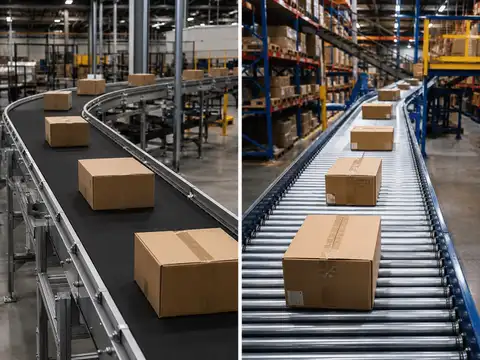
Continuous support
Better first choice for small, soft, irregular or unstable-bottom products and for applications requiring grip through inclines or declines.
Discrete support
Better first choice for rigid cartons, totes and trays that bridge multiple rollers reliably—especially where gravity or zone accumulation is valuable.
Product-handling lab
Choose the carrying surface before choosing the conveyor price.
Belt and powered roller can cost almost the same in some current standard configurations. The product bottom, accumulation requirement and route geometry should decide which technology survives the application.
Soft, small or irregular bottoms do not need to bridge gaps between rollers.
Now accumulation, transfers, energy, maintenance and process control decide.
Independent zones make zero-pressure accumulation a natural roller architecture.
Price does not settle this comparison
Two current Ultimation products make that unusually clear.
Its current 18-inch-wide, 10-foot roller-bed belt conveyor is listed at $1,918.50.
Its current 18-inch-wide, 10-foot 24V MDR roller conveyor starts at $1,932.50.
The difference is only $14.
That is less than one percent of either product's purchase price.
The products are not identical systems: the belt unit uses a continuous belt over a roller bed and the MDR unit uses independently powered roller zones with photo-eye sensing.
But the near-identical price proves an important procurement point: at this scale, belt vs powered roller should be chosen by process fit rather than headline CAPEX.
Start with the product bottom
Hytrol's current technical comparison says belted conveyor is better suited to lighter and smaller items because the continuous belt gives the product a larger support surface.
Hytrol also notes that irregular or very small products can be unsuitable for live roller because they can fall between the rollers.
This is the first test because no amount of low purchase price fixes a conveyor that cannot reliably support the SKU.
Soft bottom and small dimensions favor continuous support.
Stable flat bottom lets process requirements decide.
Rigid base works well if roller centers support it correctly.
Product should not be expected to bridge ordinary roller gaps.
“Roller is cheaper, so let us make the package work on rollers.” Product compatibility should be established before technology cost.
Can the smallest SKU bridge the rollers?
A roller conveyor supports the product at discrete points. The product has to remain stable across enough rollers to travel predictably.
Very short cartons, flexible packaging and irregular-bottom goods can stall, tip or fall between widely spaced rollers.
The roller-conveyor cost guide uses the common supplier rule of keeping the product supported by at least three rollers as an early design screen. Final roller centers should be validated with the actual product.
Does the SKU need continuous contact?
Belt eliminates gaps beneath the product.
Interroll's current BM 8350 is explicitly intended for small goods and products that are not suitable for roller tracks.
Continuous contact can improve transport of:
- small cartons;
- bags;
- mailers;
- loose or bundled items;
- products with non-flat bottoms.
Does the process need accumulation?
Roller conveyor has a particularly natural architecture for zone accumulation.
Ultimation's current MDR line moves products one zone at a time using individual 24V motorized rollers and photo-eye sensing.
Hytrol and Interroll both offer current zero-pressure accumulation architectures based on powered roller zones.
Belt can also accumulate product, including through zone-based designs such as Interroll's BM 8350, but powered roller remains a particularly common choice for carton/tote buffering.
Does the route change elevation?
Belt generally gains an advantage when product must climb or descend.
Hytrol's current belt-over conveyor guidance highlights the increased grip and product control of a belted surface for incline and decline applications.
Belt selection, surface friction, product bottom and incline angle still need to be engineered together.
Cleats can be added where friction alone cannot reliably hold product.
Current decision matrix
Roller conveyor should not be dismissed as only a carton technology
Hytrol currently describes live roller as an economical transport solution for boxed and palletized goods in warehousing, manufacturing, food and beverage distribution and e-commerce.
Roller is especially strong when the product is:
- rigid;
- flat-bottomed;
- wide enough to span multiple rollers;
- stable under point support.
It can also scale from light cartons to heavy pallet systems when roller, frame and drive specifications change appropriately.
Belt gains an advantage when product control matters more than discrete support
Hytrol's current belt-over conveyor guidance explicitly highlights:
- better product support;
- more accurate control of flow;
- better grip;
- incline/decline performance.
Those properties become economically useful when roller conveyor would require:
- smaller roller spacing;
- trays;
- manual intervention;
- special transfer devices;
- repeated product correction.
The same rigid carton can work perfectly on either technology
This is the point where the decision becomes more interesting.
If a 16 × 12 × 8-inch corrugated carton has:
- flat rigid bottom;
- stable weight;
- no unusual fragility;
- adequate roller support
both belt and roller can move it.
Now select from:
- accumulation requirement;
- incline requirement;
- transfers;
- energy architecture;
- maintenance strategy;
- future product mix.
Accumulation often pushes rigid-carton applications toward MDR
Independent roller zones can:
- hold one carton;
- detect the next free zone;
- release carton by carton;
- minimize product contact;
- stop inactive zones.
This is one reason MDR is common before packing, sortation and automated machines.
Gravity roller can be cheaper than both powered options
Belt vs roller does not always mean powered belt vs powered roller.
If a rigid carton can move by gravity or occasional manual push, gravity roller can reduce CAPEX dramatically.
Ultimation currently publishes broad gravity roller planning costs around $13–$40 per foot for low-cost configurations.
Its simple powered belt/MDR category is roughly $150–$400 per foot.
That price gap can make gravity the real comparison if the workflow does not need powered transport.
Do not pay powered-belt money for a gravity task
If cartons leave a packing bench and only need to roll six feet into a manual shipping lane, the real decision may be gravity roller versus no conveyor—not belt versus MDR.
Transfers can reverse an otherwise obvious decision
A product that travels well on rollers can still struggle when it has to cross:
- 90-degree transfers;
- small gaps;
- scales;
- adjacent machines;
- belt-to-roller interfaces.
Dorner's current transfer guidance emphasizes that transfer method should be selected from product and process rather than conveyor family alone.
Small products often benefit from nose-bar or other reduced-gap belt transfers.
A roller line with a bad transfer is still a bad system
Measure:
- minimum product length;
- center of gravity;
- transfer gap;
- product speed;
- receiving conveyor height;
- orientation.
The SKU has to survive the complete route, not only the straight section.
Belt tracking is a real maintenance difference
Dorner identifies belt tracking as one of the larger maintenance issues associated with belt conveyors.
Tracking can be influenced by:
- belt splice accuracy;
- frame alignment;
- roller/pulley accuracy;
- belt tension;
- side loading;
- debris buildup.
A poorly tracked belt can rub frames, damage belt edges and create downtime.
Roller conveyor avoids belt tracking but adds roller-by-roller components
Roller systems have:
- bearings;
- roller shafts;
- drive bands/chains where powered;
- motorized rollers in MDR;
- sensors and zone controls in accumulation systems.
A failed individual roller is often easier to replace than an entire conveyor belt.
The number of individual wear points can be higher.
Belt replacement can create longer maintenance windows
Replacing a long belt can require:
- removing guards;
- releasing tension;
- threading or installing the new belt;
- splicing where applicable;
- retensioning;
- tracking;
- loaded testing.
If the conveyor is mission-critical, include a replacement belt and documented change procedure in the spares plan.
MDR distributes drive failure across zones
Modern MDR does not necessarily depend on one central drive for an entire long line.
Ultimation's current 10-foot MDR uses two or three motorized zones depending on configuration.
Interroll's current modular conveyor architecture likewise distributes drive and zone controls.
This can make fault isolation and modular replacement easier, but it increases the count of powered components.
Energy depends more on architecture and duty cycle than on “belt vs roller” alone
A continuously running central-drive belt can consume energy whenever the line is running, even with little product.
Zone-controlled MDR can power only active sections.
But a high-throughput roller line with many active zones can still consume substantial energy.
Compare actual:
- motor/drive power;
- duty cycle;
- active zones;
- hours/year;
- measured kWh.
Do not apply generic energy-savings percentages across unrelated conveyor designs.
Belt friction can require more drive power on long/heavy runs
A belt has continuous contact with its supporting bed or rollers.
Slider-bed systems introduce sliding friction between belt and bed.
Roller-bed belt conveyors reduce that support friction by carrying the belt over rollers.
This is one reason roller-bed belt architecture can be useful on longer or heavier applications.
Roller conveyor offers extremely low-energy gravity options
If slope or manual force can move the product safely, gravity roller uses no conveyor-drive electricity.
Belt conveyor normally requires powered movement.
This can make roller the lifecycle-cost winner for short passive routes even when both technologies could physically carry the SKU.
Inclines are where belt often becomes clearly superior
Hytrol's current guidance says belt provides more friction and stability than live roller for changes in elevation.
Belt can also use:
- high-friction surfaces;
- cleats;
- sidewalls;
- special patterns.
Roller incline applications exist, but product control can become much more application specific.
Do not assume one maximum incline angle
Maximum angle depends on:
- belt material;
- package bottom;
- product weight;
- center of gravity;
- cleats;
- speed;
- acceleration.
Test the actual product rather than applying an angle copied from another belt.
Belt is usually the better answer for poly mailers
A poly mailer can:
- sag between rollers;
- catch on roller gaps;
- present inconsistent shape;
- rotate unpredictably.
Continuous belt support removes the basic roller-gap problem.
E-commerce facilities with significant soft-pack volume should include those packages in the design sample, not test only corrugated cartons.
Roller is usually the natural answer for rigid tote accumulation
Standardized plastic totes provide:
- rigid bottoms;
- consistent dimensions;
- predictable weight range;
- repeatable roller contact.
Those characteristics fit powered roller and zero-pressure accumulation especially well.
Cartons are the true overlap zone
For ordinary corrugated cartons, both systems are common.
Choose belt when:
- cartons are very small;
- bottom quality is inconsistent;
- inclines matter;
- precise continuous surface control matters.
Choose roller when:
- cartons are rigid and standardized;
- gravity sections can reduce CAPEX;
- ZPA buffering is central;
- easy modular roller maintenance matters.
Food and washdown requirements can change the answer completely
Dorner's current sanitary conveyor families emphasize cleanability, open architecture and washdown-specific materials.
Its May 2026 hygienic-design guidance warns that stainless steel alone does not create a sanitary conveyor; frame cavities, welds, fasteners and access can create harborage points.
A sanitary belt system can therefore be preferable even if an ordinary industrial roller conveyor would be cheaper.
Roller can also be built for food applications—but sanitation must be designed
Hytrol currently lists food and beverage distribution among live roller applications.
Distribution of closed cartons is different from direct food-process contact.
Do not apply a warehouse carton-conveyor specification to a washdown food process.
Precision positioning can favor specialized belt architectures
Dorner describes precision conveyance as a belt-conveyor category for applications needing accurate product movement or placement.
Examples include:
- robotic picking;
- automated assembly;
- box filling;
- wide / sheet-part handling;
- controlled indexing.
This is a different requirement from simply transporting cartons through a warehouse.
Roller remains excellent for high-volume rigid-product transport
Hytrol's July 2026 manufacturing guidance describes live roller as ideal for cartons, totes, trays and finished products moving between production, packaging and shipping.
The same source highlights powered roller as durable and relatively low maintenance for high-volume rigid-product environments.
That is a strong fit when the product geometry is already roller-friendly.
Current product cost says almost nothing about long-line system cost
The $14 difference between the two cited 10-foot products is useful but limited.
A real project may add:
- curves;
- transfers;
- supports;
- multiple drives;
- ZPA zones;
- PLC/HMI;
- electrical work;
- guarding;
- installation;
- commissioning.
Compare the final route, not one catalog section.
The cheaper component can create the more expensive system
A roller section may cost slightly less, but if small products require trays, operators must load and unload those trays and the facility needs a tray-return loop. A belt that directly carries the SKU may produce the lower total system cost.
Conversely, belt can be overkill for standardized tote flow
If every item moves inside a rigid standardized tote, continuous belt support may add little value.
Powered roller can provide:
- clean zone accumulation;
- individual tote release;
- easy sensor placement;
- modular maintenance;
- gravity options in non-powered sections.
Product standardization can therefore favor roller architecture.
Future SKU mix deserves explicit value
A conveyor bought for today's cartons may serve tomorrow's:
- mailers;
- smaller boxes;
- new tote format;
- irregular products.
If the product mix is likely to become less rigid and more variable, belt's continuous support can provide future flexibility.
If the operation is standardizing into totes, roller can become increasingly attractive.
Noise can differ by product and conveyor construction
Roller conveyor creates repeated contact between product and rollers.
Belt creates a continuous contact surface but still contains pulleys, drive components and support rollers.
Noise depends on:
- product bottom;
- speed;
- roller material;
- belt surface;
- frame;
- drive architecture.
Measure sound in the real operating environment if workstations are immediately adjacent.
Maintenance access can matter more than theoretical maintenance frequency
A component that fails once per year but requires four hours to access can create more downtime than a component replaced quarterly in ten minutes.
Compare:
- belt-change access;
- roller replacement access;
- guard-removal time;
- drive access;
- critical spare lead times.
Do not forget machine guarding and LOTO
Powered belt and roller systems both create moving-machine hazards.
OSHA's general-industry machine-guarding and hazardous-energy requirements can apply to servicing and operation depending on the final system.
The specific guarding arrangement differs because belt conveyors have pulleys, belts and return paths while powered roller systems have powered rollers, drive bands/chains and transfer mechanisms.
Use a representative SKU test before final equipment selection
Send or test:
- smallest SKU;
- largest SKU;
- lightest;
- heaviest;
- softest package;
- most irregular bottom;
- damaged-but-still-acceptable carton;
- future package type.
One perfect 16-inch carton is not a representative conveyor test.
Test the worst transfer, not only straight transport
The most revealing point can be:
- belt-to-roller transfer;
- 90-degree divert;
- incline transition;
- scale;
- scanner;
- sorter induction;
- packing-machine interface.
If the SKU survives those transitions reliably, the straight conveyor is usually the easy part.
Choose belt when these conditions dominate
- small or flexible packages;
- irregular bottoms;
- poly mailers;
- incline/decline movement;
- continuous product support;
- precision transport;
- specialty belt surface or sanitary requirement.
Choose roller when these conditions dominate
- rigid cartons, totes or trays;
- product spans rollers reliably;
- gravity flow can reduce cost;
- zero-pressure accumulation is central;
- individual roller maintenance is desirable;
- high-volume rigid-product transport dominates.
Use both when the warehouse has more than one material-flow job
A common integrated architecture can use:
- belt for mailer induction;
- roller for carton accumulation;
- belt incline to change level;
- MDR buffer before sortation;
- gravity roller at manual packing/shipping lanes.
There is no operational advantage in forcing the entire building onto one conveyor surface.
RFQ checklist for a fair belt-vs-roller comparison
Ask both suppliers to design around the same:
- SKU matrix;
- minimum/maximum dimensions;
- minimum/maximum weights;
- bottom conditions;
- required throughput;
- route;
- elevation changes;
- accumulation quantity;
- transfer points;
- environment;
- controls requirement;
- installation scope;
- acceptance criteria.
Then normalize:
- equipment;
- supports;
- controls;
- electrical;
- guarding;
- installation;
- spares;
- maintenance assumptions.
The decision rule
If the product needs a continuous surface, choose belt unless another technology has a compelling application-specific reason.
If the product is rigid and roller-compatible, ask what the process needs next: gravity, accumulation and modular zone control favor roller; grip, inclines and continuous product support favor belt.
When both technologies can perform the job, compare the complete system—not the conveyor frame. The current $14 difference between the two cited 10-foot products is a useful reminder that the correct surface can matter far more than the equipment price.
Frequently asked questions
Is belt conveyor more expensive than roller conveyor?
Not necessarily. Current Ultimation 18-in × 10-ft examples are almost identical: the roller-bed belt unit is $1,918.50 and the 24V MDR roller unit starts at $1,932.50. Gravity roller can be much cheaper than either powered option.
Which is better for boxes?
Both can be excellent. Rigid, flat-bottom cartons work well on appropriately spaced rollers; belt can provide more continuous support and becomes stronger for smaller, less stable cartons or incline applications.
Which is better for poly mailers?
Belt is usually the stronger choice because flexible mailers do not need to bridge gaps between rollers.
Which is better for totes?
Rigid standardized totes are often an excellent powered-roller application, especially when zero-pressure accumulation is needed.
Which is better for inclines?
Belt normally has the advantage because the continuous surface provides more grip and stability. Hytrol specifically highlights belt for incline/decline applications.
Which is better for accumulation?
Powered roller / MDR is especially strong for zone-based zero-pressure accumulation. Belt accumulation systems also exist, including Interroll's current BM 8350.
Which has lower maintenance?
It depends on architecture. Roller avoids belt tracking and allows individual roller replacement. Belt has fewer product-support elements but requires belt inspection, tension/tracking and eventual belt replacement.
Which uses less electricity?
A gravity roller line uses no conveyor-drive electricity. Between powered belt and powered roller, actual consumption depends on motors, duty cycle, zone activity, load and controls rather than technology name alone.
Can belt conveyor accumulate products?
Yes. Belt systems can be zoned and controlled for accumulation. Interroll's current BM 8350 can operate as a zero-pressure-accumulation belt module.
Can roller conveyor handle small products?
Yes if roller diameter and centers provide adequate support. Very small or irregular products may still be better on a belt.
Why does belt tracking matter?
Dorner identifies tracking as a major belt-conveyor maintenance issue. Poor alignment, tension, splices, side loading or debris can make the belt drift and wear against the frame.
Can a warehouse use both belt and roller conveyor?
Yes. Mixed systems are common because different SKU types and process zones benefit from different carrying surfaces.
Sources and methodology
Warehouse Fieldbook uses current public Ultimation prices for one 18-in × 10-ft roller-bed belt conveyor and one 18-in × 10-ft MDR roller conveyor to demonstrate that purchase price can be almost neutral between powered technologies in a standard configuration. The $14 difference is simple subtraction and is not a claim that all belt and MDR conveyors have equivalent pricing. Hytrol provides current manufacturer guidance on product fit, powered live roller, belt-over product control and current 2026 manufacturing applications. Interroll provides current BM 8350 and modular conveyor architecture for belt/roller/ZPA applications. Dorner provides current belt tracking, transfer and sanitary-design guidance. OSHA sources support general machine-guarding and hazardous-energy context.
- Ultimation — current 18-in × 10-ft roller-bed belt conveyor price
- Ultimation — current 18-in × 10-ft MDR powered roller price and zone controls
- Ultimation — current gravity and simple powered conveyor planning cost categories
- Hytrol — belt vs roller product and application comparison
- Hytrol — small/irregular product and incline comparison
- Hytrol — current belt-over product support and incline/decline guidance
- Hytrol — current powered live roller applications
- Hytrol — July 2026 manufacturing conveyor selection guidance
- Interroll — current Modular Conveyor Platform belt and roller architectures
- Interroll — current BM 8350 belt conveyor and ZPA capability
- Dorner — current belt-product application guidance
- Dorner — belt tracking maintenance guidance
- Dorner — current product-transfer selection guidance
- Dorner — May 2026 hygienic conveyor design guidance
- Dorner — precision belt conveyance applications
- OSHA — 29 CFR 1910.212 general machine guarding
- OSHA — hazardous-energy control / lockout-tagout