
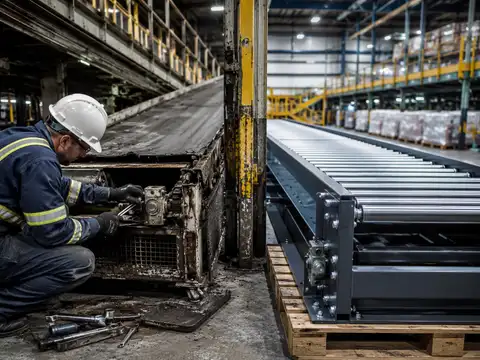
Repair the failure. Retrofit the limitation. Replace the liability.
A failed roller does not make an entire conveyor obsolete. A functioning conveyor that can no longer meet throughput can still be economically obsolete.
Repair decision docket
The decision has three legitimate outcomes—not two.
A localized failure can justify repair. A structurally useful but aging line can justify retrofit. Full replacement becomes stronger when the old system no longer meets the operation or when downtime and parts risk become chronic.
Failure is isolated, parts are available, layout still works, throughput still fits.
Upgrade drives, controls, sensors, safety or zones while avoiding full mechanical replacement.
Failures are recurring, parts are obsolete, capacity is wrong or the system blocks future operations.
Ultimation's current legacy-system framework matches the three-path decision
Ultimation's current support guidance for legacy Portec and Jervis Webb conveyor separates the decision into repair, retrofit and replacement.
Its framework says repair is often appropriate when:
- the failure is localized;
- only a few components are affected;
- the layout still works;
- throughput still meets the operation;
- the main problem is sourcing the correct part.
Retrofit becomes stronger when the conveyor still has useful life but suffers from recurring issues, weak control or rising maintenance burden.
Full replacement becomes stronger when failures are frequent and unpredictable, parts are repeatedly unavailable or the system no longer matches throughput, safety or integration needs.
Five questions settle most repair decisions
Is the failure local?
One roller, sensor, driver card, bearing or belt can be a component failure. Replacing the entire line because one serviceable component failed destroys remaining asset value.
Does the conveyor still do the required job?
If product, throughput, accumulation and route requirements remain valid, a repair can restore value without redesigning the process.
Are parts still obtainable quickly?
Legacy systems become risky when a low-cost component has a long or uncertain lead time. Availability can matter more than the part price.
Are failures repeating?
Replacing the same wear item again and again can indicate an alignment, load, controls or architecture problem rather than random component failure.
Would the new system solve a business constraint?
Replacement is stronger when it changes capacity, safety, integration, energy, footprint or labor—not simply because the old conveyor is old.
Current public parts prices show why isolated repair can be cheap
Current Ultimation 15-in BF, 1.9-in galvanized replacement roller.
Current Tri-Tronics MINI-EYE receiver sold by Ultimation.
Current Itoh Denki HB-510 motorized-roller driver card.
Current 15-in BF Itoh Denki 24V motorized roller.
Current Ultimation BS100B variable-frequency-drive package.
Current Ultimation basic PLC package; system integration scope is far larger than one component swap.
These are parts and subsystem snapshots—not installed repair invoices.
Labor, diagnostics, travel, freight, programming and downtime remain separate.
Still, the examples show why a localized repair can preserve a large amount of usable conveyor at relatively low component cost.
A $7 roller and a $7,000 controls panel are both “conveyor repairs”
The phrase “conveyor repair cost” is too broad to make a useful replacement rule.
A warehouse may be deciding between:
- $7.20 roller replacement;
- $193.50 powered roller replacement;
- $254.90 VFD package;
- a multi-thousand-dollar controls rebuild;
- a complete conveyor replacement.
These decisions belong in different capital classes.
Compare repair with the relevant replacement—not with the entire warehouse
A failed 5-foot MDR section can be compared with a current 5-foot replacement module starting at $1,649.75.
A failed motorized roller inside that section currently costs around $193.50 before labor and shipping.
Replacing one compatible motorized roller is roughly 12% of the cited new 5-foot MDR module's starting hardware price.
That ratio is useful only for this specific public hardware example.
It is not a universal repair threshold.
A $193 roller can be a good repair if the rest of the conveyor is healthy. The same repair can be poor economics if the line fails every week, its controls are obsolete and production needs twice its current capacity.
Current belt hardware shows the same logic
Ultimation currently lists its 18-inch × 5-foot roller-bed belt conveyor at $1,559.50.
Its current BS100B VFD package is $254.90.
If a compatible VFD is the isolated failure and the mechanical conveyor remains sound, replacing the entire conveyor solely to avoid a VFD repair can waste substantial remaining value.
If the belt, bearings, drive, frame and controls are all near end of life, the same $254.90 component is no longer the whole decision.
Repair cost should include the complete event
Expected cost over the decision horizon
repair now + likely near-term repairs + maintenance + downtime + emergency freight/service + obsolescence risk
Expected cost over the same horizon
new system + installation + controls/integration + cutover + training + expected maintenance − salvage/reuse value
Use the same time horizon for both paths.
Comparing one repair invoice with the purchase price of a new system ignores most of the economics.
Three years is often more useful than “repair today vs replace today”
A future-horizon model can reveal:
- two expected belt changes;
- controls obsolescence;
- repeat motor failures;
- rising technician hours;
- a planned warehouse expansion;
- known product-volume growth.
A repair that looks cheapest today may only postpone an unavoidable replacement.
Do not count hypothetical future repairs as certain
Use:
- actual failure history;
- OEM condition findings;
- part age / condition;
- known obsolescence notices;
- maintenance records.
Avoid building a replacement case by assuming every old component will fail next year.
Retrofit is the overlooked middle option
Ultimation's current legacy-system guidance explicitly recommends targeted retrofit where the system still provides value but control, reliability or maintenance burden is becoming a problem.
Examples include:
- converting gravity to motorized zones;
- adding zero-pressure accumulation;
- replacing obsolete controls;
- updating drives;
- adding current safety features;
- replacing old components with supported equivalents.
Retrofit can preserve:
- frames;
- supports;
- route;
- installed steel;
- some field wiring or interfaces.
Interroll also treats retrofit as a normal lifecycle service
Interroll's current Lifetime Service program includes:
- repairs;
- refurbishment;
- preventive maintenance;
- spare parts;
- retrofits;
- modernization.
Interroll explicitly positions retrofit around extending longevity, optimizing performance and minimizing cost and downtime.
It also supports repairs of phased-out and older Interroll products.
Old does not automatically mean unserviceable.
Parts availability is an economic variable
Ultimation's December 2025 legacy-support guidance highlights a practical problem with old Portec and Jervis Webb systems: one damaged trolley, worn belt or missing lacing clip can halt a line while maintenance searches for the correct legacy part.
The cost is not only the component.
It is:
part price + search time + lead time + downtime + expedited shipping + uncertainty.
A cheap unavailable part can justify modernization
Imagine a proprietary control card costs only $200 but requires a six-week used-parts search.
If failure can stop a high-throughput line, the financial risk is much larger than $200.
Retrofit can replace the unsupported controls architecture before the next failure.
Obsolescence should be scored before a breakdown
Audit:
- PLC model;
- HMI;
- VFDs;
- motor controllers;
- sensors;
- network hardware;
- special belts;
- proprietary mechanical parts.
Record:
- OEM support status;
- current lead time;
- available substitute;
- stock on hand;
- last successful purchase.
Maintenance history is the best repair-vs-replace dataset
Review the last 12–36 months for:
- parts spend;
- technician labor;
- emergency calls;
- unplanned downtime;
- repeat failures;
- expedited freight;
- production workarounds.
A system with one expensive repair in three years can be healthier than a line with twenty small failures.
Failure frequency matters more than one ugly invoice
Localized major repair followed by stable operation.
Twelve $500 events before counting technician disruption or downtime.
The smaller invoice can produce the worse asset economics.
The values above are intentionally illustrative, not market averages.
Downtime can reverse the repair decision
A repair may cost $1,000 in parts and labor but require three days waiting for a part.
Another repair may cost $5,000 but restore operation the same shift.
The first event can be more expensive to the business.
Use a conservative downtime model:
idle labor + overtime recovery + emergency logistics + verified lost contribution + temporary workaround.
Do not count all sales revenue during downtime as lost unless the orders are truly lost.
Capacity obsolescence can make a reliable conveyor economically obsolete
Hytrol's TCO framework says useful life includes obsolescence caused by the business outgrowing the system.
A conveyor can be mechanically healthy and still fail the business because:
- throughput is too low;
- product mix changed;
- destination count increased;
- new automation needs better controls;
- the layout wastes too much space.
Repair restores the old performance.
It does not solve an old design limit.
Do not replace a conveyor solely because new equipment is more efficient
Hytrol's TCO guidance encourages lifecycle analysis including:
- maintenance;
- spare parts;
- labor;
- training;
- energy;
- useful life.
An efficiency improvement only justifies replacement if the measurable savings and operating improvements recover the installed replacement cost.
Energy savings alone rarely justify an early replacement without real numbers
Calculate:
current measured kWh/year − expected new-system kWh/year
multiplied by the facility's electricity cost.
If annual savings are $800 and replacement costs $100,000, energy is not the primary business case.
If replacement also removes labor, downtime and throughput constraints, the combined case can become strong.
Safety can force the decision outside pure ROI
A damaged or modified conveyor must still be safe to operate.
OSHA's general machine-guarding and hazardous-energy requirements apply based on the equipment and servicing hazards.
If an old system requires extensive guarding, controls or access changes to achieve acceptable safe operation, include those upgrade costs in the repair and retrofit path.
Do not compare an unsafe “repair only” option with a compliant replacement.
Warranty does not equal remaining economic life
Dorner currently offers a 10-year limited warranty to the original purchaser on its conveyors under defined conditions.
The same warranty excludes normal wear and says Dorner is not responsible for labor, freight or duties associated with replacing defective parts.
Warranty status therefore does not answer:
- whether the conveyor still fits throughput;
- how much downtime costs;
- whether normal wear is extensive;
- whether replacement is economically attractive.
A young conveyor can still deserve replacement
Examples:
- wrong conveyor selected for the product;
- system chronically jams;
- layout changed;
- capacity doubled;
- new automation cannot integrate;
- maintenance access is fundamentally poor.
Calendar age is only one variable.
An old conveyor can still deserve repair
Ultimation's legacy-support article notes that many Portec and Jervis Webb systems have exceeded expected service life and still have useful operating years remaining.
Repair can remain logical when:
- steel is sound;
- route still fits;
- parts can be sourced;
- failure is isolated;
- throughput remains sufficient.
Use a traffic-light decision, not one percentage
One or few failures, parts available, stable maintenance history, no capacity problem.
Controls/drive obsolescence, recurring issues, weak sensing or safety/functionality gap.
Frequent unpredictable failures, unavailable parts, throughput mismatch or major integration limitation.
Score the system before requesting capital
Repair is usually strongest when these conditions are true
- failure is localized;
- the remaining conveyor is sound;
- parts are readily available;
- throughput still fits;
- maintenance cost has not been rising structurally;
- future layout does not require a major redesign.
Retrofit is usually strongest when these conditions are true
- frames and route still have value;
- controls or drives are obsolete;
- zero-pressure accumulation or sensing would improve flow;
- safety needs modernization;
- full replacement would cause unnecessary disruption;
- the existing structure can support the future process.
Replacement is usually strongest when these conditions are true
- failures are frequent and unpredictable;
- multiple subsystems are aging at once;
- parts have poor availability;
- the system is an operational bottleneck;
- product or throughput has outgrown the design;
- integration requirements demand a new architecture;
- repair and retrofit would only postpone an unavoidable project.
Replacement cost is more than new conveyor hardware
Include:
- new conveyor;
- demolition / removal;
- rigging;
- installation;
- electrical work;
- controls;
- software integration;
- guarding;
- commissioning;
- cutover downtime;
- training;
- spares;
- disposal or salvage.
A $50,000 equipment quote can become a materially larger replacement project.
Repair cost is more than the part
Include:
- diagnostic labor;
- part price;
- freight;
- technician labor;
- travel;
- programming or configuration;
- line restart;
- downtime.
This creates a fairer comparison.
Ask vendors for three quotations when the decision is genuinely uncertain
Request:
- restore current functionality;
- targeted modernization / retrofit;
- full replacement.
Require each option to state:
- scope;
- expected performance;
- parts support;
- installation time;
- cutover duration;
- warranty;
- future expansion limits.
This is much more informative than asking a replacement vendor whether the old conveyor should be replaced.
Use a condition report before a large replacement
Inspect:
- frames;
- supports;
- rollers / pulleys;
- belts / chains;
- bearings;
- drives;
- controls;
- sensors;
- guarding;
- electrical panels;
- documentation.
A condition report can identify which parts of the asset still deserve capital credit.
Do not forget the cutover plan
Full replacement may require:
- temporary bypass;
- weekend shutdown;
- inventory pre-build;
- manual handling plan;
- parallel controls testing;
- rollback plan.
A retrofit may provide similar performance improvement with much less disruption.
The practical recommendation
Repair localized component failures when the conveyor still does the job.
Retrofit when the structure and route remain valuable but technology is aging.
Replace when the old conveyor has become a repeated source of operational risk or the business has outgrown what the architecture can deliver.
The decision should be based on:
future repair burden + downtime risk + parts support + remaining process fit versus total installed replacement cost + measurable operating improvement.
The decision in one line
Do not replace remaining useful life—and do not keep repairing a conveyor whose real failure is that the business has already outgrown it.
Frequently asked questions
When should a conveyor be repaired instead of replaced?
Repair is usually strongest when the failure is isolated, replacement parts remain available, the structure is sound and the conveyor still meets throughput and process requirements.
When should an old conveyor be replaced?
Replacement becomes stronger when failures are frequent and unpredictable, parts are difficult to source, multiple subsystems are aging or the conveyor no longer meets throughput, safety or integration requirements.
Is there a 50% repair-vs-replacement rule for conveyor?
No reliable universal rule is supported by the current manufacturer guidance used here. Compare repair, retrofit and replacement over the same future horizon.
What is a conveyor retrofit?
A retrofit keeps useful portions of the existing system while upgrading components such as controls, drives, sensors, powered zones or safety features.
How much does a conveyor repair cost?
It ranges from very small parts to major controls work. Current public examples include a $7.20 gravity roller, $47.85 photo-eye receiver, $169.90 driver card, $193.50 motorized roller and a $6,918 basic MDR PLC panel before labor and integration.
How much does it cost to replace a motorized conveyor roller?
Ultimation currently lists one 15-in-BF Itoh Denki 24V motorized roller at $193.50 before labor, shipping and any additional troubleshooting.
How much does a conveyor VFD cost?
Ultimation currently lists its BS100B belt-conveyor VFD package at $254.90. Other conveyor drives and VFDs vary by motor, voltage, enclosure and controls.
Can an old conveyor be upgraded instead of replaced?
Yes. Ultimation currently describes gravity-to-MDR conversion, updated controls and modern safety / functionality as examples of retrofit paths. Interroll also provides current retrofit and refurbishment lifecycle services.
Why does parts obsolescence matter?
A cheap component can create expensive downtime if it takes weeks to identify or source. Track support status and lead time for critical proprietary parts.
Should downtime be included in the repair decision?
Yes, but only count defensible consequences such as idle labor, overtime recovery, emergency logistics, verified lost contribution and workaround cost.
Can a conveyor be economically obsolete before it is worn out?
Yes. Hytrol's TCO framework explicitly treats business obsolescence as part of useful life. A mechanically sound conveyor can still be too slow, inflexible or difficult to integrate with the current operation.
What information should be collected before replacing a conveyor?
Gather maintenance history, downtime, failure patterns, parts availability, condition of structure/drives/controls, current and future throughput, product requirements and a complete installed replacement scope.
Sources and methodology
Warehouse Fieldbook uses current manufacturer and integrator guidance to distinguish repair, retrofit and replacement rather than applying an arbitrary repair-cost percentage. Ultimation's current legacy-support guidance supplies the three-path framework and its 2025 legacy-component guidance identifies failure signals such as jams, bearing seizure, roller wear, belt problems and system inefficiency. Current Ultimation online prices are used only as transparent component and module snapshots. Interroll's current Lifetime Service program confirms repair, refurbishment, parts support, retrofit and modernization as normal lifecycle options. Hytrol provides a TCO framework that includes maintenance, support, energy and useful-life obsolescence. Dorner's current warranty is used only to clarify that warranty status does not equal economic life and that normal wear/labor/freight can remain outside coverage. OSHA is used for machine-guarding and hazardous-energy context.
- Ultimation — current legacy conveyor repair, retrofit and replacement framework
- Ultimation — legacy conveyor wear, component replacement and modernization signals
- Ultimation — current 15-in BF gravity replacement roller price
- Ultimation — current Tri-Tronics photo-eye receiver price
- Ultimation — current Itoh Denki HB-510 driver-card price
- Ultimation — current 15-in BF Itoh Denki motorized-roller price
- Ultimation — current BS100B belt-conveyor VFD package price
- Ultimation — current basic 24V MDR PLC-panel package price
- Ultimation — current 18-in × 5-ft MDR replacement-module price
- Ultimation — current 18-in × 5-ft roller-bed belt conveyor price
- Interroll — current Lifetime Service repairs, refurbishment, spare parts and retrofit services
- Hytrol — conveyor TCO and useful-life / obsolescence framework
- Dorner — current limited warranty and exclusions for wear, labor and freight
- OSHA — 29 CFR 1910.212 machine guarding
- OSHA — hazardous-energy / lockout-tagout requirements