
Current supplier-published pricing provides three useful starting tiers:
Gravity: ~$13–$40/ft · Simple powered: ~$150–$400/ft · High-speed DC systems: ~$300k–$5MThe first two ranges describe relatively simple conveyor hardware. A complete warehouse project can add curves, transfers, accumulation, sortation, electrical distribution, controls, WCS/WMS interfaces, guarding, installation and commissioning. Price the system architecture before multiplying a per-foot number across the building.
Conveyor projects become expensive in layers.
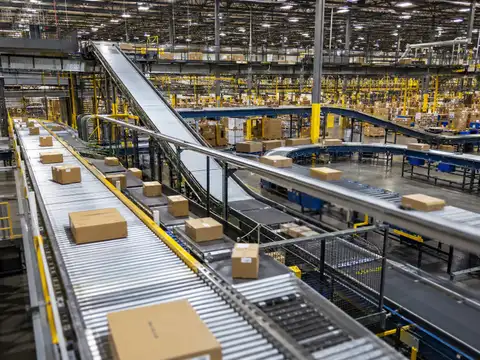
The straight section visible on the warehouse floor is easy to price. The business logic around that section is usually where budgeting becomes difficult: when should a carton stop, where should it divert, how much accumulation is needed, what happens when downstream equipment faults, and how does the WMS know where each item belongs?
A useful conveyor budget therefore separates transport hardware from material-flow automation.
Conveyor project cost stack
The conveyor frame is only the first layer of system cost
Straights, curves, supports, drives, belts or rollers.
Merges, diverts, stops, lifts, ZPA zones and buffers.
Sensors, panels, PLC/WCS logic, network and scanning.
Field labor, guarding, power, testing, training and cutover.
Linear-foot pricing is useful for straight transport. It becomes weaker as the project adds accumulation, transfers, elevation changes, sortation, controls, integration and installation.
Supplier price ranges and their limits
Current conveyor cost ranges from one U.S. manufacturer
Ultimation currently publishes unusually transparent planning numbers for several conveyor categories.
| Conveyor category | Current supplier planning reference | What the number represents |
|---|---|---|
| Low-cost gravity roller | About $13–$40/linear ft | Simple non-powered conveyor |
| Simple belt / motor-driven roller | About $150–$400/linear ft | Basic powered transport |
| High-speed distribution-center conveyor | About $300,000–$5 million | Larger integrated high-speed systems |
These are Ultimation's current planning ranges. They are not independent U.S. market averages and do not mean that every complete warehouse conveyor project falls neatly inside one of the three bands.
Heavy loads, specialty environments, elevation changes and sophisticated automation can move a project far outside simple linear-foot assumptions.
Current online products show why the range is so wide
Ultimation currently sells a 10-foot, 18-inch powered MDR conveyor with power supply starting around $1,932.50.
That is approximately $193 per foot before treating the line as a complete installed warehouse system.
Its current 5-foot version starts around $1,649.75, or roughly $330 per foot.
Shorter sections can cost more per foot because the drive, controls, power supply and end hardware are concentrated across fewer feet.
10 ft MDR: ~$1,932.50
Approximate equipment price per foot: $193/ft.
This is a current product configuration, not an installed-project estimate. Supports, field wiring, adjacent modules, guarding and integration can add cost.
Heavy-duty pallet conveyor can cost much more per foot
Ultimation currently lists a 48-inch-wide, 5-foot chain-driven live roller conveyor with motor and legs at approximately $4,149 on its current sale price, versus a displayed original price of $4,989.
At the current advertised price, that one module is roughly $830 per foot.
The reason is not mysterious: a conveyor intended to move drums, crates or pallets requires a much heavier structure and drive system than a small carton conveyor.
Load weight, roller diameter, frame strength, chain drive, motor sizing and support structure can change equipment cost by multiples before controls or installation are considered.
Flexible powered conveyor can also be a five-figure purchase
Ultimation's current powered flexible roller conveyor with zero-pressure accumulation and variable-speed control is listed around $10,869.
Portable flexible conveyor solves a different problem from permanent fixed conveyor: truck loading/unloading, temporary routes and variable staging positions.
Its price should therefore be compared with:
- manual dock labor;
- fixed conveyor installation;
- dock-door flexibility;
- equipment relocation frequency;
- peak-season requirements.
Build a budget around system functions
Why price per foot works only for simple conveyor
Linear-foot pricing works reasonably well when a project is:
- mostly straight;
- one conveyor type;
- one elevation;
- simple start/stop control;
- few transfers;
- no sortation;
- minimal software integration.
The moment the system begins making decisions, cost becomes increasingly tied to functions rather than feet.
A 100-foot straight line and a 100-foot sortation line are not comparable
Same length, different system
System A: 100 ft of straight powered transport.
System B: 100 ft with accumulation, barcode scanning, four diverts, two merges and WCS routing.
Both have 100 conveyor feet. System B contains far more controls, sensors, actuators, logic, commissioning and failure modes.
Build the budget from functional modules
A useful conveyor estimate breaks the system into:
- straight conveyor;
- curves;
- inclines / declines;
- transfers;
- merges;
- diverts;
- accumulation zones;
- stops;
- turntables;
- lifts / vertical conveyors;
- scanners;
- weighing / dimensioning;
- sorters;
- controls;
- guarding;
- electrical work;
- installation and commissioning.
The budget becomes much more defensible when every system function has an owner and a cost bucket.
Gravity conveyor and powered roller options
Gravity conveyor is the low-cost end of the market
Gravity roller conveyor has:
- no drive motor;
- minimal controls;
- simple supports;
- low electrical complexity.
Ultimation's current published planning range of roughly $13–$40 per foot reflects that simplicity.
Gravity works best where product can:
- move downhill safely;
- be manually pushed;
- queue without product-damage concerns;
- move at relatively low controlled throughput.
Gravity becomes expensive when labor has to compensate for the missing motor
Low equipment cost does not guarantee low operating cost.
If employees repeatedly:
- push heavy cartons;
- walk product long distances;
- clear stalled loads;
- control accumulation manually;
- move product between non-powered sections
powered conveyor may produce the stronger lifecycle economics.
Motor-driven roller is a common warehouse automation building block
Modern MDR conveyor divides the line into zones.
Interroll's current RM 8310, for example, uses one RollerDrive per zone with slave rollers connected by PolyVee belts and supports zero-pressure accumulation.
The module is delivered fully assembled and pre-wired.
Current specifications include:
- 24/48V drive;
- up to 50 kg per zone;
- approximately 0.1–1.0 m/s at up to 50 kg;
- zero-pressure accumulation;
- deep-freeze configuration down to -30°C.
Zero-pressure accumulation adds controls and can reduce product contact
Interroll's 2026 parcel-system guidance explains that motorized roller systems can use zero-pressure accumulation so packages queue in controlled zones without contacting one another.
That can reduce:
- box collisions;
- product pressure;
- jam propagation;
- uncontrolled release into downstream equipment.
The trade-off is more zones, sensors, controllers and logic than simple continuous powered conveyor.
Zone count can matter more than conveyor length
100 ft with 10 zones vs 100 ft with 40 zones
Both systems are the same length.
The 40-zone system can require many more sensors, drive/control points, wiring connections and software objects.
Fine zoning can improve buffering and product control, but it is not free.
Controls, wiring and energy costs
Controls are now part of the mechanical system
Interroll's current MultiControl architecture can manage multiple motor-driven rollers and sensors, including decentralized control of up to four conveyor zones.
Current functions include:
- start/stop;
- speed;
- direction;
- zero-pressure accumulation;
- dynamic routing;
- fieldbus communication.
Conveyor automation therefore needs electrical and controls engineering even when the mechanical frames are standardized.
Decentralized controls can reduce field wiring
Interroll currently positions decentralized zone controls as a way to reduce wiring, simplify expansion and accelerate installation.
That can lower:
- home-run wiring;
- panel complexity;
- commissioning effort;
- future expansion labor.
The economics depend on system size and architecture.
Energy cost depends strongly on control strategy
Interroll's June 2026 energy-efficiency guidance emphasizes decentralized motor rollers that operate only where goods are present.
Interroll says its current RollerDrive architecture can save up to 50% energy compared with central-drive approaches in suitable zero-pressure-accumulation applications.
That is a manufacturer claim under its comparison framework—not a guaranteed warehouse savings percentage.
Still, it highlights an important TCO question: does the entire conveyor run continuously when only one zone contains product?
Calculate conveyor energy from measured duty, not motor nameplates alone
A first annual model is:
Annual conveyor energy cost
measured kWh/year × effective facility $/kWh
Where measurement is not yet possible, estimate using:
- motor/drive power;
- number of active zones;
- actual duty cycle;
- hours/year;
- drive efficiency.
Replace the estimate with meter data after commissioning.
Conveyor types and changes in direction
Belt conveyor is usually selected because product needs a continuous surface
Interroll's current BM 8350 belt conveyor is intended for small products and items that are not suitable for roller tracks.
Belt conveyor can be stronger for:
- small cartons;
- poly mailers;
- bags;
- uneven-bottom products;
- items that would fall between rollers;
- inclines/declines depending on belt and design.
The next dedicated belt-conveyor guide will price this category in more detail.
Roller conveyor is strongest when the load presents a stable bottom
Roller conveyor is efficient for:
- cartons;
- totes;
- cases;
- trays;
- pallets when heavy-duty rollers are specified.
Roller spacing has to support the conveyed item reliably.
A small package that contacts only one roller at a time can become unstable or stop between rollers.
Pallet conveyor is a separate cost class
Bastian/Toyota Automated Logistics currently describes pallet-conveyor systems using:
- gravity rollers;
- chain-driven rollers;
- drag chains;
- slat conveyors;
- transfers;
- turntables.
Pallet loads push:
- frame strength;
- roller size;
- drive torque;
- support structure;
- transfer cost;
- safety guarding
far above light carton-conveyor assumptions.
Transfers can be expensive relative to the conveyor around them
A straight conveyor moves product in one direction.
A transfer may need to:
- lift product;
- change direction;
- synchronize with another line;
- detect product position;
- stop upstream flow;
- prevent collisions;
- confirm successful transfer.
A few transfer points can therefore add disproportionate mechanical and controls cost to a short project.
Curves are not just bent straight conveyor
Roller curves can require tapered rollers to maintain package orientation.
Interroll's current RM 8320 driven roller curve uses tapered rollers and RollerDrive/zone control to maintain orientation through the curve.
Belt curves and modular-belt curves use different technology again.
Price curves as functional modules rather than multiplying the straight-conveyor price by curve length.
Inclines and declines require product-control engineering
Changing elevation introduces:
- belt/roller traction;
- product rollback risk;
- braking;
- cleats or grip surfaces;
- transition geometry;
- additional supports;
- headroom;
- falling-product protection.
A conveyor that works perfectly on the flat can be unsuitable on a 10-degree incline.
Vertical movement is normally a separate machine
When product has to move between levels, the project may need:
- vertical reciprocating conveyor;
- spiral conveyor;
- continuous lift;
- incline belt;
- special pallet lift.
That machinery should be budgeted separately from horizontal conveyor footage.
Accumulation, sortation and throughput
Accumulation capacity should be sized in units, not feet alone
Ask:
- how many cartons need buffering;
- what is the longest downstream stoppage the system should absorb;
- what is the average package length;
- is product allowed to touch;
- how quickly must the buffer release.
Then convert required units into conveyor length and zone architecture.
A five-minute buffer can require substantial conveyor
1,200 cartons/hour process
1,200/hour = 20 cartons/minute.
A five-minute accumulation target therefore needs space for approximately 100 cartons before considering gaps, package-length variation and release logic.
This is why throughput and required recovery time should be defined before conveyor footage.
Sortation changes the cost class of the system
Sortation adds:
- item identification;
- routing logic;
- high-speed diverts;
- destination lanes;
- recirculation / exception handling;
- software interfaces;
- higher commissioning burden.
Interroll's current 2026 material-handling portfolio spans sorter technologies from several thousand to tens of thousands of items per hour, depending on sorter type.
A sorter should therefore never be budgeted as “more conveyor.”
Throughput determines technology
Interroll's current product portfolio includes examples such as:
- high-performance divert modules around 3,600 items/hour;
- modular chainbelt sortation up to 8,000 items/hour;
- multibelt switch around 10,000 items/hour;
- vertical crossbelt around 14,000 items/hour;
- horizontal crossbelt around 20,000 items/hour;
- split-tray systems above 20,000 items/hour.
These are product-family throughput figures, not guarantees for every SKU mix, induction method or layout.
The warehouse sortation system cost guide covers this category separately.
Do not buy sorter throughput that induction cannot feed
A 10,000-item/hour sorter does not produce 10,000 correctly sorted items per hour if upstream induction can supply only 5,000.
System throughput is constrained by:
- induction;
- scanning;
- gapping;
- sorter;
- destination capacity;
- downstream packing/shipping;
- exception handling.
Price the bottleneck, not only the fastest component.
Integration and installation scope
Software integration can become a major project cost
Bastian/Toyota Automated Logistics currently describes conveyor projects as integrated operations involving routing, scanning and system coordination.
Larger systems may need:
- PLC logic;
- HMI;
- WCS;
- WES;
- WMS interface;
- barcode / RFID integration;
- host messaging;
- alarms;
- historian / analytics;
- remote support.
The mechanical line can be physically complete and still unable to run production until controls integration is commissioned.
Define control responsibility before issuing the PO
Clarify who provides:
- device controls;
- PLC hardware;
- panel build;
- field wiring;
- network switches;
- WCS;
- WMS interface;
- barcode logic;
- software testing;
- production support after go-live.
Conveyor projects become risky when every vendor assumes another party owns the interface.
Electrical infrastructure can be a hidden site cost
The conveyor quote may exclude:
- new panels;
- disconnects;
- branch circuits;
- transformers / power supplies;
- cable tray;
- conduit;
- drops from building power;
- network cabling;
- utility shutdowns;
- electrical permits.
Ask the integrator to identify the electrical demarcation point: where does its scope stop and the facility electrician's scope begin?
Installation cost depends on where the conveyor goes
Installation is easier when conveyor is:
- floor mounted;
- at one elevation;
- installed in an empty building;
- accessible by lift equipment;
- installed before production starts.
Installation becomes more difficult when:
- work occurs over active production;
- conveyor is elevated;
- roof steel needs validation;
- night/weekend shutdown windows are short;
- existing conveyor must stay operational;
- many field welds or custom supports are required.
Overhead conveyor shows how installation can rival equipment cost
Ultimation currently states that installation for overhead conveyor can in some cases cost as much as the conveyor equipment itself because the system is mounted above the production area.
That is specific supplier guidance for overhead conveyor—not a universal installation multiplier for floor conveyor.
It demonstrates why a complete project quote should keep equipment and installation separate.
Existing-building projects carry more unknowns
Retrofit conveyor can encounter:
- floor elevation differences;
- columns not matching drawings;
- existing electrical capacity limits;
- sprinkler conflicts;
- egress conflicts;
- dock equipment;
- rack;
- other utilities;
- legacy controls that need interfaces.
Field verification before final design reduces change-order exposure.
New buildings are easier mechanically but still require coordination
In a greenfield project, conveyor should be coordinated with:
- columns;
- rack;
- mezzanines;
- sprinklers;
- lighting;
- egress;
- dock equipment;
- electrical rooms;
- IT/network infrastructure.
Late conveyor design can force expensive building changes even when conveyor hardware itself has not changed.
Safety and commissioning requirements
Guarding belongs in the base budget
OSHA's current warehousing guidance tells employers to:
- inspect conveyors regularly;
- adequately guard pinch points;
- develop lockout procedures where needed;
- provide appropriate lighting and working surfaces around conveyors.
Machine guarding is not a discretionary “option” to remove when the project exceeds budget.
General-industry conveyor safety commonly draws from machine guarding and LOTO rules
OSHA's current warehousing standards page points warehouses to:
- 29 CFR 1910.147 — control of hazardous energy;
- 29 CFR 1910.212 — general machine guarding;
- 29 CFR 1910.219 — power-transmission apparatus;
- applicable conveyor safety standards.
Design reviews should identify nip points, belts, chains, sprockets, drives and maintenance access before equipment is installed.
OSHA 1926.555 contains conveyor requirements for construction. General-industry warehouses are generally governed through the applicable 1910 standards and recognized conveyor safety standards. The correct safety review should match the actual workplace and installation.
Emergency stopping and restart logic need deliberate design
A long conveyor system should not be designed as one inaccessible motor with one distant stop button.
Safety and controls engineering may need:
- accessible emergency stops;
- pull cords;
- safe restart logic;
- zone isolation;
- fault indication;
- safe maintenance access.
The final requirements should follow the applicable codes, standards and risk assessment.
Lockout/tagout affects maintenance architecture
OSHA 1910.147 establishes hazardous-energy-control requirements for servicing and maintenance where unexpected energization or release of stored energy could injure employees.
Conveyor design should therefore consider:
- disconnect locations;
- energy isolation points;
- stored mechanical energy;
- pneumatic devices;
- gravity hazards;
- maintenance zones.
A maintainable design can reduce both service time and safety complexity.
Commissioning cost grows with the number of states the system can enter
Straight conveyor commissioning may verify:
- direction;
- speed;
- tracking;
- sensor operation.
An integrated system must also test:
- accumulation;
- release;
- merge priority;
- divert logic;
- scanner rejects;
- full destination lanes;
- jam recovery;
- WCS disconnect;
- power recovery;
- emergency-stop recovery;
- downstream faults;
- manual mode.
Every exception state requires design and testing effort.
Factory acceptance testing can reduce field surprises
For larger systems, define whether the project includes:
- FAT documentation;
- controls simulation;
- representative product testing;
- scanner testing;
- throughput demonstration;
- software interface validation.
Not every conveyor can be assembled fully at the factory, but controls and critical modules can still be tested before field installation.
Site acceptance should test throughput, not only movement
A conveyor that successfully moves one box from A to B has not proven the business case.
Acceptance criteria can include:
- sustained units/hour;
- peak units/hour;
- minimum/maximum product sizes;
- accumulation capacity;
- sort accuracy;
- recovery from faults;
- system availability;
- noise if relevant.
Tie acceptance to the process requirements used to approve the project.
Product characteristics and operating environment
Product data is one of the strongest cost inputs
Before requesting a conveyor quote, build a product matrix with:
- minimum length;
- maximum length;
- minimum width;
- maximum width;
- minimum height;
- maximum height;
- minimum weight;
- maximum weight;
- bottom condition;
- bag/carton/tote/pallet type;
- fragility;
- temperature;
- special contamination or washdown requirements.
Designing only around the “average carton” is a common source of exceptions.
The smallest product can control roller spacing
A roller conveyor needs enough contact points beneath the product to keep it stable.
Very small cartons or irregular packages may require:
- closer roller centers;
- smaller-diameter rollers;
- belt conveyor;
- special transfers.
Those choices affect equipment cost and maintenance.
The heaviest product can control motor and structure
One occasional 120-lb carton can force a different conveyor specification from a system otherwise handling 20-lb boxes.
Decide whether the rare heavy product should:
- drive the entire conveyor design;
- use a separate route;
- be handled manually;
- use a pallet system.
Designing every foot for the worst rare exception can be expensive.
Cold storage can increase conveyor cost
Interroll's current RM 8310 can be configured for environments down to approximately -30°C.
Cold-storage systems can need:
- temperature-rated motors;
- lubricants;
- belts;
- sensors;
- cables;
- controls enclosures;
- condensation management.
Do not assume ambient conveyor pricing survives unchanged inside a freezer.
Washdown and corrosive environments create another premium
Food, pharma and wet-process applications can require:
- stainless construction;
- washdown-rated motors;
- sealed bearings;
- sanitary belt design;
- drainage;
- special guarding;
- cleanability.
Dorner currently offers separate sanitary and washdown conveyor product families precisely because these requirements are materially different from ordinary warehouse carton transport.
Noise can matter in high-density work areas
Motorized roller technology can run only active zones rather than driving one long conveyor continuously.
Interroll positions current decentralized RollerDrive systems as lower-noise as well as lower-energy solutions.
Noise should be measured in the actual warehouse if employees work next to the conveyor for full shifts.
Layout flexibility and alternatives to conveyor
Maintenance access has a financial value
A cheap layout can become expensive if technicians cannot reach:
- motors;
- sensors;
- belts;
- rollers;
- controls;
- drive chains;
- transfer mechanisms.
Provide access panels, safe working space and replaceable modules where practical.
Modularity can lower future change cost
Interroll's current conveyor platforms emphasize modular, pre-wired and plug-and-play construction.
That can improve:
- installation speed;
- future expansion;
- module replacement;
- layout changes;
- spare-parts standardization.
A modular system can cost more upfront than the simplest fabricated line and still have a lower lifecycle change cost.
Conveyor layout can become a building constraint
Fixed conveyor creates a permanent traffic pattern.
It can:
- cross forklift aisles;
- divide work areas;
- consume staging space;
- block future rack changes;
- require crossovers;
- change pedestrian routes.
Future flexibility should be valued before replacing manual or mobile movement with a fixed path.
AMRs can be cheaper than conveyor in some low-density routes—and more expensive in others
Conveyor is strongest when:
- origin and destination are stable;
- flow is repeatable;
- volume is high;
- buffering is valuable;
- continuous transport matters.
Mobile robots can be stronger when:
- routes change;
- flow is sparse;
- many destinations exist;
- the building cannot accept fixed conveyor easily.
Do not compare one conveyor quote with one robot price. Compare the complete throughput system.
Labor savings, ROI and payback
A conveyor can replace travel without replacing labor
If an employee currently walks 300 feet carrying cartons, conveyor may remove the walking.
The employee can still be needed for:
- picking;
- packing;
- quality checks;
- induction;
- exception handling.
ROI should monetize the labor task actually eliminated or the throughput genuinely gained.
Do not model every saved minute as headcount reduction
Conveyor often creates:
- higher capacity;
- shorter lead time;
- less walking;
- more balanced work;
- less forklift traffic.
Those can be valuable without reducing total employees.
Use an operating-capacity model when staffing is unchanged.
Simple conveyor ROI formula
Annual net conveyor benefit
verified labor/overtime value + equipment cost avoided + damage reduction + throughput value where supportable − energy − maintenance − added operating cost
The dedicated conveyor ROI guide develops the model in much more detail.
Simple payback formula
Conveyor payback period
total installed project cost ÷ annual net conveyor benefit
Use total installed project cost—not the equipment PO only.
Compare quotes on equivalent scope
A $200,000 conveyor project can be cheaper than a $150,000 conveyor quote
Scope normalization
Vendor A: $150,000 mechanical conveyor only.
Electrical: $25,000.
Controls/WCS: $35,000.
Installation: $30,000.
Total: $240,000.
Vendor B: $200,000 turnkey quote including those scopes.
The larger headline quote is actually the lower project cost.
Normalize every conveyor quote
| Cost bucket | What to confirm |
|---|---|
| Mechanical conveyor | Lengths, widths, loads, speeds, curves, supports |
| Flow modules | Transfers, stops, merges, diverts, accumulation |
| Controls | PLC, zone controls, panels, HMI, programming |
| Software | WCS/WES/WMS interfaces, scanner logic, licenses |
| Electrical | Power distribution, conduit, cabling, disconnects |
| Network | Industrial Ethernet, switches, drops, IT scope |
| Guarding / safety | Machine guards, e-stops, crossovers, access |
| Installation | Rigging, field labor, lifts, welding, anchors |
| Commissioning | Controls test, throughput test, cutover support |
| Training | Operators, maintenance, controls personnel |
| Spares | Critical rollers, motors, sensors, belts, controls |
| Freight / tax | Delivered project cost |
Ask for exclusions in writing
Useful questions include:
- Who anchors the conveyor?
- Who provides branch electrical power?
- Who supplies network drops?
- Who modifies sprinkler or lighting conflicts?
- Who provides crossovers?
- Who integrates scanners?
- Who owns the WMS interface?
- Who provides weekend installation labor?
- Who performs production-rate testing?
- Who supports the first week after go-live?
An exclusion list often reveals more than the equipment price.
Contingency should reflect project maturity
A budget based on:
- rough sketch;
- unknown product matrix;
- unverified building dimensions;
- undefined software interfaces
carries much more uncertainty than a final engineered quote.
Do not present early conceptual budgets with the same precision as contracted pricing.
Request a budgetary quote before the final design if the business case is uncertain
A good sequence is:
- define process and throughput;
- create rough layout;
- obtain budgetary system cost;
- test ROI;
- perform detailed design;
- obtain firm proposal;
- complete safety/code review;
- purchase and implement.
This prevents weeks of detailed engineering on a project whose economics were never viable.
Phasing, retrofits and replacement
Phasing can reduce first-year capital
Bastian/Toyota Automated Logistics currently describes conveyor systems as scalable components within broader automation architectures.
A warehouse may begin with:
- transport conveyor;
- limited accumulation;
- manual diverting.
and later add:
- automatic sortation;
- additional lanes;
- WCS logic;
- robotic interfaces.
Design the first phase so later expansion does not require replacing the entire line.
But phasing can cost more if infrastructure has to be installed twice
Consider installing in phase one:
- panel capacity;
- network backbone;
- future support points;
- spare conduit;
- controls architecture;
- floor space for future modules.
The cheapest first phase can become the most expensive final system if every expansion requires rework.
Retrofit can be cheaper than complete replacement
Ultimation currently notes that existing gravity conveyor can sometimes be upgraded with motorized roller and zero-pressure-accumulation retrofit kits.
Retrofit deserves consideration when:
- frames are structurally sound;
- width/height still fit the product;
- layout is still useful;
- controls can be modernized;
- spare parts remain available.
Do not replace good steel simply because the controls are obsolete.
Replace when the architecture itself is wrong
Retrofit is weak when:
- the conveyor is too narrow;
- loads are now much heavier;
- product mix changed;
- the route creates congestion;
- the system lacks needed accumulation space;
- mechanical parts are worn broadly;
- legacy drives and controls have poor support.
A controls upgrade cannot fix a bad physical flow.
Maintenance and availability costs
Conveyor maintenance cost begins at design
Maintenance is affected by:
- number of motors;
- number of zones;
- belt length;
- chain drives;
- rollers;
- sensors;
- transfer mechanisms;
- accessibility;
- spare-parts commonality.
A system with standardized modular zones can be easier to maintain than a custom-built line with many one-off assemblies.
Critical spares should be part of initial CAPEX
Ask the vendor for a recommended startup-spares package including the components whose failure would stop production.
Typical items may include:
- motor-driven rollers;
- gear motors;
- sensors;
- belts;
- drive bands;
- controllers;
- power supplies;
- special transfer components.
The ideal list depends on redundancy and supplier lead time.
Availability can matter more than maintenance dollars
A conveyor may be relatively inexpensive to repair and still be operationally costly if one failed component stops the entire shipping line.
Identify single points of failure:
- one vertical lift;
- one scanner tunnel;
- one critical merge;
- one PLC;
- one sorter induction;
- one power supply.
Decide whether bypasses, redundancy or stocked spares are economically justified.
Build the business case: three project examples
The conveyor business case should start with the current manual process
Document:
- people involved;
- walking distance;
- forklift moves;
- cart moves;
- touches per unit;
- queue time;
- damage;
- peak throughput;
- overtime;
- space consumed.
Without a baseline, automation ROI becomes an exercise in optimism.
Example: simple 200-foot powered transport concept
Use linear-foot pricing only as conceptual hardware context
200 ft × $150/ft = $30,000.
200 ft × $400/ft = $80,000.
This arithmetic applies Ultimation's current simple motorized-conveyor planning range only.
It does not include an assumed percentage for controls, installation or software because those scopes depend on the actual design.
Example: why a $50,000 hardware concept can become a much larger project
Suppose the concept later requires:
- six curves;
- three powered transfers;
- 40 ZPA zones;
- two scanners;
- four automatic diverts;
- PLC/HMI;
- WMS routing;
- new building electrical;
- weekend installation;
- guarding and crossovers.
The original per-foot equipment estimate is no longer the meaningful budget basis.
Example: high-speed DC projects belong in a different capital process
Ultimation currently describes high-speed distribution-center conveyor projects broadly in the $300,000–$5 million range.
At that scale, the company should normally use:
- formal requirements;
- capacity model;
- controls architecture;
- project schedule;
- FAT/SAT plan;
- risk register;
- spares strategy;
- lifecycle support plan.
The project is no longer a conveyor purchase. It is an operational system implementation.
Prepare the integrator brief
What to send an integrator for a useful budget
Provide:
- building layout / CAD;
- origins and destinations;
- product dimension/weight matrix;
- average throughput;
- peak throughput;
- accumulation requirement;
- hours/day;
- days/year;
- required availability;
- temperature/environment;
- WMS/WCS requirements;
- scanner / sort destinations;
- existing electrical/network conditions;
- installation window;
- future expansion scenario.
The better the requirements, the smaller the gap between conceptual budget and final quote.
Ask integrators to identify assumptions explicitly
A useful proposal should state assumptions around:
- product size distribution;
- maximum weight;
- required speed;
- release logic;
- utility availability;
- working hours;
- building conditions;
- customer-furnished equipment;
- software interfaces.
Assumptions become change orders when reality differs.
Do not buy throughput without designing exceptions
Real warehouses process:
- damaged cartons;
- open boxes;
- labels that will not scan;
- oversize items;
- underweight polybags;
- leaking products;
- cartons outside normal dimensions.
Define how those items leave the automated flow.
Exception handling affects labor, layout and controls.
The strongest conveyor design automates the stable flow
Conveyor works best when the process is repetitive and predictable.
Do not make the system infinitely complex to handle the final 0.5% of strange product.
It can be cheaper to create a manual exception lane than engineer every rare load through the automated route.
Choose the appropriate level of automation
When a low-cost gravity system is usually enough
- short transport distances;
- low throughput;
- stable cartons/totes;
- manual push or safe slope is acceptable;
- no automatic buffering/routing is required;
- labor cost of pushing remains small.
When simple powered conveyor is usually the strongest next step
- repetitive A-to-B transport;
- manual walking is significant;
- product flow is predictable;
- controlled movement matters;
- light accumulation is useful;
- sortation is not yet needed.
When an integrated conveyor system deserves consideration
- multiple destinations;
- high sustained throughput;
- automated routing;
- buffering between processes;
- scanner-based identification;
- sortation;
- WMS/WCS coordination;
- labor and congestion constraints.
When conveyor may be the wrong technology
Fixed conveyor can be weak when:
- routes change frequently;
- volume is low;
- origins/destinations move;
- product varies too much;
- future building layout is uncertain;
- fixed infrastructure blocks forklifts or people;
- mobile automation offers better flexibility.
Turn the scope into a purchasing decision
The practical budgeting method
- Define products and throughput. Do not begin with conveyor length.
- Map the material flow. Origins, destinations, buffers and exceptions.
- Select conveyor type by function. Gravity, belt, MDR, pallet, incline, overhead or specialty.
- Count functional modules. Transfers, curves, accumulation and sortation.
- Define controls and software. PLC, WCS, scanners and host interfaces.
- Add site work. Electrical, guarding, installation and commissioning.
- Normalize vendor scopes. Compare total installed project cost.
- Test lifecycle economics. Labor, throughput, energy, maintenance and flexibility.
The practical recommendation
Use current per-foot pricing only to establish the order of magnitude for simple transport hardware.
Roughly $13–$40/ft can be useful gravity context. Roughly $150–$400/ft can be useful simple belt/MDR context.
Stop using linear-foot pricing as soon as the design starts accumulating, transferring, scanning, routing or sorting product.
At that point, build the project from functional modules and price the complete installed system.
The correct conveyor budget is not feet × price per foot.
It is: the cost of delivering the required material flow safely, at the required throughput, with enough control and maintainability to keep the operation running.
Frequently asked questions
How much does a warehouse conveyor system cost?
Current Ultimation planning guidance ranges from roughly $13–$40/ft for low-cost gravity roller and $150–$400/ft for simple belt or MDR conveyor to roughly $300,000–$5 million for high-speed distribution-center systems. Complete installed cost depends heavily on controls, installation and system functions.
How much does powered conveyor cost per foot?
Ultimation currently uses roughly $150–$400 per foot as a planning range for simple belt or motor-driven-roller conveyor. Heavy-duty or highly automated configurations can cost substantially more.
How much does gravity roller conveyor cost per foot?
Ultimation currently publishes approximately $13–$40 per foot for low-cost gravity roller conveyor, depending on width, roller diameter and roller quantity.
Why does pallet conveyor cost more?
Pallet conveyor needs heavier frames, rollers, drives and supports and can require chain transfers, turntables and more guarding. One current 5-ft heavy-duty CDLR module from Ultimation is around $4,149 at its advertised sale price.
What is MDR conveyor?
Motor-driven-roller conveyor divides a line into powered zones using motors integrated into selected rollers. It is widely used for controlled carton/tote transport and zero-pressure accumulation.
What does zero-pressure accumulation mean?
Products are buffered in controlled conveyor zones so they can queue without pressing against each other. Sensors and zone controls release products as downstream space becomes available.
Are controls included in conveyor price per foot?
Not necessarily. Simple MDR products may include local power/zone components, but integrated projects can require PLCs, panels, network, scanners, WCS/WMS interfaces and commissioning that are separate from mechanical conveyor pricing.
How much does conveyor installation cost?
There is no reliable universal percentage. Installation varies with elevation, field conditions, active-production constraints, supports, electrical scope and working hours. Ultimation notes that overhead-conveyor installation can in some cases cost as much as the equipment itself, illustrating the potential range.
What makes a conveyor system expensive?
Heavy loads, many accumulation zones, transfers, elevation changes, sortation, scanners, controls/software integration, guarding, electrical work and difficult installation conditions are major cost drivers.
Is conveyor cheaper than forklifts?
It depends on the flow. Conveyor can be strong for repetitive fixed routes with high volume. Forklifts remain more flexible when origins, destinations or load types change frequently. Compare the full process rather than equipment prices alone.
How do I calculate conveyor ROI?
Compare total installed project cost with verified annual labor/overtime value, equipment avoided, damage reduction and supportable throughput value, then subtract energy, maintenance and added operating costs.
Does OSHA have conveyor safety requirements?
OSHA's warehousing guidance points general-industry employers to machine-guarding and hazardous-energy-control requirements, including 29 CFR 1910.212 and 1910.147, and recommends regular inspection, guarding of pinch points and appropriate conveyor lockout procedures.
Sources and methodology
Warehouse Fieldbook uses Ultimation's current published conveyor pricing only as supplier planning guidance and current online product listings as hardware snapshots, not completed-project averages. Interroll provides current conveyor, RollerDrive, controls, accumulation and 2026 sorter specifications. Bastian Solutions / Toyota Automated Logistics provides current integrated conveyor system architecture for transport, accumulation, sortation, pallet handling, merges and diverts. OSHA is used for current general-industry warehousing, machine-guarding and hazardous-energy requirements. Illustrative calculations are simple arithmetic and deliberately do not add unsupported universal installation or controls percentages.
- Ultimation Industries — current gravity, powered and high-speed conveyor planning cost ranges
- Ultimation Industries — current 10-ft powered MDR conveyor price
- Ultimation Industries — current 5-ft powered MDR conveyor price
- Ultimation Industries — current heavy-duty 5-ft CDLR conveyor price
- Ultimation Industries — current powered flexible conveyor price
- Ultimation Industries — gravity roller conveyor design and section guidance
- Ultimation Industries — gravity-to-MDR retrofit context
- Interroll — current RM 8310 MDR/ZPA conveyor specifications
- Interroll — current RM 8320 powered conveyor curve
- Interroll — current BM 8350 belt conveyor
- Interroll — current RollerDrive energy and zero-pressure accumulation guidance
- Interroll — current decentralized conveyor controls and MultiControl
- Interroll — June 2026 conveyor energy-efficiency guidance
- Interroll — May 2026 conveyor and zero-pressure accumulation guidance
- Interroll — current conveyor and sorter portfolio throughput specifications
- Toyota Automated Logistics / Bastian Solutions — current conveyor integration architecture
- Dorner — current industrial conveyor system cost drivers
- OSHA — current warehousing conveyor hazards and solutions
- OSHA — current warehousing standards relevant to conveyors
- OSHA — 29 CFR 1910.212 general machine guarding
- OSHA — 29 CFR 1910.147 hazardous-energy control / lockout-tagout