
Current U.S. fixed-sorter planning benchmark
$750k–$4M linear · $2M–$10M loopThese are current Tompkins Robotics investment ranges, not guaranteed quotes. The final project can move materially depending on the sorter, throughput, destinations and surrounding automation.
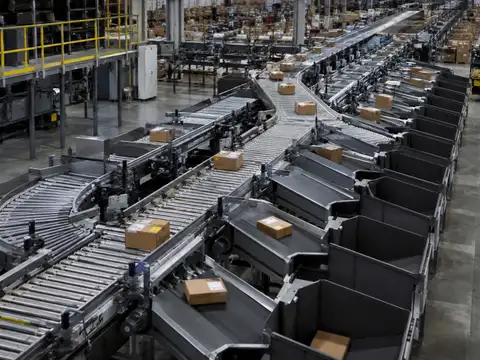
Sortation is where a conveyor system stops being only a transport system and starts making routing decisions.
The sorter identifies an item, assigns a destination and physically diverts it to a lane, chute, packing station, shipping door or downstream process.
That additional decision layer is why sortation costs far more than simply adding conveyor footage.
Investment map · 2026
Sortation cost rises when the machine has to identify, decide and divert faster.
Throughput is only one axis. Destination count, item variability, induction, scanner architecture, recirculation and software integration can change the project more than total conveyor footage.
Ball, belt or pop-up divert modules inside a conveyor network.
Current Tompkins Robotics planning range for fixed linear systems.
Current Tompkins planning range; generally higher-volume fixed infrastructure.
Induction, scanners, destinations, WCS, recirculation and surrounding conveyor.
There is no useful single “sortation cost per foot”
Linear footage matters, but it is not the dominant cost variable once a system must scan and route product.
A 200-foot line with two diverts and a 200-foot line with 40 destinations, recirculation and high-speed scanning are fundamentally different projects.
The second system can require:
- many more divert mechanisms;
- more destination conveyor;
- more sensors and I/O;
- scanner tunnels or vision;
- additional PLC/WCS logic;
- exception handling;
- recirculation;
- more commissioning.
The clearest current U.S. budget ranges are technology-level ranges
Ball sorter, pop-up wheel, belt divert or high-performance transfer
Best when the warehouse needs a limited number of routing decisions inside an existing conveyor architecture. Public turnkey prices are uncommon, so request a configured quote rather than inventing a national range.
Sliding shoe, wheel, pusher and related straight-line architectures
Tompkins Robotics currently describes fixed linear sorter projects with approximately 8–12 month implementations and investments from $750,000 to $4 million.
Crossbelt and tilt-tray loop systems
Tompkins currently places fixed loop-sorter investment around $2–$10 million depending on capacity, with implementation commonly described around 12–18 months.
Sorter plus full induction, destination, software and building integration
BEUMER's June 2026 international planning guidance illustrates how large the complete project category can become: €500,000–€2 million for smaller or semi-automated systems, €2–€10 million for mid-sized systems and €10–€50+ million for large fully integrated systems.
The Tompkins and BEUMER bands are not contradictory.
They describe different technology groupings, system boundaries and project scales. The useful takeaway is that a sorter can move from a targeted conveyor module to a multi-million-dollar distribution-center infrastructure project very quickly.
Five numbers should drive the RFQ
If these numbers are unknown, the project is not ready for a meaningful capital quote.
Throughput is the first cost driver—but theoretical throughput is not the number to buy
Toyota Automated Logistics currently describes high-speed sortation as the category used when requirements exceed approximately 90 units per minute.
That equals 5,400 units per hour before considering the rest of the system.
Toyota lists technologies such as sliding shoe, crossbelt and tilt tray for this high-speed tier.
But BEUMER makes an important distinction in its 2026 guidance: technical sorter throughput and real system throughput are not the same.
Actual performance depends on:
- induction rate;
- product quality;
- scanner read rate;
- destination availability;
- operator loading;
- recirculation;
- upstream and downstream constraints.
A sorter rated for 20,000 items/hour is not a promise that the warehouse will process 20,000 customer items/hour. Buy the required sustained system rate under representative product and induction conditions.
Interroll shows the current performance ladder
Current Interroll equipment provides a useful view of how sorter technology scales without assigning unsupported prices to each model.
| Current Interroll technology | Published throughput | Published load context |
|---|---|---|
| High-Performance Divert / modular sort element | Up to about 3,600 pieces/hour in current MCP guidance | Unit-load conveyor applications |
| Multibelt Switch BM 1300 | Up to 10,000/hour | Up to 50 kg |
| MX-Vs Vertical Crossbelt | 2,000–10,000/hour | Smaller-item vertical crossbelt architecture |
| MX-V Vertical Crossbelt | 2,000–12,500/hour | Up to 35 kg |
| MX-H Horizontal Crossbelt | 4,000–20,000/hour | Up to 50 kg |
These are published machine capabilities, not system acceptance rates and not price bands.
Destination count can be as important as throughput
Consider two operations that both process 6,000 cartons/hour.
One sorts to six carrier lanes. The other sorts to 80 store destinations.
The second project may need:
- many more discharge points;
- more downstream conveyor;
- larger footprint;
- more destination-full logic;
- more recirculation;
- more software routing;
- more operator consolidation positions.
Throughput alone therefore cannot estimate sortation CAPEX.
Crossbelt earns its cost when routing density and product mix justify it
Interroll's current MX-H Horizontal Crossbelt Sorter is published for approximately 4,000–20,000 items/hour and product weights up to 50 kg.
Crossbelt carriers can handle a broad mix including:
- cartons;
- parcels;
- small packages;
- padded envelopes;
- clothing;
- packaged food.
This breadth can be valuable in e-commerce, retail and parcel operations where the product mix is too varied for a simpler mechanical divert.
Linear sorters can be the better physical fit in existing warehouses
Tompkins currently describes linear systems as easier to fit into straight building layouts than loop systems and says they can expand by extending the sorter or adding parallel lanes.
Tompkins places the current sweet spot around operations processing roughly 5,000–15,000 units/hour where cartons and totes dominate.
The main limitation is fixed infrastructure.
If the building or destination layout changes significantly, the linear system does not move as easily as mobile robotics.
Loop sorters buy high sustained capacity and many destinations
Tompkins currently describes loop systems as a high-volume fixed-infrastructure choice with a current investment band around $2–$10 million.
Their closed geometry can support:
- many destinations;
- recirculation;
- high sustained volume;
- dense discharge arrangements.
The trade-offs include:
- large capital commitment;
- floor/structural requirements;
- longer implementation;
- less physical flexibility than modular/mobile solutions.
Modular diverts deserve their own category
Not every warehouse needs a dedicated linear or loop sorter.
Interroll's High Performance Conveyor Platform uses its Multibelt Switch as a diverting element capable of up to 10,000 parts/hour and multiple destinations.
Ultimation's August 2026 ball-sorter guidance describes modular ball sortation as attractive where:
- floor space is limited;
- layouts are likely to change;
- routing flexibility matters;
- continuous product flow is useful.
Ultimation also explicitly says a simpler transfer or pop-up diverter may be lower cost when only one fixed point-to-point transfer is needed.
That is the key low-cost sortation principle
Do not buy a sorter when a transfer will solve the routing problem.
If the operation only needs:
conveyor A → conveyor B at one known location,
a dedicated sortation platform can add unnecessary:
- controls;
- mechanical complexity;
- maintenance;
- software;
- capital cost.
Induction is often the hidden bottleneck
Every item has to enter the sorter at the correct spacing, orientation and identity.
Induction may require:
- operators or automatic feeders;
- gapping conveyor;
- alignment;
- barcode scanning;
- dimensioning;
- weighing;
- no-read rejection.
A high-speed sorter cannot compensate for an induction process that feeds it inconsistently.
Calculate required induction rate before specifying the sorter
A target of 9,000 items/hour equals 150 items/minute. If six manual induction positions share the work evenly, the conceptual average is 25 items/minute per position before downtime, no-reads, fatigue and imbalance. Validate whether that induction task is realistic.
Scanning can become a system inside the system
Toyota Automated Logistics currently emphasizes integrated scanner and vision systems that identify products at operating speed.
Depending on label placement and product variability, the project may need:
- single-side barcode read;
- multi-side scan tunnel;
- camera vision;
- OCR;
- dimensioning;
- weighing;
- RFID;
- exception lane.
Scanner architecture changes both capital cost and read-rate performance.
Sort accuracy should be contracted as an acceptance metric
Toyota Automated Logistics currently says modern scan-based sortation can achieve destination accuracy of 99.9% or higher.
Treat that as a supplier capability claim, not a universal guarantee.
The project contract should define:
- what counts as a mis-sort;
- whether no-reads are included;
- test product mix;
- test duration;
- required sustained rate;
- acceptable recirculation;
- exception handling.
Recirculation has a cost
A loop sorter can recirculate an item when:
- destination is full;
- divert is unavailable;
- route decision is late;
- downstream is blocked.
Recirculation preserves flow, but excessive recirculation consumes sorter capacity and can hide an under-designed destination area.
Track recirculation percentage in FAT/SAT.
Destination conveyor can rival sorter footprint
The sorter might occupy one central spine or loop.
Every destination still needs somewhere for items to go:
- chute;
- gravity lane;
- powered takeaway;
- put wall;
- packing station;
- shipping lane;
- bag/cart/tote.
Eighty destinations can create far more downstream equipment than eight.
Software integration should be its own cost bucket
Toyota Automated Logistics currently describes sortation systems as integrated with WCS, WES and WMS platforms for real-time routing.
The software layer may need to:
- receive order / destination data;
- associate barcode with route;
- track item position;
- choose destination;
- handle full lanes;
- manage recirculation;
- report exceptions;
- provide throughput/diagnostic data.
A sorter can be mechanically complete and commercially unusable until these interfaces are validated.
Retrofit projects carry a different cost risk from greenfield projects
Existing buildings can introduce:
- columns;
- low clear height;
- old conveyor;
- limited power;
- sprinkler conflicts;
- active operations;
- legacy WMS/WCS;
- restricted shutdown windows.
A sorter that fits well mechanically can still become expensive if installation requires repeated weekend cutovers.
Implementation time should be treated as a capital risk
Current Tompkins guidance gives:
- linear sorter: approximately 8–12 months;
- loop sorter: approximately 12–18 months.
BEUMER's broader 2026 guidance gives:
- small to mid-sized systems: approximately 3–6 months;
- large fully integrated systems: approximately 6–12+ months.
Different definitions explain the overlap. Use the vendor's actual design, manufacturing, site and commissioning schedule.
FAT and SAT are not paperwork exercises
Sortation needs representative product testing because:
- polybags behave differently from cartons;
- reflective labels can affect scanning;
- small packages can transfer differently;
- destination-full states change routing;
- peak induction changes spacing.
Factory Acceptance Test and Site Acceptance Test should include real operating conditions, not only empty mechanical running.
Maintenance architecture changes by sorter type
A modular divert can concentrate maintenance into:
- small belts;
- wheels;
- motors;
- sensors;
- actuators.
A crossbelt system adds many carriers and moving components around a loop.
A sliding-shoe system adds divert shoes, slats and drive components.
The right maintenance question is not “which sorter has fewer parts?”
It is: which architecture can the site maintain while meeting required availability?
Availability can matter more than raw speed
A 20,000-item/hour sorter running 80% of planned time can deliver less daily output than a slower system with stronger availability.
Model:
- planned uptime;
- mean time to repair;
- critical spares;
- OEM response time;
- maintenance windows;
- redundancy / bypass.
The throughput contract should include system availability assumptions.
Buy capacity for the peak that actually matters
Peak can mean:
- highest five minutes;
- highest hour;
- holiday day;
- carrier cutoff window;
- weekly promotion.
A sorter designed for a five-minute spike can be unnecessarily expensive if upstream buffering can smooth the flow.
Conversely, using daily average volume can under-size a system that must clear a two-hour shipping wave.
Peak duration changes the business case
If the site reaches 10,000 items/hour for only 20 minutes each day, model whether buffering can absorb the spike before buying a sorter designed to sustain 10,000 items/hour for an entire shift.
Sortation ROI should be measured per correctly routed unit
The sorter can create value through:
- manual sorting labor avoided;
- higher peak throughput;
- lower mis-sort / reship cost;
- fewer touches;
- reduced staging space;
- better carrier cutoff performance.
The cleanest operating metric is often cost per correctly sorted unit.
A simple annual-value model
Use:
labor and overtime avoided + verified mis-sort / reship reduction + measurable throughput value − maintenance − energy − software/service − incremental operating labor.
Then compare this with total installed CAPEX, not the sorter hardware alone.
Total installed CAPEX should include the full sorting loop
Budget:
- induction conveyor;
- gapping / alignment;
- scanner / vision;
- sorter machine;
- destination chutes / conveyor;
- recirculation;
- PLC / safety controls;
- WCS/WES integration;
- network;
- electrical;
- guarding;
- structural steel / mezzanine if applicable;
- installation;
- commissioning;
- training;
- critical spares;
- go-live support.
One budget mistake: comparing a sorter-only quote with a turnkey quote
Vendor A may quote only the core sorter.
Vendor B may include:
- induction;
- destinations;
- controls;
- WCS;
- electrical;
- installation;
- SAT.
The larger headline price can be the lower final project cost.
Normalize quotes with a project ledger
| Cost line | What to normalize |
|---|---|
| Rated throughput | Technical and guaranteed sustained system rate |
| Product envelope | Min/max dimensions, weight, bags, cartons, totes |
| Destinations | Active lanes plus future expansion |
| Induction | Manual/automatic stations, gapping, alignment |
| Identification | Barcode sides, camera, OCR, RFID, no-read lane |
| Sorter | Technology, length/loop, carriers/diverts |
| Downstream | Chutes, lanes, conveyors, consolidation |
| Controls | PLC, safety PLC, HMI, I/O |
| Software | WCS/WES, host integration, licenses |
| Site | Power, steel, floor, guarding, network |
| Delivery | Freight, rigging, installation |
| Acceptance | FAT, SAT, throughput and accuracy tests |
When a modular divert is usually enough
Good fit
- Few destinations
- Existing conveyor can be reused
- Moderate throughput
- Layout may change
- Compact routing point needed
Move up a technology class when
- Destination count is high
- Peak rate is sustained
- Product variety is broad
- Recirculation is needed
- One divert point becomes the bottleneck
When a linear sorter is usually strongest
- cartons and totes dominate;
- building geometry favors a straight line;
- 5,000–15,000 units/hour is a relevant operating tier;
- fixed infrastructure is acceptable;
- destinations can be placed along the sorter;
- capital budget is below typical loop-sorter scale.
When a loop sorter is usually strongest
- very high sustained volume;
- many destinations;
- broad item mix;
- recirculation is valuable;
- large fixed infrastructure is acceptable;
- the long-term volume justifies multi-million-dollar CAPEX.
When fixed sortation may be the wrong answer
Consider mobile or manual alternatives when:
- volume is low;
- destinations change frequently;
- seasonality is extreme;
- the building lease is short;
- layout changes are expected;
- batch sizes are unstable;
- capital flexibility matters more than maximum throughput.
The decision is not “automation or no automation.” The decision is the level of fixed infrastructure the operation can justify.
The practical recommendation
Do not begin with a sorter brand.
Begin with:
peak sustained rate + destination count + product envelope + required accuracy + peak duration.
If one or two routing points solve the flow, quote modular diverts first.
If the building supports straight high-volume carton/tote flow, evaluate linear sortation and use the current $750,000–$4 million Tompkins range only as an early screening benchmark.
If the operation requires very high sustained throughput and many destinations, loop sortation moves into a current $2–$10 million planning class before the broader DC integration around it.
The final budget should be a system budget. A sorter that cannot be fed, scanned, discharged or maintained at its advertised speed is simply an expensive bottleneck.
Frequently asked questions
How much does a warehouse sortation system cost?
Current Tompkins Robotics planning guidance puts fixed linear sorters around $750,000–$4 million and loop sorters around $2–$10 million depending on capacity. Smaller modular divert projects can cost much less but are usually quote-based.
How much does a crossbelt sorter cost?
Public model-specific crossbelt pricing is uncommon. Tompkins currently places loop sorters, a category that includes crossbelt and tilt-tray architectures, around $2–$10 million depending on capacity. A full project can cost more once induction, destinations, controls and site work are included.
How much does a linear sorter cost?
Tompkins Robotics currently publishes approximately $750,000–$4 million for fixed linear sorter implementations.
What counts as high-speed sortation?
Toyota Automated Logistics currently describes high-speed sortation as relevant when throughput requirements exceed roughly 90 units per minute.
What is a modular sortation system?
It uses smaller divert/transfer modules inside a conveyor architecture instead of one large dedicated sorter. Interroll's Multibelt Switch and modular high-performance diverts are examples of this approach.
How many destinations can a sorter handle?
It depends on sorter architecture, physical layout and throughput. Destination count should be specified explicitly because each discharge lane can add conveyor, controls, floor space and congestion constraints.
What determines sortation cost most?
Peak sustained throughput, destination count, item size/weight variability, induction, identification/scanning, sorter technology, downstream destination design, controls/software and retrofit complexity.
Does sortation include scanners and WMS integration?
Not automatically. Integrated systems often require barcode/vision equipment, PLC logic and WCS/WES/WMS interfaces, but vendor quote boundaries differ. Normalize scope before comparing prices.
How long does a sortation project take?
Tompkins currently describes roughly 8–12 months for linear sorters and 12–18 months for loop systems. BEUMER's broader guidance gives 3–6 months for smaller/mid-sized systems and 6–12+ months for large integrated systems. Actual schedules depend on project scope.
Should I buy a sorter based on maximum items per hour?
No. Buy guaranteed sustained system performance under representative product, induction, destination and availability conditions. Theoretical sorter speed can exceed real warehouse throughput.
When is a ball sorter better than a full sorter?
Ultimation's current guidance favors modular ball sorters where routing flexibility, limited footprint and changing layouts matter. It also notes that simpler transfers may be cheaper for basic point-to-point routing.
Sources and methodology
Warehouse Fieldbook uses current published technology and investment guidance rather than inventing one national average. Tompkins Robotics provides current U.S. investment and implementation bands for linear and loop sortation. Interroll provides current throughput and load specifications for modular diverts, Multibelt Switch and crossbelt technologies. Toyota Automated Logistics provides current high-speed-sortation, scan integration and system-routing context. Ultimation provides August 2026 guidance on modular ball sortation. BEUMER's June 2026 article is used only as an international cross-check on complete-project scale and is left in euros rather than converted. Final procurement requires project-specific quotations and guaranteed system acceptance criteria.
- Tompkins Robotics — current linear and loop sorter investment / implementation guidance
- Toyota Automated Logistics — current sortation technology, throughput and integration guidance
- Interroll — current MX-H Horizontal Crossbelt Sorter throughput and item-weight specifications
- Interroll — current MX-V Vertical Crossbelt Sorter specifications
- Interroll — current MX-Vs Vertical Crossbelt Sorter specifications
- Interroll — current Multibelt Switch BM 1300, up to 10,000 parts/hour
- Ultimation / Interroll — current modular divert and high-performance sorting element context
- Ultimation / Interroll — current HPP high-performance sortation architecture
- Ultimation — August 2026 ball-sorter selection guidance
- BEUMER — June 2026 international warehouse sortation cost and implementation benchmarks
- OSHA — 29 CFR 1910.212 general machine guarding
- OSHA — hazardous-energy control / lockout-tagout