
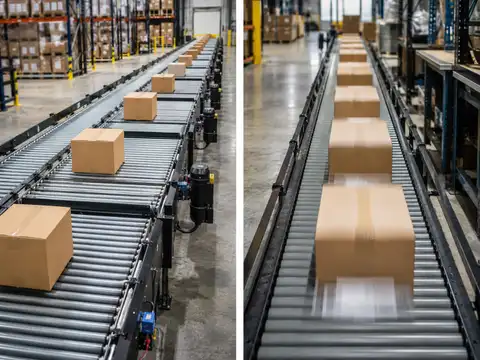
What should happen when the next process stops for 30 seconds?
If upstream should stop too, standard powered transportation may be enough. If upstream should keep working, the system needs somewhere controlled to hold product. That is the economic purpose of accumulation.
Buffer-control blueprint
The value of accumulation appears when downstream stops.
A transportation conveyor moves product. An accumulation conveyor decides where product can wait, how much can wait, and when each zone may release.
A conventional continuous-drive route does not automatically create a controlled buffer when the next process becomes unavailable.
Hytrol currently describes minimum-pressure accumulation at approximately 2% back pressure, appropriate where light product contact is acceptable.
Sensors and independently controlled zones stop product without package-to-package accumulation pressure.
Standard powered conveyor moves product; accumulation controls waiting
Hytrol currently separates transportation conveyor from accumulation conveyor by function.
Transportation equipment is intended to move product through the process.
Hytrol defines accumulation conveyor as equipment that can remove drive in segments or zones so products can stop or collect where needed.
Those buffers are commonly used before:
- merges;
- sortation;
- palletizers;
- packaging machines;
- robot cells;
- inspection;
- labeling / scanning.
The difference is therefore control of queue behavior—not simply whether the rollers have motors.
An MDR conveyor can be transportation or accumulation
Ultimation's current 24V MDR guidance explicitly lists both:
- transportation;
- zero-pressure accumulation
as normal uses of motor-driven roller conveyor.
Its current 18-inch × 10-foot MDR product starts at $1,932.50 and uses independently powered zones with photo-eye sensors.
This is important: the mechanical conveyor family does not alone determine whether the process has sophisticated accumulation.
Zone length, sensors, driver/control logic and release behavior determine the function.
The three operating modes
Minimum pressure is the middle ground
Hytrol currently describes minimum-pressure accumulation as allowing products to lightly touch with approximately 2% back pressure.
Hytrol's July 2026 manufacturing guidance says minimum-pressure conveyor is well suited for cartons, cases and other durable products where light contact is acceptable.
Examples include flow ahead of:
- case sealers;
- labelers;
- stretch wrappers.
The value proposition is straightforward: create a buffer without paying for the highest level of independent product separation where product contact creates little risk.
Zero pressure buys individual queue control
Hytrol currently defines zero-pressure accumulation as a system that creates space between products so they do not touch while accumulating.
Hytrol's current EZLogic control uses photo-electric sensing plus discrete logic to create zero-pressure accumulation without requiring pneumatic logic or a PLC for the basic accumulation function.
Its E24 system uses a decentralized drive in each accumulation zone and EZLogic zone controllers to detect and release product according to the programmed behavior.
Interroll uses the same zone principle
Interroll's current RollerDrive EC5000 is specifically designed for:
- straight conveyors;
- conveyor zones;
- belt conveyors;
- zero-pressure accumulation.
It is currently available in 24V or 48V DC.
Interroll's current ZoneControl provides built-in ZPA logic for small to medium numbers of zones and can operate without a PLC or fieldbus.
For larger systems, Interroll's MultiControl architecture controls four RollerDrive zones and supports ZPA plus networked operation.
Zone count is the true design variable
One 40-foot conveyor is not one accumulation buffer.
It might be:
- four 10-foot zones;
- eight 5-foot zones;
- twenty 2-foot zones.
More zones can provide:
- denser accumulation;
- more individual product control;
- shorter release increments.
They can also require:
- more sensors;
- more controlled drives;
- more wiring / communication;
- more configuration points.
One product generally consumes one accumulation zone
For a simple one-product-per-zone design, the zone must be long enough for the product plus appropriate control allowance.
The exact relationship depends on conveyor architecture and controls.
Do not define 24-inch zones for a product population containing 36-inch cartons simply because shorter zones increase theoretical buffer density.
Buffer capacity starts with the bottleneck duration
This is an early planning calculation, not a final controls design.
It answers the practical question: how many units arrive while downstream is unavailable?
Example: 20 cartons/minute upstream
20 cartons/min × 3 minutes = 60 cartons of conceptual buffer.
If the line stores one carton per zone, that means roughly 60 usable accumulation positions before adding system-specific operating margin.
The buffer should solve a real interruption—not store unlimited WIP
A warehouse can always add more conveyor.
More buffer can hide:
- slow downstream equipment;
- poor staffing;
- excessive machine downtime;
- bad release logic.
Measure the interruption distribution:
- typical stop duration;
- 90th / 95th percentile stop;
- maximum recoverable stop;
- frequency of stops.
Size the buffer for the operating strategy rather than the worst event imaginable.
Accumulation creates decoupling
Short downstream pauses do not have to propagate immediately to the previous process.
Release product to machines, merges and sortation when capacity is available.
ZPA keeps suitable products separated while waiting.
Workers do not need to repeatedly move cartons into and out of floor staging.
That decoupling is where ROI should come from
Accumulation has economic value when it reduces one or more of:
- upstream idle time;
- manual staging labor;
- product damage;
- machine starvation;
- missed throughput;
- floor WIP;
- operator intervention.
If downstream never stops and the route simply moves product continuously, accumulation controls can have very little value.
Do not confuse accumulation with higher conveyor speed
A buffer can improve system throughput without increasing conveyor speed.
Example:
a case sealer pauses for 30 seconds.
Without accumulation, the upstream pack line stops.
With enough buffer, the pack line continues and the queued cartons clear after the sealer restarts.
The conveyor never needed to run faster.
It needed to absorb variability.
Accumulation can also prevent downstream starvation
A buffer before a machine can maintain a ready queue so the machine receives the next product immediately when it is available.
This can matter before:
- robotic cells;
- case sealers;
- labelers;
- inspection machines;
- sorters;
- palletizers.
Hytrol's July 2026 manufacturing guidance explicitly connects accumulation with maintaining controlled flow around these types of processes.
Current component prices show where ZPA complexity lives
Public pricing does not provide a universal “ZPA premium per foot.”
But current Ultimation component prices make the cost stack visible.
Current Itoh Denki 1.9-in, 15-in BF 24V MDR drive roller.
Current Itoh Denki HBK-608F driver card with built-in two-zone ZPA logic.
Current Ultimation 20A 24V DC MDR power supply.
Current 18-in-wide Ultimation MDR with power supply and selectable 2 or 3 zones.
These prices should not be added together blindly.
The complete MDR module already includes components such as its power supply and selected powered-zone hardware.
The separate component prices are useful for understanding architecture, retrofit and repair—not for double-counting a new conveyor quote.
Current ZPA control card: $294.90 for two zones
Ultimation currently lists the Itoh Denki HBK-608F two-zone hybrid driver card at $294.90.
The card includes built-in zero-pressure-accumulation logic, two sensor connections and communication with adjacent cards.
It can control up to two compatible Power Mollers.
This provides a concrete example of why accumulation is not “free software.”
The zone needs control hardware, sensing and drive functionality.
Current 24V power supply: $630
Ultimation currently lists its 24V 20A MDR power supply at $630.
Again, this is a component price.
Large systems require electrical design based on:
- zone quantity;
- motor current;
- simultaneous starts;
- voltage drop;
- control topology;
- redundancy.
Standard powered conveyor can be mechanically simpler
A conventional continuous-powered route can use:
- one or relatively few drives;
- fewer sensors;
- simpler control logic;
- fewer independent zones.
This can reduce:
- initial controls cost;
- commissioning;
- device count;
- troubleshooting complexity.
If the process has no buffering need, this simplicity has real value.
But continuous drive can waste energy when conveyor sits empty
Ultimation currently emphasizes “Run on Demand” as a benefit of MDR: motorized rollers switch off when product is not detected.
Interroll likewise says RollerDrive in ZPA conveyor moves goods only when necessary.
Interroll currently claims up to 50% energy savings compared with central drives in relevant ZPA applications.
Treat that as manufacturer guidance—not a guaranteed project result.
Real energy savings depend on:
- duty cycle;
- product flow;
- zone utilization;
- motor efficiency;
- baseline system.
Interroll's food-processing test shows how application-specific energy comparisons can be
Interroll reported in 2025 that its MCP CleanLine roller conveyor operating in ZPA mode used 90% less energy in tests than an identically sized belt conveyor.
This is a specific manufacturer test in a particular hygienic-conveyor comparison.
It should not be turned into “ZPA saves 90% energy” across every warehouse.
It does reinforce the broader point: run-on-demand zones can substantially change energy behavior when the alternative runs a belt continuously.
Product protection can be a stronger business case than energy
Hytrol's March 2026 guidance says ZPA is particularly appropriate for:
- delicate products;
- high-value products;
- operations where surface damage matters;
- precise release requirements.
If cartons touching in accumulation create no damage, minimum pressure may be adequate.
If products are fragile or cosmetic, package separation can justify the additional control.
Minimum pressure should not be dismissed as “old technology”
Hytrol still lists minimum-pressure accumulation as a current product category.
Its July 2026 guidance specifically recommends it for durable cartons and cases where light product contact is acceptable.
The correct economic question is:
does the product require zero contact?
If not, do not automatically pay for more sophisticated separation.
Zero pressure is strongest before automation
Automated equipment often benefits from known product spacing.
Hytrol currently identifies ZPA applications before:
- robotic work cells;
- inspection stations;
- automated packaging;
- sortation.
Controlled release can prevent two products entering a machine at once.
Accumulation can reduce labor strain by removing manual queue management
Hytrol's March 2026 article frames smart accumulation as a way to improve material flow and reduce unnecessary worker intervention.
Without a buffer, people may:
- pull cartons off a stopped line;
- stage them on the floor;
- carry them around the blockage;
- reload them after restart.
A controlled buffer can turn that manual exception into normal system behavior.
Measure queue-management labor before claiming savings
Track:
- manual interventions/day;
- minutes/intervention;
- employees involved;
- overtime caused by blockage recovery.
Do not count normal operator time as “saved” unless the accumulation system actually removes or repurposes that work.
Accumulator density is limited by zone length
Example:
60 feet of usable ZPA conveyor ÷ 3-foot zones = approximately 20 accumulation positions.
This is conceptual layout arithmetic.
Final design needs:
- maximum product length;
- zone-control rules;
- transfer lengths;
- sensor placement;
- operating gaps.
Interroll says ZPA can reduce runout length in parcel applications
Interroll's May 2026 parcel-hub guidance says traditional accumulation can need long runout zones, while individually controlled ZPA zones can create more compact accumulation in tight spaces.
This can turn accumulation into a space decision, not only a throughput decision.
If ZPA saves enough queue/staging floor area, include the value of that usable warehouse space in the business case.
Do not assign arbitrary dollars to floor space
Space creates value when the warehouse can actually use it for:
- storage;
- pick faces;
- production;
- another conveyor;
- avoided building expansion.
Empty floor area with no alternative use is not automatically a cash saving.
Buffer logic can be standalone or networked
Interroll's current ZoneControl supports ZPA without fieldbus.
Hytrol's EZLogic likewise provides zero-pressure control without requiring a PLC for basic zone logic.
Larger systems may still integrate:
- PLC;
- WCS;
- WES;
- sorter controls;
- machine interlocks.
Do not assume every ZPA project requires enterprise-level controls.
Networked controls become useful when the buffer must make system decisions
Higher-level control can add value when:
- multiple destinations exist;
- priority orders must bypass ordinary queues;
- buffer occupancy drives upstream release;
- WCS must track every tote;
- downstream equipment reports capacity state.
Here, accumulation becomes part of warehouse orchestration rather than local conveyor logic.
More zones create more maintenance points
ZPA architecture adds distributed:
- motorized rollers;
- sensors;
- driver cards / zone controllers;
- power connections;
- communication cables.
Standard continuous-drive conveyor can contain fewer powered components.
The maintenance trade-off is:
more modular components in exchange for independent control and run-on-demand behavior.
Distributed failure can be easier to isolate
A failed sensor or motorized roller can often be traced to one zone.
That can simplify troubleshooting compared with a long central drive problem.
But the facility must stock:
- correct MDR models;
- sensors;
- controllers;
- power components.
The maintenance program should reflect the control architecture.
Current powered flex conveyor shows accumulation in a portable package
Ultimation currently lists its powered flex roller conveyor with ZPA accumulation and variable-speed control at $10,869.
This is a specialized expandable portable system—not a benchmark for fixed MDR accumulation per foot.
It demonstrates that accumulation functionality is available even in flexible dock / warehouse equipment where route configuration changes.
Accumulation does not always require fixed infrastructure
Portable powered flex can be relevant for:
- truck loading/unloading;
- seasonal operations;
- temporary shipping lanes;
- areas where a fixed conveyor route is undesirable.
The business case differs from fixed MDR because mobility itself has value.
Case study logic: 60-carton buffer
Unless another staging method absorbs the 60 cartons arriving during the interruption.
Potential fit if cartons are durable and light package contact is acceptable.
Potential fit when individual separation, release logic or product protection matters.
The correct choice depends on product and process.
ZPA is not automatically the answer simply because it provides the most control.
Calculate the value of avoided upstream stops
Then value only what that productive time creates:
- reduced overtime;
- more output;
- lower labor requirement;
- avoided missed cutoff.
Do not automatically convert every preserved minute into revenue.
Example: 12 minutes preserved per day
Suppose a buffer prevents upstream from stopping for 12 minutes on each of 250 operating days.
That preserves:
12 × 250 = 3,000 minutes, or 50 hours/year.
Whether those 50 hours are worth $500 or $50,000 depends on what the operation can actually do with them.
Accumulation is strongest where process variability is expensive
Strong use cases include:
- upstream machine must not starve or stop;
- downstream cycles intermittently;
- sorter induction needs controlled spacing;
- robot requires one product at a time;
- carrier cutoff makes lost minutes expensive;
- manual floor staging creates labor or congestion.
Standard powered transport is strongest where flow is continuous
Keep the simpler architecture when:
- one origin and one destination;
- downstream rarely blocks;
- product can stop at the endpoint;
- no product protection problem exists;
- no controlled buffer is required;
- lower controls complexity matters.
Minimum pressure is strongest where contact is acceptable
It can be attractive for:
- durable corrugated cartons;
- cases;
- short queues;
- steady feed before packaging machinery;
- applications where light back pressure creates no product issue.
This is the “do not over-engineer the buffer” option.
Zero pressure is strongest where control matters
Choose ZPA when:
- product contact is unacceptable;
- high-value / fragile goods are handled;
- one-at-a-time release is important;
- automation needs precise spacing;
- compact controlled buffer capacity has value;
- run-on-demand energy behavior matters.
Do not install accumulation everywhere
If only 25 feet before a case sealer needs buffering, adding ZPA zones across a 300-foot transport route can create unnecessary sensors, controls and maintenance. Put accumulation where variability occurs.
Hybrid design is usually the most economical
A strong warehouse route can contain:
- standard powered transportation;
- ZPA before a merge;
- continuous transport after the merge;
- ZPA before sortation;
- gravity takeaway at packing.
The route does not need one control philosophy from end to end.
Define accumulation zones around process boundaries
Look for:
- machine interfaces;
- merges;
- diverts;
- inspection;
- manual workstations;
- sortation;
- carrier staging;
- robot cells.
These are the places where one process can run at a different instantaneous rate from the next.
RFQ checklist for accumulation
Give the integrator:
- minimum and maximum product length;
- minimum and maximum weight;
- fragility / product-contact tolerance;
- normal units/minute;
- peak units/minute;
- typical downstream stop duration;
- maximum buffer target;
- desired zone length;
- release logic;
- upstream / downstream handshakes;
- standalone vs PLC/WCS control;
- environment;
- future product mix.
Normalize vendor quotes by buffer positions
Comparing only $/foot can mislead.
Compare:
- usable accumulation positions;
- zone length;
- product envelope;
- controls included;
- power supplies;
- sensors;
- PLC/WCS scope;
- installation;
- commissioning.
A more expensive 60-foot line can be better value if it creates 30 useful product positions while a cheaper design creates only 15.
A useful capital metric: installed dollars per usable buffer position
This is not an ROI metric.
It is a procurement-normalization metric.
Compare it only across systems handling the same product and process requirement.
Do not forget the operating cost of complexity
Accumulation can add:
- sensor cleaning / alignment;
- zone-controller spares;
- motorized-roller spares;
- controls troubleshooting;
- software configuration.
Those costs should be included against the value of:
- less downtime propagation;
- less product damage;
- less manual staging;
- better process synchronization.
The practical recommendation
Use standard powered conveyor when the job is simply transportation.
Use minimum-pressure accumulation when a durable product needs to queue and light contact is acceptable.
Use zero-pressure accumulation when the business needs controlled individual buffering, product separation or machine synchronization.
Most importantly: install accumulation only around the process variability that needs to be absorbed.
The decision in one line
Standard conveyor moves the queue; accumulation manages the queue. Pay for the extra control only when waiting product has measurable operational value.
Frequently asked questions
What is the difference between accumulation and regular powered conveyor?
Regular powered conveyor primarily transports product. Accumulation adds controlled buffering so product can stop, queue and release according to downstream availability.
What is zero-pressure accumulation?
ZPA divides conveyor into controlled zones so products can accumulate without package-to-package pressure. Sensors detect occupancy and release product when the downstream zone is available.
When should I use minimum pressure instead of zero pressure?
Minimum pressure can be sufficient for durable cartons or cases where light contact causes no damage and precise individual separation is unnecessary.
How much does an MDR accumulation conveyor cost?
Ultimation currently lists one 18-in × 10-ft MDR conveyor starting at $1,932.50 with selectable powered zones and a power supply. Complete ZPA system cost depends on zone count, sensors, controls, installation and integration.
How much does a zero-pressure accumulation controller cost?
One current public example is the Itoh Denki HBK-608F two-zone ZPA driver card at $294.90. Other controllers and networked systems vary materially.
How many accumulation zones do I need?
Start from the number of products that arrive during the downstream interruption the buffer is intended to absorb, then size zones for the product envelope and control architecture.
Does zero-pressure accumulation save energy?
It can because zone drives run on demand. Interroll currently states RollerDrive ZPA can save up to 50% energy versus central drives in relevant applications, but actual project savings depend on duty cycle and baseline equipment.
Does accumulation increase throughput?
It can improve system throughput by preventing short downstream interruptions from immediately stopping upstream processes. It does not automatically increase the conveyor's mechanical maximum speed.
Can accumulation reduce product damage?
Zero-pressure accumulation can reduce package-to-package contact, which is valuable for fragile, high-value or cosmetic products. Minimum pressure may be sufficient when light contact is harmless.
Should an entire conveyor line use ZPA?
Not necessarily. Hybrid design is often more economical: use standard transport on stable routes and accumulation around merges, machines, sortation and other variable process boundaries.
Accumulation controls product spacing and queueing, while sortation adds destination decisions and divert hardware. The sortation system cost guide covers that additional layer.
Sources and methodology
Warehouse Fieldbook distinguishes transportation, minimum-pressure accumulation and zero-pressure accumulation using current Hytrol terminology. Hytrol's current product pages and July/March 2026 guidance support the use cases for durable products, delicate products and controlled buffers. Interroll provides current RollerDrive EC5000, ZoneControl and MultiControl architecture and current manufacturer energy-efficiency claims for run-on-demand ZPA systems. Ultimation provides current MDR module and component pricing and describes transportation, ZPA and Run-on-Demand as standard MDR functions. Public prices are used as component/system snapshots, not as a universal ZPA premium. Buffer examples are transparent arithmetic rather than industry benchmarks.
- Hytrol — current accumulation conveyor product categories
- Hytrol — current minimum-pressure accumulation and approximately 2% back-pressure guidance
- Hytrol — current zero-pressure accumulation definition
- Hytrol — current E24 decentralized accumulation architecture
- Hytrol — current EZLogic zero-pressure control architecture
- Hytrol — March 2026 accumulation, labor and product-protection guidance
- Hytrol — July 2026 minimum-pressure and zero-pressure application guidance
- Interroll — current EC5000 RollerDrive, ZPA and energy-efficiency guidance
- Interroll — current standalone ZoneControl ZPA architecture
- Interroll — current four-zone MultiControl AI ZPA architecture
- Interroll — May 2026 compact ZPA buffer guidance for parcel hubs
- Interroll — application-specific MCP CleanLine ZPA energy test
- Ultimation — current MDR transportation, ZPA and Run-on-Demand guidance
- Ultimation — current 18-in × 10-ft MDR conveyor price
- Ultimation — current two-zone ZPA driver-card price
- Ultimation — current 15-in BF motorized-roller price
- Ultimation — current 24V 20A MDR power-supply price
- Ultimation — current powered flex conveyor with ZPA accumulation price