
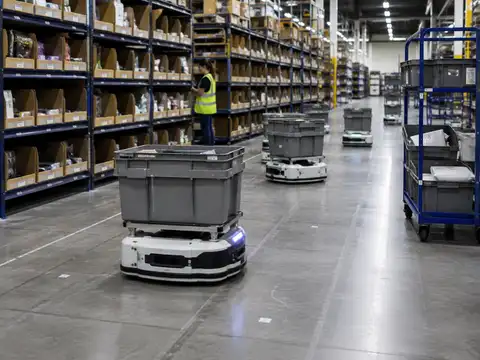
One industrial AMR can start around €45,000; an operational fleet is a different purchase.
KNAPP currently states that its Open Shuttle begins at about €45,000 and varies with equipment. It separately says integration expenses depend on the project. Treat that number as a robot-level price anchor, not as an installed-fleet price.
Fleet procurement dossier
The robot chassis is only line 1 of the AMR purchase order.
Payload, footprint, battery, navigation, safety hardware and onboard compute.
Lift, fork, conveyor top, cart interface, shelf carrier or custom fixture.
Automatic chargers, locations, electrical feeds and charging strategy.
Traffic control, task assignment, maps, priorities, orchestration and analytics.
WMS/MES/ERP interfaces, pickup/drop stations, doors, elevators, network and process design.
Training, preventive maintenance, service coverage, spare parts and lifecycle support.
Current public AMR price anchor: €45,000+
KNAPP's February 2026 AMR cost guide states that one Open Shuttle begins at €45,000.
KNAPP's current Open Shuttle product page repeats the same base-price guidance and explicitly says:
- price varies with equipment;
- integration expense depends on the project.
Warehouse Fieldbook does not convert that number into dollars because exchange rates change and KNAPP is not publishing it as a U.S. dollar list price.
An eight-robot fleet is not simply €360,000 installed
The arithmetic:
8 robots × €45,000 = €360,000.
That is useful only as an illustrative base-hardware multiplication.
It does not establish the cost of:
- fork/lift/conveyor modules;
- automatic chargers;
- fleet software;
- servers or cloud/service architecture;
- WMS/MES/ERP integration;
- pallet/tote pickup stations;
- automatic doors/elevators;
- site network changes;
- training;
- spares;
- service.
AMR cost has six purchasing layers
Payload, battery, safety sensors, navigation, onboard controls and mechanical chassis.
Forks, lift deck, conveyor top, cart coupling, shelf carrier or custom fixture.
Chargers, electrical feeds, racks, stands, conveyors, pallet stations and interfaces.
Fleet management, task release, WMS/MES/ERP connection, doors, elevators and controls.
Payload class changes both robot price and the rest of the system
KNAPP Open Shuttle
Current KNAPP configuration for containers, cartons and trays with payload up to 120 kg / 265 lb.
MiR250
MiR's current compact robot handles up to 250 kg and is intended for flexible internal transport in constrained areas.
MiR600 / OTTO 600
Both manufacturers currently offer 600-kg-class AMRs. MiR600 can move up to 600 kg at up to 2 m/s in its base specification.
OTTO 1200 / MiR1350 / KNAPP Open Shuttle Fork
Current heavy platforms span roughly 1,200–1,350 kg payload classes, depending on model and application module.
Do not buy payload capacity you do not use
Higher-payload platforms can bring:
- larger chassis;
- different turning/clearance requirements;
- different battery/charging behavior;
- different top modules;
- different transfer-station requirements.
Size the AMR from:
- maximum real load weight;
- center of gravity;
- load footprint;
- handling method;
- required speed;
- route constraints.
Do not specify a 1,350-kg robot because the warehouse occasionally handles a heavy pallet if 98% of missions carry 150-kg carts and the heavy flow can be handled separately.
The top module can change the application more than the robot chassis
MiR's current ecosystem shows how broad this layer can become.
Its MiR Go catalog includes:
- pallet lifts;
- cart movers;
- roller-conveyor modules;
- shelf carriers;
- pallet racks;
- conveyor docking;
- elevator interfaces;
- automatic doors;
- custom modules.
The AMR is therefore a mobile base.
The application hardware determines how it actually exchanges material.
A base robot rated for 600 kg does not mean the complete pallet application carries 600 kg
MiR600 itself is rated for up to 600 kg.
MiR's current U.S. Pallet Lift 600 application is rated to autonomously lift and transport payloads up to 500 kg.
Likewise, MiR1350 has a 1,350-kg base payload while its current U.S. Pallet Lift 1350 application handles pallets up to 1,250 kg.
Budget and size the complete configured application—not the chassis data sheet alone.
Fleet size should come from cycle time
This gives the number of robots that would be continuously busy at 100% utilization.
It is not the fleet recommendation yet.
A complete AMR mission has more than loaded travel
Measure door-to-door robot time, not just meters per second.
Dock, lift, fork, cart coupling or conveyor transfer.
Distance, speed restrictions, intersections and traffic.
Positioning, handshake, transfer and confirmation.
Empty travel or strategic fleet positioning.
Traffic, blocked stations, charging and operational reserve.
Illustrative fleet-sizing example
Assume:
- 30 required pallet/cart moves/hour;
- 8-minute measured average mission cycle.
Base robot workload:
30 × 8 ÷ 60 = 4 continuously busy robots.
A four-robot purchase would imply effectively 100% useful utilization with no operational margin.
If the engineering team chooses an illustrative 80% target utilization:
The 80% figure is not an industry standard.
Choose the utilization target from:
- traffic variability;
- charging strategy;
- mission criticality;
- peak demand;
- acceptable queueing;
- maintenance reserve.
Robot speed is usually not the fleet-sizing shortcut people expect
MiR600 currently lists a maximum speed of 2.0 m/s / 6.6 ft/s.
MiR1350 currently lists 1.2 m/s / 3.9 ft/s.
Those are maximum product specifications.
Average mission speed can be lower because of:
- pedestrians;
- forklift traffic;
- corners;
- intersections;
- doors;
- congestion;
- docking;
- safety-field behavior.
Model measured or simulated cycle time instead of dividing route distance by maximum speed.
Traffic can make robot number nonlinear
Ten robots do not necessarily produce exactly twice the throughput of five.
As fleet size grows:
- intersections can become congested;
- chargers can queue;
- pickup/drop stations can bottleneck;
- narrow corridors can serialize traffic.
KNAPP says Open Shuttle fleets can range from two robots to more than 100.
That scalability requires fleet orchestration and an environment capable of accepting the traffic.
Site geometry can become a hidden AMR cost
MiR currently lists approximately 3,500 mm / 137.8 in as the operational corridor width for two MiR600 robots passing with the default setup.
MiR lists approximately 2,700 mm / 106.3 in in a minimized-footprint / muted-protective-field configuration. Final safety design remains application-specific.
This matters because an AMR project can discover that:
- two-way traffic does not fit;
- one-way loops are required;
- rack needs to move;
- staging blocks routes;
- manual forklifts conflict with robot paths.
“No fixed guidance infrastructure” does not mean “no layout engineering.”
Charging must be designed from mission demand
MiR600 currently lists:
- up to 11 hours active operation;
- a charging ratio up to 1:12;
- 10 minutes of charging providing roughly two hours of runtime at maximum payload under its stated conditions.
This illustrates opportunity charging.
It does not prove every AMR fleet can operate with the same charge ratio.
Battery behavior changes with:
- payload;
- travel distance;
- speed;
- temperature;
- top module;
- traffic;
- battery age.
Charger count is a throughput decision
Too few chargers can create:
- charging queues;
- robots unavailable during peaks;
- long deadhead travel to charging points.
Too many chargers can add unnecessary:
- capital;
- electrical work;
- floor/wall locations.
Simulate charging against the actual mission schedule.
Fleet software is not optional at scale
KNAPP's current Open Shuttle architecture uses KiSoft FCS to manage transport resources and fleet behavior.
OTTO likewise emphasizes fleet-management software as a core requirement for large AMR deployments.
Fleet software can decide:
- which robot receives each mission;
- route selection;
- traffic priorities;
- charging;
- blocked-route recovery;
- vehicle balancing;
- system status.
Ask whether software is:
- included;
- licensed annually;
- licensed by robot;
- licensed by site;
- cloud or on-premises;
- subject to support fees.
Integration can be simple—or the biggest project line
KNAPP currently describes three Open Shuttle task-release models:
- direct connection with the customer's higher-level system;
- transport orders generated from machine-control sensor signals;
- transport orders created directly by employees.
A simple employee-triggered route can require relatively little enterprise integration.
A fleet that must coordinate:
- WMS;
- MES;
- SAP/ERP;
- conveyor;
- AS/RS;
- robot cells;
- doors;
- elevators
is a different software project.
Cost the pickup and drop points
AMRs need physical interfaces such as:
- pallet stands;
- flow racks;
- cart parking locations;
- conveyor docking points;
- lift stations;
- robotic-machine handoff points.
KNAPP explicitly lists transfer stations, conveyors and flow racks among its Open Shuttle accessories.
A robot cannot autonomously exchange material with a station that was never designed for autonomous exchange.
The AMR project cost stack
Service contracts are part of AMR TCO
MiR currently offers Care plans with fixed annual-fee structures intended to make service cost more predictable.
OTTO currently offers lifecycle support through OTTO Care, including support for fleets ranging from first deployments to large installations.
RFQs should separate:
- warranty;
- preventive maintenance;
- remote support;
- on-site response;
- software support;
- battery replacement;
- wheels / wear parts;
- critical spares.
Do not use a generic annual maintenance percentage without vendor data
AMR lifecycle cost depends on:
- vehicle model;
- distance traveled;
- load;
- floor condition;
- battery cycles;
- top-module complexity;
- service-level agreement.
Request an annual service schedule and replacement-parts forecast.
Safety is an engineering scope, not a checkbox
MiR currently states that its industrial platforms are designed around standards including ISO 3691-4 and RIA R15.08-1, with model-specific details and exceptions disclosed in technical specifications.
OTTO likewise states that its AMR fleet complies with standards including:
- ISO 3691-4;
- ANSI/RIA R15.08-1;
- ANSI/ITSDF B56.5.
The robot's compliance does not replace the facility's application risk assessment.
Route design must consider:
- pedestrians;
- manual forklifts;
- blind corners;
- doors;
- crossings;
- load overhang;
- emergency access;
- transfer stations.
Facility modification can still be required
AMRs generally avoid the fixed guidance infrastructure associated with traditional AGVs and fixed conveyor.
But a real deployment may still require:
- route widening;
- rack/staging relocation;
- automatic door interfaces;
- floor repairs;
- network improvements;
- charger power;
- new pickup/drop equipment.
This is why “infrastructure-free navigation” should not be translated into a $0 facility budget.
Floor quality affects cycle time and wear
Inspect:
- gaps;
- thresholds;
- ramps;
- floor damage;
- debris;
- drains;
- slopes.
The robot must navigate the actual route with the actual load.
A successful demo on a clean 50-foot path is not enough to size a 24/7 fleet.
Network quality can become an integration cost
Depending on vendor architecture, fleet management, WMS integration, monitoring and updates can rely on reliable facility networking.
Survey:
- coverage;
- roaming;
- latency;
- segmentation/security;
- server/cloud connectivity.
Budget switches, access points or industrial networking if the existing site is inadequate.
AMR financing can change cash flow
MiR currently advertises financing from approximately €7.99 / $8.67 per robot-hour under its finance offering. This is a financing example—not a purchase price, not a universal RaaS rate and not automatically comparable with KNAPP's €45,000 base robot price.
Financing can:
- reduce upfront cash;
- match payments to operating benefits;
- change accounting treatment depending on contract.
It does not eliminate:
- integration;
- site work;
- performance risk;
- support obligations.
A later Warehouse Fieldbook guide compares RaaS and robot ownership directly.
Current manufacturer ROI guidance: roughly 1–3 years in many KNAPP projects
KNAPP's February 2026 cost article says many AMR projects achieve ROI in around 1–3 years, depending on application, shift model and company size.
It also states that one AMR can replace roughly 0.3–1.2 FTE depending on use.
These are manufacturer planning claims.
Do not use:
- 1–3 years as a promised payback;
- 1.2 FTE per robot as a default labor saving.
Measure your route and labor baseline.
Labor value comes from transport work actually removed
Measure current:
- walking/driving minutes per mission;
- missions per shift;
- employees assigned;
- waiting time;
- overtime;
- temporary labor.
Then determine whether AMRs reduce:
- paid hours;
- overtime;
- temp labor;
- planned hiring;
- nonproductive material-movement time.
An AMR can save labor without eliminating a job
A machine operator who currently spends 15 minutes every hour moving material can remain employed while the AMR absorbs transport.
The economic benefit may be:
- more production;
- less line starvation;
- less overtime;
- fewer additional hires.
Do not call the entire employee salary “saved” if payroll does not change.
AMRs are strongest where transport is repetitive but routes still change
Strong applications include:
- production line supply;
- pallet movement between departments;
- cart/tote transport;
- replenishment;
- warehouse-to-production movement;
- express/hot missions;
- connecting automation islands.
KNAPP currently positions Open Shuttle as an alternative or complement to stationary container and pallet conveyor.
AMRs are weaker where one fixed high-volume path dominates
If material moves continuously:
- from one origin;
- to one destination;
- at very high sustained rate;
- with no route flexibility requirement
fixed conveyor may deserve comparison.
AMR flexibility has value only if the process uses it.
Do not compare AMR and forklift by vehicle price alone
Compare:
- vehicle/fleet CAPEX;
- operator labor;
- energy;
- maintenance;
- route capacity;
- damage;
- safety exposure;
- space;
- availability.
A forklift is flexible and can perform many tasks.
An AMR can be highly efficient at repetitive transport but is not a universal forklift substitute.
Peak demand determines fleet size more than average demand
A fleet averaging 40% utilization all day can still fail if:
- receiving releases 30 moves at once;
- production cells call simultaneously;
- shipping creates a cutoff surge.
Model:
- average hour;
- peak hour;
- peak 15 minutes;
- mission-priority rules.
Mixed fleets can prevent overbuying heavy robots
KNAPP currently allows different Open Shuttle models/load-handling devices in one fleet.
A warehouse might use:
- light AMRs for totes;
- heavy AMRs for pallets;
- specialized units for machine interfaces.
This can be better than forcing every mission onto the most expensive/heavy platform.
But mixed fleets increase support complexity
More robot types can mean more:
- spare parts;
- training;
- top modules;
- chargers;
- software configuration.
Standardize where standardization has value.
Deployment can be faster than fixed automation—but do not promise weeks
KNAPP currently says fleet delivery can be three months or more depending on complexity and vehicle quantity.
Its Digmesa customer example was implemented in about four months, beginning with one Open Shuttle and later expanding.
That is a supplier case.
Actual schedule depends on:
- hardware lead time;
- integration;
- site changes;
- testing;
- IT/security approval;
- training.
Pilot cost should be reusable
A good pilot should validate:
- mission cycle time;
- traffic;
- load transfer;
- battery/charging;
- software integration;
- operator interaction;
- safety behavior.
Prefer pilot infrastructure that becomes part of production rather than a throwaway demonstration setup.
The fleet-sizing data request
Before requesting a firm quote, collect:
- origins and destinations;
- moves per hour by route;
- peak 15-minute demand;
- loaded route distance;
- empty reposition distance;
- pickup/drop handling time;
- load dimensions and weight;
- traffic intersections;
- door/elevator interactions;
- shift hours;
- charging windows;
- required availability.
The AMR RFQ should force vendors to price the same scope
Require:
- robot model and quantity;
- payload and load envelope;
- top modules;
- charger quantity;
- fleet software/license terms;
- servers/cloud requirements;
- pickup/drop hardware;
- doors/elevators;
- WMS/MES/ERP interfaces;
- site/network work;
- simulation assumptions;
- guaranteed sustained moves/hour;
- acceptance test;
- training;
- warranty;
- annual service;
- battery/wear-part assumptions;
- cost to add the next robot.
Ask for cost per delivered move, not only cost per robot
This is a procurement-normalization metric, not ROI.
It helps compare fleets with:
- different robot counts;
- different payloads;
- different mission cycle times;
- different infrastructure scope.
One more robot should have a known marginal cost
Before purchase, ask:
- Does existing software cover it?
- Does another license apply?
- Is another charger required?
- Does server/cloud capacity change?
- Can current pickup/drop stations handle the extra traffic?
AMRs are sold as scalable automation.
Procurement should know the actual cost of that scalability.
Do not issue a capital request that says “10 AMRs × robot price.” A fleet is an operating system. The project is not complete until the robots can receive work, pick up the real load, navigate the real site, recharge, exchange material and recover from exceptions.
The practical recommendation
Use the current KNAPP €45,000+ Open Shuttle price only to establish robot-level order of magnitude.
Then build the project in this order:
- measure moves/hour and mission cycle;
- calculate required fleet workload;
- choose payload class and load-handling module;
- simulate traffic and charging;
- price transfer points and site changes;
- price software/integration;
- price annual service and spares;
- only then approve fleet quantity.
The cost rule
An AMR price buys a mobile platform. An AMR project buys dependable transport capacity. Budget the second one: robot + load interface + charging + software + integration + site + lifecycle support.
Frequently asked questions
How much does an autonomous mobile robot cost?
KNAPP currently states that one Open Shuttle begins at approximately €45,000, with price varying by equipment and additional integration costs depending on the project. Other vendors generally require quotation.
How much does an AMR fleet cost?
Fleet cost depends on robot quantity, payload, top modules, charging, fleet software, transfer stations, integration, site readiness, training and lifecycle service. Robot quantity × base price is not a turnkey estimate.
How many AMRs does a warehouse need?
Start with required moves/hour × average mission cycle minutes ÷ 60, then add operating reserve for charging, traffic, variability, maintenance and peak demand.
What counts as an AMR mission cycle?
Include pickup, loaded travel, drop-off, empty repositioning, traffic/waiting and charging allowance. Do not size a fleet from loaded travel time alone.
How much payload can an AMR carry?
Current industrial products span widely. Examples include KNAPP Open Shuttle at up to 120 kg for containers, MiR250 at 250 kg, MiR600 and OTTO 600 at 600 kg, OTTO 1200 at 1,200 kg and MiR1350 at 1,350 kg.
Does a 600-kg AMR carry a 600-kg pallet with every top module?
Not necessarily. The complete application can have a lower payload rating. MiR600 is rated to 600 kg, while its current U.S. Pallet Lift 600 application is rated for pallet loads up to 500 kg.
Are chargers included in AMR pricing?
Do not assume so. Request robot, automatic charging hardware, electrical work and charging strategy as separate scope lines unless the vendor explicitly states they are included.
Is fleet-management software included?
It varies by vendor and commercial model. Request the software, licensing basis, support, server/cloud architecture and future per-robot/site charges explicitly.
Does AMR installation require facility changes?
AMRs generally avoid fixed guidance tracks, but projects may still need route changes, network improvements, chargers, automatic-door/elevator interfaces, floor repairs and pickup/drop infrastructure.
How much space does an AMR need?
It depends on robot, load, safety fields, traffic and throughput. As one current example, MiR lists about 3.5 m for two MiR600s passing in the default setup and about 2.7 m in a minimized-footprint configuration.
How often do AMRs need charging?
It varies by model and duty cycle. MiR600 currently lists up to 11 hours of active operation and a stated charging ratio up to 1:12 under specified conditions. Final charger quantity should be simulated from actual missions.
Can an AMR be financed instead of purchased?
Yes. MiR currently advertises financing from approximately $8.67 per robot-hour. KNAPP also describes purchase and rental models. Commercial terms vary and should not be confused with robot purchase price.
What is a typical AMR payback period?
KNAPP currently says many projects achieve ROI in roughly 1–3 years depending on application and operating model. Treat that as manufacturer guidance, not as a guaranteed project payback.
Is an AMR cheaper than conveyor?
It depends on route and throughput. AMRs can avoid fixed path infrastructure and are flexible when routes change. Conveyor can be economically stronger on stable, continuous, high-volume routes.
Is an AMR cheaper than a forklift?
Vehicle price alone does not answer this. Compare fleet CAPEX, operator labor, energy, maintenance, throughput, route flexibility, damage, safety exposure and useful lifecycle.
Sources and methodology
Warehouse Fieldbook uses current manufacturer data for public price anchors, payloads, charging and deployment architecture. KNAPP's February 2026 AMR cost article and current Open Shuttle page supply the €45,000 starting price, project-specific integration warning, 1–3 year manufacturer ROI guidance, 0.3–1.2 FTE manufacturer estimate, fleet scalability and current container / pallet payload examples. MiR supplies current MiR250, MiR600 and MiR1350 payload, speed, charging and corridor-width data, Pallet Lift application limits, finance pricing and Care-plan structure. OTTO supplies current 600-kg and 1,200-kg platform examples and AMR safety-standard references. Manufacturer ROI, labor and financing claims are identified as such and are not used as default project assumptions. The fleet-sizing formula in this guide is transparent workload arithmetic, not a vendor performance guarantee.
- KNAPP — February 2026 AMR cost, ROI, FTE and lifecycle-cost guidance
- KNAPP — current Open Shuttle pricing, payloads, integration, fleet sizing and acquisition models
- MiR — current MiR250 250-kg AMR platform
- MiR — current MiR600 600-kg platform
- MiR — current MiR600 speed, runtime, charging and corridor specifications
- MiR — current MiR1350 1,350-kg AMR
- MiR — current U.S. Pallet Lift 600 application payload
- MiR — current U.S. Pallet Lift 1350 application payload
- MiR — current AMR top-module and integration ecosystem
- MiR — current manufacturer financing example
- MiR — current AMR service/Care-plan structure
- OTTO — current OTTO 600 payload/application guidance
- OTTO — current OTTO 1200 heavy-payload AMR
- OTTO — current AMR safety-standard references
- OTTO — current AMR lifecycle-support structure