
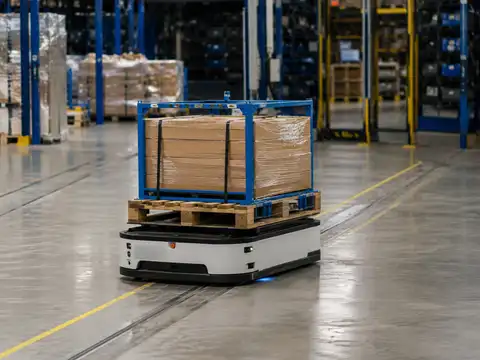
In 2026, treat industrial AGVs as configured systems—not catalog-priced warehouse vehicles.
Toyota's current U.S. automated guided vehicle lineup, for example, directs buyers to request a quote across products ranging from entry-level guided carts to automated forklifts and tuggers. That is the correct procurement signal: vehicle class, navigation, load handling, route and integration determine the project.
AGV tender board
“AGV price” is meaningless until the vehicle class and route architecture are fixed.
Simple repetitive routes, small loads, magnetic tape or other low-complexity guidance.
Toyota Key Cart: 1,100 lbPulls carts or trailers on repeatable milk-run or point-to-point routes.
Toyota automated tow tractor: 10,000 lb towAutonomous pickup, transport and placement of pallets without a driver.
Toyota CB18: 4,000 lb loadAutomates pallet putaway/retrieval at greater lift heights and tighter aisles.
Dematic RTS 120: 1,200 kg · 10 mWhy there is no useful single AGV price
Current OEM product portfolios put very different machines under the AGV umbrella.
Toyota's current U.S. lineup includes:
- guided carts;
- tow tractors;
- automated pallet-style vehicles;
- automated forklifts;
- autonomous mini-load transport.
Dematic's current AGV portfolio extends into:
- counterbalance vehicles;
- reach trucks;
- high-bay automated pallet handling.
The word AGV identifies the automation category.
It does not identify the machine price.
Current AGV classes and specifications
Toyota Key Cart
Toyota positions the Key Cart as an entry-level, budget-friendly AGV. It uses magnetic tape guidance and can be programmed with up to 30 tasks using an Excel-based route/task setup.
Toyota Core Tow Tractor Automated Forklift
Designed for repeatable horizontal transport and cart trains. Toyota uses LiDAR-based natural-features navigation rather than a physical wire/track route on this current platform.
Toyota CB18
Current automated guided forklift intended for pallet transport and lift tasks using natural-features navigation.
Dematic RTS 120
Dematic introduced this automated reach truck family in late 2025 for high-bay pallet handling.
Vehicle class creates the first cost jump
A guided cart can avoid:
- mast;
- automated fork positioning;
- high-bay sensors;
- pallet-entry logic;
- vertical load handling.
An automated reach truck may require:
- precise pallet localization;
- lift-height control;
- fork sensors;
- rack-position interfaces;
- high-bay safety validation.
Do not apply a cart-style cost assumption to an automated forklift.
The configured AGV project has at least eight cost blocks
Cart, tugger, pallet mover, counterbalance truck, reach truck or custom heavy carrier.
Forks, tow coupling, conveyor deck, lift table, cart interface or special tooling.
Magnetic tape, wire, reflectors, natural features or hybrid localization architecture.
Fleet control, WMS/WES/MES interfaces, traffic management, charging and station logic.
Then add:
- charging infrastructure;
- pickup/drop stations;
- facility changes and safety engineering;
- training, maintenance and spares.
The full AGV cost formula
Guidance architecture can be a real project cost
“AGV” historically often meant a vehicle following:
- embedded wire;
- magnetic tape;
- reflectors;
- fixed markers.
Those methods still exist.
Toyota's current Key Cart, for example, explicitly uses magnetic tape.
But Toyota's automated tow tractor and automated forklift products use LiDAR-based natural-features navigation with little or no additional guidance infrastructure.
Modern AGV and AMR terminology now overlaps
This matters for cost articles.
A modern vehicle can be sold as an AGV or automated forklift while using:
- LiDAR;
- natural-feature mapping;
- dynamic obstacle detection;
- software-defined routes.
Therefore:
“AGV always needs magnetic tape” is no longer accurate.
The next Warehouse Fieldbook guide compares AGV and AMR architecture directly.
Navigation cost depends on route-change frequency
The low-cost AGV can be expensive if the route keeps changing
Toyota's Key Cart is intentionally simple:
- magnetic-tape route;
- Excel-based programming;
- up to 30 tasks;
- 1,100-lb capacity.
That simplicity is attractive when:
- the route is stable;
- payload is modest;
- pick/drop behavior is simple.
If production moves every month, repeatedly changing physical guidance can reduce the apparent simplicity advantage.
Natural navigation can reduce physical infrastructure without making integration free
Toyota says its current automated tow tractor uses natural-features navigation and requires little to no additional infrastructure or complicated setup.
Its center-controlled automated forklift likewise uses mapped environmental features and can position/deliver loads within roughly half an inch according to Toyota's current product guidance.
But the project can still require:
- mapped routes;
- station setup;
- load interfaces;
- WMS/MES task release;
- charging;
- safety validation.
Fleet sizing still comes from work content
A full AGV mission can include:
- dispatch delay;
- travel to pickup;
- load acquisition;
- loaded travel;
- load placement;
- empty return/reposition;
- traffic waits;
- charging allowance.
Measure the complete route clock
One mission ends when the vehicle is ready for useful work again.
Task release and route assignment.
Fork, tow, dock, lift or transfer the load.
Loaded route with traffic and speed controls.
Align, deposit, release and confirm.
Reposition, wait or charge for the next mission.
Tugger AGVs can move multiple loads per mission
Toyota's current automated Core Tow Tractor is rated to tow up to 10,000 lb.
A tugger can therefore pull:
- multiple carts;
- multiple line-side kits;
- a milk-run train.
Do not compare a tugger mission with one pallet-forklift mission solely by moves/hour.
Normalize:
- loads delivered per mission;
- units delivered per route;
- labor removed;
- required delivery cadence.
Automated forklifts add autonomous load pickup
A towing AGV can rely on carts being coupled or presented correctly.
An automated forklift must:
- locate the pallet;
- align forks;
- enter the pallet;
- lift safely;
- transport it;
- place it accurately.
This adds sensors, control logic and commissioning work.
High-bay AGVs move into another cost class
Dematic's RTS 120 reach-truck AGV was introduced in November 2025.
Current published capabilities include:
- up to 1,200 kg load capacity;
- up to 10 m reach height;
- high-bay pallet placement/retrieval.
This is a fundamentally different project from a floor-level guided cart.
High-bay automation must prove:
- rack position accuracy;
- pallet condition;
- fork positioning;
- load stability;
- mast/lift behavior;
- safe operation around infrastructure.
Heavy-duty AGVs can go much further
A Kollmorgen-equipped Heli project published in 2024 used specialized AGVs to handle pallets weighing up to 3 tons.
The AGVs used:
- laser navigation;
- reflectors;
- 5G network connectivity;
- WMS order routing;
- high-precision fork sensors.
This illustrates why load class can change the entire control and hardware package.
That Heli/Kollmorgen case also demonstrates commissioning cost
Kollmorgen reports:
- less than six months from project start to operational site;
- final AGV commissioning completed in 45 days;
- a supplier-reported 60% cost saving.
Those are project-specific case-study results.
Do not apply 60% savings or a six-month schedule as generic assumptions.
soft-bag pallet handling
supplier-reported implementation
supplier-reported final phase
supplier-reported savings; not a benchmark
AGV high-bay throughput can be substantial
A current Kollmorgen/Rocla case for Bring describes:
- 81,200 pallet spaces;
- rack height around 10.65 m;
- AGVs handling loads up to 1,000 kg;
- around 200 pallets/hour.
This is a specific VNA AGV project.
It proves that modern guided vehicles can be engineered as a high-throughput storage subsystem, not merely slow point-to-point carts.
Do not use that 200-pallet/hour figure to size a normal forklift AGV fleet
The project has:
- purpose-designed rack;
- defined interfaces;
- dedicated automated operation;
- multiple vehicles;
- system controls.
Your facility may have:
- mixed manual traffic;
- longer routes;
- different lift heights;
- more exceptions.
Simulate your own flow.
Charging architecture affects fleet quantity
Current AGVs use strategies such as:
- opportunity charging;
- scheduled charging;
- battery exchange;
- automatic charger docking.
Toyota's Key Cart specifically lists opportunity charging among its current features.
Charger design affects:
- vehicle availability;
- electrical scope;
- route deadhead;
- required spare capacity.
Fleet software can be simple or enterprise-grade
At the low end, Toyota's Key Cart uses an Excel-based method for task programming.
At the complex end, Kollmorgen's NDC control architecture supports:
- order routing;
- traffic management;
- vehicle navigation;
- control;
- host-system integration.
The software scope grows with:
- vehicle count;
- route intersections;
- priorities;
- automated storage;
- WMS/MES integration;
- mixed fleets.
Traffic management is a hidden capacity constraint
AGVs are predictable vehicles.
That predictability can still create queues where:
- routes intersect;
- one aisle serves many missions;
- chargers cluster;
- one pickup station blocks;
- manual traffic receives priority.
A quote should include simulation or other evidence that vehicle quantity can deliver the required sustained rate.
Pickup/drop stations can cost more than expected
A complete pallet AGV interface may need:
- pallet stands;
- conveyor interfaces;
- load presence sensors;
- pallet alignment;
- barcode/RFID;
- PLC handshakes;
- machine guarding.
A tugger route may require:
- standard carts;
- automatic coupling/uncoupling;
- line-side stations.
Price the interface count, not only vehicle count.
Safety validation is part of system cost
AGVs operate around:
- pedestrians;
- manual forklifts;
- rack;
- conveyor;
- doors;
- production equipment.
Dematic's current AGV safety material emphasizes:
- collision avoidance;
- automatic slowing/stopping;
- emergency stops;
- visual/audible warnings;
- safety-rated system design.
Vehicle safety hardware does not eliminate application engineering.
Mixed manual and automated traffic can raise the cost of deployment
A fully automated storage zone can use:
- predictable vehicle behavior;
- controlled crossings;
- restricted human access.
A mixed warehouse may require:
- additional signage/marking;
- pedestrian separation;
- crossing controls;
- speed zones;
- process changes;
- manual-vehicle rules.
The cheapest vehicle can be the wrong system if traffic interaction destroys throughput.
AGV TCO should separate capital from annual cost
Configured AGV/automated forklift fleet and load-handling equipment.
Tape, reflectors, mapping, stations, charging, electrical and safety modifications.
Fleet control, WMS/MES/WCS, PLCs, machine interfaces, doors and elevators.
Preventive service, wear parts, batteries, sensors, wheels, support labor and service contracts.
Licenses, support, upgrades, servers/cloud and lifecycle engineering where applicable.
BALYO's current TCO framework reinforces this structure
BALYO's November 2025 financial guide says AGV fleet TCO should include:
- hardware price × vehicle quantity;
- automated charging stations;
- required batteries;
- initial spare-parts kit;
- software;
- integration;
- maintenance/service.
That is a much more defensible framework than applying one generic price per vehicle.
Payback claims should stay separate from price
Kollmorgen currently says vehicle automation can achieve payback as low as 1–2 years.
BALYO likewise publishes aggressive automation ROI claims in its own commercial material.
These are supplier claims.
They do not tell you the purchase price of the proposed fleet.
Build ROI from:
- actual driver labor removed;
- actual shift coverage;
- throughput changes;
- damage reduction;
- maintenance difference;
- new software/service expense.
“This AGV pays back in two years” does not imply any specific vehicle price. The same payback can result from a low-cost cart replacing modest labor or an expensive automated forklift replacing multiple shifts of high-cost material handling.
AGV versus manual forklift: compare full task cost
A manual forklift requires:
- vehicle;
- operator;
- training;
- energy/fuel;
- maintenance;
- supervision;
- damage/safety exposure.
An automated forklift requires:
- higher automation capital;
- fleet software/integration;
- charging;
- maintenance/support;
- stable autonomous process.
The correct business case compares annual task cost and useful capacity over the same horizon.
AGV versus conveyor: route stability is the key economic question
Conveyor can be strong where:
- origin/destination are fixed;
- flow is continuous;
- throughput is high;
- floor route can remain dedicated.
AGVs can be stronger where:
- multiple origins/destinations exist;
- routes change;
- loads need autonomous lift/tow handling;
- fixed conveyor would obstruct the floor.
Compare total installed capacity, not equipment categories.
AGV fleet quantity should be tested against peak demand
Model:
- average hour;
- peak hour;
- peak 15-minute burst;
- route congestion;
- charging;
- one vehicle unavailable.
A fleet that works only with every vehicle available at 100% utilization is undersized.
Availability reserve is application-specific
Do not blindly add “20% extra vehicles.”
The correct reserve depends on:
- fleet size;
- mission criticality;
- maintenance model;
- charging architecture;
- spare-vehicle strategy;
- manual fallback.
One spare vehicle is a 50% reserve in a two-vehicle fleet and a 5% reserve in a twenty-vehicle fleet.
Commission acceptance by useful work, not miles driven
Acceptance testing should verify:
- correct task release;
- correct pallet/cart acquisition;
- route behavior;
- traffic management;
- safe obstacle response;
- accurate drop-off;
- charging;
- exception recovery;
- peak sustained rate.
A vehicle completing an empty demo loop does not prove production capacity.
Use a scope-normalized RFQ
Require every bidder to state:
- vehicle type/model;
- vehicle quantity;
- load/tow capacity;
- lift height where relevant;
- guidance/navigation method;
- guidance infrastructure included;
- charger quantity;
- battery assumptions;
- fleet-control software;
- license/support fees;
- WMS/MES/WCS interfaces;
- pickup/drop stations;
- doors/elevators;
- site/safety work;
- simulation assumptions;
- guaranteed sustained rate;
- commissioning;
- training;
- initial spares;
- warranty;
- annual service.
Request the marginal cost of expansion
Ask:
- What does AGV #6 cost after a five-vehicle system?
- Does another software license apply?
- Does another charger apply?
- Does the current fleet manager support it?
- Does route capacity still work?
- Does another pickup/drop station become necessary?
Scalable vehicle automation is valuable only if the expansion increment is understood.
Separate vehicle price from installed capacity
This metric helps compare:
- a larger fleet of simple vehicles;
- a smaller fleet of faster/more capable vehicles;
- different guidance architectures;
- different station/integration scope.
It is not ROI.
It is quote normalization.
Then calculate lifecycle economics separately
Compare that against:
- manual vehicle OPEX;
- driver labor;
- overtime;
- damage;
- throughput constraints.
The practical recommendation
Do not begin procurement by asking vendors:
“How much is one AGV?”
Begin with:
- what load must move;
- where it starts/ends;
- how many moves are required at peak;
- whether the vehicle must tow, carry or lift;
- how stable the route is;
- how the fleet receives tasks;
- what happens when one vehicle is unavailable.
Then obtain a configured quotation for the full production system.
The cost rule
An AGV quote should buy a guaranteed material-flow capability, not merely a driverless vehicle. Price the vehicle, route, load interface, fleet control, charging, integration, safety and lifecycle support together.
Frequently asked questions
How much does an AGV cost?
There is no reliable universal 2026 list price. Major industrial OEMs reviewed for this guide primarily use request-a-quote pricing because vehicle class, navigation, load handling, fleet quantity and integration vary significantly.
Why don't major AGV manufacturers publish a simple price?
A production AGV system often includes configured vehicles, navigation, chargers, fleet-control software, stations, WMS/MES integration, site work, commissioning and lifecycle service. The vehicle alone does not define the project.
What is the cheapest type of AGV?
Simple guided carts are generally the low-complexity end of the category. Toyota currently describes its 1,100-lb magnetic-tape Key Cart as an entry-level, budget-friendly solution, but still uses quote-based pricing.
What is the most expensive type of AGV?
High-capacity/high-bay autonomous forklifts, reach trucks and specialized heavy-load vehicles generally require more hardware and engineering than simple carts or tuggers. Exact project pricing is quote-based.
How much can a warehouse AGV carry?
It varies widely. Current examples range from Toyota's 1,100-lb Key Cart to 4,000-lb automated forklifts, 10,000-lb automated tow tractors and specialized industrial AGVs handling multi-ton loads.
How high can an automated guided forklift lift?
It depends on vehicle class. Toyota's CB18 currently lists up to 176 inches, while Dematic's current RTS 120 automated reach truck reaches up to 10 meters.
Do AGVs require magnetic tape?
Not all of them. Toyota's current Key Cart uses magnetic tape, while several Toyota automated forklift/tugger products use LiDAR-based natural-features navigation.
Do AGVs require facility infrastructure?
Usually some project infrastructure remains even with natural navigation: charging, transfer stations, mapping, network/integration and safety/layout work can still be required.
How many AGVs does a warehouse need?
Calculate required moves/hour × complete mission cycle minutes ÷ 60, then validate fleet quantity with traffic, charging, availability and peak-demand simulation.
What should be included in an AGV quote?
Include configured vehicles, guidance/navigation, charging, load interfaces, pickup/drop stations, fleet software, host-system integration, site/safety work, commissioning, training, spares, warranty and annual service.
What is a typical AGV payback period?
Kollmorgen currently says vehicle automation can achieve payback as low as 1–2 years. Treat this as supplier guidance rather than a universal guarantee.
Is an AGV cheaper than an AMR?
Not inherently. Modern product categories overlap. A simple guided cart may be inexpensive, while a high-bay AGV can be highly engineered. The next guide compares AGV and AMR architectures directly.
Is an AGV cheaper than a forklift?
The automated vehicle generally carries added automation/integration cost. The business case comes from comparing the full automated system with manual forklift purchase, driver labor, energy, maintenance, damage and throughput.
Can AGVs operate in pallet racking?
Yes. Current systems include automated reach trucks and VNA AGVs designed for pallet storage/retrieval at significant lift heights.
Can AGVs operate 24/7?
They can be engineered for multi-shift or continuous operation, but fleet size, charging, maintenance, availability and support must be designed accordingly.
Sources and methodology
Warehouse Fieldbook deliberately does not publish a generic AGV dollar range because current primary-source OEM pages reviewed for this guide are predominantly quote-based and cover fundamentally different vehicle classes. Toyota's current U.S. material supplies the Key Cart, automated tow tractor and CB18 capacities/navigation examples. Dematic's November 2025 RTS 120 release supplies the current 1,200-kg / 10-meter automated reach-truck example. Kollmorgen supplies the current 1–2 year supplier payback claim, the Heli heavy-load implementation case and the Bring high-bay/VNA case. BALYO's November 2025 TCO guide supports the full-system cost model of hardware, charging, batteries, initial spares, software, integration and maintenance. Supplier payback and case-study savings are identified as such and are not used as universal budget assumptions.
- Toyota Material Handling — current U.S. AGV product lineup and quote-based procurement
- Toyota — current Key Cart capacity, magnetic-tape guidance, speed and programming
- Toyota — current automated tow tractor capacity and natural-features navigation
- Toyota — current CB18 automated forklift capacity and lift height
- Toyota — current natural-features navigation and positioning guidance
- Dematic — November 2025 RTS 120 automated reach-truck capacity and lift height
- Dematic — current AGV/AMR collision-avoidance and safety-system guidance
- Kollmorgen — current AGV purchasing, flexibility and supplier payback guidance
- Kollmorgen — heavy-load Heli AGV implementation, commissioning and supplier-reported result
- Kollmorgen — Bring VNA AGV storage/throughput case
- BALYO — November 2025 robotic-fleet TCO cost structure