
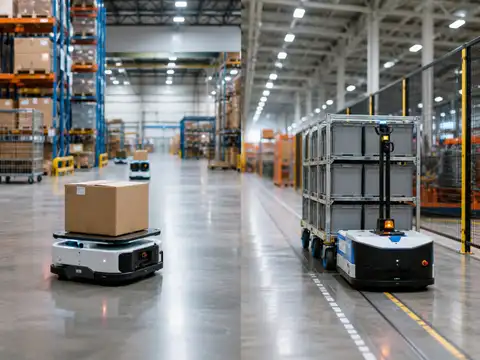
Choose by route behavior, not by acronym.
A predictable, repetitive flow can favor AGV architecture because guided execution is efficient when the environment is controlled. A changing, shared-use environment can favor AMRs because onboard autonomy can select and replan routes. But modern natural-navigation AGVs blur the old hardware distinction, so procurement must inspect actual behavior.
Route stress test
The useful difference appears when the route stops behaving as planned.
Predictable route, repeatable interactions and controlled traffic favor guided execution.
Autonomy works, but extra routing flexibility may have little value if the route never changes.
Behavior depends on the specific AGV and fleet controller; many traditional systems do not independently invent a new path.
An AMR can calculate an alternate route when a safe, permitted path remains available.
Magnetic tape or wire may require physical changes; natural-navigation AGVs can reduce this burden.
Software-defined maps and autonomous path planning are designed for changing routes and shared spaces.
The traditional definition is still useful—but incomplete
MiR's current comparison defines the traditional distinction like this:
- AGV: follows fixed routes or tracks, commonly using wires, magnetic strips or other guidance;
- AMR: uses onboard sensors, mapping and software to navigate without relying on one fixed route.
That distinction remains useful when comparing a classic floor-guided AGV with a modern AMR.
The problem appears when people turn it into:
“all AGVs need tape.”
That statement is no longer accurate.
Modern AGVs can use natural navigation too
Toyota's current U.S. Center-Controlled Rider Automated Forklift is sold as an automated guided vehicle / automated forklift and uses:
- LiDAR;
- natural-features navigation;
- mapped environmental objects;
- advanced obstacle-detection sensors.
Toyota says this architecture requires little to no additional physical guidance infrastructure.
Its current automated Core Tow Tractor likewise uses LiDAR-based natural-features navigation.
Kollmorgen makes the terminology overlap explicit
Kollmorgen's CVC700 currently supports natural navigation, laser navigation, magnetic tape, inductive wire, barcode, multi-navigation and even obstacle avoidance around a blocked drive path.
This is why the useful procurement question is not:
“Does it have a laser scanner?”
Ask instead:
- Who calculates the path?
- Can the vehicle choose a new path independently?
- Does it select only from predefined routes?
- What happens when its normal path is blocked?
- What work is required to change the route permanently?
Behavior is the better AMR-vs-AGV boundary
When AGV is the stronger choice
Fixed production flows, repeatable pallet movement, stable pickup/drop points and high utilization can favor an AGV architecture. Kollmorgen specifically describes AGVs as highly efficient where throughput and predictability dominate, including manufacturing environments.
Shared aisles, workers, forklifts, changing routes, multiple missions and future reconfiguration favor onboard autonomy. OTTO and MiR both position AMRs around dynamic material movement where route replanning adds value.
AGV can be the better technology when the route never needs creativity
Consider AGV strongly when:
- the same origin/destination pair repeats thousands of times;
- the route is protected or controlled;
- pickup/drop stations rarely move;
- traffic rules are stable;
- high utilization is expected;
- payload or lift work favors an automated forklift platform;
- the facility is designed around the transport system.
In that environment, autonomous detouring can add little business value.
AMR is stronger when avoiding one blockage matters
OTTO's current guidance recommends AMRs for:
- dynamic workflows;
- operations that may need reconfiguration;
- multi-user aisles;
- routes shared with workers, forklifts and tuggers;
- mission-critical flows where a blockage would otherwise stop material movement.
The value is not merely that the robot detects the obstacle.
Both AGVs and AMRs can have obstacle detection.
The value is whether the vehicle/system can continue the mission through another permissible route.
Obstacle detection and obstacle avoidance are different capabilities
A vehicle can:
- detect an obstacle;
- slow;
- stop before contact
without being able to generate a new path around it.
Dematic's current safety guidance describes AGVs using safety-rated scanners to slow and stop when objects enter warning/protective fields.
An AMR autonomy layer can add:
- localization;
- alternate-path calculation;
- kinematic path evaluation;
- real-time rerouting.
But even AGV obstacle behavior is evolving
Kollmorgen's current CVC700 software explicitly includes an obstacle-avoidance function that can drive around obstacles blocking the vehicle's path.
Therefore procurement documents should request the specific behavior rather than assuming capability from the AGV/AMR label.
Ask vendors to demonstrate blocked-route recovery live
During evaluation:
- send the vehicle on a normal production mission;
- block its expected path safely;
- observe whether it stops, reroutes or requests assistance;
- measure delay;
- repeat with a second route constrained;
- test recovery after the obstacle disappears.
This test reveals more than the marketing acronym.
Navigation technologies now overlap heavily
Classic guided route
Toyota's current Key Cart uses magnetic tape and remains a clean example of traditional guided behavior.
Not AMR-exclusive
Toyota uses LiDAR natural-features navigation on multiple products it categorizes as automated guided vehicles / automated forklifts.
Precise mapped navigation
Kollmorgen supports laser-based free-ranging navigation alongside floor-based approaches.
AMR differentiator
MiR and OTTO emphasize onboard intelligence that uses a facility map and current conditions to calculate and adapt routes.
Cost: neither AMR nor AGV is universally cheaper
Public pricing makes this comparison especially dangerous.
KNAPP currently publishes one Open Shuttle AMR starting around €45,000 before project-specific equipment/integration.
Toyota's current U.S. AGV lineup is quote-based.
Its Key Cart is described as budget-friendly, but Toyota does not publish a current universal purchase price on the product page.
Therefore there is no defensible public calculation saying:
“AMR costs X% more/less than AGV.”
The cost architecture is different
Tape, wire, markers or reflectors may add installation and route-change work, though simple guided carts can also be relatively straightforward.
Natural-navigation automated forklifts can avoid much of the physical guidance infrastructure associated with older systems.
Mapping, onboard perception, fleet management and path-planning intelligence support flexibility without fixed route infrastructure.
Charging, stations, WMS/MES interfaces, traffic management, safety, commissioning and service can apply to either architecture.
Compare installed transport capacity, not robot price
Total installed CAPEX should include:
- vehicles;
- load-handling modules;
- guidance/navigation infrastructure;
- charging;
- fleet software;
- stations;
- integration;
- site/safety work;
- commissioning;
- initial spares.
A cheaper robot can require a more expensive route
This is the classic AGV cost trap.
If vehicle A is cheaper but requires:
- physical route installation;
- floor work;
- more protected crossings;
- more route changes during the next five years
its installed lifecycle cost can exceed a more flexible vehicle.
A more autonomous robot can also be overkill
If the mission is:
- dock A to station B;
- same route;
- controlled aisle;
- no layout change;
- high repeat volume
then sophisticated rerouting may create little measurable value.
A simpler guided architecture can be rational.
Payload alone does not decide AGV versus AMR anymore
Historically, heavy autonomous forklift work was associated strongly with AGV architectures.
Today, AMRs also reach heavy payload classes.
Warehouse Fieldbook's current AMR cost guide includes current platforms up to roughly 1.2–1.35 metric tons.
Toyota automated forklifts and industrial AGVs likewise serve heavy pallet/tow applications.
The decision should combine:
- load weight;
- lift/tow requirement;
- route behavior;
- traffic;
- throughput;
- facility change.
High throughput does not automatically mean AGV
Kollmorgen's guidance says AGVs can be highly efficient in predictable, high-throughput manufacturing.
But throughput is a system outcome.
AMRs can also support high-throughput material flow where:
- enough parallel paths exist;
- fleet software manages traffic well;
- pickup/drop stations do not bottleneck;
- charging is designed correctly.
Simulate the actual warehouse.
Predictability is sometimes more valuable than flexibility
A production line may prefer deterministic behavior:
- known route;
- known cycle;
- known interaction sequence;
- controlled interface timing.
This can simplify:
- traffic design;
- line-side coordination;
- acceptance testing;
- operator expectations.
Do not pay for flexibility simply because flexibility sounds technologically superior.
Flexibility becomes valuable when the business actually changes
AMR value rises when:
- production cells move;
- routes change seasonally;
- new customers require new flows;
- warehouse zones are frequently reconfigured;
- temporary overflow routes appear;
- one robot performs several mission types.
Every avoided route reconstruction can have economic value.
Safety: do not assume AMR = safe and AGV = unsafe
Both technologies require safety-rated vehicle functions and application-level risk engineering.
Dematic describes safety-rated scanners, warning fields, protective fields and controlled stopping for AGVs.
Safety standards address situations where proximity sensing must be muted near loads and require compensating controls.
Pedestrian crossings, blind corners, manual forklifts, load overhang and transfer stations must be engineered for both.
Dematic notes that ISO 3691-4 covers driverless industrial truck systems including AGV/AMR-type equipment in its cited jurisdictional framework.
The correct question is whether the complete application meets applicable safety requirements—not which acronym appears on the vehicle.
AMR route freedom is still constrained freedom
An AMR does not drive anywhere it wants.
Its map can contain:
- one-way aisles;
- no-go zones;
- speed limits;
- stop points;
- queue areas;
- traffic rules;
- preferred paths.
Autonomy operates inside the permitted operating domain.
AGV predefined routing does not mean no intelligence
Modern AGV systems can use:
- fleet optimization;
- traffic management;
- natural localization;
- dynamic obstacle response;
- multiple navigation methods;
- host-system integration.
Kollmorgen's current platform is direct evidence of that convergence.
The categories are becoming a spectrum
A useful spectrum is:
magnetic-line cart → virtual/predefined-route AGV → natural-navigation AGV → highly autonomous AMR.
Where one supplier draws the naming boundary may differ from another.
Procurement specifications should define behavior, not rely on taxonomy.
Mixed fleets can be the best answer
OTTO's April 2026 material describes VDA 5050-based coordination of mixed AGV/AMR fleets so jobs, traffic and vehicle behavior can be managed through common fleet-control architectures. This changes the question from “Which technology wins?” to “Which technology should perform each workflow?”
A warehouse can use:
- predictable heavy AGVs in automated pallet storage;
- AMRs in dynamic shared transport zones;
- different vendors for different payload classes.
Kollmorgen similarly argues that AGV and AMR are complementary technologies intended for different roles rather than a simple old-vs-new replacement story.
Mixed fleets add interoperability risk
OTTO's current 2026 guidance identifies the need to coordinate:
- traffic;
- routes;
- job execution;
- vehicle behavior;
- fleet-master communication.
Kollmorgen also highlights ownership ambiguity when:
- vehicle software comes from one supplier;
- fleet control comes from another;
- ERP/WMS integration comes from a third.
Define support boundaries contractually.
Do not turn a simulation claim into a business-case default
OTTO's April 2026 article cites simulation work indicating mixed AGV/AMR fleets can improve throughput by up to 51% versus AGV-only operation in the modeled conditions.
That is simulation evidence cited by a vendor.
It is not a universal mixed-fleet improvement.
Use it only to justify testing hybrid architectures in simulation.
Run five decision gates before choosing
How often does the route change?
Rarely changed and highly repetitive routes favor guided architectures. Frequent changes strengthen the AMR case.
How often is the route blocked?
If obstructions are routine and alternate aisles exist, autonomous replanning can protect throughput.
Is traffic controlled or shared?
Dedicated automation zones favor predictability. Mixed human/forklift aisles raise the value of adaptable routing.
What does the load require?
Tow, pallet pickup, high-bay lift, cart movement and tote transport can point to different vehicle architectures regardless of acronym.
What will the facility look like in five years?
Stable operations can monetize predictable automation. Uncertain layouts increase the value of redeployment and software-defined routes.
Measure route-change cost explicitly
For a tape/wire-guided system, this can include physical work.
For a natural-navigation AGV or AMR, the cost may be more heavily:
- mapping;
- software configuration;
- safety validation;
- acceptance testing.
Neither route change is automatically free.
Measure blocked-route cost too
If this number is tiny, autonomous rerouting may have little financial value.
If the blocked route starves production or misses shipping cutoffs, the value can be material.
Do not ignore deterministic throughput
AMR comparisons often overvalue flexibility and undervalue predictability.
A high-volume manufacturing route may prioritize:
- repeatable cycle time;
- fixed traffic interactions;
- known station sequence;
- minimal route variance.
In that case an AGV can be exactly the right tool.
Do not ignore future change either
A warehouse with:
- seasonal re-slotting;
- temporary staging;
- frequent construction;
- new customers;
- changing production cells
can repeatedly pay the cost of rigid routing.
Flexibility becomes an economic asset only when it is used.
Use the same fleet-sizing method for both
Regardless of classification:
Then adjust for:
- charging;
- traffic;
- availability;
- peak bursts;
- maintenance reserve.
AMR autonomy does not eliminate fleet-capacity math.
Run the same acceptance test for both
Require:
- sustained useful moves/hour;
- actual payload;
- actual pickup/drop stations;
- mixed traffic;
- blocked-route event;
- charger behavior;
- one vehicle unavailable;
- host-system interruption;
- safe restart/recovery.
Buy performance, not terminology.
Do not write an RFQ that merely asks for “AGVs” or “AMRs.” Specify required route behavior, load, throughput, obstacle response, change frequency, interoperability, charging, safety and recovery. Let suppliers prove which architecture meets those requirements.
The practical recommendation
Favor AGV when:
- routes are stable;
- work is highly repetitive;
- traffic is controlled;
- predictability matters more than dynamic rerouting;
- automated forklift / lift / tow work aligns with the process.
Favor AMR when:
- routes change;
- aisles are shared;
- unexpected obstacles are normal;
- missions vary;
- redeployment and incremental scaling have real value.
Consider a mixed fleet when different workflows need different behaviors.
The decision rule
AGV versus AMR is no longer a contest between floor tape and LiDAR. The meaningful question is how much route autonomy the workflow needs. Use guided, deterministic transport where predictability creates value; use autonomous routing where change and disruption are part of the operating model.
Frequently asked questions
What is the main difference between an AMR and an AGV?
Traditionally, AGVs follow predefined guided routes while AMRs have greater onboard autonomy to choose and replan paths. Modern natural-navigation AGVs blur the hardware distinction, so route behavior is now a better comparison criterion.
Do all AGVs use magnetic tape?
No. Toyota currently sells automated guided forklifts and tow tractors using LiDAR-based natural-features navigation, while its Key Cart remains a magnetic-tape example.
Can an AGV navigate around an obstacle?
It depends on the system. Traditional AGVs commonly stop or use predefined alternatives, but modern platforms can provide more advanced behavior. Kollmorgen's current CVC700 explicitly supports obstacle avoidance around blocked paths.
Can an AMR follow a fixed route?
Yes. An AMR can be constrained by maps, preferred paths, one-way aisles, no-go zones and other traffic rules even though it has greater autonomous path-planning capability.
Which is cheaper, AMR or AGV?
Neither is universally cheaper. KNAPP currently publishes an Open Shuttle AMR starting around €45,000, while major U.S. AGV products from Toyota are quote-based. Compare complete installed system scope and lifecycle cost.
Which is faster, AMR or AGV?
There is no universal answer. Vehicle speed, mission cycle, traffic, pickup/drop time and route architecture determine useful throughput. AGVs can be very efficient in predictable high-throughput operations.
Which is better for a changing warehouse?
AMRs are generally stronger where routes, layouts and missions change frequently because autonomous mapping/path planning reduces dependence on fixed route infrastructure.
Which is better for manufacturing?
Both can fit. AGVs are especially strong for stable, repetitive production flows with controlled routes. AMRs are strong where production cells, traffic or mission assignments change frequently.
Which is better for mixed pedestrian and forklift traffic?
AMRs are often selected for dynamic shared environments because they can adapt routes around changing conditions. Both technologies still require proper safety engineering and application validation.
Are AMRs safer than AGVs?
Do not assume that from the acronym. Both use safety-rated sensing and must meet applicable driverless-vehicle safety requirements. Safety depends on the complete vehicle/system/application design.
Can AGVs and AMRs work together?
Yes. OTTO's April 2026 guidance describes mixed AGV/AMR fleets coordinated through interoperability approaches including VDA 5050.
What is VDA 5050?
It is an interoperability interface used to coordinate communication between automated/autonomous vehicles and higher-level fleet-control systems. Exact implementation and supported functionality remain vendor/system dependent.
Should I replace existing AGVs with AMRs?
Not automatically. Kollmorgen explicitly describes AGVs and AMRs as technologies suited to different roles. Existing AGVs can remain the best choice where their predictable routes continue to match the process.
What should an AMR-vs-AGV RFQ ask for?
Specify payload, load interface, useful moves/hour, route-change frequency, obstacle behavior, traffic environment, charging, fleet software, integration, interoperability, safety, availability and acceptance criteria.
Sources and methodology
Warehouse Fieldbook treats AMR-vs-AGV terminology as an engineering spectrum rather than relying on the outdated assumption that every AGV uses physical guidepaths. MiR's current comparison supplies the traditional fixed-route versus autonomous-routing distinction. Toyota's current U.S. AGV product pages provide direct evidence that AGVs can use both magnetic-tape and LiDAR-based natural-features navigation. Kollmorgen's current CVC700 platform, with May 2026 software documentation, demonstrates free-ranging, floor-based, multi-navigation and obstacle-avoidance functionality across AGV/AMR applications. Kollmorgen's interoperability guidance supports the use-case distinction between predictable high-throughput AGV roles and dynamic AMR roles. OTTO's April 2026 material supports mixed-fleet/VDA 5050 discussion; its cited 51% mixed-fleet simulation improvement is explicitly treated as a simulation result rather than a project benchmark. Dematic's safety guidance supports the conclusion that both AGVs and AMRs require safety-rated vehicle functions and application-level safety design.
- MiR — current AMR vs traditional AGV route-navigation comparison
- Toyota Material Handling — current magnetic-tape Key Cart AGV
- Toyota Material Handling — current LiDAR natural-features automated forklift
- Toyota Material Handling — current natural-features automated tow tractor
- Kollmorgen — current AGV/AMR controller with natural, laser, floor-based, multi-navigation and obstacle avoidance
- Kollmorgen — AGV and AMR role differentiation and interoperability guidance
- OTTO by Rockwell Automation — workflow conditions favoring AMR versus AGV
- OTTO by Rockwell Automation — current autonomy-software and route-planning distinction
- OTTO by Rockwell Automation — April 2026 mixed AGV/AMR fleet and VDA 5050 guidance
- Dematic — current AGV/AMR safety-system and ISO 3691-4-related guidance
- KNAPP — February 2026 Open Shuttle AMR cost anchor and lifecycle scope