
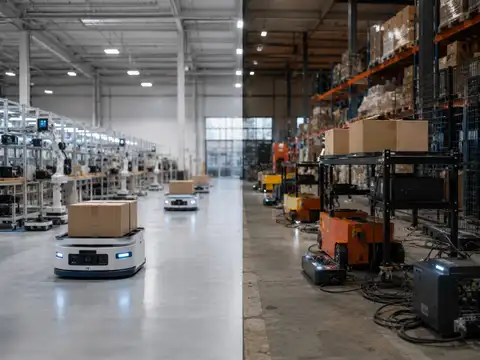
RaaS buys risk transfer and flexibility. Ownership buys control and residual value.
If demand is uncertain, seasonal, customer-contract driven or likely to change by site, paying a provider to own and support the fleet can be rational even if recurring payments eventually exceed a simple hardware purchase. If the workflow is stable, utilization is high and your team can maintain the system for many years, buying can capture more of the asset's long-term value.
Contract & cash-flow ledger
Three ways to use the same class of robot can create three very different risk profiles.
Robot fleet, software, integration, chargers and project infrastructure.
Maintenance, batteries, software/support, upgrades, spares and technical capability.
Residual value or continued useful life belongs to the owner.
Equipment cost is spread through scheduled payments.
Maintenance, software and operating support depend on the actual lease package.
Return, renewal or buyout treatment must be read in the lease terms.
Subscription/service replaces most robot ownership capital, though implementation or site costs may remain.
Typical full-service models combine hardware, software, support, maintenance and updates.
Robots can return to the provider unless the contract contains a purchase option.
What RaaS actually means in warehouse robotics
Locus Robotics currently defines warehouse RaaS as a subscription model in which the provider leases robots to customers together with:
- maintenance;
- support;
- software upgrades.
Locus says its current monthly subscription covers:
- hardware;
- software;
- AI updates;
- maintenance;
- 24/7 support.
inVia Robotics describes an even more service-led version:
- inVia owns the robots;
- inVia operates them;
- inVia maintains them;
- inVia continuously optimizes the system;
- the customer pays based on required warehouse productivity/throughput.
These current models make clear that RaaS is not merely “borrow a robot and pay monthly.”
Exact inclusions still vary by contract. Implementation fees, site licensing, additional integrations, facility work and exit terms must be checked rather than assumed to be included.
Buying warehouse robots is structurally different
Under ownership, the buyer normally carries:
- robot purchase CAPEX;
- fleet software purchase/license;
- integration;
- chargers;
- site modifications;
- ongoing maintenance;
- batteries and wear parts;
- software support/upgrades;
- internal technical ownership;
- obsolescence risk.
In return, the buyer can keep:
- the asset;
- residual value;
- continued use after the economic payback period;
- more freedom to self-maintain or redeploy where vendor terms permit.
Current purchase benchmark: KNAPP Open Shuttle starts at €45,000
KNAPP's February 2026 cost guidance says one Open Shuttle AMR starts at €45,000.
It also says complete AMR cost includes:
- hardware;
- fleet software;
- infrastructure;
- project engineering;
- integration/startup;
- training;
- service and maintenance;
- software updates;
- wear parts;
- energy;
- future fleet expansion.
Therefore:
€45,000 × robot count is not a five-year ownership cost.
KNAPP currently offers purchase, leasing and pay-per-use
That is useful because one robot family can be acquired through several commercial structures.
It proves the technology choice and the financial model are separate decisions.
First decide:
- which robot/application works;
- how many robots are required.
Then compare:
- buy;
- lease;
- pay-per-use / service.
Financial leasing is not automatically Robots-as-a-Service
MiR currently advertises financing from $8.67 per robot-hour in its example.
The calculation is based on:
- 48-month financial leasing period;
- $711 monthly payment;
- 160 working hours/month;
- one-shift operation.
The same MiR page also advertises $8.67 per robot-hour, but that figure does not arithmetically reconcile with $711 divided by the stated 160 monthly hours. Warehouse Fieldbook therefore preserves the published monthly lease example and treats the hourly headline as vendor marketing rather than reconstructing an unsupported universal hourly rate.
More importantly:
the published MiR structure is a financial lease.
It should not be treated as a Locus/inVia-style full RaaS subscription unless the actual contract separately includes equivalent:
- maintenance;
- software;
- support;
- upgrades;
- fleet flex.
Three commercial models side by side
RaaS pricing is mostly quote-based
Locus and inVia do not publish a universal current U.S. price-per-robot/month on the pages reviewed for this guide.
That is important.
Do not invent:
- a standard $/robot/month;
- a standard $/pick;
- a standard RaaS markup over purchase.
Current providers price based on variables such as:
- robot/application type;
- fleet size;
- throughput requirement;
- site complexity;
- integration;
- support level;
- contract term;
- seasonal flexibility.
Current public commercial anchors
KNAPP current Open Shuttle base robot starting price. Project hardware, software, integration and lifecycle costs remain additional.
MiR current 48-month financial-leasing example. This is financing—not a generic full-service RaaS subscription.
Locus and inVia currently describe subscription/full-service economics without publishing one universal warehouse rate.
Compare five-year cash flows at the same project boundary
If finance policy requires:
- discounted cash flow;
- tax treatment;
- depreciation;
- cost of capital
add those using company-specific rates.
Do not use a generic internet discount rate.
The RaaS premium is a useful procurement concept
If the result is positive:
that does not automatically mean buy.
The premium may purchase:
- maintenance risk transfer;
- software updates;
- 24/7 support;
- seasonal scaling;
- reduced obsolescence exposure;
- faster swap/redeployment;
- lower internal engineering requirement.
Procurement should decide whether those services are worth the premium.
If RaaS costs less on paper, check the scope before celebrating
A low subscription may exclude:
- implementation;
- WMS integration;
- chargers;
- network upgrades;
- site licensing;
- peak robots;
- special hardware;
- facility moves;
- early termination.
Locus's own 2025 legal guidance specifically flags:
- implementation fees;
- site licensing;
- maintenance responsibilities
as contract points that must be understood.
The strongest RaaS advantage is risk allocation
Every commercial model moves a different set of operational risks.
Locus bundles maintenance/support; inVia says it owns, operates and maintains equipment; Formic advertises full maintenance coverage.
Locus says enhancements are rolled out continuously to customers without separate upgrade projects or fees in its current model.
Locus currently allows customers to add robots for peak and return extra units after demand normalizes.
If purchased robots remain useful after payback, continued operation can make ownership increasingly attractive.
RaaS can make maintenance performance contractible
Formic's current Full Service Automation model illustrates an aggressive service boundary:
- installation and commissioning;
- performance monitoring;
- SLAs;
- continuous software updates;
- 24/7 technical support;
- field service;
- managed spare parts.
Its current palletizing service additionally advertises:
- 100% maintenance included;
- contracted performance and uptime guarantees;
- flat recurring commercial structure;
- month-to-month or multi-year arrangements;
- equipment swaps as needs change.
This is manufacturing/end-of-line automation rather than warehouse AMR picking, but the commercial lesson is directly relevant:
a true service contract can put measurable operating responsibility on the provider.
Ask for the SLA in measurable operational units
Do not accept “premium support.” Define:
- uptime calculation;
- response time;
- remote support window;
- on-site response time;
- parts availability;
- excluded downtime;
- planned maintenance treatment;
- service credits/remedies;
- minimum fleet performance.
If robot downtime affects warehouse service level, contract the service level.
Buying gives control—but only if the buyer can actually support the fleet
Ownership is strongest when the warehouse has:
- automation technicians;
- controls/software support;
- spare-parts processes;
- preventive-maintenance capability;
- battery lifecycle management;
- vendor escalation procedures.
A robot asset with no internal owner can become expensive downtime.
Internal labor should appear in ownership TCO
Use loaded internal labor cost.
Do not assume salaried technical staff are “free” because they already exist.
Ownership becomes attractive when the useful-life tail is long
A fleet expected to run the same high-value mission for six, eight or more years can continue producing after the initial capital has been recovered. If maintenance and software remain controlled, that long tail can make ownership economically powerful.
If robot quantity, workflow, site or technology may change materially, paying for flexibility and support can avoid stranded owned assets and reduce the cost of being wrong.
A three-year 3PL contract changes the answer
Suppose a 3PL signs a customer for three years.
Buying a robot fleet creates questions:
- What happens if the customer leaves?
- Can the robots move to another building?
- Does the next customer use the same workflow?
- Will the WMS/integration investment transfer?
RaaS can align the asset horizon more closely with commercial uncertainty.
But the contract must actually allow:
- fleet reduction;
- site relocation;
- exit;
- equipment swaps.
Do not call RaaS flexible without reading the term
A five-year subscription with:
- minimum robot quantity;
- limited reduction rights;
- high early-termination charges
may be economically less flexible than its marketing language suggests.
Conversely, Formic currently advertises month-to-month or multi-year choices in its specific palletizing service.
Locus currently advertises the ability to scale robots up and down.
Contract wording decides whether that flexibility exists for your deal.
Seasonality is where RaaS can create a unique economic advantage
illustrative normal requirement
illustrative holiday requirement
unless redeployed elsewhere
provider/logistics lead time still matters
Locus currently states that customers can receive extra bots as volume changes and return them when capacity is no longer required.
Its September 2025 KSP case reports robots being added in blocks of 25 units to match peak demand.
That is a specific deployment example.
It is useful evidence that fleet elasticity is operationally real in some RaaS implementations.
Peak flex still needs commercial detail
Ask:
- How much notice is required?
- Is peak capacity guaranteed?
- Are extra robots billed daily, monthly or for a minimum period?
- Who pays shipping?
- Are chargers already installed?
- Does software licensing automatically expand?
- Does the site need onboarding/configuration for each added robot?
- What is the minimum quantity that can be returned?
“Scale up/down” is not a financial model until those terms are priced.
Multi-site operators can create another RaaS advantage
A retailer or 3PL with many warehouses can experience:
- different seasonal peaks;
- customer churn;
- site openings/closures;
- different labor shortages.
RaaS can potentially support:
- fleet reallocation;
- supplier-managed scaling;
- standard software/support across sites.
Locus's current flexibility guidance explicitly discusses multi-site fleet sharing and reallocation as a commercial flexibility lever.
Again:
verify the actual contract allows the movement you expect.
Ownership can also support multi-site redeployment
Owned AMRs can often be physically moved.
But cost can include:
- new mapping;
- new integration;
- new chargers;
- training;
- shipping;
- vendor re-commissioning.
An owned robot is transferable only if its ecosystem is transferable economically.
Technology obsolescence is one of the hardest ownership costs to model
Warehouse robots evolve through:
- new sensors;
- new batteries;
- new compute;
- new safety functions;
- new software/AI;
- new workflow capabilities.
Ownership risk:
a perfectly functioning robot can become economically obsolete before it becomes mechanically unusable.
RaaS can reduce software obsolescence
Locus says current customers receive continuous software/system enhancements through the service model without separate upgrade projects or fees.
That can keep:
- routing;
- analytics;
- workflow software;
- AI capability
current during the subscription.
Do not assume hardware replacement is automatic unless the contract says so.
Buying can be superior if hardware remains useful and software stays supported
A purchased fleet that:
- runs reliably;
- receives software support;
- continues serving a stable workflow;
- has moderate maintenance cost
can produce many years of value after payback.
That long ownership tail does not exist when the customer must keep paying a subscription to keep using provider-owned robots.
RaaS creates vendor dependency by design
Because the provider may own:
- hardware;
- fleet software;
- maintenance knowledge;
- remote operations;
- analytics;
- system configuration,
switching vendors can become a major operating project.
This is not automatically bad.
It is the price of outsourcing system ownership.
Buying can create vendor lock-in too
Ownership does not guarantee independence.
You can still depend on:
- proprietary fleet software;
- vendor-only spare parts;
- licensed updates;
- certified service;
- closed APIs;
- integration middleware.
Evaluate lock-in separately from accounting ownership.
Data rights belong in the RaaS contract
Robotics systems can generate:
- warehouse maps;
- pick/transport rates;
- labor productivity;
- SKU/workflow data;
- traffic patterns;
- equipment telemetry;
- incident logs.
Define:
- who owns operational data;
- who can use aggregated data;
- how long data is retained;
- what is exported at termination;
- what cybersecurity requirements apply.
The article is not giving legal advice; these are procurement scope questions.
Exit terms are part of the price
Early termination
Understand remaining subscription liability, notice periods and any termination charges.
Robot removal
Define who disconnects, decommissions, packs and ships provider-owned robots.
Integration/data unwind
Determine how WMS interfaces, user accounts, maps, reports and operational data are removed or exported.
Purchase option
Some service agreements may permit a later buyout while others do not. If optional ownership matters, price the clause before deployment.
Formic's June 2026 RaaS guidance explicitly recommends that agreements state:
- who owns the hardware;
- responsibility for damage;
- early-exit treatment;
- whether a purchase/buyout option exists.
That is sound procurement practice for warehouse robotics too.
Do not compare monthly RaaS to depreciation expense
Compare cash economics and operating scope consistently.
Bad comparison:
- RaaS monthly subscription;
- versus accounting depreciation on owned robots.
Better comparison:
- actual RaaS cash outflow over the horizon;
- versus actual ownership cash outflow over the same horizon;
- then apply company tax/accounting treatment separately.
Do not claim RaaS has “immediate ROI” simply because CAPEX is zero
A recurring service can create positive monthly economics immediately if:
monthly measurable benefit > monthly all-in service cost.
But that is not the same as saying the technology is free or inherently superior.
Use realized benefits.
Do not insert vendor productivity claims directly into the cash model.
RaaS can improve budget approval without improving fundamental economics
Locus and MiR both emphasize OPEX-style approval advantages.
Spreading cost can help when:
- capital budgets are constrained;
- other projects compete for CAPEX;
- the warehouse needs automation quickly.
But:
easier approval does not make a poor workflow economically good.
The robot still needs to create measurable value.
Buying can be rational even when RaaS has a faster first-year payback
A purchase may have:
- large year-one negative cash flow;
- lower years 3–8 cash outflow;
- residual value.
RaaS may have:
- small year-one outflow;
- continued subscription every year;
- no residual asset.
Short-term payback and long-term TCO can point to different choices.
Decision horizon should match business certainty
A warehouse owner with:
- a 15-year building horizon;
- stable product;
- three shifts;
- internal automation staff
should strongly model ownership.
A 3PL with:
- three-year customer contracts;
- seasonal volume;
- changing SKUs;
- multiple sites
should strongly model RaaS.
RaaS is also useful as an uncertainty bridge
A warehouse may not know:
- future robot quantity;
- true labor benefit;
- peak throughput;
- whether the workflow will change.
A flexible service model can reduce the cost of learning.
After several years of validated demand, ownership may become more attractive.
Ask whether the provider offers:
- buyout;
- contract conversion;
- term extension;
- equipment refresh.
But switching from RaaS to owned robots can mean reintegration
If the purchased replacement uses:
- different fleet software;
- different WMS APIs;
- different chargers;
- different workflow logic
the migration cost can be substantial.
Model exit architecture at the beginning.
RaaS contract checklist
What exactly is billed?
Robot/month, site/month, usage, picks, throughput, flat service rate, implementation fee or a combination.
What can you actually scale down?
Minimum robot quantity, minimum site term, volume floor and notice period determine whether commercial elasticity is real.
How are temporary robots priced and guaranteed?
Define lead time, logistics, chargers, software entitlement, minimum rental period and return terms.
Preventive, corrective and parts?
Clarify labor, travel, batteries, wheels, wear parts, accidental damage, spare robots and on-site response.
Which upgrades are included?
Fleet software, feature upgrades, AI functionality, security patches, analytics, APIs and integration support.
What result is contractually supported?
Uptime, response time, robot availability and sustained warehouse throughput should use agreed definitions.
How does the system leave?
Early termination, decommissioning, shipping, data export, integration removal and potential buyout.
Ownership RFQ checklist
Buying also needs a disciplined quote boundary.
Require:
- robot unit price;
- top modules;
- chargers;
- fleet software/license;
- WMS/MES/WCS integration;
- network/site work;
- installation;
- commissioning;
- training;
- initial spares;
- warranty;
- preventive-maintenance price;
- software-support price;
- battery replacement assumptions;
- major wear-part prices;
- upgrade policy;
- end-of-life support policy.
Require the same performance from both proposals
If you compare:
- a RaaS fleet guaranteed for 1,000 picks/hour;
- with an owned fleet quoted only as “20 robots,”
you are not comparing equivalent products.
Require both to state:
- robot quantity;
- sustained useful throughput;
- operator assumptions;
- peak duration;
- availability;
- charging;
- software/integration boundary;
- support model.
Normalize by useful warehouse capacity
Use:
- picks/hour;
- moves/hour;
- lines/hour
depending on the actual robot application.
Then compare cost per useful annual transaction
This exposes underutilized owned robots and expensive subscriptions alike.
RaaS can be the wrong choice for a stable high-utilization fleet
Warning signs:
- robots will run three shifts for many years;
- workflow rarely changes;
- fleet size is stable;
- internal automation support already exists;
- subscription does not materially improve SLA/risk;
- five-/seven-year RaaS cash cost materially exceeds ownership.
In this profile, recurring payments may simply rent an asset that the warehouse could economically own.
Buying can be the wrong choice for uncertain operations
Warning signs:
- 3PL customer term shorter than robot life;
- large seasonal fleet swings;
- new automation team;
- workflow still evolving;
- site may move;
- technology selection remains uncertain;
- capital is constrained.
In this profile, owning the wrong fleet can be more expensive than paying a service premium.
Never compare “$711/month lease” or another financing figure directly with a full-service RaaS quote unless both include the same hardware, software, maintenance, support, upgrades, integration and commercial flexibility. Financing lowers upfront cash. RaaS changes who owns the operating problem.
The practical recommendation
Favor buying when:
- demand is stable;
- fleet utilization will be high;
- facility/process horizon is long;
- internal maintenance/controls capability exists;
- you value asset ownership and residual life;
- same-horizon TCO materially favors ownership.
Favor RaaS when:
- demand is seasonal or uncertain;
- 3PL/customer contracts can change;
- robot quantity may flex;
- internal automation support is limited;
- maintenance/software risk transfer has value;
- preserving CAPEX matters;
- the contract genuinely permits scaling and exit.
Favor a financial lease when:
- the technology and long-term quantity are reasonably certain;
- the primary problem is upfront cash rather than maintenance/technology risk;
- lease terms are economically stronger than immediate ownership.
The decision rule
Do not choose RaaS because “OpEx is better” or ownership because “subscriptions are expensive.” Compare the same automation outcome over the same business horizon. Then price the risks each model leaves with you: maintenance, obsolescence, seasonality, support, exit and residual value.
Frequently asked questions
What is Robots-as-a-Service?
RaaS is a subscription/service model in which a robotics provider retains substantial ownership and operational responsibility for the automation. Current Locus and inVia models combine robots with software, maintenance, support and ongoing optimization/updates.
Is RaaS the same as leasing robots?
No. A financial lease primarily spreads equipment payments. RaaS typically bundles broader service obligations such as maintenance, software, support and sometimes performance commitments or fleet scaling.
How much does warehouse RaaS cost?
Major warehouse RaaS providers reviewed here do not publish one universal current price. Subscription cost depends on fleet, workflow, throughput, integration, support, contract term and scalability requirements.
How much does it cost to buy a warehouse AMR?
KNAPP currently says one Open Shuttle begins at €45,000 before complete project software, infrastructure, integration and lifecycle costs.
How much does it cost to lease an AMR?
MiR currently publishes one financing example at $711/month for 48 months. That is a financial-leasing example rather than a universal full-service RaaS rate.
Does RaaS include maintenance?
Often yes, and it is a core feature of providers such as Locus, inVia and Formic. Exact preventive/corrective maintenance, parts, batteries and damage exclusions still need to be confirmed in the contract.
Does RaaS include software?
Current Locus and inVia offerings combine robotics with software. Locus currently states that ongoing software/system enhancements are made available through its service model. Exact licenses and interfaces remain contract-specific.
Can I add robots only for peak season?
Locus currently markets exactly this capability: customers can add robots as volume rises and return extra units afterward. Lead times, pricing and minimum terms should be defined contractually.
Who owns the robots in RaaS?
The provider generally retains hardware ownership. inVia explicitly states that it owns, operates and maintains its RaaS equipment over the service contract.
Can I buy the robots at the end of a RaaS contract?
Only if the agreement provides that option. Formic's current RaaS contracting guidance specifically recommends checking whether a buyout clause exists.
Is RaaS cheaper than buying?
Not universally. RaaS can lower upfront cash and transfer service/technology risk, but recurring payments may exceed ownership over a long, stable, high-utilization horizon. Compare same-horizon TCO.
When is buying robots better?
Buying is strongest when the workflow and robot quantity are stable, utilization is high, the facility horizon is long and internal teams can support the fleet.
When is RaaS better?
RaaS is strongest when demand is uncertain or seasonal, fleet size may change, capital is constrained or the warehouse places high value on outsourced maintenance, software updates and support.
What is the biggest RaaS contract risk?
A subscription advertised as flexible may still contain minimum quantities, long terms, site restrictions or costly exit provisions. Scale-down, relocation and termination rights should be priced before signature.
What should I compare between RaaS and purchase quotes?
Compare the same robot application, throughput, integration boundary, availability, maintenance, software, support, scaling rights and project horizon, then calculate total cash cost and risk allocation.
Sources and methodology
Warehouse Fieldbook distinguishes outright robot ownership, financial leasing and true Robots-as-a-Service rather than combining all recurring-payment structures. Locus Robotics' current RaaS page and 2025 legal guidance provide the subscription definition, maintenance/support/software-upgrade inclusion, seasonal scaling model and contract considerations including implementation fees, site licensing and maintenance responsibilities. Locus' October 2025 ROI guidance states that its monthly subscription includes hardware, software, updates, maintenance and 24/7 support. inVia's current RaaS page states that it owns, operates and maintains the equipment and aligns subscription scope with throughput requirements. KNAPP's February 2026 AMR-cost guide provides the €45,000 Open Shuttle purchase anchor and confirms purchase, leasing and pay-per-use commercial options. MiR's current finance page provides its $711/month, 48-month financial-leasing example. Formic's current Full Service Automation and June 2026 rental guidance provide examples of all-in service, maintenance, SLA, flexibility, ownership and exit-contract terms. Provider ROI and marketing claims are not used as universal economic assumptions.
- Locus Robotics — current warehouse Robots-as-a-Service model and peak scaling
- Locus Robotics — March 2025 RaaS contract, maintenance, site-license and software-upgrade considerations
- Locus Robotics — October 2025 current subscription inclusion and RaaS economics guidance
- Locus Robotics — September 2025 KSP peak-fleet scaling example
- inVia Robotics — current provider-owned, operated and maintained warehouse RaaS model
- KNAPP — February 2026 AMR purchase cost and purchase/leasing/pay-per-use options
- KNAPP — current Open Shuttle purchase and rental acquisition models
- MiR — current 48-month financial-leasing example
- Formic — current Full Service Automation inclusions, service, software and equipment flexibility
- Formic — current recurring palletizer model, maintenance, SLA and contract-flexibility examples
- Formic — June 2026 RaaS agreement, ownership, uptime and exit-term guidance