
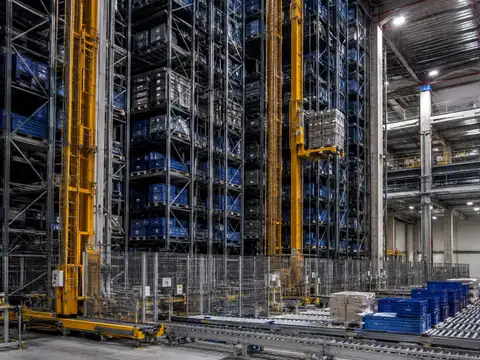
Structural AS/RS typically begins in the high six figures and quickly becomes a seven-figure systems project.
Kardex currently publishes starting anchors of $750,000+ for mini-load, $1 million+ for unit-load and multi-shuttle, and $1.5 million+ for robotic cube storage. A fully integrated mini-load managing more than 80,000 SKUs can exceed $3 million in the same supplier's guidance.
AS/RS quote deconstruction
The storage machine is only the center of the bid.
Rack, grid, bins, trays, pallet positions, structural depth and height.
Crane, shuttle, robot, lift or extractor count and load-handling devices.
Conveyor, lifts, pallet checks, transfer stations, ports and workstations.
PLC, WCS/WES, WMS interface, inventory logic, slotting and fault recovery.
Slab, steel, power, network, sprinklers, seismic requirements and access.
Mechanical/electrical work, integration, testing, SAT, training and ramp-up.
Service, spares, software support, maintenance and future capacity additions.
Current AS/RS starting prices
Standalone component AS/RS
Kardex's broad AS/RS cost guide currently starts Vertical Carousel Modules around $70,000+.
Automated vertical tray storage
Kardex currently lists a broad VLM baseline around $95,000+. Its December 2025 detailed U.S. cost guide also gives roughly $6,000–$8,000 per vertical foot as a starting planning rule.
Compact automated bin/tote buffer
Kardex currently publishes a $180,000+ starting anchor for Vertical Buffer Modules.
Crane-based bins, cartons or trays
Kardex currently places mini-load AS/RS at $750,000+ to start. It also cites fully integrated mini-load projects with more than 80,000 SKUs at $3 million+.
Pallet cranes / heavy unit loads
Kardex currently gives $1 million+ as a starting anchor. Final cost depends heavily on pallet positions, height, aisle count, cranes/shuttles, pallet interfaces and building/fire-protection requirements.
High-throughput tote/carton storage
Kardex currently starts multi-shuttle systems around $1 million+. Shuttle count, lifts, aisles, depth and workstation interfaces drive the configured project.
Dense grid + robots + ports
Kardex currently publishes $1.5 million+ as a broad starting anchor for robotic cube storage.
They are useful for project scale, not as national installed averages. Two AS/RS projects with the same technology label can differ materially in storage capacity, throughput, building work, integration and redundancy.
Not every system called AS/RS belongs in the same capital class
Component AS/RS and structural AS/RS are often mixed in cost articles.
Swisslog distinguishes equipment such as vertical carousels and vertical lift modules that can operate as components alongside people and existing processes. They can begin in the tens or low hundreds of thousands.
Structural AS/RS relies on robotics for storage and retrieval across a larger rack or grid architecture. These are the projects that commonly move into seven-figure system cost.
This distinction explains why online answers such as “AS/RS starts around $70,000” and “AS/RS starts around $1 million” can both be technically defensible while answering different questions.
For a conventional warehouse AS/RS, start the budget at the storage structure
Swisslog's current AS/RS definition identifies common system elements:
- storage structures such as rack;
- material-handling equipment such as conveyor;
- robotics such as cranes or shuttles;
- warehouse software.
Kardex makes a closely related cost point: the moving element is typically the expensive part, while adding more static storage capacity can reduce cost per cubic foot as the system grows.
Storage capacity and retrieval capacity are not the same thing
A project can add rack positions without adding another crane, robot or lift.
That may reduce capital per storage position.
But if retrieval demand rises too, the project may need additional:
- cranes;
- shuttles;
- robots;
- lifts;
- ports;
- workstations.
Budget storage capacity and throughput capacity separately.
Neither metric alone is enough.
A cheap system per position can be poor value if it cannot feed the operation fast enough.
What pushes AS/RS equipment cost upward?
Taller systems add storage but can require different cranes, structural design and fire-protection coordination.
Deeper storage increases density but changes access logic, load-handling devices and SKU/channel strategy.
Heavy pallets, oversized inventory or special trays can require stronger storage and handling equipment.
Higher transactions per hour can require more moving equipment and more infeed/outfeed capacity.
Kardex explicitly identifies climate-controlled, cleanroom and seismic requirements as cost drivers.
Inventory requiring special containment, materials or controls changes system specification and price.
Unit-load cost is driven by pallet geometry before automation technology
Swisslog's June 2026 pallet-AS/RS guidance says planning should start with:
- pallet footprint;
- load height;
- weight range;
- SKU profile;
- peak throughput;
- building constraints.
Its current Vectura crane family supports single-, double- and multi-deep configurations and loads up to 3,500 kg depending on solution.
A heavy or unstable pallet population can therefore change:
- rack structure;
- crane/load-handling device;
- pallet checking;
- transfer conveyor;
- exception handling.
Deep-lane pallet AS/RS trades access flexibility for density
Swisslog currently describes PowerStore as a deep-lane pallet shuttle system designed for high storage density.
Its June 2026 comparison says PowerStore can handle up to 200 pallets/hour per cell in suitable configurations.
This is a product capability—not an industry-wide throughput guarantee.
Deep-lane systems can reduce aisle count but generally require more disciplined SKU/channel logic than a broad-access crane configuration.
Four-way pallet shuttles change the expansion model
Swisslog's current AgileStore concept uses roaming shuttles that can move forward, backward, laterally and vertically.
Swisslog positions that architecture for:
- irregular layouts;
- limited ceiling heights;
- incremental scaling by adding shuttles.
This changes cost timing: more capacity or throughput can sometimes be added incrementally instead of installing the full future machine count on day one.
Mini-load AS/RS has a different cost engine
Mini-load typically stores:
- bins;
- cartons;
- trays;
instead of full pallets.
Swisslog says mini-load systems commonly include:
- shelving/rack;
- rack aisles;
- conveyor;
- workstations.
Kardex currently places crane-based mini-load at $750,000+ to start.
The cost rises with:
- aisle count;
- crane count;
- storage positions;
- load-handling device;
- infeed/outfeed;
- goods-to-person stations;
- software integration.
A $3M+ mini-load example shows what “integrated” does to price
general mini-load starting point
Kardex example for very large SKU population
storage machine price does not define total project
SKU count is only one project driver
Do not divide $3 million by 80,000 SKUs and call that an AS/RS benchmark
SKU count does not tell you:
- inventory quantity per SKU;
- bin dimensions;
- throughput;
- aisle count;
- crane count;
- workstations;
- software scope.
The example is useful only to show how a large integrated project can move far above the category's starting price.
Multi-shuttle cost is driven by concurrency
A shuttle architecture can place multiple vehicles across levels or aisles rather than relying on one crane per aisle.
Swisslog's current CycloneCarrier can be built up to 150 meters long and 25 meters high.
Swisslog states up to 2,000 infeeds and outfeeds per aisle for its high-performance configuration.
It also offers:
- double- to quadruple-deep storage;
- single- or double-deck lifts;
- goods-to-person use;
- order-consolidation buffering;
- robot-picking integration.
Every added shuttle, lift, aisle and workstation can change both throughput and price.
More robots can increase throughput without increasing storage capacity
This is especially important in robotic cube systems.
Storage capacity can be increased by:
- grid size;
- bin count.
Throughput can be increased by:
- robot count;
- port/workstation count;
- software and routing performance.
These are different cost levers.
AutoStore has publicly described a CAPEX/subscription split
AutoStore's published Pay-Per-Pick model separates:
- an upfront payment for grid infrastructure;
- a recurring subscription for robots, ports and software based on order volume.
When AutoStore launched the model, it expected grid infrastructure to represent roughly 20–40% of a typical total system cost.
That published figure dates from the service model's 2023 launch.
Use it to understand cost architecture—not as a 2026 quotation or market average.
Why that 20–40% figure matters conceptually
It demonstrates that a robotic cube system's storage grid is not the whole investment.
Significant economic value can sit in:
- robots;
- ports;
- software;
- integration;
- service.
Two systems with identical bin capacity can have different throughput and lifecycle cost because robot/port configuration differs.
Software cost should be visible in every AS/RS bid
Swisslog says current AS/RS shares a software layer that monitors and coordinates storage and retrieval.
Its June 2026 pallet guidance goes further: hardware sets the performance ceiling, while software determines how close the operation gets to that ceiling through:
- real-time optimization;
- slotting;
- fault recovery;
- WMS integration.
Ask the bid to separate:
- perpetual software licenses;
- subscriptions;
- host integration;
- database/server/cloud requirements;
- annual support;
- future version upgrades.
Infeed and outfeed can become the hidden bottleneck
An AS/RS can only store and retrieve as quickly as product can enter and leave the system.
Budget interfaces such as:
- pallet conveyor;
- carton/tote conveyor;
- vertical lifts;
- pallet profile checks;
- scanners;
- turntables / transfers;
- goods-to-person workstations;
- robot cells.
A crane capable of high cycles per hour has little value if one transfer station throttles the aisle.
Workstation count is a major mini-load and cube-storage cost decision
More workstations can:
- increase simultaneous picking;
- provide redundancy;
- separate processes;
- reduce queueing.
They also add:
- ports;
- conveyor;
- operator equipment;
- software logic;
- floor space;
- labor positions.
Do not buy stations solely from peak theoretical demand without modeling utilization.
Building cost can be material in high-bay AS/RS
Project scope can include:
- slab verification;
- structural steel;
- rack-supported structure;
- roof/enclosure coordination;
- power;
- network;
- fire protection;
- seismic design;
- maintenance access.
Kardex specifically identifies environment and seismic requirements as AS/RS cost drivers.
Fire protection must be priced before design freeze
Dense automated storage changes:
- storage geometry;
- commodity location;
- rack/grid access;
- vertical obstruction;
- maintenance access.
Fire-protection engineering can affect:
- rack design;
- sprinkler arrangement;
- clearances;
- building utilities;
- permit scope.
Do not carry fire protection as a late generic contingency.
Freezer AS/RS can have stronger labor economics and higher equipment cost
Kardex identifies climate-controlled environments as a cost driver.
At the same time, automated pallet storage can reduce the number of employees working in low-temperature areas.
Compare:
- freezer-rated equipment premium;
- energy;
- maintenance access;
- labor reduction;
- building-volume reduction from higher density.
The dedicated ROI article next will handle the economics rather than burying them inside this cost guide.
Installation cost depends on whether the project is greenfield or brownfield
Greenfield AS/RS can coordinate:
- building dimensions;
- slab;
- fire protection;
- power;
- automation installation
from the beginning.
Brownfield AS/RS may require:
- demolition;
- temporary storage;
- phased cutover;
- night/weekend work;
- legacy WMS integration;
- operating around existing inventory.
A less expensive machine can become the more expensive installed project if the building fights the design.
Commissioning must prove the complete storage flow
Test:
- inbound identification;
- load profile validation;
- putaway;
- retrieval;
- inventory reconciliation;
- blocked destination;
- machine fault;
- communications loss;
- restart;
- manual recovery;
- peak throughput;
- redundancy modes.
A crane moving one pallet is not a Site Acceptance Test.
Availability is part of capacity
If a nominal 200-pallet/hour system is unavailable during critical periods, its annual usable capacity is lower than the brochure number.
Procurement should ask for:
- availability definition;
- excluded downtime;
- planned maintenance assumptions;
- MTTR targets;
- spares strategy;
- remote-support response;
- redundancy behavior.
Redundancy can raise CAPEX and reduce business risk
Examples:
- two lifts instead of one;
- multiple robots per grid;
- cross-aisle shuttle capability;
- multiple ports;
- alternate conveyor routes.
The project should state what happens when one major component is unavailable.
Paying for redundancy is a risk decision—not wasted duplicate equipment by definition.
Spare-parts cost should be split into initial stock and annual consumption
Initial spares can include:
- sensors;
- drives;
- shuttle wheels;
- motors;
- controls hardware;
- belts/chains;
- critical proprietary parts.
That inventory is working capital held to protect uptime.
Annual consumed parts are a different operating-cost line.
Lifecycle service belongs in TCO, not hidden after go-live
Swisslog currently emphasizes service and maintenance as part of system availability and future performance.
CycloneCarrier, for example, is designed so maintenance can occur by level and shuttles can be serviced with limited impact on the overall aisle.
These design choices can justify higher initial cost when downtime is expensive.
Do not compare bids using total price alone
Ask for the cost of the next increment of capacity
A good AS/RS quote should explain what happens when the business needs:
- 10,000 more bins;
- 5,000 more pallet positions;
- another 100 pallets/hour;
- two more workstations;
- another shuttle or robot group.
The first system cost is only part of the decision.
Expansion economics determine whether the architecture remains attractive as volume grows.
Some systems scale storage and throughput independently
This is an important procurement advantage when demand is uncertain.
A system may allow:
- more static storage without more robots;
- more robots without more storage;
- more ports without rebuilding the whole grid;
- more shuttles as throughput grows.
Other architectures require larger future steps such as a new aisle or crane.
Compare minimum expansion increments.
Do not pay today for throughput the business may never need
Size:
- day-one inventory;
- day-one peak;
- credible growth;
- expansion trigger;
- available building capacity.
Then distinguish:
- infrastructure that must be installed now;
- machines/robots that can be added later.
This is one of the cleanest ways to avoid over-capitalizing an AS/RS project.
But underbuilding fixed infrastructure can be even more expensive
If future expansion requires:
- moving a building wall;
- replacing rack;
- adding a new fire zone;
- major electrical shutdown;
- rebuilding infeed/outfeed
it may be cheaper to install some future-ready infrastructure in phase one.
Separate cheap future capacity from expensive future structural changes.
The most useful early AS/RS budget has three numbers
Those three numbers make very different AS/RS proposals easier to interrogate.
AS/RS price is only useful if the system fits the inventory
Before requesting a quote, prepare:
- SKU count;
- inventory by SKU;
- pallet/bin/carton dimensions;
- weight distribution;
- daily inbound/outbound transactions;
- peak hour;
- growth assumptions;
- ABC velocity;
- special environments;
- required redundancy;
- building clear height and footprint.
Vendors cannot price useful capacity from square footage alone.
The practical recommendation
Use current public starting points to establish order of magnitude:
- mini-load: $750,000+;
- unit-load: $1 million+;
- multi-shuttle: $1 million+;
- robotic cube: $1.5 million+.
Then stop using category averages.
Build the actual project from:
storage positions + guaranteed throughput + retrieval machines + infeed/outfeed + software + building scope + installation + commissioning + lifecycle support.
The cost rule
AS/RS is not priced by rack alone and it is not priced by robot count alone. The real cost is the complete storage-and-retrieval operating system required to hold the inventory and deliver it at the rate the warehouse needs.
Frequently asked questions
How much does an AS/RS system cost?
Current Kardex supplier guidance starts mini-load AS/RS around $750,000+, unit-load and multi-shuttle around $1 million+, and robotic cube storage around $1.5 million+. Complete installed projects can be materially higher.
How much does mini-load AS/RS cost?
Kardex currently lists a $750,000+ starting anchor and gives an example of a fully integrated mini-load managing more than 80,000 SKUs at $3 million+.
How much does unit-load AS/RS cost?
Kardex currently publishes $1 million+ as a starting point. Pallet positions, aisle/crane count, depth, height, throughput, pallet-handling interfaces and building work can increase final cost.
How much does multi-shuttle AS/RS cost?
Kardex currently uses $1 million+ as a broad starting anchor. Final cost depends on shuttle/lift quantity, storage positions, throughput and workstation/integration scope.
How much does robotic cube storage cost?
Kardex currently uses $1.5 million+ as a broad starting point for robotic cube storage. Grid size, bins, robots, ports, software and integration define the configured system.
Is a Vertical Lift Module an AS/RS?
It is commonly categorized under AS/RS, but Swisslog distinguishes component systems such as VLMs from larger structural AS/RS where robotics handle the complete storage/retrieval process.
How much does a VLM cost?
Kardex currently gives a broad baseline around $95,000 and its December 2025 detailed U.S. guide suggests roughly $6,000–$8,000 per vertical foot as a starting planning range before advanced options and integration.
What is included in AS/RS cost?
A complete project can include rack/grid, cranes/shuttles/robots, conveyor, lifts, ports, workstations, controls, software, WMS integration, electrical work, fire protection, installation, commissioning, training and spares.
Why does AS/RS cost vary so much?
The largest drivers include storage capacity, throughput, machine count, height, depth, load dimensions/weight, environment, building constraints, software and integration.
Does a taller AS/RS always cost more per storage position?
Not necessarily. Kardex notes that moving components are typically expensive relative to static storage, so larger/taller systems can reduce cost per cubic foot when additional static capacity is added efficiently.
Can AS/RS be expanded later?
Many systems can expand, but the increment differs by architecture. Some add robots, shuttles, bins or ports incrementally; others may require a new aisle, crane or structural phase.
What should I compare between AS/RS quotes?
Normalize usable storage positions, guaranteed sustained throughput, availability, software, building scope, infeed/outfeed, installation, commissioning, lifecycle support and future expansion cost.
Is AS/RS worth the cost?
That depends on labor, space, throughput, accuracy, building-expansion avoidance and lifecycle cost. The next Warehouse Fieldbook guide covers AS/RS ROI and payback separately rather than assuming a universal return period.
Sources and methodology
Warehouse Fieldbook uses current public supplier guidance as order-of-magnitude cost anchors rather than national installed-price claims. Kardex's current U.S. AS/RS cost guide supplies the $70,000+ VCM, $95,000+ VLM, $180,000+ Vertical Buffer Module, $750,000+ mini-load, $1 million+ unit-load and multi-shuttle, and $1.5 million+ robotic cube starting points, plus its $3 million+ integrated mini-load example. Kardex's December 2025 VLM cost guide supplies the current $6,000–$8,000 per vertical-foot planning range. Swisslog's current AS/RS pages distinguish component and structural AS/RS and define unit-load, mini-load and software architecture. Its June 2026 pallet-automation guidance supplies current Vectura, PowerStore and AgileStore application data, while CycloneCarrier provides current multi-shuttle dimensions and throughput capability. AutoStore's Pay-Per-Pick launch is used only to illustrate one published hardware/subscription cost architecture and is explicitly dated rather than treated as a current project quotation.
- Kardex — current U.S. AS/RS starting costs and cost factors
- Kardex — December 2025 VLM cost considerations and vertical-foot planning range
- Kardex — current crane-based mini-load AS/RS architecture
- Swisslog — current AS/RS architecture, component vs structural systems, unit-load and mini-load definitions
- Swisslog — June 2026 pallet AS/RS technology and throughput/application guidance
- Swisslog — current CycloneCarrier multi-shuttle dimensions and throughput
- Swisslog — current mini-load AS/RS system scope
- AutoStore — published Pay-Per-Pick grid vs recurring robot/port/software cost architecture
- Dematic — current AS/RS technology categories and high-density storage architecture