
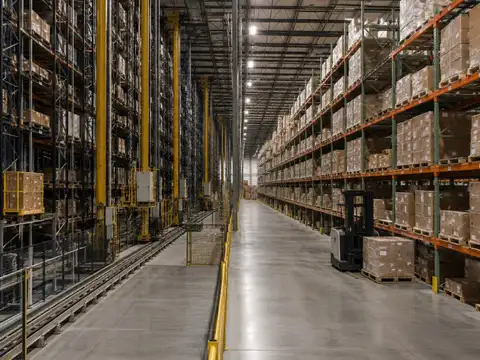
Choose conventional rack when access and flexibility matter more than extreme density. Choose AS/RS when the building, labor and throughput constraints are expensive enough to automate.
Selective rack stores pallets cheaply and keeps every pallet directly accessible. AS/RS removes most forklift travel inside storage and can use the building much more densely, but it replaces simple steel with machines, software, controls and a substantially larger capital commitment.
Warehouse cross-section
The same pallet inventory can consume the building in two very different ways.
- Direct access to each pallet
- Low automation dependency
- Easy SKU/layout changes
- Aisle area is part of the storage cost
- Higher vertical and horizontal density
- Automated storage/retrieval
- Software and maintenance dependency
- Higher capital commitment to the building/process
The short answer
Many SKUs, low-to-moderate pallet count per SKU, changing inventory, uncertain building horizon and low tolerance for automation dependence.
Expensive space, high clear height, repeatable pallet geometry, significant forklift/labor cost and enough stable volume to use the automation.
AS/RS reserve storage can feed selective rack, case picking, production or shipping while low-volume exceptions remain manual.
Selective pallet racking is optimized for direct access
Interlake Mecalux currently describes standard single-deep selective rack as storing one pallet per position with direct access to every unit load.
It recommends the architecture particularly where the operation has:
- many SKUs;
- relatively few pallets per SKU.
That is the basic strength of selective rack: almost any accessible pallet can be retrieved without moving another pallet first.
Direct access has a space cost
Forklift access requires aisles.
Those aisles are productive transportation space, but they do not hold pallets.
The building also has to accommodate:
- turning radius;
- cross aisles;
- end-of-aisle clearance;
- pedestrian separation;
- rack protection;
- staging.
A conventional rack layout therefore trades storage density for broad access and operational simplicity.
AS/RS changes the access mechanism
Swisslog currently defines AS/RS as a storage system where robotics, mechanical components and software move goods to and from storage.
For pallets, retrieval can be performed by:
- stacker cranes;
- shuttles;
- multi-directional shuttle architectures.
The storage aisle no longer has to accommodate a human-driven forklift.
That enables:
- narrower machine aisles;
- greater vertical utilization;
- deeper storage architectures;
- automated movement inside the storage block.
Current Swisslog guidance: roughly 2–4× the density of conventional racking
Swisslog's current automated-distribution-center guidance says AS/RS storage density typically runs two to four times higher than conventional racking.
Treat this as an order-of-magnitude supplier planning statement.
It is not a guaranteed density multiplier for every project.
Actual density depends on:
- building clear height;
- pallet height;
- aisle architecture;
- single/deep storage;
- fire protection;
- SKU/channel rules;
- maintenance clearances.
Swisslog's July 2026 food-and-beverage analysis shows the vertical mechanism
Swisslog currently says:
- block stacking uses around 30% of available building height;
- conventional racking reaches approximately 60%;
- automated storage can use 90% or more.
Those figures are supplier planning guidance for the F&B space problem.
The important lesson is not the exact percentage.
It is that automation can turn otherwise unusable high-bay volume into pallet positions.
Compare the two systems across the full operating model
The price gap looks enormous if you compare the wrong things
One rack starter unit versus one complete AS/RS category is not an economic comparison.
Uline currently lists one 120 × 42 × 144-in heavy-duty pallet-rack starter unit at $885 for quantity one. It includes two upright frames and four beams. Installation kit and accessories are separate.
Kardex currently uses $1 million+ as a starting anchor for unit-load AS/RS. That category includes an automated storage-and-retrieval architecture, not merely steel pallet positions.
Comparing $885 with $1 million and declaring manual rack “1,000× cheaper” would be nonsense.
The manual warehouse still needs:
- many rack bays;
- installation;
- anchors / protection;
- forklifts or reach trucks;
- operators;
- inspection and repair;
- aisle area;
- possibly a larger building.
The AS/RS project still needs:
- rack/grid;
- cranes/shuttles;
- conveyor and interfaces;
- controls/software;
- building work;
- commissioning;
- maintenance/support.
The proper capital comparison
Then compare annual operating cost for both.
Manual rack usually wins the day-one CAPEX test
If the building already exists and has adequate space, conventional selective rack is difficult to beat on initial simplicity.
It is particularly attractive when:
- growth is uncertain;
- warehouse tenure is short;
- inventory changes frequently;
- daily pallet moves are modest;
- labor and forklift capacity are available.
AS/RS should not be purchased solely because it is technologically more advanced.
AS/RS becomes much stronger when the alternative is another building
This is where storage-density economics matter.
If conventional rack requires:
- 50,000 additional square feet;
- external overflow storage;
- a second warehouse;
- building expansion
to hold planned inventory, the AS/RS business case is no longer rack vs machine.
It is:
automated high-density storage vs the complete cost of obtaining conventional capacity.
Use facility cost only when it actually changes
Do not assign rent savings simply because AS/RS uses less floor space.
Space creates financial value when it:
- avoids a lease;
- avoids construction;
- allows a lease area to be surrendered;
- creates productive capacity for another process;
- removes paid external storage.
Otherwise treat density as strategic capacity rather than fake cash savings.
Selective rack is much easier to re-slot physically
Beam elevations can be changed.
Bays can be added, removed or reassigned.
A forklift can retrieve a different pallet tomorrow without re-engineering a crane aisle.
This makes conventional rack forgiving when:
- pallet heights change;
- SKUs change;
- customers change;
- storage zones move;
- the warehouse is temporary.
AS/RS flexibility exists inside its designed envelope
Modern AS/RS can be highly flexible in:
- slotting;
- inventory sequencing;
- priority retrieval;
- software-defined allocation;
- robot/shuttle fleet scaling in modular systems.
But physical limits remain:
- maximum load size;
- maximum weight;
- rack geometry;
- machine reach;
- aisle/grid dimensions;
- port/interface configuration.
Software flexibility is not the same as structural flexibility.
SKU profile can decide the architecture before ROI does
Interlake Mecalux recommends single-deep selective rack where the warehouse has many SKUs with few pallets of each.
High-density automated storage becomes more natural as the operation gains:
- more pallets per SKU;
- repeatable pallet dimensions;
- stable channel rules;
- higher inventory volume.
Deep-lane AS/RS can be especially attractive with fewer SKUs and many pallets per SKU.
Do not confuse AS/RS with deep-lane storage only
Automated pallet systems can also use:
- single-deep rack;
- double-deep rack;
- multi-deep shuttle storage.
Mecalux notes that automated pallet stacker-crane systems can operate with single- and double-deep conventional pallet racking as well as live storage configurations.
Automation and density depth are separate design choices.
Three warehouse profiles
20,000 pallets · many SKUs · uncertain growth
Existing building has adequate space, pallet access changes frequently and daily moves are moderate. The business values reconfiguration more than maximum density.
20,000 pallets · constrained building · stable volume
Expansion is expensive, clear height is available and forklift travel consumes significant labor. Pallet dimensions and operating rules are stable.
Fast reserve storage feeding manual forward pick
The warehouse needs dense reserve pallet storage but still benefits from flexible human picking at the front end.
Throughput is where AS/RS can separate from manual rack
Manual pallet movement depends on:
- forklift travel distance;
- aisle congestion;
- driver availability;
- lift height;
- staging;
- shift pattern.
AS/RS turns movement into an engineered machine cycle.
Swisslog's June 2026 pallet-automation guidance says its PowerStore deep-lane architecture can handle up to 200 pallets/hour per cell in suitable configurations.
That is a specific supplier capability, not an automatic AS/RS rate.
Do not compare peak machine speed with average forklift productivity
Ask for:
- guaranteed sustained pallet moves/hour;
- inbound/outbound mix;
- availability assumptions;
- blocked-destination behavior;
- peak-hour conditions.
Compare those with measured conventional operations.
Forklift labor disappears from the storage block—but maintenance labor appears
A structural AS/RS can remove or reduce:
- putaway drivers;
- retrieval drivers;
- travel time inside storage;
- manual location decisions.
It adds:
- mechanical maintenance;
- controls support;
- software support;
- spare-parts management.
Compare net labor cost rather than assuming “automation = zero labor.”
AS/RS can reduce forklift-related rack exposure inside storage
Conventional pallet rack exists in a working environment where lift trucks operate next to uprights, beams and stored loads.
That creates:
- rack-impact risk;
- inspection requirements;
- repair/replacement events;
- rack-protection needs.
Automated storage removes human-driven forklifts from the storage aisles, changing the damage mechanism.
AS/RS still has machine collision, alignment, controls and structural risks; it does not eliminate inspection or maintenance.
Selective rack is easier to bypass after a localized problem
If one aisle is blocked, operations may still use other aisles.
If one forklift fails, another may cover the workload.
This creates practical redundancy through:
- multiple aisles;
- multiple trucks;
- manual decision-making.
It can be inefficient but resilient.
AS/RS resilience must be engineered
A failed:
- crane;
- lift;
- shuttle;
- conveyor interface;
- software service
can affect a defined portion of automated storage.
The project should define:
- redundancy;
- bypass;
- manual recovery;
- critical spares;
- MTTR;
- vendor response.
The risk profiles are different
Impact, operator error, congestion and manual location/handling behavior.
Machines, controls, software and interfaces become operationally critical.
Low CAPEX can become expensive if another building or overflow storage is required.
High fixed investment earns weak return if volume or inventory growth does not arrive.
Cold storage can tilt the economics toward AS/RS
Swisslog currently argues that deep-freeze pallet AS/RS can reduce cooling-energy cost compared with conventional designs because higher density reduces the volume that must be refrigerated for the same inventory.
Automation can also reduce:
- employee exposure to low temperatures;
- forklift activity inside the freezer;
- door/opening activity depending on layout.
But freezer-rated automation itself can cost more.
Compare total cold-storage lifecycle economics.
Very narrow aisle rack is the important manual middle ground
Conventional selective rack does not have to mean broad counterbalance-forklift aisles.
Interlake Mecalux describes VNA as selective rack positioned closer together to increase space utilization.
VNA can preserve direct access while using:
- specialized narrow-aisle trucks;
- guidance systems;
- tighter aisle geometry.
Before jumping from ordinary selective rack directly to AS/RS, compare VNA when:
- direct access remains essential;
- the building needs more density;
- full automation does not yet justify itself.
High-density manual rack is another middle ground
Drive-in, push-back and pallet-flow systems can reduce aisle count without full automation.
They trade some direct access or SKU flexibility for density.
The choice is not binary:
selective → VNA → high-density rack → semi-automated shuttle → structural AS/RS.
The correct point on that spectrum depends on inventory and economics.
Building horizon matters more for AS/RS
A rack system can often be:
- reconfigured;
- resold;
- relocated;
- expanded in smaller increments.
Structural AS/RS typically commits more engineering and integration to one building.
If a lease ends in three years and relocation is likely, a seven-figure fixed AS/RS can be difficult to justify unless:
- it is designed to be moved;
- the landlord/business horizon is extended;
- the return occurs before relocation;
- the alternative is even more expensive.
Modular robot-based storage changes this somewhat
Some shuttle and cube architectures can expand through:
- robot count;
- port count;
- bin count;
- additional grid or rack modules.
This can reduce the minimum capital increment for growth.
It does not make the initial building/interface design irrelevant.
Inventory accuracy matters more when storage is automated
Manual operations can sometimes recover from poor system data through operator knowledge.
AS/RS depends heavily on:
- correct pallet identity;
- correct dimensions/weight;
- correct location data;
- consistent inbound controls.
A pallet outside the system envelope can become an automation exception rather than a routine forklift judgment.
Standardize the load before automating the load
Review:
- pallet dimensions;
- pallet quality;
- overhang;
- lean;
- weight;
- wrap stability;
- damaged boards;
- protrusions.
Conventional rack can tolerate more manual judgment.
AS/RS rewards tighter load standards.
Compare capacity at the same service level
Both options must hold the same inventory and support the same operating demand.
Do not use theoretical pallet positions
Deduct:
- blocked locations;
- oversize zones;
- fire-protection constraints;
- maintenance access;
- SKU/channel inefficiency;
- operating reserve.
Compare usable storage, not CAD rectangles.
AS/RS is strongest when several constraints occur together
The business case becomes much stronger when the warehouse has:
- expensive/limited space;
- high clear height;
- large stable inventory;
- significant pallet moves;
- high forklift labor cost;
- difficulty staffing;
- long facility horizon;
- repeatable pallet geometry.
One benefit alone may not justify the capital.
Several benefits can.
Selective rack is strongest when uncertainty dominates
Keep the manual architecture when:
- inventory is volatile;
- pallet types are inconsistent;
- building tenure is uncertain;
- volume is modest;
- space is inexpensive;
- the existing forklift workforce is efficient;
- direct access is strategically important.
Hybrid design is often stronger than winning the argument
Examples:
- AS/RS reserve + selective forward pick;
- AS/RS freezer + conventional ambient storage;
- automated high-volume SKUs + selective slow movers;
- AS/RS production buffer + manual finished-goods rack.
Do not automate SKUs that do not benefit from automation simply for architectural consistency.
What to model before selecting AS/RS
Gather:
- pallet count;
- SKU count;
- pallets per SKU;
- pallet size/weight distribution;
- daily inbound/outbound moves;
- peak hour;
- clear height;
- building footprint;
- rent/expansion alternatives;
- forklift fleet and labor cost;
- five- to ten-year volume forecast;
- facility horizon.
What to request from both vendors
Ask rack/forklift and AS/RS proposals to state:
- usable pallet positions;
- footprint;
- clear-height use;
- guaranteed sustained pallet moves/hour;
- labor assumptions;
- equipment quantity;
- installed CAPEX;
- annual maintenance;
- energy;
- expected availability;
- expansion increment;
- implementation downtime.
Do not let the AS/RS vendor define the manual baseline
Build the conventional alternative independently.
Likewise, do not let a rack vendor dismiss automation by comparing rack steel with an automated system's turnkey price.
Normalize both architectures yourself.
“Rack costs $X per bay and AS/RS costs $1M+” is not a decision model. The relevant comparison is the lifetime cost and delivered capacity of two complete warehouse operating architectures.
The practical recommendation
Choose conventional selective pallet rack when:
- you need maximum direct access;
- inventory changes frequently;
- space is not the limiting constraint;
- CAPEX must remain low;
- the building horizon is uncertain.
Put AS/RS through a serious business case when:
- density can avoid expensive space;
- forklift travel/labor is material;
- volume is high and stable;
- vertical building volume is available;
- the facility will remain in use long enough to recover the capital.
And use a hybrid when only part of the inventory has those characteristics.
The decision rule
Pallet rack buys flexible access. AS/RS buys controlled density and automated movement. The better system is the one whose complete operating architecture solves the warehouse's expensive constraint at the lowest defensible lifecycle cost.
Frequently asked questions
Is AS/RS better than pallet racking?
Not universally. AS/RS is usually stronger where high storage density, automated movement, labor reduction or facility avoidance justify high capital. Selective rack is stronger where direct access, flexibility and low initial complexity matter more.
How much denser is AS/RS than conventional pallet racking?
Swisslog currently states that AS/RS storage density typically runs about two to four times higher than conventional racking. Actual results depend on the building and storage architecture.
Why is selective pallet rack less dense?
Single-deep selective rack provides direct access to every pallet, which requires forklift operating aisles and related clearances between rack rows.
Does AS/RS eliminate forklifts?
It can eliminate forklifts from the automated storage block, but forklifts may still be used at receiving, shipping, production or other manual zones.
Is pallet rack much cheaper than AS/RS?
Rack hardware has dramatically lower initial cost, but a fair comparison must include the full manual system: rack installation, protection, forklift fleet, labor and the building space needed for aisles.
How much does unit-load AS/RS cost?
Kardex currently uses $1 million+ as a starting anchor for unit-load AS/RS. Complete installed systems can be materially higher.
When should I choose selective pallet rack?
It is especially attractive for many SKUs with relatively few pallets per SKU, uncertain growth, changing layouts, modest pallet movement and situations where direct access is valuable.
When should I choose pallet AS/RS?
Consider it when storage space is expensive or constrained, clear height is available, pallet geometry is standardized, pallet movement is high and the business has a long enough facility horizon to justify the capital.
Can AS/RS use selective-style racking?
Yes. Automated pallet systems can use single-deep or double-deep rack as well as deeper shuttle architectures. Automation and storage depth are separate design variables.
Is VNA a good alternative to AS/RS?
It can be. VNA preserves direct pallet access while reducing aisle width using specialized equipment, making it an important middle option between ordinary selective rack and structural automation.
Can manual rack and AS/RS be combined?
Yes. Hybrid layouts can use AS/RS for dense reserve/high-volume inventory and selective rack for low-volume, irregular or frequently changing SKUs.
Which system is easier to expand?
Selective rack is usually easier to expand in small physical increments where floor space exists. AS/RS expansion depends on architecture: some systems add robots/shuttles incrementally, while others require major new aisles or structural work.
Which system is more resilient?
They fail differently. Manual rack often has decentralized forklift/aisle redundancy, while AS/RS reliability depends more on engineered redundancy, machine availability, controls, spares and recovery procedures.
Sources and methodology
Warehouse Fieldbook compares complete storage architectures rather than rack steel with automated-system turnkey pricing. Swisslog's current U.S. material supplies its 2–4× AS/RS-vs-conventional-racking density statement and July 2026 building-height utilization guidance. Interlake Mecalux supplies the current selective-rack direct-access use case and VNA definition. Kardex's current U.S. AS/RS cost guide supplies the $1 million+ unit-load starting anchor. Uline's current heavy-duty starter rack price is used only to demonstrate the hardware price trap, not as an installed rack-system benchmark. Swisslog's June 2026 pallet-automation guidance supplies a current PowerStore capability example, and its deep-freeze material supports the lifecycle-energy discussion.
- Swisslog — current AS/RS density versus conventional racking guidance
- Swisslog — July 2026 building-height utilization and storage-density guidance
- Swisslog — current AS/RS system architecture and pallet automation categories
- Swisslog — June 2026 pallet automation, PowerStore, Vectura and shuttle guidance
- Swisslog — pallet AS/RS deep-freeze TCO and cooling-density guidance
- Interlake Mecalux — current selective pallet rack direct-access application guidance
- Interlake Mecalux — VNA selective-rack architecture
- Interlake Mecalux — automated pallet storage depth and AS/RS architecture
- Kardex — current U.S. structural AS/RS starting-cost guidance
- Uline — current heavy-duty pallet rack starter-unit hardware price