
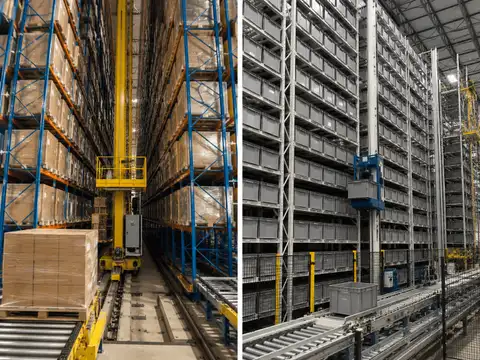
What does the storage machine physically pick up?
If the machine stores and retrieves full pallets or other heavy unit loads, start with unit-load AS/RS. If it stores totes, bins, cartons or trays, start with mini-load. Then choose crane, shuttle, cube or another architecture based on throughput, density and process.
Load-envelope routing desk
Choose the load carrier first. The AS/RS architecture follows.
Large dimensions, high weight, pallet handling, reserve storage or production buffer.
Heavy-duty rack, pallet crane or shuttle, pallet conveyor and pallet infeed/outfeed.
Smaller handling units, many SKUs, piece/case picking, kitting or consolidation.
Lighter rack, high-speed crane/shuttle/cube storage, tote conveyor and goods-to-person stations.
The difference is load scale, not simply warehouse size
Swisslog's current AS/RS guidance makes the primary distinction very clearly.
Unit-load systems handle:
- full pallets;
- large/heavy items;
- bulk unit loads.
Mini-load systems handle:
- totes;
- bins;
- cartons;
- trays;
- smaller/light goods.
A huge e-commerce facility can still be mini-load dominated.
A smaller manufacturing plant can still need unit-load if its automated storage unit is a heavy pallet.
Do not choose from SKU count alone
One SKU may arrive as a full pallet, be stored in unit-load reserve, be decanted into totes, and then be picked from mini-load.
The same SKU therefore can appear in both systems.
Choose architecture by:
- the handling unit at each process step;
- required transactions/hour;
- inventory quantity per handling unit;
- how downstream work consumes the inventory.
Load envelope: the first engineering gate
Standard or nonstandard pallets, overhang, height, lean, load stability and pallet quality all affect automated handling.
Swisslog's current automated pallet warehouse supports loads up to 3,500 kg per load carrier depending on the equipment/configuration.
Container dimensions, bottom quality, lids, barcodes and stack/nesting behavior become the interface standard.
Swisslog describes mini-load around lighter goods and prioritizes speed and efficiency rather than pallet-scale carrying capacity.
Current Swisslog unit-load specifications show the scale difference
Swisslog's current automated pallet warehouse page lists:
- rack/aisle heights up to 45 meters;
- stacker-crane payload from 200 kg to 3,500 kg;
- stacker-crane throughput around 20–45 double cycles/hour;
- pallet-shuttle payload up to 1,500 kg for standard applications;
- shuttle-system throughput up to 200 pallets/hour per module.
These are Swisslog product-family figures—not guaranteed figures for every unit-load AS/RS.
Mini-load changes from pallet cycles to small-load presentations
Swisslog's current mini-load guidance emphasizes high-speed storage and retrieval of smaller items.
Its Tornado mini-load crane, for example, is currently described with:
- height up to 24 meters;
- load capacity up to 250 kg / 550 lb;
- reserve-case-storage and omnichannel applications.
Kardex's current mini-load guidance gives a different reference configuration:
- single- or double-deep rack;
- around 100 lb average load per single-deep location;
- around 200 lb average load per double-deep location;
- roughly 60–100 lines/hour in the single-deep example;
- up to 120 putaways and 120 picks/hour in its double-deep example.
These are supplier planning examples for particular crane-based mini-load architectures—not a universal mini-load performance band.
Unit-load and mini-load solve different warehouse layers
Do not compare throughput using the same unit
“200 pallets/hour” and “500 tote presentations/hour” are not competing numbers.
One pallet can contain:
- one SKU or many cases;
- dozens or hundreds of sellable units;
- inventory that later feeds a mini-load system.
Compare throughput at the process level.
Unit-load AS/RS is a reserve-storage and pallet-flow machine
Strong unit-load applications include:
- finished-goods pallet storage;
- raw-material pallets;
- production buffers;
- cold/freezer pallet storage;
- high-bay reserve;
- case-picking source pallets;
- shipping sequencing.
Swisslog says high-bay stacker cranes are a standard arrangement for pallet-heavy distribution where throughput is predictable and high.
Mini-load AS/RS is usually closer to order fulfillment
Strong mini-load applications include:
- e-commerce piece picking;
- retail replenishment;
- parts storage;
- manufacturing kitting;
- pharmaceutical inventory;
- order consolidation;
- case reserve;
- returns buffers.
Swisslog specifically emphasizes high volumes of small items where retrieval speed, accuracy and space efficiency matter.
Goods-to-person is more central to mini-load design
Dematic's current order-picking guidance describes totes from mini-load or shuttle AS/RS being conveyed directly to goods-to-person workstations.
The operator:
- receives the inventory tote;
- picks the required pieces;
- places them into the order container;
- returns residual inventory to AS/RS.
That workstation can become the throughput constraint.
Unit-load can also support goods-to-person—but at case level
Dematic also describes pallets from pallet AS/RS being conveyed to ergonomic goods-to-person case-picking stations.
Cases are removed from the inventory pallet and transferred to the outbound order pallet.
The residual inventory pallet returns automatically to storage.
Therefore “goods-to-person” does not automatically mean mini-load.
The question is what the person is picking:
- cases from a pallet → unit-load can feed the station;
- pieces from a tote → mini-load is more natural.
The pick station changes the system boundary
Pallet arrives at workstation
Unit-load AS/RS can bring an inventory pallet forward so an operator or robot removes cases without forklift travel inside reserve storage.
Tote arrives at workstation
Mini-load can sequence totes to ergonomic stations where each presentation supports one or many order lines.
Pallet becomes totes
Unit-load reserve can feed a decant station, where cases or pieces are transferred into standardized totes for mini-load storage.
The hybrid flow is often the actual answer
This architecture uses each technology at the handling-unit scale where it is strongest.
Why decant exists
A full pallet is efficient for:
- receiving;
- bulk storage;
- long-distance movement.
It is often inefficient for:
- single-item e-commerce picks;
- high-SKU goods-to-person work;
- precise order consolidation.
Decant converts a pallet-scale supply chain into a tote-scale fulfillment flow.
Cost: mini-load starts lower, but do not assume it is always cheaper
Category price follows architecture—not simply load weight.
Current Kardex starting point. Large integrated mini-load projects can rise well above this depending on storage, cranes/shuttles, workstations, conveyor and software.
Current Kardex starting point. Pallet capacity, height, crane/shuttle count, conveyor interfaces, building/fire protection and throughput can drive materially higher installed cost.
The $250,000 difference between these published starting anchors is not a budgeting rule.
A high-throughput mini-load with:
- multiple aisles;
- many shuttles;
- multiple lifts;
- many goods-to-person stations;
- large conveyor network
can cost more than a simpler pallet AS/RS.
Compare configured system scope.
Mini-load refers to the handling-unit scale, not necessarily the size, throughput or capital of the installation. A large mini-load fulfillment system can be one of the most complex automation assets in a distribution center.
Unit-load cost concentrates in heavy structure and heavy handling
Major unit-load cost drivers include:
- high-bay rack;
- stacker cranes or pallet shuttles;
- pallet conveyor;
- load profile checking;
- high-capacity lifts;
- rack-supported building structures;
- fire protection;
- freezer or seismic requirements.
Mini-load cost concentrates in concurrency and workstations
Major mini-load cost drivers include:
- tote/bin count;
- aisle or grid size;
- crane/shuttle/robot count;
- vertical lifts;
- ports/workstations;
- light-goods conveyor;
- WCS/WES orchestration;
- pick-to-light / put-to-light;
- order-buffer logic.
A mini-load project with six workstations and large peak concurrency is economically different from reserve-case storage with one simple extraction point.
SKU count is more influential in mini-load—but still not sufficient
Kardex currently suggests crane-based mini-load can be attractive when the operation has:
- 10,000+ totes;
- 25,000+ SKUs
in the example category it describes.
That does not mean every operation above those thresholds should install mini-load.
Also measure:
- picks per SKU;
- units per tote;
- tote velocity;
- order-lines per order;
- peak presentations/hour.
Unit-load is more sensitive to pallets per SKU and channel depth
A pallet warehouse with:
- few SKUs;
- many pallets per SKU
can exploit deeper automated storage.
A pallet warehouse with:
- many SKUs;
- one pallet per SKU
needs broader access and may favor single-/double-deep crane-based architecture.
Channel depth and SKU profile are linked.
Mini-load single-deep vs double-deep has the same basic trade-off
Single-deep:
- simpler direct access;
- lower location depth;
- potentially lower density.
Double-deep:
- greater density;
- different load-handling devices;
- more retrieval logic;
- different throughput behavior.
Kardex's current guide specifically describes both arrangements.
Throughput comes from concurrency, not only machine speed
A single fast crane can still become a bottleneck if every transaction depends on it.
Higher-throughput systems create concurrency with:
- multiple aisles;
- multiple cranes;
- multiple shuttles;
- multiple lifts;
- multiple ports;
- buffering.
Mini-load architectures often scale throughput by increasing simultaneous small-load movements.
Unit-load architectures can scale through:
- multiple stacker-crane aisles;
- pallet-shuttle modules;
- multiple pallet conveyor interfaces.
Do not size mini-load from pick rate alone
A workstation producing 500 order lines/hour may need fewer than 500 tote presentations/hour if each tote supports several picks.
Conversely, it may require more presentations if:
- single-unit orders dominate;
- inventory is fragmented;
- totes contain only one relevant SKU;
- source totes must be recirculated.
This is planning arithmetic, not a final equipment-sizing formula.
Do not size unit-load from outbound shipments alone
Pallet AS/RS also performs:
- inbound putaway;
- replenishment;
- production supply;
- returns;
- internal relocation;
- sequence moves.
Peak machine demand can exceed shipped pallets/hour.
Standardization matters more as automation becomes tighter
Unit-load should define:
- pallet footprint;
- deck-board condition;
- overhang;
- load height;
- load stability;
- weight;
- wrap;
- barcode position.
Mini-load should define:
- tote/carton dimensions;
- bottom stiffness;
- maximum deflection;
- lid state;
- barcode/RFID position;
- weight;
- container damage rules.
Cartons can be mini-load units—but standardized totes are easier
Variable cartons can differ in:
- rigidity;
- surface friction;
- bottom flatness;
- dimensions;
- barcode presentation.
Reusable totes provide a more repeatable machine interface.
But totes require:
- decant;
- empty-tote management;
- cleaning / repair;
- inventory of containers.
Container strategy is therefore part of mini-load economics.
Unit-load usually has fewer, heavier conveyor interfaces
Swisslog notes that unit-load systems use heavy-duty pallet conveyor, while mini-load systems use lighter handling equipment for cartons, totes and bins.
Unit-load interfaces can include:
- chain conveyor;
- powered pallet roller;
- turntables;
- pallet transfers;
- vertical lifts;
- profile checks.
Mini-load usually has more route complexity around picking
Mini-load interfaces can include:
- tote conveyor;
- vertical lifts;
- diverts;
- buffers;
- goods-to-person loops;
- order consolidation;
- empty-container returns.
The storage machine can be only one part of a larger fulfillment loop.
Software role also differs by process
Both systems need reliable inventory and machine control.
Unit-load software often focuses heavily on:
- storage location;
- FIFO/FEFO;
- pallet sequencing;
- production/shipping release;
- crane/shuttle routing.
Mini-load software often adds more:
- order-wave logic;
- workstation balancing;
- tote sequencing;
- batching;
- order consolidation;
- dynamic replenishment.
The process layer can therefore make mini-load software orchestration particularly important.
Failure consequences are different
Unit-load failure can block:
- a high-bay aisle;
- production supply;
- pallet shipping;
- large quantities of inventory behind one machine.
Mini-load failure can block:
- one shuttle level;
- one lift;
- one GTP station;
- a picking/consolidation flow.
Architecture determines whether failure is centralized or distributed.
Redundancy should match the process consequence
Ask:
- Can another crane serve the inventory?
- Can shuttles change aisles or levels?
- Can another port serve the same stock?
- Can work be rerouted to manual picking?
- How much inventory becomes inaccessible after one failure?
“99.x% availability” is not enough without knowing the failure boundary.
Cold storage often strengthens unit-load economics
Swisslog currently lists pallet AS/RS operation from -30 °C to +45 °C.
In freezer operations, automation can:
- reduce human exposure;
- reduce forklift traffic;
- increase storage density;
- reduce refrigerated building volume for the same pallet inventory.
Freezer-rated equipment, fire protection and maintenance also affect cost.
Mini-load can also support temperature-controlled small goods
Pharmaceutical, food and specialty-parts operations may require:
- temperature control;
- clean environments;
- traceability;
- secure access.
Do not assume only pallet AS/RS has environmental requirements.
Expansion works differently
Unit-load expansion may require:
- another aisle;
- another crane;
- another shuttle module;
- rack/building extension.
Mini-load expansion may use:
- more shuttles/robots;
- more lifts;
- more ports;
- grid/rack expansion;
- another aisle.
The minimum capacity increment should appear in the RFQ.
Compare future throughput additions before selecting architecture
Ask each vendor:
- What costs one more 50 pallets/hour?
- What costs another 500 tote presentations/hour?
- What building/interface work must be installed day one?
- What equipment can wait until demand exists?
Future expansion economics can matter almost as much as initial CAPEX.
Three common decision mistakes
If the process stores full pallets and ships full pallets, SKU count alone does not convert the handling unit into a tote.
Pallet cycles and tote presentations serve different process layers. A single pallet move can replenish hundreds of individual piece picks.
Receiving, reserve, decant, picking and shipping can legitimately use different handling units and therefore different automation architectures.
RFQ data for unit-load
Provide:
- pallet standards;
- minimum/maximum pallet dimensions;
- load height;
- weight distribution;
- pallets per SKU;
- usable pallet positions;
- peak inbound/outbound pallet moves;
- FIFO/FEFO rules;
- temperature/environment;
- building clear height;
- future pallet growth.
RFQ data for mini-load
Provide:
- tote/carton/tray dimensions;
- container weight;
- SKU count;
- units per SKU;
- totes per SKU;
- peak order lines/hour;
- average useful picks per presentation;
- station count;
- batch/wave strategy;
- decant flow;
- returns flow;
- future SKU and order growth.
The practical recommendation
Use unit-load AS/RS when the automated storage object is fundamentally a pallet or heavy load.
Use mini-load AS/RS when the automated storage object is fundamentally a tote, carton, bin or tray and the system must feed smaller-unit fulfillment or production.
Use both when pallet reserve must feed tote-scale fulfillment.
Then compare crane, shuttle, cube and other architectures inside the correct load class.
The decision rule
Do not start with “Which AS/RS is faster?” Start with “What load carrier must move, how many of those loads must move at peak, and what does the next process need to receive?” The correct system follows from that interface.
Frequently asked questions
What is the difference between unit-load and mini-load AS/RS?
Unit-load AS/RS is designed primarily for pallets and heavier unit loads. Mini-load AS/RS is designed primarily for smaller handling units such as totes, bins, cartons and trays.
Is mini-load AS/RS only for small warehouses?
No. “Mini-load” refers to the handling-unit size, not project size. Large e-commerce and omnichannel facilities can operate very large mini-load systems.
How much does mini-load AS/RS cost?
Kardex currently publishes a starting anchor of $750,000+. Large integrated systems can cost substantially more depending on storage, machines, workstations, conveyor and software.
How much does unit-load AS/RS cost?
Kardex currently publishes a starting anchor of $1 million+. Height, pallet positions, aisle/crane/shuttle count, building work and infeed/outfeed can materially increase installed cost.
How heavy can unit-load AS/RS handle?
Swisslog's current automated pallet warehouse family lists stacker-crane payloads from 200 kg up to 3,500 kg depending on configuration.
How heavy can mini-load AS/RS handle?
It varies substantially by architecture. Swisslog's Tornado mini-load crane is currently described with load capacity up to 250 kg / 550 lb, while other mini-load technologies have different limits.
Is mini-load faster than unit-load?
Mini-load commonly prioritizes high-speed small-load handling, but comparing raw cycle rates is misleading because one pallet move and one tote presentation do different jobs.
Can unit-load AS/RS support picking?
Yes. Pallets can be delivered to case-picking or depalletizing stations. Dematic currently describes goods-to-person case picking fed directly from pallet AS/RS.
Can mini-load AS/RS support goods-to-person picking?
Yes. This is one of its strongest use cases: source totes or cartons are automatically presented to operators or robots for piece picking.
Can a warehouse use both systems?
Yes. A common integrated concept is unit-load pallet reserve feeding a decant process that transfers inventory into totes, followed by mini-load storage and goods-to-person fulfillment.
Should SKU count decide between unit-load and mini-load?
No. SKU count matters, but the primary decision starts with the physical handling unit and required transactions at that level.
What is the best AS/RS for e-commerce?
Mini-load, shuttle and robotic cube systems are common where e-commerce orders require high-volume small-item retrieval. Pallet unit-load storage may still be used upstream for reserve inventory.
What is the best AS/RS for full-pallet distribution?
Unit-load pallet AS/RS is the natural starting category, using stacker cranes, pallet shuttles or related heavy-load automation depending on density and throughput.
What should I compare in vendor proposals?
Compare load envelope, usable storage capacity, guaranteed sustained throughput, availability, infeed/outfeed, workstation requirements, software, installed CAPEX, lifecycle cost and future expansion increments.
Sources and methodology
Warehouse Fieldbook treats unit-load and mini-load as different handling-unit architectures rather than ranking one as inherently better. Swisslog's current U.S. unit-load and mini-load guidance supplies the primary distinction between heavy pallet loads and totes/cartons/trays, and its automated pallet warehouse page supplies current rack height, payload and throughput capability examples. Swisslog's omnichannel guidance supplies the current Tornado mini-load 24-meter / 250-kg capability example and the pallet-reserve-to-light-goods integration model. Kardex's current U.S. AS/RS cost guide supplies the $750,000+ mini-load and $1 million+ unit-load starting anchors, while its AS/RS technology guide supplies crane-based mini-load single-/double-deep and throughput examples. Dematic's current U.S. material supports goods-to-person case picking from pallet AS/RS and piece picking from tote-based mini-load/shuttle systems. All public performance numbers are supplier capability/planning references, not guaranteed project benchmarks.
- Swisslog — current unit-load versus mini-load architecture and load-carrier distinction
- Swisslog — current mini-load use cases, load types, throughput and selection considerations
- Swisslog — current pallet AS/RS height, load and throughput specifications
- Swisslog — current mini-load AS/RS solutions for cartons, bins, trays and small items
- Swisslog — Tornado mini-load reserve-case and integrated pallet/light-goods flow guidance
- Kardex — current U.S. mini-load and unit-load AS/RS starting-cost anchors
- Kardex — current crane-based mini-load load, depth and throughput examples
- Dematic — current U.S. unit-load and mini-load AS/RS categories
- Dematic — current goods-to-person case picking from pallet AS/RS and piece picking from mini-load