
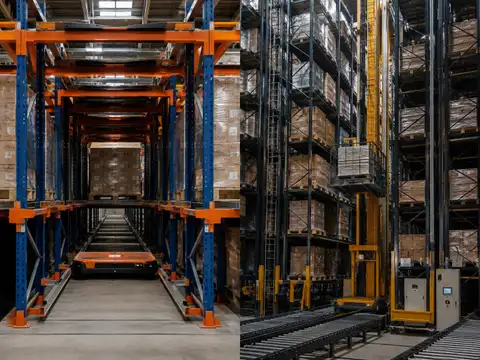
Choose semi-automated pallet shuttle when you want density without automating the whole storage transaction. Choose full AS/RS when the forklift/operator handoff is the expensive constraint.
The shuttle itself solves deep-lane movement. The automation question is who moves the shuttle or pallet between channels, levels, aisles and the rest of the warehouse: a forklift/operator, a stacker crane/transfer system, or a roaming multidirectional shuttle architecture.
Automation ladder
“Pallet shuttle vs AS/RS” is not a true binary. Pallet shuttles exist at several automation levels.
The electric shuttle moves pallets inside deep storage channels. A forklift/operator still moves the shuttle between channels and handles pallets at the rack face.
The shuttle still performs deep-lane storage, but another automatic machine carries it between levels or aisles. Conveyors and WMS/WCS close the automation loop.
Shuttles move forward, backward and cross-aisle, with lifts handling level changes. Fleet software balances traffic and allows more flexible access across the storage structure.
A radio shuttle operated with forklifts is semi-automated. A shuttle moved by stacker cranes, transfer cars or lifts and controlled through warehouse software is a fully automated pallet AS/RS. A multidirectional 4-way shuttle is another pallet AS/RS architecture.
Semi-automated pallet shuttle: the forklift stays in the process
Interlake Mecalux currently describes its Pallet Shuttle as a semi-automatic, high-density system.
The workflow is:
- a forklift carries the shuttle to the required storage channel;
- the forklift places a pallet at the channel entrance;
- the operator sends a command from a tablet;
- the shuttle carries the pallet deep into the lane;
- the shuttle returns to the channel face;
- the forklift repeats the process.
The shuttle automates the dangerous/slow deep-lane portion.
It does not automate:
- forklift travel to the rack;
- moving the shuttle between channels;
- pallet pickup/drop at the rack face;
- transport to receiving/shipping/production.
Current semi-automated Pallet Shuttle specifications
Interlake Mecalux currently states that the system can deep-store pallets in channels exceeding 131 feet.
Current maximum pallet load published for Interlake Mecalux's U.S. Pallet Shuttle.
Current published empty travel speed; loaded speed is 148 ft/min.
One tablet can currently control up to 18 Interlake Mecalux shuttles.
The same manufacturer currently lists:
- two-second lifting cycle;
- up to approximately ten hours of shuttle operation depending on load and temperature;
- FIFO and LIFO operating modes;
- operating temperatures from -22°F to 113°F.
These are product-family specifications, not a guaranteed warehouse throughput.
Semi-automated shuttle is strongest when lane density is the main problem
Consider it when:
- the warehouse has many pallets per SKU;
- deep lanes make sense;
- forklift labor remains acceptable;
- full automation is not economically justified;
- space or cold-storage volume is expensive;
- drive-in rack is too slow or creates too much rack-impact exposure.
Interlake Mecalux specifically positions Pallet Shuttle for high volumes of single-SKU pallets and intense loading/unloading activity.
Full pallet AS/RS automates the handoff that semi-auto leaves manual
Swisslog's current automated pallet warehouse architecture includes:
- rack;
- one or more aisles;
- automatic stacker cranes or pallet shuttles;
- infeed/outfeed conveyor;
- workstations;
- software controlling material flow.
The full system replaces manual pallet storage/retrieval with software-controlled movement.
That means forklift removal from the storage block
A fully automated design can reduce or eliminate forklifts performing:
- rack-face putaway;
- rack-face retrieval;
- shuttle relocation;
- high-bay travel inside storage.
Forklifts may still remain at:
- receiving;
- shipping;
- production;
- exception/manual areas.
The useful comparison
Cost: semi-auto is quote-based, full unit-load AS/RS has a public $1M+ starting anchor
Do not invent a percentage premium between the two architectures.
Interlake Mecalux currently requests a project quote. Cost depends on rack positions, lane depth, shuttle quantity, pallet load, temperature, installation and supporting forklift fleet.
Kardex currently publishes this as a starting anchor for unit-load AS/RS. Complete pallet automation can cost materially more with rack, cranes, shuttles, conveyor, controls, software and building work.
The difference is not simply:
“shuttle price vs AS/RS price.”
The semi-automatic alternative also requires:
- rack;
- shuttles;
- batteries/chargers;
- forklifts;
- operators;
- aisle access;
- rack-face staging.
The automated alternative adds:
- automatic vertical/aisle movement;
- conveyor interfaces;
- WMS/WCS integration;
- controls;
- commissioning;
- support/spares.
Compare the complete capital boundary
Then compare annual operating cost
The automation break point is often forklift work—not storage density
Semi-auto and full automated shuttle can both achieve deep, compact pallet storage.
The bigger economic difference is how many manual movements remain.
Measure:
- forklift trips to rack faces;
- shuttle relocations/hour;
- driver hours/shift;
- travel distance;
- waiting for shuttle availability;
- congestion at channel faces;
- night/weekend staffing.
If these are small, full AS/RS may be over-automation.
If these dominate warehouse labor, full automation deserves serious modeling.
Shuttle quantity matters differently in semi-auto and full automation
In a semi-auto system:
- more shuttles can let more channels work in parallel;
- forklifts/operators still have to serve those channels;
- tablet/control capacity does not eliminate forklift capacity constraints.
In full AS/RS:
- more shuttles can add concurrent machine movements;
- lifts/cranes/conveyors must also absorb the added flow;
- fleet software must prevent traffic bottlenecks.
More shuttles do not automatically equal proportionally more throughput.
Swisslog's current automated pallet guidance shows the throughput scale
Swisslog currently lists:
- stacker-crane throughput around 20–45 double cycles/hour;
- shuttle payload up to 1,500 kg for standard applications;
- shuttle-system throughput up to 200 pallets/hour per module.
These are product-family figures.
They should not be used as guaranteed performance for an arbitrary warehouse.
Stacker crane AS/RS and shuttle AS/RS solve pallet access differently
One primary machine serves an aisle vertically and horizontally
The crane travels along the aisle and lifts to the required level. Fork/load-handling devices then deposit or retrieve pallets from rack positions.
Shuttle enters the channel
A crane, transfer car or lift brings the shuttle/pallet to the correct aisle/level, while the shuttle completes deep-lane travel.
Vehicle roams across aisles
Multidirectional shuttles can change aisles and use lifts between levels, reducing dependence on one dedicated crane per aisle.
2026 development: roaming 4-way pallet AS/RS
forward, backward, cross-aisle; lifts move shuttles/pallets between levels
current AgileStore published capability
ambient and cold-store operation
traffic management across shuttles and lifts
Swisslog says this architecture is especially useful in:
- irregular warehouse geometries;
- deep-lane storage;
- mixed-SKU environments;
- operations requiring scalable performance.
The architecture uses:
- purpose-built rack;
- high-speed lifts;
- roaming shuttles;
- Wi-Fi connectivity;
- traffic-management software.
Interlake Mecalux's 3D Automated Pallet Shuttle shows the same architectural shift
Interlake Mecalux currently describes its 3D Automated Pallet Shuttle as:
- multidirectional;
- autonomous across aisles/channels;
- using lifts to change levels;
- controlled through fleet-management software;
- scalable through additional shuttles, aisles and levels.
It explicitly eliminates the need for additional handling vehicles such as stacker cranes or transfer cars inside the storage architecture.
That makes “pallet shuttle vs AS/RS” even less accurate in 2026
Modern pallet shuttles are increasingly:
- the storage/retrieval vehicle;
- the traffic network;
- the scalable throughput layer
inside an AS/RS.
The useful choices are:
- semi-auto vs full automation;
- crane vs shuttle AS/RS;
- 1D/deep-lane shuttle vs 4-way roaming shuttle;
- single/deep storage vs multiple-deep storage.
SKU profile: deep lanes reward pallet depth per SKU
Semi-auto pallet shuttle is particularly strong where:
- many pallets belong to each SKU;
- lane occupancy stays high;
- FIFO/LIFO rules are predictable.
A deep lane holding twelve pallets of one SKU uses space efficiently.
Twelve deep locations used by twelve different slow-moving SKUs can create poor lane utilization or access complexity.
Full AS/RS can add more dynamic slotting—but cannot repeal physical lane logic
Software can improve:
- SKU-to-channel assignment;
- priority retrieval;
- FIFO/FEFO;
- channel balancing;
- shuttle allocation.
But deep storage still imposes:
- sequence constraints;
- channel occupancy rules;
- potential relocation/re-marshalling.
Automation improves execution; it does not make inventory profile irrelevant.
4-way shuttles reduce some lane/aisle rigidity
Swisslog says AgileStore can support dynamic access across deep lanes and mixed-SKU environments.
Interlake Mecalux says its 3D system can store more than one SKU/pallet size in a channel in its designed architecture.
That is a meaningful flexibility improvement compared with traditional deep compact storage.
It also requires:
- more sophisticated software;
- more fleet traffic management;
- lifts;
- purpose-built rails/rack.
Cold storage strengthens both options
High-density shuttle rack reduces:
- forklift aisle volume;
- cooled cubic volume per pallet;
- time forklifts spend inside deep lanes.
Full automation can further reduce:
- operator exposure;
- forklift traffic;
- manual pallet travel inside frozen storage.
Current manufacturer ranges include:
- Interlake Mecalux semi-auto Pallet Shuttle to -22°F;
- Swisslog automated pallet systems to -30°C.
Verify the complete system—not just shuttle electronics—for the target environment.
Cold-storage ROI should include refrigeration economics carefully
Density can reduce required refrigerated volume when it allows:
- a smaller freezer;
- more pallets inside the same envelope;
- avoidance of another cold room;
- avoidance of external frozen storage.
Do not claim energy savings simply from fewer aisles unless:
- cooling load changes;
- building volume changes;
- door/traffic behavior changes.
Throughput: forklift handoffs are the semi-auto ceiling
The shuttle may move quickly inside the channel.
But the complete transaction still waits for:
- forklift arrival;
- shuttle placement;
- pallet placement at channel face;
- operator command;
- shuttle retrieval when changing channels.
Therefore warehouse throughput can be much lower than theoretical shuttle travel speed suggests.
Full AS/RS turns throughput into a machine-network problem
The bottlenecks move to:
- crane cycles;
- shuttle count;
- lift capacity;
- conveyor interfaces;
- traffic management;
- infeed/outfeed stations.
This is more capital-intensive but easier to engineer for a defined sustained rate.
Do not compare shuttle speed with AS/RS throughput
Interlake Mecalux's 295 ft/min empty shuttle speed describes one vehicle's channel travel.
Swisslog's up-to-200-pallets/hour figure describes a pallet shuttle system module.
They are different metrics.
Compare:
Semi-auto can be more resilient through manual flexibility
If:
- one shuttle fails;
- one lane is unavailable;
- one forklift is down
operations may:
- move another shuttle;
- use another truck;
- change channel priorities;
- temporarily work around the problem manually.
Manual redundancy can be inefficient but adaptable.
Full AS/RS needs engineered redundancy
Ask:
- Can another shuttle serve the blocked location?
- Can another lift handle the level?
- Can another crane serve the aisle?
- Can conveyor bypass a failed station?
- Can pallets be recovered manually?
- Which inventory becomes inaccessible after one failure?
“System availability” must be tied to a failure boundary.
4-way shuttles can distribute failure differently
In a conventional crane aisle:
one crane may be closely tied to one aisle.
In a roaming shuttle architecture:
- multiple vehicles may share aisles;
- work can be redistributed;
- lifts become critical shared resources;
- fleet-control software becomes critical.
Redundancy does not disappear.
It moves to different components.
Maintenance skills also move up the ladder
Semi-auto maintenance includes:
- rack;
- rails;
- shuttle wheels/sensors;
- batteries;
- forklifts.
Full AS/RS adds:
- stacker cranes/lifts;
- conveyor;
- PLC/control systems;
- fleet software;
- WMS/WCS interfaces;
- network infrastructure.
Labor cost can fall while technical-maintenance dependency rises.
Software is optional-to-helpful in semi-auto and mission-critical in full AS/RS
Interlake Mecalux's semi-auto shuttle can operate through tablet commands and can integrate with WMS.
A full AS/RS depends on software to:
- know where pallets are;
- select storage/retrieval tasks;
- route cranes/shuttles;
- control traffic;
- balance lifts;
- interface with host systems.
Software uptime and support become part of storage availability.
Expansion can favor different systems at different stages
Semi-auto expansion can involve:
- more rack channels;
- more shuttle vehicles;
- more forklift capacity.
Full shuttle AS/RS expansion can involve:
- more shuttles;
- more lifts;
- more rack;
- more conveyor interfaces;
- software capacity.
A roaming 4-way design can make robot/shuttle additions more modular, but physical rack/lift capacity still imposes limits.
Ask for the marginal cost of the next 50 pallet moves/hour
For each design, ask:
- How many more shuttles are required?
- Is another forklift required?
- Is another lift/crane required?
- Does conveyor need expansion?
- Does software licensing change?
- Can the rack geometry support it?
This reveals whether scalability is genuinely modular.
Three warehouse profiles
High-density reserve · moderate daily moves
Many pallets per SKU, expensive space, but forklift staffing and throughput remain manageable.
24/7 high-volume pallet flow
Production or distribution continuously feeds pallets, forklift labor is significant and a defined high sustained rate is required.
Irregular building · variable flows · future expansion
High density is required but conventional dedicated crane aisles would reduce flexibility.
The pallet profile can rule out all three
Deep-lane shuttle architecture becomes less attractive when:
- almost every pallet is a different SKU;
- pallet quality is poor;
- loads lean/overhang unpredictably;
- pallet footprints vary widely;
- inventory dwell is very short;
- direct random access dominates.
In those cases compare:
- selective rack;
- VNA;
- single-/double-deep stacker-crane AS/RS.
Standardize pallet quality before automating deep storage
Define:
- pallet dimensions;
- maximum deflection/buckling;
- load overhang;
- load lean;
- maximum weight;
- wrap stability;
- broken-board criteria.
Interlake Mecalux currently specifies a one-inch maximum pallet buckling limit for its semi-auto Pallet Shuttle platform.
Full automation generally makes load-quality checks more important, not less.
RFQ data for a fair comparison
Give every bidder:
- usable pallet positions;
- SKU count;
- pallets per SKU;
- pallet size/weight distribution;
- FIFO/LIFO/FEFO rules;
- average and peak moves/hour;
- inbound/outbound mix;
- shift schedule;
- clear height;
- building footprint;
- temperature;
- labor rates;
- forklift fleet;
- growth horizon;
- required availability.
Force both quotes to include the same operating boundary
Semi-auto quote:
- rack;
- rails;
- shuttles;
- batteries/chargers;
- tablet/control;
- installation;
- required forklift assumptions;
- annual shuttle service.
Full AS/RS quote:
- rack;
- cranes/shuttles/lifts;
- conveyor;
- controls;
- WMS/WCS integration;
- network;
- building/electrical work;
- commissioning;
- training;
- spares;
- annual service/software.
Require throughput under the same test profile
The acceptance profile should define:
- pallet load;
- channel depth;
- inbound/outbound mix;
- peak duration;
- simultaneous tasks;
- forklift availability for semi-auto;
- crane/lift/shuttle availability for AS/RS.
Compare complete pallet transactions/hour.
Normalize the economic comparison
These metrics reveal whether the more automated option actually creates enough useful capacity/labor reduction to justify its capital.
Do not compare a semi-automatic radio shuttle quote with a seven-figure AS/RS quote and conclude that the AS/RS is “too expensive” without including forklifts, operators, travel, rack-face handling and required throughput on the semi-automatic side.
The practical recommendation
Choose semi-automated Pallet Shuttle when:
- deep storage density is valuable;
- many pallets per SKU justify channels;
- forklift labor is still economical;
- throughput is moderate enough for manual rack-face handling;
- capital needs to stay materially below full automation.
Choose fully automated pallet AS/RS when:
- 24/7 pallet flow is significant;
- forklift labor/travel is a major cost;
- high, repeatable throughput is required;
- cold-storage/operator exposure matters;
- inventory accuracy/control justify software-driven storage;
- the facility horizon is long enough to recover automation capital.
Choose a roaming 4-way shuttle AS/RS when:
- high density and high automation are both required;
- the building geometry or flow benefits from cross-aisle movement;
- distributed shuttles and modular throughput expansion have real value.
The decision rule
Pallet Shuttle versus AS/RS is the wrong first question. Decide which manual pallet movements you want to eliminate. If forklifts can economically handle rack-face work, semi-auto shuttle can deliver density without full automation. If rack-face and inter-aisle handling must also be automated, you are already designing a pallet AS/RS—and the next decision is crane versus shuttle architecture.
Frequently asked questions
Is a pallet shuttle an AS/RS?
A semi-automated pallet shuttle is not a fully automated AS/RS because forklifts and operators still move the shuttle and pallets between rack channels. Fully automated pallet shuttle systems are AS/RS architectures.
What is the main difference between semi-auto Pallet Shuttle and AS/RS?
Semi-auto systems automate pallet movement inside deep channels while keeping forklift/operator handling at the rack face. Full AS/RS automates storage and retrieval across aisles, levels and interfaces using cranes, shuttles, lifts, conveyors and software.
How much does a pallet shuttle system cost?
Major manufacturers such as Interlake Mecalux currently use project-specific quote pricing. Cost depends on rack positions, lane depth, shuttle quantity, payload, environment and installation.
How much does pallet AS/RS cost?
Kardex currently publishes $1,000,000+ as a starting anchor for unit-load AS/RS. Complete pallet systems can cost materially more depending on size and throughput.
How deep can Pallet Shuttle lanes be?
Interlake Mecalux currently states that its semi-automatic Pallet Shuttle can store pallets in lanes exceeding 131 feet.
How much weight can a Pallet Shuttle carry?
Interlake Mecalux currently publishes up to 3,307 lb for its U.S. semi-auto Pallet Shuttle. Swisslog's automated shuttle family lists up to 1,500 kg for standard applications. Check the specific model and pallet type.
How fast is a Pallet Shuttle?
Interlake Mecalux currently publishes 295 ft/min empty and 148 ft/min loaded for its semi-auto shuttle. These are shuttle travel speeds, not complete warehouse pallet transactions/hour.
How fast is automated pallet AS/RS?
Swisslog currently publishes up to 200 pallets/hour per shuttle-system module in its product-family guidance, while stacker cranes are listed at around 20–45 double cycles/hour. Final throughput depends on configuration.
What is a 4-way pallet shuttle?
It is a multidirectional shuttle that can move along lanes and cross-aisles; integrated lifts move shuttles/pallets between levels. The architecture supports more flexible routing than a traditional one-direction deep-lane shuttle.
Is a 4-way pallet shuttle an AS/RS?
Yes. Swisslog's AgileStore and Interlake Mecalux's 3D Automated Pallet Shuttle are current examples of fully automated pallet AS/RS architectures using multidirectional shuttles.
Which is better for cold storage?
Both can be strong. Semi-auto shuttle delivers high density with less capital. Full AS/RS can further reduce forklift/operator activity inside the freezer. Evaluate refrigeration, labor and maintenance together.
Which is better for many SKUs?
Traditional deep-lane shuttle is strongest when there are many pallets per SKU. Highly diverse slow-moving SKU profiles may favor selective or single-/double-deep AS/RS. New roaming shuttle designs can improve mixed-SKU flexibility.
Which has lower maintenance cost?
Semi-auto generally has fewer automation components but still has forklifts and shuttle maintenance. Full AS/RS adds cranes/lifts, conveyor, controls and software while reducing manual material-handling equipment and labor.
Can I upgrade semi-auto Pallet Shuttle to full automation later?
Sometimes, but do not assume a simple retrofit. Rack geometry, rails, shuttle type, aisle design, controls, conveyor interfaces and structural requirements must be compatible with the future automated architecture.
What should I compare between quotes?
Compare usable pallet positions, sustained pallet transactions/hour, installed CAPEX, forklift/labor requirements, annual maintenance/software, expansion increments, availability and the complete integration boundary.
Sources and methodology
Warehouse Fieldbook distinguishes semi-automatic radio-shuttle storage from fully automated pallet AS/RS and does not treat “Pallet Shuttle” and “AS/RS” as mutually exclusive categories. Interlake Mecalux's current U.S. Pallet Shuttle page supplies the semi-automatic workflow, 131+ ft lane guidance, 3,307-lb payload, 295/148 ft/min travel speeds, battery and tablet-control specifications. Its current 3D Automated Pallet Shuttle page supplies the multidirectional roaming-shuttle architecture, lift integration, fleet software and scalability model. Swisslog's current automated-pallet-warehouse material supplies stacker-crane and pallet-shuttle AS/RS architecture, 20–45 double cycles/hour crane guidance, 1,500-kg shuttle payload and up-to-200-pallets/hour module capability. Swisslog's March 2026 AgileStore launch supplies current 4-way roaming-shuttle details. Kardex supplies the $1,000,000+ current unit-load-AS/RS starting anchor. Public manufacturer performance figures are treated as product-family references rather than guaranteed project outcomes.
- Interlake Mecalux — current U.S. semi-automated Pallet Shuttle operation and specifications
- Interlake Mecalux — current fully automated Pallet Shuttle architecture
- Interlake Mecalux — current 3D multidirectional pallet shuttle AS/RS
- Interlake Mecalux — semi-automated versus automated Pallet Shuttle distinction
- Swisslog — current pallet AS/RS crane and shuttle architecture, payload and throughput guidance
- Swisslog — March 2026 AgileStore 4-way roaming pallet shuttle AS/RS
- Kardex — current unit-load AS/RS $1,000,000+ starting-cost anchor