
Optimize inventory holding.
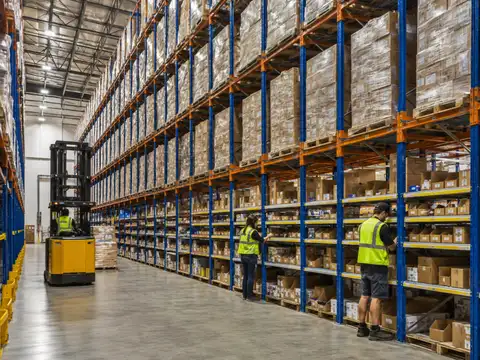
Reserve stores the majority of inventory in a system chosen for capacity, pallet handling, vertical use and SKU depth. It can be farther from the picker because it does not serve every order line directly.
Priority: density + inventory controlOptimize order access.
Forward pick holds a smaller working quantity in a compact area selected for high-frequency retrieval. Its value comes from reducing picker travel and presenting products in an efficient pick configuration.
Priority: access + pick productivityForward-reserve is a two-echelon inventory system
MHI describes the forward-reserve configuration as a way to compress picking into a smaller area so pickers travel less.
In that architecture:
- reserve storage holds the deeper inventory;
- forward pick holds only the working quantity needed for order fulfillment;
- replenishment connects the two.
Higher-density storage, pallet reserve, slower access and larger quantities per SKU can be appropriate here.
Smaller quantity, high accessibility, shorter picker travel and faster order-line execution.
The design problem is not “reserve or forward.” It is how much belongs in each.
Too little forward inventory can create:
- stockouts at the pick face;
- emergency replenishments;
- picker waiting;
- replenishment/picking conflicts.
Too much forward inventory can create:
- oversized pick faces;
- longer picker travel;
- poor use of premium pick space;
- slow inventory occupying high-access locations.
The right answer balances pick travel against replenishment work.
MHI says forward-pick sizing should consider SKU count, size, popularity and replenishment
MHI's current Forward Pick Area design guidance identifies several inputs:
- forward-pick area dimensions;
- input/output location;
- aisle configuration;
- storage equipment;
- how replenishment will be performed;
- number of SKUs;
- SKU size;
- product popularity/velocity;
- product assignment and allocation.
MHI also emphasizes that popularity changes over time and recommends modeling what-if scenarios rather than treating the forward area as static.
Start with the replenishment window
A forward location must carry enough inventory to survive until the next replenishment can realistically arrive.
More explicitly:
The buffer is a planning input.
There is no universal buffer percentage.
It should reflect:
- demand variability;
- replenishment reliability;
- consequence of a pick-face stockout;
- available forward space.
Forward-pick sizing calculator
How much stock should the forward pick face hold?
Size the face around demand between practical replenishment opportunities. This is a planning model, not a universal minimum/maximum rule.
Peak demand through the selected replenishment interval plus buffer.
Average daily picks divided by the face target. This is workload pressure, not an exact task count.
Total on hand minus the modeled forward quantity.
Useful for seeing how much inventory is being moved into the high-access area.
A larger face reduces replenishment frequency but consumes more forward-pick real estate and can leave slow stock in the most valuable area.
What the calculator is actually telling you
The calculator does not attempt to choose a storage system or WMS rule.
It exposes one trade-off:
if the face holds fewer units, the warehouse must replenish it more aggressively.
If the face holds more units:
- replenishment pressure falls;
- premium forward space consumption rises.
The “full-face equivalents per day” output is not an exact replenishment-task count.
Actual tasks depend on:
- reorder trigger;
- replenishment quantity;
- case/pack conversion;
- top-off policy;
- inventory already in the face.
Honeywell treats replenishment as the control link between reserve and forward pick
Honeywell's current warehouse-replenishment guidance describes the operational logic directly:
when a SKU reaches a low inventory level, the system can trigger a replenishment order from reserve inventory.
Honeywell also notes that case and pallet flow can be used to move reserve stock into forward-picking locations as needed.
This reinforces a key design principle:
the forward area cannot be evaluated separately from the replenishment process.
Three replenishment strategies
Replenishment starts when inventory falls to a defined threshold intended to cover demand until the refill arrives.
Interlake Mecalux describes top-off as replenishing picking locations during fluctuations or slower periods.
Smaller forward inventory can work when replenishment is highly responsive and the process can reliably deliver stock on demand.
WMS/WES and automated movement can trigger and execute replenishment based on current inventory and workload.
A forward face should be sized from peak demand, not average velocity alone
Suppose a SKU averages 480 case picks per day.
That average hides the intraday shape.
If:
- peak demand reaches 90 cases/hour;
- replenishment can reliably reach the face every two hours;
- the planner chooses a 20% demand buffer;
then:
90 × 2 × 1.20 = 216 cases.
That is a concept forward target.
It is not proof that the physical pick face should contain exactly 216 cases.
Case dimensions, shelf/rack configuration, ergonomics and replenishment unit size can force a different practical quantity.
Face capacity should align with the replenishment unit
If reserve replenishes forward in:
- full pallets;
- full cases;
- totes;
- inner packs
then forward-face capacity should be tested against those discrete movement units.
A face that holds 216 cases but receives 80-case pallets can create awkward partial-pallet handling unless the process is designed for it.
Fast movers do not automatically deserve the largest forward faces
High velocity increases the value of a forward location.
But allocating enormous quantities to the fastest movers can expand the pick module and increase travel between SKUs.
The optimum can be:
- small face + frequent replenishment for extremely fast movers;
- larger face + less frequent replenishment where replenishment capacity is limited;
- direct pallet/case picking for very high-volume products;
- goods-to-person for suitable automated operations.
Slow movers often belong only in reserve—or in a low-cost pick location
If a SKU receives very few picks:
- dedicating premium forward space can be wasteful;
- the picker may travel farther overall because the forward area grows;
- inventory can sit unused at the pick face.
Some operations pick slow movers directly from reserve or use a separate slow-mover area.
The decision depends on:
- order profile;
- travel path;
- handling unit;
- service requirement.
SKU proliferation increases both forward and reserve pressure
Dematic's 2026 discussion of SKU proliferation in beverage warehousing notes that more SKUs can mean:
- more pick faces;
- more reserve locations;
- more replenishment work;
- more planning complexity.
That is an important correction to a common assumption:
SKU count can consume space even when total inventory does not grow proportionally.
Every forward SKU has a space tax
Adding a SKU to the forward area can require:
- a dedicated location;
- separator/slot width;
- labeling;
- replenishment logic;
- inventory synchronization.
Therefore the decision should ask:
does the travel saved by forward-picking this SKU justify its location and replenishment cost?
Forward pick can reduce picker travel substantially in the right operation
MHI's forward-pick guidance explains that compressing high-pick activity into a smaller area reduces the amount of walking required from pickers.
That benefit is strongest when:
- picker-to-parts is the operating model;
- a subset of SKUs produces a large share of order lines;
- the reserve area is physically large;
- replenishment can keep the forward area reliably supplied.
If every order requires many slow movers outside the forward area, the benefit can be smaller.
Do not create a forward-pick area without a replenishment labor model
If a SKU consumes four face equivalents per day, the operation must be capable of replacing that volume without interfering with picking.
Test:
- replenishment labor hours;
- pallet/case moves;
- travel distance from reserve;
- congestion at the forward area;
- replenishment timing;
- stockout frequency.
Replenishment should avoid competing with picking where possible
A forward area can fail operationally if replenishment equipment repeatedly blocks active picking.
Potential design responses include:
- rear replenishment;
- gravity carton flow;
- separate replenishment aisles;
- off-shift top-off;
- timed replenishment windows;
- automated replenishment.
The physical storage system should support the intended replenishment workflow.
A forward pick area can show excellent picker travel on paper and still perform poorly if replenishment repeatedly enters the same aisle, arrives too late, or cannot keep up with peak consumption. Evaluate picking and replenishment as two interacting workloads.
Reserve location should minimize replenishment travel, not only storage cost
The nearest reserve pallet for a fast-moving forward SKU can be more valuable than a denser reserve location at the far end of the building.
Possible reserve strategies include:
- reserve directly above/beside the pick face;
- fast-mover reserve near the forward module;
- high-density bulk reserve farther away;
- automated reserve feeding pick stations.
The correct structure depends on replenishment volume.
Reserve storage can use a different storage system from forward pick
Forward pick may use:
- carton flow;
- shelving;
- pallet flow;
- selective rack;
- pick modules;
- goods-to-person workstations.
Reserve may use:
- selective pallet rack;
- double-deep;
- drive-in;
- pallet shuttle;
- AS/RS.
Interlake Mecalux describes combined storage systems as a way to use the most appropriate storage, picking and handling system for each product/area rather than forcing one technology across the facility.
Forward-pick design should follow order lines, not inventory value
A high-value SKU with few picks may not deserve prime forward space.
A low-value SKU with thousands of order-line touches may.
Useful inputs include:
- order lines by SKU;
- units/cases per line;
- pick frequency;
- cube;
- weight;
- handling characteristics.
This is why forward-pick assignment is primarily a slotting/fulfillment decision.
The forward area should be re-slotted as demand changes
MHI specifically warns that product popularity changes.
Therefore review:
- seasonal movers;
- promotional SKUs;
- new products;
- declining products;
- discontinued SKUs.
A forward pick area that never changes gradually becomes a museum of yesterday's velocity profile.
Measure four things together
Does forward picking reduce walking/driving?
Track distance or time per order/line before and after slotting changes.
How many units and tasks move from reserve?
Measure replenishment moves, labor and travel rather than treating the work as free.
Does the face survive demand peaks?
Emergency replenishment and picker waiting indicate that capacity or trigger logic may be too tight.
How much premium space does each SKU consume?
Compare the pick travel saved with the cubic/floor space dedicated to the SKU.
Example: the smallest forward face is not automatically cheapest
If the warehouse cannot reliably replenish that SKU often enough, options include:
- larger face;
- shorter replenishment travel;
- more frequent top-off;
- different storage equipment;
- automated replenishment;
- direct picking from pallet reserve for extreme movers.
Forward reserve changes the warehouse-space model
The warehouse space requirements guide separates storage, picking and other operating zones.
Forward reserve adds two distinct space demands:
- reserve capacity for the deeper inventory;
- forward capacity for active pick faces.
If the forward module expands, gross building requirements can rise even if total inventory stays constant.
Reserve density still matters
The warehouse storage density guide explains how reserve can be made denser through:
- vertical levels;
- aisle strategy;
- deeper storage;
- automation.
This can free more space for the forward module without increasing the building.
But density should match SKU depth and replenishment accessibility.
Put the replenishment path on the layout drawing
The pallet rack layout guide emphasizes flow before rack count.
For forward reserve, draw:
- reserve source locations;
- replenishment travel path;
- forward face;
- picking path;
- cross-traffic points;
- staging/drop zones.
If replenishment must repeatedly cross the highest-volume picking route, the architecture may need to change.
Forward pick should not become hidden reserve storage
A common drift occurs when:
- teams overfill forward locations;
- extra cartons/pallets are staged beside the face;
- aisles become overflow reserve;
- location capacity in the WMS no longer matches reality.
That destroys both:
- the travel advantage of the forward area;
- the safety/traffic assumptions of the layout.
Keep forward location capacity explicit.
Replenishment priority should consider time-to-stockout
This is a useful operational signal when demand rate is reasonably current.
It can help distinguish:
- a face with 50 units and 5 picks/hour;
- a face with 50 units and 80 picks/hour.
The same on-hand quantity has radically different urgency.
WMS/WES systems can use richer demand, task and inventory data to prioritize work.
Automated replenishment changes the feasible face size
Interlake Mecalux describes WMS-controlled:
- just-in-time replenishment;
- reorder-point replenishment;
- top-off replenishment.
It also describes automated handling systems supplying pick stations continuously.
If replenishment becomes:
- faster;
- more predictable;
- less labor constrained
the operation may be able to use smaller forward quantities without increasing stockout risk.
That can reduce the active pick-area footprint.
But automation does not eliminate SKU-allocation decisions
The system still needs to know:
- which SKUs deserve forward locations;
- how much forward capacity each receives;
- when replenishment triggers;
- what reserve source to use;
- how priorities change during peaks.
Automation changes execution speed.
It does not make poor slotting logic good.
When direct picking from reserve can be better
Consider direct reserve picking when:
- the SKU is very slow;
- order frequency is low;
- the handling unit is already a full pallet;
- forward-location space is expensive;
- the reserve location is easy to access.
Forward reserve adds value when it removes more pick travel than the replenishment process adds.
When a dedicated forward pick area is especially attractive
It deserves analysis when:
- a relatively small SKU subset generates many order lines;
- the reserve warehouse is large;
- picker travel is a major labor component;
- replenishment can be separated or scheduled;
- SKU velocity can be refreshed regularly.
When forward reserve becomes difficult
Be cautious when:
- nearly every SKU must have a forward face;
- SKU churn is high;
- products are bulky;
- replenishment labor is already constrained;
- pick and replenishment traffic share narrow aisles;
- inventory accuracy is weak.
In those cases, the forward area can grow while replenishment complexity grows at the same time.
Forward-reserve design audit
- Order lines by SKU.
- Average daily picks by SKU.
- Peak-hour pick rate by SKU.
- Pick unit: each, inner, case or pallet.
- SKU dimensions and weight.
- Total on-hand inventory by SKU.
- Reserve storage location/system.
- Candidate forward location/system.
- Forward-face physical capacity.
- Reliable replenishment interval.
- Replenishment unit quantity.
- Reorder trigger / top-off logic.
- Reserve-to-forward travel distance.
- Replenishment tasks/moves per day.
- Pick-face stockouts.
- Picker travel per line/order.
- Peak picking/replenishment conflict.
- SKU seasonality and churn.
- Frequency of forward re-slotting.
What to monitor after go-live
Review:
- forward stockout incidents;
- emergency replenishments;
- replenishment tasks per SKU;
- picker travel;
- face occupancy;
- unused forward locations;
- SKUs that should enter/leave the forward area;
- reserve congestion.
Rebalance when:
- velocity changes;
- face stockouts rise;
- replenishment workload becomes excessive;
- forward space becomes constrained.
Why this calculator adds value
Unlike a generic warehouse-capacity calculator, this model quantifies a specific operational trade-off:
how much working inventory is required to bridge the time between replenishments.
It does not predict labor cost or claim an optimal buffer.
It gives the planner a transparent starting quantity that can be tested against:
- physical face capacity;
- replenishment unit size;
- actual stockout history;
- available forward space.
The decision rule
Reserve storage and forward picking should be designed as one system. Keep only enough stock in the forward area to support reliable picking between replenishment opportunities, and keep the remaining inventory in the storage architecture best suited to reserve. Every additional forward unit consumes premium pick space; every unit removed from the face increases replenishment pressure. Optimize the total labor, space and service result—not either side alone.
Frequently asked questions
What is reserve storage in a warehouse?
Reserve storage holds the deeper inventory that is not currently required at the active pick face. It replenishes forward locations as their working stock is consumed.
What is forward picking?
Forward picking places a smaller quantity of selected SKUs in a compact, high-access area so order pickers travel less and can retrieve products more quickly.
What is a forward-reserve warehouse configuration?
It separates active pick inventory from deeper reserve stock. Replenishment moves product from reserve into the forward area before the pick face runs out.
How much inventory should be in a forward pick location?
There is no universal amount. A useful starting model is peak pick rate multiplied by the time between reliable replenishment opportunities, plus a justified demand buffer.
How often should forward pick locations be replenished?
It depends on face capacity, demand, replenishment unit size and operating capability. Smaller faces generally require more frequent replenishment.
What is top-off replenishment?
It is a strategy that refills pick locations during lower-activity periods so they begin the next picking period with more available stock.
What is reorder-point replenishment?
It triggers replenishment when inventory in the forward location falls to a defined threshold intended to cover demand until more stock arrives.
Should slow movers have forward pick locations?
Not automatically. If pick frequency is very low, the space and replenishment overhead of a dedicated forward face may exceed the travel savings.
Should fast movers get very large forward faces?
Not automatically. A larger face lowers replenishment pressure but consumes more premium pick space and can expand picker travel. Test the total trade-off.
How does SKU proliferation affect forward picking?
More SKUs can require more pick faces, more reserve locations and more replenishment work even when total inventory does not grow proportionally.
Can a WMS automate replenishment?
Yes. Current Honeywell and Interlake Mecalux guidance describes WMS/WES-driven replenishment triggered by inventory levels and predefined replenishment strategies.
Can reserve and forward pick use different storage systems?
Yes. Reserve may prioritize density while forward pick prioritizes access. Many warehouses deliberately combine different storage and handling systems by zone.
Sources and methodology
Warehouse Fieldbook models forward reserve as a two-echelon inventory and replenishment problem. MHI's current Forward Pick Area guidance provides the framework: compress high-pick activity to reduce picker travel, then size and allocate the area based on SKU count, size, popularity, equipment and replenishment design, with what-if modeling because demand changes over time. Honeywell's current replenishment guidance describes inventory-level triggers moving reserve stock into forward-picking locations. Interlake Mecalux provides current descriptions of reorder-point, just-in-time and top-off replenishment, including WMS-directed replenishment. Dematic's 2026 SKU-proliferation discussion is used to show how SKU growth increases pick-face, reserve-location and replenishment complexity. Calculator defaults are illustrative and do not represent universal best-practice quantities or buffers.
- MHI — Forward Pick Area: Design and Operations
- Honeywell Intelligrated — warehouse replenishment and forward-pick inventory availability
- Interlake Mecalux — automated replenishment, reorder point, JIT and top-off
- Interlake Mecalux — warehouse slotting and high-pick product accessibility
- Interlake Mecalux — combined storage, picking and handling systems by area
- Dematic — 2026 discussion of SKU proliferation, pick faces, reserve and replenishment