
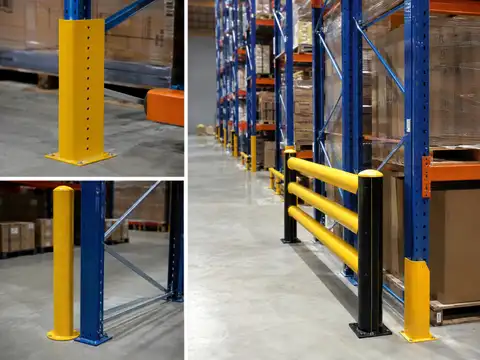
For simple upright protection, current retail pricing is modest:
$16–$69 per common post protectorUline currently lists plastic snap-on rack protectors around $16–$18 each and steel bolt-down models from about $37 to $69 depending on width and height. Larger end-of-row guards, heavy guardrail and VNA systems are usually better treated as quote-based project items.
Pallet-rack protection is one of the few warehouse investments where a small piece of steel or polymer can be compared directly with a four-figure repair event. That makes the ROI look obvious—but protecting every upright in a building is not automatically the best use of capital.
RMI identifies forklift impact as one of the largest causes of accidental rack damage and specifically points to aisle-facing columns and row ends as vulnerable locations. A good protection program therefore starts by mapping exposure, not by multiplying the number of uprights by a catalog price.
Protection priority
Protect exposure, not every upright equally
Turning trucks, cross aisles and repeated corner exposure.
Highest priorityTraffic passes directly beside exposed structural columns.
High priorityFrequent pallet placement, reversing and tight maneuvering.
Risk-basedProtect when damage history or operating conditions justify it.
Selective spendCommon plastic and steel post protectors before installation.
End-of-row, guardrail and VNA solutions depend heavily on geometry.
What pallet rack protectors cost right now
Uline's current U.S. catalog provides a useful transparent price snapshot. Its steel rack protectors are listed from about $37 for a 12-inch-high, 4¼-inch-wide model up to about $69 for a 24-inch-high, 6½-inch-wide model before volume discounts.
The same current page lists plastic 9-inch snap-on protectors at about $18 each in quantities of six, falling to roughly $16 each at larger quantities. A concrete installation kit for the steel guards is only a few dollars in Uline's current listing.
Lyon Workspace provides a second market check. Its current heavy-gauge steel pallet-rack upright impact guards are approximately $29.98–$46.99 per unit, with installation hardware included.
| Protection type | Current public price snapshot | Typical role |
|---|---|---|
| Snap-on plastic upright guard | About $16–$18 each | Light / moderate upright contact |
| Steel bolt-down post protector | About $30–$69 each | Higher-impact exposed uprights |
| Concrete anchor kit | About $4–$5 in one current listing | Floor-mounted steel guard installation |
| End-of-row protector | Quote-based | Row ends / turning traffic |
| Heavy guardrail / barrier | Quote-based | High-energy separation / infrastructure protection |
| VNA rack-end protection | Quote-based | Impact protection where aisle space is extremely constrained |
These are product prices, not installed project costs. A warehouse with 400 protectors may spend more on layout, drilling, anchors, labor and work-zone coordination than a small pilot installation does on the guards themselves.
Basic post protectors are standardized enough for useful retail snapshots. End-of-row and engineered barrier systems are not. Geometry, steel thickness, impact requirement, rack depth and installation conditions vary too much to turn one supplier quote into a national cost-per-foot benchmark.
The first dollars should usually go to row ends
RMI's current rack-protection guidance identifies row ends as a particularly vulnerable area because forklifts are turning, entering and leaving rack aisles. Cross aisles and rack tunnel bays create similar exposure.
This makes row-end protection attractive even in facilities that do not protect every intermediate upright. One barrier can shield the exposed end frame from the repeated turning path of multiple vehicles.
Handle-It currently manufactures end-of-aisle rack protectors in common 42- and 48-inch lengths, with standard, heavy-duty, space-saving and VNA variants. The existence of several geometries is important: “end guard” is a category, not a single standardized part.
20 row ends vs 240 aisle-facing uprights
A facility may have 240 potentially protectable aisle uprights but only 20 row ends receiving repeated turning exposure. Protecting those 20 critical locations first can generate a better initial risk reduction than buying light-duty guards for every post simply because they are inexpensive.
Steel bolt-down post protectors
This is the traditional upright guard: formed steel wraps around the exposed faces of the rack column and is typically anchored into the concrete floor. RMI lists free-standing formed-steel guards as one of the common methods for protecting aisle-facing uprights.
Uline's current versions use ¼-inch steel uprights welded to seven-inch-deep baseplates. Lyon's current guards use heavy-gauge steel with pre-punched floor plates and concrete wedge anchors.
Their main advantage is straightforward physical separation between the truck or pallet and the rack column. A small impact can be taken by a replaceable guard instead of the load-bearing upright.
The floor becomes part of a bolt-down guard system
Floor-mounted protection transfers impact into its base and anchors. That means the slab condition and anchor location matter. Installing more steel is not useful if the protector cannot be anchored correctly or conflicts with the rack's own baseplate and anchors.
RMI specifically advises buyers to verify that there is adequate space for additional floor anchors when selecting guards.
This issue becomes more noticeable around large seismic footplates, floor joints and tight VNA layouts.
Plastic and polymer snap-on protectors
Plastic or polymer protectors attach around the rack column without the same floor-drilling requirement. RMI includes plastic, foam and other attached protectors among common rack-column protection options.
Their current low retail price makes them attractive for larger deployments. They are also quick to install and replace.
The trade-off is impact regime. A light clip-on protector should not be assumed to provide the same performance as a heavy floor-mounted steel barrier under a substantial forklift collision.
A warehouse should distinguish recurring low-level pallet contact from a high-energy truck strike at a row end. The same guard is not necessarily appropriate for both exposures.
Attached guards vs free-standing guards
RMI describes both configurations. Some protectors attach directly to the rack column with bolts, straps or similar methods. Others are structurally independent and anchor to the floor in front of or around the upright.
The difference matters because a directly attached device can transmit at least some impact force into the rack, while an independent barrier is intended to intercept the vehicle before it reaches the column.
That does not make attached protection useless. It makes it important to understand the intended impact level and manufacturer design rather than treating every yellow protector as equivalent.
End-of-row protection solves a larger collision problem
End-of-row guards typically run along the rack depth and protect the exposed corner or full end frame. RMI lists multiple approaches: industrial guardrail, structural steel angles, formed pipe or tube, polymer barriers and guards attached directly to frame sides.
Handle-It's current standard products are available in 42- and 48-inch lengths to match common rack depths, and it offers longer or customized configurations where required.
Because row ends receive turning impacts rather than simple frontal contact, it is reasonable for the protection to be larger and more structurally substantial than a small post guard.
Space-saving end guards matter in tight aisles
Adding a thick barrier can protect the rack and simultaneously make the aisle harder to navigate. RMI explicitly warns that guards in restricted-width or very narrow aisle systems should not obstruct required handling clearances.
Handle-It currently sells a notched space-saving end protector that nests close to the rack and a dedicated VNA square protector. The VNA product is designed to save up to five inches of aisle space compared with bulkier protection.
That dimensional difference can matter enormously in an aisle already designed around turret trucks, order pickers, AGVs or wire-guided equipment.
A guard that narrows the aisle can cost more than it saves
If a protector pushes into the required truck envelope, operators may clip the guard repeatedly or the facility may lose the aisle width assumed by the material-handling design. Protection has to fit inside the operating geometry, not be added after the aisle is finalized.
Wide and seismic footplates need special attention
Standard upright guards are often designed around common three-inch rack columns. The footplate beneath the upright can be substantially wider, particularly in seismic or certain bolted-frame designs.
Handle-It currently distinguishes guards with wider internal openings and specialized raised/universal configurations for large baseplates. Its guidance describes common seismic footplates around five inches deep by eight inches wide as an example where a normal narrow protector may not fit.
The lesson is simple: measure the entire column/baseplate assembly before ordering protection in volume.
Column doublers and inserts are another protection strategy
RMI identifies column doublers and internal inserts as alternatives for increasing impact resistance at the most vulnerable lower portion of an upright.
A doubler adds another steel section to the aisle-facing column. An insert can be installed inside the lower rack column, sometimes extending from roughly 12 inches to several feet in height.
These are particularly relevant when specified during original rack manufacture or as part of an engineered system. They strengthen the rack location itself rather than placing a separate external barrier in the aisle.
A stronger upright is not a substitute for traffic control
RMI makes this point explicitly: protective guarding can reduce impact damage, but it does not replace proper forklift operator training.
The same logic applies to column reinforcement. A warehouse that repeatedly strikes the same row end should investigate visibility, turning radius, aisle geometry, speed, congestion and operator behavior—not simply keep adding steel.
Protection economics should start with damage history
The strongest ROI model uses the facility's own maintenance records. Count:
- rack impacts by location;
- upright repairs;
- frame replacements;
- engineering inspections after impact;
- hours of aisle or bay downtime;
- product handling required for repairs;
- repeated damage at the same locations.
Then overlay those events on the rack plan. The protection budget should follow the collision map.
A simple 100-upright equipment budget
100 steel post protectors
At a current retail reference of $37 each, material is about $3,700. At $69 each, it is $6,900. Anchors, installation labor, freight and warehouse disruption are additional.
That range is useful because the preceding rack-repair article shows how one damaged upright can become a four-figure maintenance event. A few avoided repairs can therefore recover a meaningful portion of a targeted guard installation.
But 100 guards may be worse than 30 better guards
Imagine only 30 of those 100 uprights sit at row ends, transfer aisles or documented impact locations. Spending the same budget on heavier protection in those 30 areas can be more rational than distributing the money evenly across low- and high-risk locations.
This is why Warehouse Fieldbook does not include a “rack guards required” calculator. Protector quantity should come from the facility's traffic and damage map, not from a generic percentage of pallet positions.
End-of-row ROI should include the frame it protects
A row-end impact can damage more than the first few inches of one column. It can affect the upright, anchors, braces and potentially the rack configuration around that frame.
The economic comparison should therefore include the potential cost of frame repair or replacement, unloading affected bays and the professional evaluation required after meaningful damage.
One recurring row-end incident
Suppose a location has required two $2,000 rack repairs over five years, plus internal labor and temporary storage each time. A more substantial end-of-row barrier does not need to eliminate every possible collision to make a strong economic case—it only needs to materially reduce the expected frequency or severity of the next event.
Do not count product containment as impact protection
Pallet stops, flue guards, safety netting and back-of-rack mesh solve different hazards. They can help keep pallets or products from moving or falling beyond the intended storage location, but they do not automatically protect the rack upright from a forklift strike.
Conversely, a steel post guard can protect the column without preventing cartons from falling out the back of the rack.
A complete rack-safety project may use both categories, but procurement should keep their purposes distinct.
Guardrail can protect more than pallet rack
Free-standing industrial guardrail can create a protective boundary around rack ends, building columns, offices, conveyors and pedestrian areas.
RMI lists guardrail among typical end-of-row rack-protection methods. ProGMA, the Protective Guarding Manufacturers Association within MHI, covers fixed barriers and devices intended to protect personnel, equipment and inventory in industrial facilities.
Where a rack row sits beside a pedestrian path or expensive infrastructure, a larger barrier system can solve several protection objectives at once.
Pedestrian barriers need a different engineering question
A rack protector is primarily protecting infrastructure. A barrier separating people from moving industrial vehicles has a more consequential personnel-safety role.
RMI's 2024 guarding guidance points buyers of pedestrian guardrail toward ANSI MH31.2 for impact-resistant barrier engineering.
The related warehouse-safety articles will treat pedestrian separation separately. Do not assume a small rack post guard is suitable simply because it is made of steel.
Are rack guards required by OSHA?
There is no standalone OSHA rule that says every pallet-rack upright must have a column protector. Mazzella's current rack-guard guidance states this directly: OSHA does not prescribe specific equipment such as warehouse rack guards.
OSHA's broader materials-handling and General Duty requirements still matter, and rack condition is part of maintaining a safe warehouse. RMI and ProGMA provide industry guidance and product standards relevant to protective guarding.
Buying a guard does not certify the entire storage system or warehouse as OSHA compliant. The device still has to suit the rack, floor, aisle, vehicle traffic and broader hazard-control program.
Protection can create new anchor conflicts
Rack columns already have engineered baseplates and anchors. A free-standing protector may add two or four more holes in the same general slab area.
RMI warns users to check anchor spacing and available installation area when selecting guards. Large baseplates, expansion joints and embedded utilities can make a seemingly simple retrofit more complicated.
For a large project, marking guard locations and verifying the slab conditions before crews arrive can prevent field delays.
Installation cost scales differently from product cost
Snap-on plastic protectors can be installed quickly without floor drilling. Bolt-down steel guards need layout, drilling, anchoring and cleanup. End-of-row barriers may use larger anchors and require a more substantial work zone.
Mazzella notes that guard installation can become labor intensive in large facilities and may require specialized equipment and coordination to limit downtime.
That is why the installed cost gap between a $20 plastic part and a $50 steel part can be much larger than $30.
Retrofit vs new-install protection
RMI notes that rack protection can be added during a new installation or retrofitted to an existing system. New construction has an obvious planning advantage: column, guard and floor-anchor geometry can be coordinated before the rack is loaded.
Retrofitting an active warehouse may require temporary aisle closures, moving pallets or working around the existing traffic schedule.
If a new rack project is being designed in a high-impact environment, pricing protection at the same time can be significantly easier than treating it as a separate project after the first collision.
Inspect the guards too
RMI explicitly says protective devices should be reviewed during routine rack inspections. Damage to the guards should be recorded and the guard repaired or replaced promptly.
This is especially important for a free-standing protector that has already absorbed an impact. A bent guard or loosened anchor may no longer provide the same protection during the next collision.
Protection systems therefore create their own small maintenance inventory: spare plastic guards, replacement steel units, anchors and documented inspection points.
A practical protection zoning plan
Divide the warehouse into four risk classes:
| Zone | Typical exposure | Protection strategy |
|---|---|---|
| Red | Row ends, intersections, tunnel bays, documented repeat impacts | Heavy end guard / robust floor-mounted protection |
| Amber | High-throughput aisle uprights | Steel or suitable impact-rated post protection |
| Green | Moderate traffic, occasional contact | Light / moderate guards where justified |
| Monitor | Low traffic and no damage history | Inspection and operator controls first |
The color names are a planning device, not a regulatory classification. They help the facilities team direct stronger protection toward the locations with the highest expected collision cost.
How to build the business case
For each proposed protection zone, estimate:
- Number of exposed locations. Count row ends, aisle posts and other identified hazards.
- Installed protection cost. Product + freight + anchors + labor + downtime.
- Historical damage frequency. How often has this zone produced rack repairs?
- Average repair-event cost. Include inspection, product movement and downtime.
- Expected reduction. Use a conservative internal assumption rather than a vendor's marketing claim.
This produces a risk-adjusted investment rather than a blanket accessory budget.
A five-year illustrative example
$7,500 protection project vs repeated repairs
Suppose 50 exposed locations cost $7,500 to protect once installation is included. Those locations have historically generated three $2,000 rack-repair events every two years. If protection substantially reduces the recurrence rate, the five-year avoided maintenance cost can approach or exceed the original guard investment before product damage and downtime are counted.
The numbers above are illustrative. The useful input is the warehouse's own incident history.
When guards are not fixing the real problem
Protection should trigger a broader investigation when:
- the same guard is hit repeatedly;
- drivers cannot turn without contacting row ends;
- aisles are narrower than the truck/load combination can practically use;
- pallet overhang intrudes into travel paths;
- blind intersections create repeated near misses;
- traffic and pedestrian routes are mixed;
- racks are frequently hit during one specific task or shift.
In those cases, aisle geometry, forklift selection, slotting, traffic rules or operator training may have more leverage than adding another layer of steel.
What to put in an RFQ
Give protection suppliers:
- rack upright width and depth;
- baseplate dimensions;
- rack frame depth;
- current aisle width;
- forklift / reach truck / VNA equipment type;
- row-end geometry;
- traffic direction and turning points;
- known impact locations;
- floor condition;
- seismic or wide-footplate conditions where relevant;
- required quantity;
- whether installation is included;
- impact-performance information available for the proposed guard;
- replacement-part availability.
Photos and a marked rack plan are often more useful than sending only the total number of pallet positions.
The practical recommendation
Start with row ends, cross aisles, tunnel bays and documented impact locations. Protect those properly before automatically specifying a light guard on every upright in the building.
Use inexpensive snap-on protection where the expected impact level and product design justify it. Use floor-mounted steel or larger barriers where higher-energy vehicle contact is plausible. In VNA layouts, treat every inch of protector intrusion as a material-handling design variable.
Most importantly, use inspection and repair records to determine whether the protection program is working. A yellow guard that is repeatedly destroyed is not evidence of success by itself—it may be evidence that the traffic problem still needs to be fixed.
Frequently asked questions
How much do pallet rack protectors cost?
Current August 2026 U.S. retail examples range from approximately $16–$18 for basic plastic snap-on guards to about $30–$69 for common steel upright protectors before installation. Larger end-of-row and guardrail systems are usually quote-based.
Where should pallet rack protectors be installed?
RMI highlights aisle-facing columns and row ends, particularly corners, cross aisles and rack tunnel bays where forklift traffic creates higher impact exposure.
Are pallet rack guards required by OSHA?
OSHA does not have a standalone rule requiring a protector on every rack upright. Rack protection should be selected as part of the facility's broader hazard, materials-handling and rack-safety program.
Are plastic rack protectors as good as steel?
They solve different impact conditions. Plastic and polymer guards can be quick, inexpensive and useful for lighter contact. Heavier floor-mounted steel or engineered barriers are more appropriate where the expected collision energy is greater.
What is an end-of-row rack protector?
It is a barrier installed along the exposed end frame of a rack row to intercept impacts from forklifts turning into, out of or across storage aisles.
Can a rack guard make an aisle too narrow?
Yes. RMI specifically warns users to consider handling clearances, particularly in VNA layouts. The protector footprint must be coordinated with the truck and aisle design.
Do rack guards need inspection?
Yes. RMI recommends checking protective devices during routine rack inspections and repairing or replacing guards that have been damaged.
Should I protect every pallet rack upright?
Not automatically. A risk-based plan usually starts with high-exposure row ends, intersections, tunnel bays and locations with a known history of impacts, then expands protection where the expected damage justifies the cost.
Sources and methodology
Warehouse Fieldbook reviewed current August 2026 U.S. retailer listings for basic upright-guard pricing, current manufacturer documentation for end-of-row and VNA products, and RMI / MHI guidance for guard location and selection. Published retail prices are used as snapshots rather than national installed-cost averages. OSHA discussion is intentionally limited to what federal guidance actually supports.
- Uline — current U.S. steel and plastic rack-protector pricing
- Lyon Workspace — current steel upright-guard pricing and installation details
- Rack Manufacturers Institute — column-guard locations, types and selection considerations
- Rack Manufacturers Institute — external column-protection options
- Rack Manufacturers Institute — rack guarding and ANSI MH31.2 context
- MHI / ProGMA — protective guarding terminology and fundamentals
- Handle-It — current end-of-row, space-saving and VNA protection options
- Handle-It — current VNA end-of-rack protector geometry
- Mazzella Companies — rack-guard installation and OSHA context
- OSHA — warehousing standards and enforcement context