
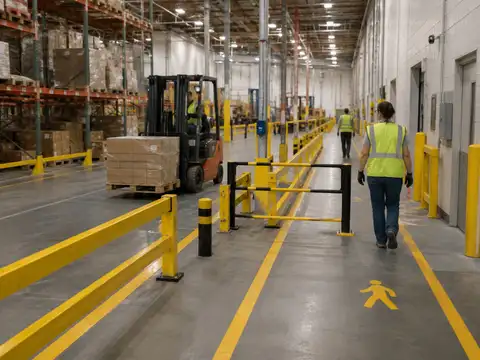
Remove routine pedestrian work from forklift space.
If a workstation, printer, time clock, trash point or break-room route causes employees to walk through a truck lane all day, redesigning that task can remove more exposure than adding another warning sign.
Elimination changes the route so the pedestrian-forklift conflict does not happen during normal work.Physically separate the routes and control the openings.
Dedicated walkways and suitable barriers can keep people out of vehicle space. Crossings should be limited, visible and designed as intentional conflict points rather than gaps appearing wherever employees find a shortcut.
A barrier is useful only if the path around it remains practical enough that people actually use it.Use markings, mirrors, lights, sensors and PPE to reinforce—not replace—the layout.
Warning technology can increase awareness and some systems can slow the truck, but pedestrians and operators still need safe routes, clear sightlines and enforceable traffic rules.
A blue light or camera does not convert a mixed-traffic aisle into a separated pedestrian system.Separation hierarchy
Design the System from Exposure Elimination Outward
Paint, alarms and high-visibility apparel can help, but they should not carry the entire pedestrian-safety burden where forklift exposure can be removed or physically separated.
Relocate workstations, vending, printers, time clocks, break access and routine walking routes so people do not need to enter vehicle space to do normal work.
Separate travel paths, guardrail/barrier systems, protected refuges and controlled crossing openings reduce the opportunity for vehicle-person contact.
Use limited crossing locations, sight-distance improvement, stop/yield logic, mirrors, lighting, gates or signals appropriate to the site's traffic pattern.
Configure technology for the actual truck, direction of travel, detection zone and environment. Treat it as an assist layer—not permission to mix traffic freely.
Speed limits, horns, pedestrian rules, visitor controls, crossing procedures and refresher training keep the engineered system usable.
PPE and lights can improve conspicuity, but neither physically prevents a truck from entering pedestrian space.
What OSHA actually requires—and what its eTool recommends
OSHA 29 CFR 1910.176(a) requires sufficient safe clearances where mechanical handling equipment is used, and says aisles and passageways must be kept clear and in good repair.
It also requires permanent aisles and passageways to be appropriately marked.
OSHA's current Powered Industrial Truck eTool goes further as recommended practice.
It tells plant safety managers to consider:
- pedestrian walkways;
- permanent railings or other protective barriers;
- adequate walking space on at least one side when pedestrians must use equipment aisles;
- pedestrian walkway striping when barriers cannot be used;
- convex mirrors at blind aisle intersections;
- traffic-control signs;
- plant speed limits.
OSHA's operator-training rule explicitly includes pedestrian traffic
OSHA 1910.178(l)(3)(ii)(D) requires powered industrial truck operator training to address pedestrian traffic in areas where the vehicle will be operated.
The same training rule includes visibility, steering and maneuvering, narrow aisles and other workplace conditions that affect safe operation.
This means pedestrian separation cannot live only in a floor plan.
Operators need to understand the site's actual crossings, blind spots, pedestrian routes and traffic rules.
At blind locations, OSHA requires slow-down and horn use
OSHA 1910.178(n)(4) requires the driver to
slow down and sound the horn at cross aisles and other locations where vision is obstructed.
OSHA 1910.178(n)(6) requires the driver to look in the direction of travel and keep a clear view of the path.
And 1910.178(n)(8) requires operation at a speed that permits the truck to be brought to a stop in a safe manner.
The horn rule matters, but a high-frequency blind crossing should also be reviewed for line-of-sight, route elimination, mirror placement, traffic priority, physical channelization and whether the crossing can be moved away from the blind corner entirely.
A 2024 NIOSH-supported fatality report shows why route design outranks awareness alone
Oregon FACE published a 2024 report on a 2023 fatal incident in which a lumber-mill employee was struck by a forklift-carried load.
Investigators identified contributing factors including:
- a workstation close to forklift traffic;
- inadequate separation of pedestrian and forklift traffic;
- inadequate forklift collision-prevention controls;
- limited worker visibility;
- unclear workplace policies.
The report's first recommendation was to design workstations to eliminate exposure to forklift traffic.
Its second was clear separation of pedestrian and forklift pathways.
The same FACE report explicitly distinguishes barriers from painted outlines
The Oregon FACE report explains that painted traffic outlines require maintenance as they fade.
After the fatality, the employer added physical barriers including concrete barriers in some areas.
Investigators described physical separation as more effective than outlines because it can physically prevent crossover of traffic.
Use a zone-by-zone separation plan
| Zone | Preferred separation approach | Failure mode to design out |
|---|---|---|
| Main pedestrian spine | Dedicated walkway physically separated from primary lift-truck routes where feasible. | Routine workers repeatedly stepping into truck lanes just to cross the building. |
| Rack aisles | Keep routine pedestrian transit out of narrow equipment aisles; control access for required picking/service tasks. | Person on foot inside a constrained aisle with limited escape space and rear-swing exposure. |
| Cross aisles / blind corners | Reduce conflict points, improve sightlines, slow/stop logic, horn use, mirrors/signals and controlled crossings. | Pedestrian and truck enter the same blind point without enough time to detect each other. |
| Dock face / staging | Create a protected route behind or away from active trailer/dock traffic and keep crossing points intentional. | Pedestrians moving between trailers, forklifts, staged pallets and dock equipment. |
| Battery / charging area | Route general foot traffic around charging/service work; provide safe access for authorized servicing tasks. | Pedestrian exposure to maneuvering trucks plus charging/service hazards. |
| Pick/pack / workstations | Relocate or barrier workstations so employees are not stationed inside a vehicle travel envelope. | Fixed workstation turns a traffic lane into a permanent pedestrian exposure. |
| Entrances / time clocks / break routes | Connect pedestrian destinations without forcing workers through truck intersections. | High-frequency exposure created by facility convenience rather than material flow. |
| Visitor / contractor routes | Use escorted or clearly protected routes and site-specific induction for people unfamiliar with truck behavior. | Visitors assume forklift braking, turning and right-of-way behave like road vehicles. |
Physical barriers need an actual impact design basis
“Install guardrail” is not a complete specification. Define:
- what vehicles can reach the barrier;
- truck/load mass and likely approach geometry;
- credible impact speed at that location;
- fork/attachment height and snag points;
- required pedestrian refuge behind the barrier;
- floor/slab/anchor conditions;
- crossing gates or openings;
- interaction with rack, columns, doors and fire protection;
- inspection/replacement criteria after impact.
Do not assume a light handrail or visual chain is an impact-rated forklift barrier.
Select the system and anchorage for the actual risk and manufacturer installation requirements.
Do not create a protected walkway that blocks emergency egress
OSHA 1910.37(a)(3) requires exit routes to be free and unobstructed.
That matters when adding barrier runs, pedestrian gates, bollards or protected corridors.
A traffic improvement should not create a new evacuation problem.
Control crossings instead of multiplying them
Avoid placing the crossing immediately at an opaque rack end, doorway or blind column when a nearby location provides more sight distance.
Operators and pedestrians should know who stops, where they stop and what confirms the path is clear before either enters the conflict zone.
Barrier openings and gates should funnel routine crossing to designed points while preserving practical access and emergency egress.
Mirrors or signals can help, but first remove stored pallets, signage or fixtures that unnecessarily block direct view.
Paint is useful—but it is a traffic instruction, not a crash barrier
Floor markings can define pedestrian space, crossings, no-storage areas and forklift routes.
They are especially important where physical barriers are not practical.
But the line must remain visible, the route must remain clear, and people need a realistic destination at each end.
A walkway that terminates in a pallet staging lane is not a complete route.
Truck-assist systems can add a strong layer when correctly integrated
Computer-vision pedestrian/object detection with alerts and truck slow-down.
Toyota currently describes SEnS+ as detecting pedestrians/objects behind compatible forklifts, providing visual/audible alerts and using regenerative braking to slow the truck in specified conditions. Detection range adjusts with speed and steering; Toyota publishes a customizable 130-degree detection area. The current page says SEnS+ is available only on specified new forklift models.
LiDAR-based object detection aligned to expected vehicle path.
Crown introduced ProximityAssist in 2025. Crown says the system detects objects in the expected path, automatically slows the forklift and can provide visual/audible alerts on compatible displays. Crown says the operator remains in control and explicitly states the system does not remove operator or pedestrian responsibility.
Awareness devices can make approaching traffic more detectable.
OSHA's eTool recommends convex mirrors at blind intersections and warning methods such as horns or lights. Use these to reinforce visibility where the traffic design still contains conflict points.
Never assume that a pedestrian-detection product sees every person, pallet, obstruction or body position in every environment. Validate the manufacturer's specified detection area, compatible truck models, operating conditions and behavior in the site's real lighting, speeds, corners, load profiles and traffic.
High-visibility apparel is a visibility control, not separation
The 2024 Oregon FACE report recommended high-visibility PPE where visibility is limited, while also recommending elimination, traffic separation and engineering controls.
That hierarchy matters. A vest can make a person easier to see; it does not stop a truck from entering the pedestrian's space.
Separate people from the rear swing, not only the forks
OSHA's pedestrian eTool specifically reminds pedestrians about the wide rear swing radius of lift trucks.
This is important at:
- rack ends;
- cross aisles;
- charging areas;
- dock approaches;
- workstations placed beside turning trucks.
A pedestrian island that clears the forks but sits inside the power-unit swing envelope is poorly located.
Use Forklift Turning Radius & Aisle Planning to build the actual truck envelope into the separation design.
Aisle width and pedestrian width should not be stolen from each other
Do not create a pedestrian path by simply painting a strip inside the forklift's required operating envelope.
The warehouse still needs sufficient safe clearance for the mechanical equipment.
Validate truck, load, rack, pedestrian and barrier requirements together.
See Warehouse Aisle Width Guide.
Rack layout can create or remove pedestrian conflicts
A rack plan determines where travel aisles, cross aisles, rack ends, staging and access routes meet.
If pedestrian separation is added after the rack layout is frozen, crossings often appear in poor locations.
Use How to Plan a Pallet Rack Layout when the pedestrian route needs to be designed into a new storage plan.
Near misses should trigger a layout review, not only a coaching conversation
OSHA 1910.178(l)(4) requires relevant refresher training and evaluation when the operator has been involved in an accident or near miss.
But training should not hide a defective traffic system.
Review:
- where the pedestrian entered vehicle space;
- whether a dedicated route existed;
- whether the route was blocked or inconvenient;
- whether the crossing had sight distance;
- whether speed/horn/stop rules were practical and enforced;
- whether a workstation or destination created predictable exposure;
- whether barriers, gates or assist technology failed or were missing.
For the response discipline after an equipment collision, see What to Do After a Forklift Hits a Pallet Rack.
Validate the separation system in operation, not only on a drawing
Shortcuts often appear because the designed path is blocked, too long or does not connect the destinations people actually use.
Confirm sightlines, rear swing, barrier clearance, load overhang and stopping expectations with the equipment actually used.
Track near misses, barrier impacts, horn-heavy blind points, pedestrian shortcutting and repeated crossing violations as design feedback.
Forklift-pedestrian separation audit
- All routine pedestrian destinations mapped.
- All forklift travel routes mapped.
- All pedestrian/forklift conflict points mapped.
- Workstations inside/adjacent to truck travel identified.
- High-frequency pedestrian routes identified.
- Visitor/contractor routes identified.
- Shift-change/break traffic observed.
- Receiving/shipping peak traffic observed.
- Mechanical-equipment aisle clearances validated.
- Permanent aisles/passageways marked as applicable.
- Floor markings maintained and visible.
- Routine pedestrian exposure eliminated where feasible.
- Dedicated walkways provided where feasible.
- Physical separation evaluated where pedestrian/truck exposure remains.
- Barrier impact/design basis documented.
- Barrier anchors/slab compatibility reviewed.
- Barrier openings minimized.
- Crossing locations deliberately selected.
- Crossings moved away from blind points where feasible.
- Crossing stop/yield rule defined.
- Crossing sight distance checked.
- Convex mirrors evaluated where direct visibility is limited.
- Lighting reviewed at crossings and route transitions.
- Forklift speed rules posted/communicated where appropriate.
- OSHA horn requirement at obstructed cross aisles included in operator practice.
- Truck direction-of-travel visibility reviewed.
- Rear-swing envelope included.
- Load overhang included.
- Attachment geometry included.
- Rack-end / cross-aisle exposure reviewed.
- Dock-face pedestrian routes reviewed.
- Charging/service-area pedestrian routes reviewed.
- Emergency exit routes remain free/unobstructed.
- Pedestrian routes do not terminate in staging or forklift lanes.
- PIT operator training includes actual pedestrian traffic conditions.
- Pedestrian employees receive site-specific traffic rules.
- Visitors receive route/safety instructions.
- Refresher training process covers accidents/near misses.
- High-visibility PPE policy defined where used.
- High-visibility PPE not treated as physical separation.
- Warning-light/alarm purpose defined.
- Sensor/detection technology compatibility verified.
- Detection zone verified in real facility conditions.
- Truck-assist technology does not replace operator responsibility.
- Near misses tracked by location.
- Barrier impacts tracked by location.
- Pedestrian shortcutting observed and corrected.
- Repeated conflicts trigger layout review.
- Traffic plan reviewed after rack/layout/process/truck changes.
- Traffic plan has an owner and inspection cadence.
Why a safe-distance calculator would be misleading
A “safe pedestrian distance” calculator would be misleading.
The correct separation design depends on truck geometry, mass, speed, load, rear swing, sight distance, pedestrian volume, crossing frequency, barrier capability, floor anchorage, egress and the actual warehouse operating pattern.
OSHA's eTool says “adequate walking space” rather than supplying one universal warehouse pedestrian width.
The useful tool is the hierarchy, zone map, crossing design and audit checklist, not a false “OSHA separation distance” number.
The decision rule
Start by removing unnecessary pedestrian exposure to forklift traffic. Where shared proximity remains, create dedicated pedestrian routes and use physical separation where the risk justifies it. Concentrate unavoidable crossings at locations with strong sightlines and unambiguous traffic rules. Then add markings, lighting, mirrors, horns, speed controls, PPE and operator-assist technology as supporting layers. Validate the system with the actual truck, load, rear-swing envelope and pedestrian flow. If people routinely ignore the designed route, redesign the route before assuming the problem is simply employee behavior.
Frequently asked questions
Does OSHA require forklifts and pedestrians to be physically separated?
OSHA 1910.176(a) requires sufficient safe clearances, clear aisles/passageways and appropriate marking of permanent aisles/passageways where mechanical equipment is used. OSHA's forklift eTool recommends separation measures including pedestrian walkways and permanent railings or other protective barriers. Do not convert the eTool recommendation into a one-size federal barrier specification.
Does OSHA specify a minimum pedestrian walkway width next to forklifts?
OSHA's current forklift eTool says to provide adequate walking space on at least one side when pedestrians must use equipment aisles, but it does not publish one universal pedestrian-lane width on that page. Other requirements—such as exit-route dimensions/egress—can apply separately.
Are painted pedestrian walkways enough?
Sometimes striping is the practical control, and OSHA's eTool specifically lists it when barriers cannot be used. But striping does not physically prevent vehicle crossover. Higher-exposure areas should be evaluated for elimination or physical separation.
Should forklifts always yield to pedestrians?
OSHA's powered-industrial-truck eTool instructs operators to yield right of way to pedestrians and stop/wait when people cross the planned route. The site's traffic plan should make conflict-point behavior explicit.
Are blue lights a substitute for guardrails?
No. Warning lights can improve awareness but do not create physical separation. Use them as a supplemental layer after the traffic routes and conflict points are addressed.
Can pedestrian-detection technology automatically slow a forklift?
Some current integrated systems can. Toyota says SEnS+ can slow compatible trucks when pedestrians/objects are detected under specified conditions; Crown says its ProximityAssist system can automatically slow compatible forklifts when objects are detected in the expected path. Product capability is model- and configuration-specific.
Does pedestrian-detection technology replace forklift training?
No. Crown explicitly says ProximityAssist does not eliminate operator/pedestrian responsibility, and OSHA separately requires operator competence/training for the actual workplace conditions, including pedestrian traffic.
Where should warehouse pedestrian crossings be placed?
Prefer locations with direct sightlines, room for both parties to recognize the conflict and a clear stop/yield rule. Avoid creating crossings directly at blind rack ends, doors or columns when a nearby location offers better visibility.
Should pedestrians be allowed inside narrow forklift aisles?
Routine pedestrian transit should be designed out where feasible. When employees must enter for picking, inspection or service, define access and operating rules for that task rather than treating the aisle as a normal pedestrian corridor.
What should happen after a forklift-pedestrian near miss?
OSHA's refresher-training rule can be triggered by an accident or near miss. Also review the system cause: route, sightline, crossing, obstruction, workstation, speed, barrier and truck-assist design—not just operator behavior.
Can pedestrian barriers block an emergency exit route?
No. OSHA 1910.37 requires exit routes to remain free and unobstructed. Barrier and gate layouts must preserve the applicable egress path.
Sources and methodology
OSHA 1910.176(a) supplies the mandatory safe-clearance, clear-aisle and permanent- aisle marking requirements. OSHA's current Powered Industrial Truck pedestrian- traffic eTool supplies recommended practices for walkways, railings/barriers, adequate walking space, striping, mirrors, signs and plant speed limits and is treated as recommended practice rather than rewritten as a universal barrier mandate. OSHA 1910.178 supplies the operator-training requirement for pedestrian traffic, the blind-cross-aisle horn/slow-down rule, clear-view and safe-speed rules, plus accident/near-miss refresher requirements. OSHA 1910.37 supplies the free-and- unobstructed exit-route requirement. The 2024 Oregon FACE report, supported through NIOSH, supplies a recent fatal-incident example and its hierarchy-based recommendations for eliminating workstation exposure, separating traffic and using engineering controls. Toyota's current SEnS+ page supplies a current example of computer-vision detection, alerts, dynamic zoning and truck slow-down on specified new Toyota models. Crown's May 2025 ProximityAssist announcement supplies a current LiDAR-based object-detection/slow-down example and explicitly preserves operator/ pedestrian responsibility. Warehouse Fieldbook adds no universal pedestrian-lane width, barrier height or “safe separation distance” calculator.
- OSHA — 29 CFR 1910.176 Handling Materials — General
- OSHA — Powered Industrial Trucks eTool: Pedestrian Traffic
- OSHA — 29 CFR 1910.178 Powered Industrial Trucks
- OSHA — 29 CFR 1910.37 Exit Route Operation and Maintenance
- Oregon FACE / NIOSH-supported report — Lumber mill employee fatally struck by forklift (2024)
- Toyota Material Handling — current SEnS+ Smart Environment Sensor Plus
- Crown — May 2025 ProximityAssist System announcement