
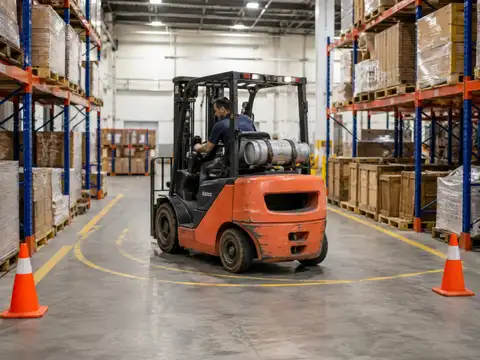
Turning radius tells you how the truck turns. It does not tell you whether the loaded truck can stack into your rack aisle.
Use turning radius to understand vehicle maneuverability and swept path. Use the manufacturer's right-angle stacking or aisle-width specification to plan rack work. Then validate the loaded truck through cross aisles, row ends, doors and blind intersections where the geometry and traffic pattern change.
Swept-path map
A forklift turn occupies more space than its published turning-radius circle suggests.
The rear of the truck swings, the load projects ahead of the forks, and the operator needs clearance to complete the maneuver without contacting rack, barriers, pallets or pedestrians.
Useful truck data, but not a complete right-angle stacking requirement.
Toyota explicitly publishes this separately from turning radius in current spec sheets.
Longer or overhanging loads can require substantially more maneuvering space.
Manufacturer/application validation should define the final clearance policy.
What forklift turning radius means
Turning radius is a vehicle-geometry measure describing the path the truck follows while steering through a turn.
Forklift specification sheets can publish:
- inside turning radius;
- outside turning radius;
- sometimes a single turning-radius figure depending on the manufacturer.
This is useful for:
- general maneuverability;
- cross-aisle turns;
- doorway approaches;
- dock/staging circulation;
- equipment comparisons.
But a rack-stacking maneuver also includes:
- the distance from steering geometry to the fork face;
- the load projecting in front of the forks;
- tail swing;
- the alignment needed to enter a pallet position;
- operational clearance.
Toyota publishes turning radius and right-angle stack separately
Toyota's current Core IC Pneumatic specification sheet is a useful proof.
In one group of current configurations, Toyota lists:
- outside turning radius: 76 inches;
- Basic Right-Angle Stacking Aisle Width: 91.9 inches.
In larger configurations on the same current specification sheet, Toyota lists:
- outside turning radius: 92.5 inches;
- Basic Right-Angle Stacking Aisle Width: 111.6 inches.
Toyota explicitly notes that load length and clearance must then be added to its Basic Right-Angle Stacking Aisle Width.
The two dimensions are related, but they are not interchangeable.
Toyota's published worked example uses:
- 86 inches Basic Right Angle Stack;
- 48 inches load length;
- 12 inches clearance.
The example result is 146 inches of minimum aisle width under that method.
Toyota also says this is only a starting assessment and recommends dealer verification before a purchasing decision.
Why rear-steer forklifts create tail swing
Conventional forklifts steer from the rear axle.
During a turn, the rear counterweight can sweep outward in the opposite direction from the front of the truck.
That creates impact risk near:
- rack ends;
- columns;
- guardrails;
- pedestrians;
- adjacent trucks;
- staged pallets.
A turn that clears the front load can still contact an obstacle with the rear of the truck.
The load creates another swept path
The front corner of the load follows a different path from the truck body.
Longer loads can require more room because they:
- project farther forward;
- change the load center;
- increase corner sweep during alignment;
- can reduce capacity if their center of gravity moves forward.
OSHA's powered-industrial-truck guidance specifically notes that load:
- weight;
- weight distribution;
- size;
- shape;
- position
affect forklift stability.
Therefore a swept-path review should use the actual design load, not an empty truck.
Four geometry terms that should stay separate
Useful for maneuverability, but not enough to size a stacking aisle by itself.
A better starting point for a 90-degree rack-stacking maneuver.
Load length, width, overhang and center of gravity can change both space and capacity.
Includes truck body, rear swing, load path and operating clearance.
Do not calculate rack aisle width from turning radius alone
A shortcut such as:
an aisle width derived only from turning radius
is not a reliable rack-design method.
It ignores:
- load projection;
- truck-to-fork-face geometry;
- clearance;
- manufacturer measurement conventions;
- the actual stacking maneuver.
Use the Warehouse Aisle Width Guide for the static rack-aisle calculation.
Use this turning-radius guide to check the truck's complete movement into and around that aisle.
Current Raymond data also shows turning radius changes by truck configuration
Raymond currently publishes a turning-radius range of 68.5 to 78.6 inches for its 4750 4-wheel sit-down counterbalanced forklift, depending on capacity.
That range is useful evidence that even inside one product family:
- capacity;
- configuration;
- truck dimensions
can change the turning geometry.
Do not design a warehouse around the smallest turning radius listed for a family unless that is the exact truck configuration being purchased and approved.
Cross aisles are a different turning problem from rack aisles
Inside a rack aisle, the truck may execute a controlled right-angle stack.
At the row end, it must transition between:
- rack aisle;
- cross aisle;
- another aisle;
- staging or dock traffic.
The required space can be controlled by:
- rack-end guards;
- opposing rack;
- columns;
- pedestrian barriers;
- staged pallets;
- two-way truck traffic.
OSHA specifically addresses cross aisles and obstructed vision
OSHA 29 CFR 1910.178(n)(4) requires drivers to slow down and sound the horn at:
- cross aisles;
- other locations where vision is obstructed.
If the load blocks forward view, OSHA requires travel with the load trailing.
OSHA 1910.178(n)(6) separately requires the driver to:
look in the direction of and keep a clear view of the path of travel.
Therefore a cross-aisle design should not merely prove that the truck can fit.
It should also address visibility and operating behavior.
OSHA 29 CFR 1910.176(a) requires sufficient safe clearances for aisles, loading docks, doorways and wherever turns or passage must be made. OSHA 1910.178(n)(15) also requires speed to be reduced to a safe level while negotiating turns. A geometric fit is therefore not, by itself, proof of a safe operating design.
Five turning zones to validate
Right-angle rack stack
Can the loaded truck turn, align, place and retrieve the pallet without contacting opposing rack or stored loads?
Rack-aisle entrance
Can the truck enter from the cross aisle without the rear counterweight clipping the rack end or barrier?
Blind cross-aisle intersection
Is there enough visibility and stopping space to operate under OSHA's cross-aisle requirements?
Doorway or dock approach
Can the truck square itself to the opening with the design load and without using protected pedestrian or staging space?
Staging-area U-turn or reversal
Can the truck change direction without sweeping through staged pallets, dock traffic or pedestrian routes?
OSHA requires sufficient clearance wherever turns are made
OSHA 29 CFR 1910.176(a) uses intentionally broad language.
Where mechanical handling equipment is used, sufficient safe clearances must be allowed:
- for aisles;
- at loading docks;
- through doorways;
- wherever turns or passage must be made.
This means the turning review should follow the truck through the entire operating route, not stop at the rack aisle.
Speed changes the operational turn even when geometry does not
A forklift may physically fit a turn at crawl speed and be unsafe at normal travel speed.
OSHA 1910.178(n)(8) requires trucks to be operated at a speed that allows them to be brought to a stop safely.
OSHA 1910.178(n)(15) specifically requires:
- reduced speed while negotiating turns;
- a smooth, sweeping steering motion;
- a moderate, even steering rate except at very low maneuvering speed.
Therefore the practical turning envelope should be reviewed together with:
- speed rules;
- traffic direction;
- visibility;
- floor condition;
- pedestrian exposure.
Long loads can dominate the turning envelope
Lumber, pipe, sheet goods and oversized products can extend much farther from the fork face than a standard pallet.
OSHA 1910.178(o)(3) specifically states that long or high loads that may affect capacity shall be adjusted.
For layout planning, long loads also affect:
- front-corner sweep;
- cross-aisle width;
- doorway alignment;
- rack-entry geometry.
Specialized multidirectional equipment can eliminate some conventional right-angle-stack movements for long loads.
Attachments can change both capacity and geometry
Side shifters, clamps, fork positioners and other attachments can alter:
- truck/load length;
- effective load center;
- capacity;
- clearance;
- stacking geometry.
The Toyota spec-sheet examples cited above are configuration-specific.
The layout should use the data plate and application information for the actual equipped truck.
Field validation should use the worst routine load
Do not test with a shorter rental truck and assume the result transfers.
Include overhang and attachment effects rather than an empty fork carriage.
Use the closest physical obstacle, not only nominal rack-center dimensions.
One turn direction can require a different path from the other.
Check sightlines and required operating behavior at intersections.
A maneuver that works in an empty warehouse can fail when staging and trucks are present.
Do not treat floor markings as extra turning space
A painted pedestrian lane, fire aisle or no-storage zone has an operating purpose.
If the forklift's tail swing routinely enters that protected space, the layout has not created safe truck clearance merely because the floor is physically open.
The pallet rack layout guide explains why truck, pedestrian and rack systems should be drawn on the same controlled layout.
Rack guards can become the true turning boundary
End-of-row protection often projects beyond the nominal rack frame.
Therefore:
Fixed intrusions can include:
- rack guards;
- columns;
- railings;
- bollards;
- equipment;
- wall projections.
Field-measure or dimension them from the final coordinated drawing.
Pallet overhang can reduce the aisle from both sides
Opposing stored pallets may project beyond the rack structure.
If each side overhangs farther into the aisle than assumed, the truck loses usable maneuvering room on both sides.
The same problem can occur at row ends where stored product projects into the cross-aisle turning envelope.
Use actual load dimensions, not only steel-to-steel rack dimensions.
Example: turning radius can look smaller while stacking geometry is still larger
This is exactly why using a turning-radius number as a minimum aisle dimension can understate the space required for pallet stacking.
Compare trucks using the same load
A procurement comparison should normalize:
- pallet/load length;
- load center;
- weight;
- attachment;
- required lift height;
- clearance assumption.
Then compare:
- outside turning radius;
- right-angle stacking requirement;
- overall truck length;
- rear overhang;
- capacity at required height.
A truck with a favorable turning radius can still have an aisle disadvantage under a particular load/configuration.
Turning geometry can change storage capacity indirectly
If a more maneuverable truck supports a smaller validated aisle or cross aisle, the warehouse may be able to:
- add rack rows;
- increase rack-block width;
- recover floor area;
- improve traffic around row ends.
But the gain is not automatic.
Use the Warehouse Storage Capacity Calculator only after the new aisle and rack geometry has been validated.
Turning-space savings are stepwise
Saving 8 inches at one row end may have zero pallet-capacity value.
Saving enough width across multiple aisles to fit:
- one full additional rack row;
- another bay;
- a more efficient cross-aisle arrangement
can create a material capacity gain.
The warehouse storage density guide explains why physical density should be compared with selectivity and throughput.
Higher lift can make turning geometry more valuable
A truck selected for tighter aisles may also enable taller rack.
That creates a combined capacity effect:
- less floor consumed by aisles;
- more pallet positions vertically.
The warehouse clear-height guide explains how to validate the vertical storage envelope before counting those extra levels.
Blind corners should be designed as operating-control points
At blind intersections, consider:
- truck approach speed;
- horn requirement;
- line of sight;
- mirrors or other controls where appropriate;
- pedestrian routes;
- one-way traffic;
- rack/end-barrier setbacks;
- staging restrictions near corners.
The goal is not to maximize the turning speed.
The goal is to create enough visibility, stopping room and predictable behavior for the intersection to operate safely.
One-way traffic can change the turn design
A one-way traffic plan can reduce:
- head-on truck conflict;
- passing requirements;
- uncertainty at intersections.
But it can increase:
- travel distance;
- circulation loops;
- concentration at specific cross aisles.
Model the actual transaction flow before sacrificing capacity or travel for a traffic rule that does not solve the real bottleneck.
Turning-radius audit checklist
- Exact forklift model and capacity configuration.
- Attachment and fork configuration.
- Outside/inside turning radius as defined by the manufacturer.
- Basic right-angle stack or stacking-aisle specification.
- Manufacturer definition of what the stacking figure includes.
- Actual load length, width and overhang.
- Load center and weight.
- Rack-aisle stacking maneuver.
- Tail swing at row ends.
- Cross-aisle entry and exit in both directions.
- Door and dock approaches.
- Rack guards, bollards and columns.
- Pedestrian routes and protected areas.
- Blind-corner sightlines.
- Peak staging and traffic conditions.
- Operating speed and site traffic rules.
- Field/application validation by the equipment supplier.
What to request from the forklift supplier
Ask for a model-specific application package including:
- truck dimensions;
- inside/outside turning radius;
- right-angle stacking or AST requirement;
- load-length assumption;
- recommended clearance;
- rear overhang;
- attachment effects;
- capacity at the required load center and lift height;
- cross-aisle/turning review for the proposed layout.
Give the vendor the same controlled rack drawing used by the rack supplier.
Why manufacturer geometry should control aisle design
A simple turning-radius calculator would encourage exactly the mistake this article is designed to prevent.
A final aisle/turn requires manufacturer-defined:
- truck geometry;
- stacking geometry;
- load dimensions;
- attachment configuration;
- clearance;
- site obstacles.
There is no responsible universal formula that converts one turning-radius number into an approved warehouse aisle.
The decision rule
Use turning radius to understand the truck's maneuverability, but design the warehouse around the complete swept path of the loaded truck. Right-angle stacking, tail swing, load projection, cross-aisle entry, visibility and operating speed all matter. If the truck only “fits” when clearances disappear or protected space is borrowed, the layout does not fit.
Frequently asked questions
Is forklift turning radius the same as aisle width?
No. Turning radius is a truck geometry metric. A stacking aisle must also account for the truck-to-fork geometry, load length and operating clearance.
What is Basic Right Angle Stack?
It is a manufacturer-published dimension used to describe the truck's geometry during a 90-degree pallet-stacking maneuver. Toyota states that load length and clearance are added to its basic figure.
Why is a forklift aisle wider than its turning radius?
The loaded truck must do more than rotate. The load projects forward, the truck rear swings outward, and the operator needs room to align and place the pallet.
What is forklift tail swing?
Because many forklifts steer from the rear, the counterweight can sweep outward during a turn. This can create impact risk even when the front of the truck clears.
Does a longer pallet increase turning space?
It can. A longer load projects farther forward and changes the corner swept path. It can also change load center and available truck capacity.
How do I size a cross aisle for forklifts?
Validate the exact truck and design load through the entry and exit turns, while accounting for rack ends, guards, columns, other traffic, visibility and required safe clearances.
What does OSHA require at forklift cross aisles?
OSHA 1910.178(n)(4) requires drivers to slow down and sound the horn at cross aisles and other locations where vision is obstructed.
What does OSHA require when turning a forklift?
OSHA 1910.178(n)(15) requires speed to be reduced to a safe level and steering to be performed with a smooth, sweeping motion at a moderate, even rate except during very-low-speed maneuvering.
Can I calculate aisle width as twice the turning radius?
That is not a reliable rack-design method. Use the truck manufacturer's right-angle stacking or aisle-width data plus the actual load and required clearance.
Does forklift capacity affect turning radius?
It can correlate with changes in chassis configuration. Raymond currently lists a 68.5–78.6-inch turning-radius range across its 4750 sit-down counterbalanced family depending on capacity.
Should a forklift swept-path test use an empty truck?
No. Validate the worst routine design load, including overhang and attachments, because the load changes both the front swept path and operating capacity.
Sources and methodology
Warehouse Fieldbook separates turning radius from stacking-aisle geometry. Toyota's current Core IC Pneumatic specification sheet publishes both turning radius and Basic Right-Angle Stacking Aisle Width as separate dimensions and instructs users to add load length and clearance to the basic stacking figure. Toyota's aisle-width guide provides the 86 + 48 + 12 = 146-inch worked example and recommends dealer verification. Raymond's current 4750 product page provides a 68.5–78.6-inch turning-radius range depending on capacity. OSHA 29 CFR 1910.176(a) supplies the requirement for sufficient safe clearance wherever mechanical equipment travels or turns, while 1910.178(n) supplies rules for cross aisles, visibility, speed and turning behavior. Manufacturer figures are application examples and are not universal aisle approvals.
- OSHA — 29 CFR 1910.176, mechanical-handling clearances
- OSHA — 29 CFR 1910.178, powered industrial trucks
- OSHA — forklift load handling, load center and stability
- Toyota Material Handling — Basic Right Angle Stack aisle-width method
- Toyota Material Handling — Core IC Pneumatic turning-radius and right-angle-stack specifications
- Raymond — current 4750 sit-down counterbalanced forklift turning-radius range
- Raymond — reach-truck and four-directional handling geometry context