
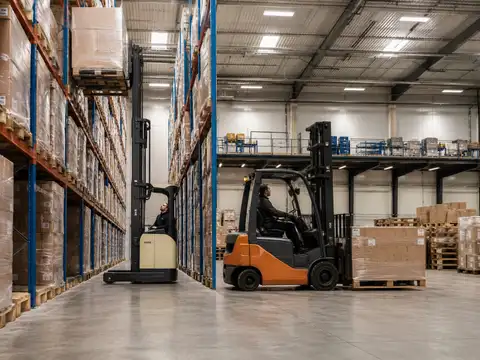
Current Toyota guidance puts reach trucks in roughly 8–10 ft aisles and sit-down counterbalance forklifts around 12–14+ ft.
Reach truck = storage density · Counterbalance = operating versatilityReach trucks can also work at substantially greater lift heights. Counterbalance trucks remain stronger generalists for trailers, docks, staging, outdoor work and applications where the truck cannot live almost entirely inside rack aisles.
Reach truck versus counterbalance forklift is one of the few equipment choices that can change the warehouse building economics more than the equipment budget.
The reason is aisle width. A forklift is purchased once. A wider aisle consumes valuable square footage for every foot of rack row, every day the building is occupied.
That makes this decision inseparable from rack design, pallet count and clear height.
Warehouse geometry
The aisle is often worth more than the forklift
Current Toyota planning guidance for narrow-aisle warehouse operation.
- High rack
- Dense storage
- Indoor specialization
Current Toyota planning guidance for conventional sit-down trucks.
- Dock-to-stock
- Trailers & staging
- Indoor/outdoor versatility
A cheaper forklift can become the more expensive warehouse decision if its turning envelope forces wider aisles and removes usable pallet positions.
What is the actual difference?
A counterbalance forklift carries a substantial weight behind the front axle to counter the pallet being lifted at the forks. It can approach a load directly because it does not need outriggers extending around the pallet.
A reach truck uses baselegs for stability and a mechanism that extends the forks or mast toward the rack. Toyota's May 2026 explanation describes the reach truck as a Class II narrow-aisle electric forklift designed specifically for high-density warehouse storage.
The different stability architecture is what lets the reach truck use a much shorter vehicle body and turn inside narrower rack aisles.
Reach truck vs counterbalance at a glance
| Decision factor | Reach truck | Counterbalance forklift |
|---|---|---|
| Typical aisle planning | About 8–10 ft | About 12–14+ ft for sit-down truck |
| Primary environment | High-density warehouse | General material handling |
| Lift height | Can exceed 40 ft | Typically lower |
| Power | Electric | Electric, propane, gas, diesel |
| Trailers / docks | Application-dependent | Strong general-purpose fit |
| Outdoor use | Mostly indoor; specialized outdoor models exist | Broad indoor/outdoor options |
| Very tall rack | Strong | Usually weaker fit |
| Dense pallet storage | Strong | Wider aisle penalty |
Reach trucks typically work in 8–10-foot aisles
Toyota's May 2026 reach-truck guide gives approximately 8–10 feet as the common operating aisle width for reach trucks, depending on load dimensions and truck configuration.
Crown's current RM 6000 specification gives another real-world reference: that reach truck can stack in aisles as narrow as 8 feet.
These are equipment references, not a universal aisle-width approval. The exact required width has to be calculated from the specific truck, load length and operating clearance.
Sit-down counterbalance usually needs substantially more aisle
Toyota's current reach-truck comparison places a sit-down counterbalance truck around 12–14+ feet of aisle.
Toyota's current Core IC Cushion product provides a useful model-specific check: the truck is designed to navigate approximately 12-foot aisles while handling capacities up to 6,500 lb.
Toyota's Core Electric counterbalance truck says it can operate in spaces as small as approximately 11 feet, again demonstrating why the actual forklift model matters more than a generic category rule.
Use manufacturer Basic Right Angle Stack / right-angle stacking data, actual pallet length and a deliberate operating clearance. Final aisle width should be verified against the quoted truck and rack layout.
Aisle width creates the main economic argument for a reach truck
Every foot removed from a travel aisle can potentially be reassigned to rack, staging, pedestrian infrastructure or another productive use.
The value compounds across multiple aisles:
Six aisles, 3 feet narrower each
Six rack aisles × 3 ft of width reduction =18 ft of building width recovered.
Whether those 18 feet produce another rack row depends on frame depth, flue spaces, columns, cross aisles and the actual layout. The point is that forklift geometry can recover a building-scale amount of space.
Do not calculate the forklift premium in isolation
Suppose the reach-truck solution costs more than a simple counterbalance truck. If the narrower aisle layout creates hundreds of additional pallet positions, the equipment premium may be economically trivial.
Compare:
incremental truck cost ÷ incremental usable pallet positions
Then compare that result with the cost of adding warehouse space or operating an overflow facility.
Lift height is the second major reach-truck advantage
Toyota's current Reach Truck offers up to 444 inches of maximum lift height.
Its High-Capacity Reach Truck extends to 542 inches—roughly 45 feet. Toyota says that model can carry 2,150 lb to more than 42 feet under the cited configuration.
Raymond's current 7530 High Capacity Reach-Fork Truck provides another high-bay reference: it can lift 2,000 lb to 505 inches in its single/deep-reach configurations.
Nominal capacity is not capacity at maximum height
A reach truck advertised at 4,500 lb does not necessarily carry 4,500 lb to the highest available mast position.
Toyota's High-Capacity Reach Truck is a useful example. It has a nominal capacity up to 4,500 lb but specifically states 2,150 lb at more than 42 feet.
High-bay design therefore needs:
- pallet weight;
- load center;
- required elevation;
- mast configuration;
- attachment;
- residual capacity at that exact height.
The highest rack beam should never be planned from the capacity printed in the forklift model name alone.
4,500 lb on the brochure does not mean 4,500 lb at 42 ft
A warehouse storing 3,000-lb pallets at very high elevations may need a different truck or lower top levels even when the reach truck's nominal ground-level capacity appears sufficient.
Counterbalance wins when the truck must do many unrelated jobs
A sit-down or stand-up counterbalance forklift is a material-handling generalist.
It can be strong at:
- loading and unloading trailers;
- dock work;
- floor stacking;
- staging;
- production movement;
- carrying loads across the building;
- mixed indoor/outdoor movement with the right tire and truck type;
- attachments that suit unusual loads.
A reach truck is optimized around rack access. If only 30% of the shift is spent putting pallets into rack, specialization may not recover its layout advantage.
Trailers favor counterbalance equipment
Raymond's current 4260 stand-up counterbalance truck specifically emphasizes visibility and operation in trailers and confined spaces.
Raymond's 4460 sit-down counterbalance truck likewise identifies trailers, ramps and stacking areas as core applications.
Counterbalance trucks approach pallets without front baselegs extending around the load, making them naturally adaptable to trailer loading and general dock work.
Reach trucks can work around docks—but do not assume every dock task fits
Toyota markets its current reach truck for dock-to-stock and stock-to-dock work, so the category should not be described as incapable of dock operations.
But loading trailers creates specific constraints:
- dock plate / leveler rating;
- trailer floor condition;
- baseleg clearance;
- mast height;
- turning room;
- grade transitions;
- truck manufacturer's approved use.
If trailer loading is a core job, test the exact reach-truck configuration rather than assuming its rack performance transfers automatically to the dock.
Outdoor work strongly favors conventional counterbalance—most of the time
Counterbalance forklifts are available with pneumatic tires and power sources designed for outdoor and mixed-duty environments.
Toyota's current Core IC Pneumatic truck, for example, carries 3,000–6,500 lb and is designed for common outdoor applications and uneven surfaces.
Most conventional reach trucks use small load wheels and are designed primarily for smooth indoor floors.
But some reach trucks are now indoor/outdoor machines
Toyota's May 2026 reach-truck guide specifically identifies its Indoor/Outdoor Moving Mast Reach Truck as a model with larger wheels, greater ground clearance and weather-protection options.
This is an important exception. “Reach truck = indoor only” is too absolute for the current market.
The better rule is: standard reach trucks favor controlled indoor floors; specialized models can expand the operating envelope.
Floor quality matters much more to a reach truck
High lift heights amplify mast movement and load sway. Small, hard wheels also make floor irregularities more noticeable.
A high-bay reach-truck warehouse should pay close attention to:
- floor flatness;
- joints;
- cracks;
- debris;
- dock transitions;
- rack alignment;
- travel speed at height.
Buying a high-reach truck without evaluating the slab can move the bottleneck from equipment to the building.
Reach trucks are fundamentally electric
Toyota's May 2026 guide defines the reach truck as a Class II electric forklift. The current Toyota and Raymond reach-truck product families are battery-powered.
This means the warehouse also needs to solve:
- battery chemistry;
- charger;
- charging windows;
- electrical capacity;
- multi-shift energy strategy;
- cold-storage battery performance where applicable.
Counterbalance trucks offer a wider energy menu: electric, LP, gas and diesel across different product families.
Power-source flexibility can matter more than aisle width in some facilities
A business with poor electrical infrastructure or continuous outdoor duty may place greater value on LP or diesel refueling than on gaining additional pallet positions.
Conversely, a dense indoor distribution center already operating an electric fleet may incur little additional infrastructure cost by adding reach trucks.
The machine category and energy strategy need to be designed together.
Single-reach vs double-reach is another decision layer
Toyota's current Reach Truck line includes both single- and double-reach models. Raymond's 7200 also lists deep-reach capability, with its published specification showing 4,000-lb maximum capacity and 2,500 lb in deep reach.
Double-deep rack can increase storage density by placing one pallet behind another, but it reduces direct pallet selectivity and requires the truck to reach the rear position.
The deeper rack system should therefore be justified from SKU depth and inventory behavior, not simply because the selected truck can reach it.
A double-deep reach truck does not make every SKU suitable for double-deep rack
Two pallets deep creates access sequencing. The front pallet can block the rear pallet unless inventory is managed accordingly.
High-SKU, low-quantity operations may gain little usable capacity because lane fragmentation offsets theoretical density.
The forklift capability is only one part of the storage-system decision.
Long loads require another specialized solution
Toyota's Multidirectional Reach Truck allows horizontal travel by articulating its load wheels.
That gives long products such as lumber, pipe and carpet a way to move parallel to narrow rack aisles instead of making a wide right-angle turn.
Raymond's 7310 4-Directional Reach Truck makes a similar argument and says its configuration can reduce aisle width by removing the need for conventional right-angle turns.
For long loads, the real comparison may therefore be multidirectional reach vs sideloader vs conventional counterbalance, not ordinary reach vs ordinary counterbalance.
Counterbalance capacity range is generally broader
Toyota's current Core Electric and Core IC Cushion counterbalance models extend to approximately 6,500 lb.
Larger counterbalance families continue much higher, ultimately reaching heavy-duty industrial capacities far outside normal reach-truck territory.
Reach trucks are optimized for dense pallet storage rather than the heaviest material-handling work.
A 6,000-lb pallet can decide the question immediately
The building wants reach-truck aisles; the load wants more truck
If the warehouse routinely stores 6,000-lb pallets, many ordinary reach-truck configurations are outside their comfortable capacity class.
The design team may need a higher-capacity specialized reach solution, lower rack height, wider counterbalance aisles or another material-handling strategy.
Travel distance changes the productivity comparison
A reach truck is highly productive when the work is concentrated between narrow rack aisles and nearby staging.
A counterbalance truck may be stronger where the work includes long horizontal travel, trailers, outdoor surfaces and frequent transitions between different tasks.
Equipment selection should therefore use a real cycle:
- start point;
- travel distance;
- pallet pickup;
- travel to rack or dock;
- lift height;
- placement time;
- return distance.
Optimizing only the 20 seconds spent in front of the rack can miss several minutes of travel elsewhere in the cycle.
Dock-to-stock operations may need both truck types
One common warehouse design uses counterbalance trucks around the dock and reach trucks inside storage aisles.
The counterbalance unloads trailers and stages pallets. Reach trucks then move staged pallets into high-density storage.
This introduces an extra handoff but lets each machine operate in the environment where it is strongest.
One versatile fleet vs specialized zones
Option A uses only counterbalance trucks from trailer to rack.
Option B uses counterbalance trucks at receiving and reach trucks in storage.
Option B adds fleet complexity and pallet handoffs but can recover building capacity through narrower storage aisles. The correct choice depends on how much the extra pallet density is worth.
Dedicated reach-truck aisles can reduce unnecessary traffic
Narrow aisles naturally limit the number and type of vehicles entering the rack zone.
That can support a more disciplined traffic design, but it also means:
- pedestrian access needs deliberate control;
- disabled trucks can obstruct the aisle;
- passing another truck may not be possible;
- replenishment and picking traffic can conflict;
- cross aisles become important for circulation.
Density and throughput should be modeled together.
Wider counterbalance aisles can sometimes increase throughput
More aisle space is not automatically waste.
A wider aisle can allow:
- easier turning;
- faster alignment;
- greater load variation;
- more operational tolerance;
- simpler dock-to-rack movement;
- less specialized equipment.
A very high-throughput pallet operation may accept lower storage density because rapid material flow is worth more than maximizing pallet positions.
Storage density should be measured as usable capacity
A reach-truck layout can add nominal pallet positions but still underperform if product mix cannot use them efficiently.
Include:
- SKU count;
- average pallets per SKU;
- seasonality;
- lot / date segregation;
- blocked locations;
- operational clearances;
- reserve vs forward-pick needs.
The goal is not maximum rack count. It is maximum usable inventory capacity without unacceptable labor or congestion.
Clear height can make reach trucks financially compelling
A building with 36 or 40 feet of usable clear height but forklifts that effectively limit storage to 20 feet is paying rent on underused cube.
Moving to high-reach equipment can create more pallet positions vertically without expanding the building footprint.
The project still needs rack engineering, sprinkler coordination and residual forklift capacity at height.
Going higher can reduce cycle speed
A pallet position at 40 feet is not operationally equivalent to one at 10 feet.
Lift and lower travel takes time, operator visibility becomes more demanding and truck control systems may reduce speed at elevation.
High-bay storage is often strongest for slower-moving reserve pallets while faster inventory remains lower and closer to shipping.
Reach trucks are especially strong in cold storage
Cold-storage buildings are expensive to construct and operate, making each cubic foot more valuable.
Narrow aisles and high rack can therefore have a stronger financial case in freezers than in inexpensive ambient warehouses.
Toyota and Crown both offer reach-truck configurations for cold-storage applications. Battery performance, cab / operator protection and condensation still need to be specified for the actual temperature.
Counterbalance can still be the right freezer truck at the dock
A freezer warehouse may use reach trucks deep inside storage and counterbalance equipment around receiving, blast-freeze staging or dock transitions.
The building does not need one forklift architecture everywhere.
Operator posture is different
Reach trucks commonly use standing operator compartments with fore/aft or side-stance configurations.
Toyota's current Reach Truck offers both Fore/Aft and Sidestance options. Raymond's current reach equipment also emphasizes operator stance and visibility at high lift.
Counterbalance equipment can be stand-up or sit-down, with the latter remaining common for general-purpose applications.
The right posture depends on travel direction changes, shift length, visibility and frequency of entry/exit.
Try the exact operator workflow before purchasing a fleet
A paper specification cannot show:
- neck rotation during reverse travel;
- visibility through the mast;
- comfort at high lift;
- entry and exit frequency;
- control familiarity;
- alignment time with rack openings.
A short rental or dealer demonstration using representative pallets and aisles can reveal productivity differences that the specification sheet cannot.
Safety is not decided by truck category
Both reach trucks and counterbalance forklifts are powered industrial trucks subject to OSHA operator-training and workplace requirements.
Narrow aisles can create different visibility, pedestrian and escape constraints from wider counterbalance environments.
Counterbalance trucks can introduce higher-speed cross-warehouse traffic, outdoor transitions and dock hazards.
The correct safety design follows the actual traffic pattern rather than assuming one forklift type is inherently safe.
The right-angle stack calculation still matters
Toyota's aisle-width guidance uses a simple starting framework:
Basic Right Angle Stack + load length + operating clearance
Toyota's published example historically uses 12 inches of clearance as a starting planning allowance. Final layout should be checked against the exact truck, load, rack and site conditions by the equipment supplier.
This matters because two pallets can have the same weight and different lengths. A longer load changes the required turning envelope even when the forklift model stays the same.
Do not forget pallet overhang and rack depth
Forklift aisle design interacts with:
- pallet depth;
- rack frame depth;
- front and rear pallet overhang;
- column protectors;
- beam position;
- load protrusion;
- pedestrian separation.
A 9-foot clear travel aisle on a CAD drawing can be something different after guards and product overhang occupy its edges.
The cheaper fleet can produce the more expensive building
Equipment savings vs space economics
Suppose the counterbalance fleet is $40,000 cheaper than the reach-truck alternative across several units.
If wider aisles eliminate enough rack positions that the warehouse needs 8,000 additional square feet of overflow space, the equipment saving is no longer the dominant number.
This is the core financial lesson of the comparison.
But do not buy reach trucks to create density the operation does not need
If the warehouse has abundant empty space, 16-foot rack, low rent and little growth pressure, paying for specialized high-reach equipment to reduce aisle width may solve a problem that does not exist.
Counterbalance equipment may provide more operational flexibility at lower system complexity.
Reach truck is usually the stronger choice when...
- the warehouse is storage-capacity constrained;
- rack height exceeds conventional counterbalance capability;
- the operation can benefit materially from 8–10 ft aisles;
- most work happens indoors on smooth floors;
- pallet dimensions are standardized;
- electric charging infrastructure already exists;
- the truck spends most of its time in rack storage;
- cold-storage cube has high economic value.
Counterbalance is usually the stronger choice when...
- one truck needs to perform many tasks;
- trailers and docks dominate the workload;
- the truck regularly works outdoors;
- loads are heavier or unusually varied;
- aisle width is not a major capacity constraint;
- fuel flexibility matters;
- floor conditions are uneven;
- the business wants a simpler general-purpose fleet.
Sometimes the right answer is both
Large distribution centers often gain more from specialization than fleet uniformity.
A sensible architecture can use:
- counterbalance trucks for unloading and staging;
- reach trucks for reserve pallet storage;
- order pickers for case picking;
- pallet jacks for horizontal movement.
The financial test is whether the productivity and space gains exceed the cost of maintaining several equipment types.
What to give a forklift dealer before requesting proposals
Send:
- rack drawing;
- current and proposed aisle widths;
- maximum beam height;
- maximum pallet weight;
- pallet dimensions;
- SKU / pallet profile;
- floor conditions;
- dock / trailer requirements;
- indoor vs outdoor percentage;
- travel distances;
- annual truck hours;
- shift schedule;
- existing battery / charging infrastructure;
- expected facility growth.
Ask the dealer to propose the truck and the required aisle width together.
What to compare in the final business case
| Business metric | Reach-truck layout | Counterbalance layout |
|---|---|---|
| Usable pallet positions | Calculate | Calculate |
| Maximum usable rack height | Calculate | Calculate |
| Forklift fleet CAPEX | Quote | Quote |
| Energy infrastructure | Electric | Depends on power source |
| Pallet moves/hour | Test / model | Test / model |
| Dock productivity | Test / model | Test / model |
| Outdoor capability | Model-specific | Broad options |
| Value of recovered space | Potentially material | Baseline |
The practical recommendation
If the warehouse's problem is capacity, begin with a reach-truck layout. Model 8–10-foot aisles, realistic residual capacity at the highest beam and the resulting usable pallet count.
If the warehouse's problem is versatility, begin with a counterbalance layout. Model docks, trailers, staging, outdoor travel and the broader task mix.
Then compare both systems at the warehouse level.
The correct answer is rarely determined by the difference between two forklift purchase prices. It is determined by what each machine forces the building to become.
Frequently asked questions
What is the difference between a reach truck and a counterbalance forklift?
A reach truck uses baselegs and a reach mechanism to access rack in narrow aisles. A counterbalance forklift uses a rear counterweight and can approach the pallet directly without front outriggers around the load.
How wide does a reach-truck aisle need to be?
Toyota's May 2026 planning guidance says most reach trucks operate efficiently in approximately 8–10 ft aisles, depending on load and configuration. Crown's current RM 6000 can stack in aisles as narrow as 8 ft.
How wide does a counterbalance-forklift aisle need to be?
Toyota's current comparison gives roughly 12–14+ ft for conventional sit-down counterbalance trucks. Specific models can differ: Toyota's Core Electric claims operation in spaces as small as about 11 ft, while the Core IC Cushion is designed around approximately 12-ft aisles.
How high can a reach truck lift?
Current Toyota reach trucks reach well above 30 ft. Its High-Capacity Reach Truck offers up to 542 inches, roughly 45 ft, depending on configuration.
Can a counterbalance forklift work in narrow aisles?
Yes, some compact electric and stand-up counterbalance trucks work in narrower spaces than conventional sit-down models. They generally still do not match the storage density of a purpose-designed reach truck.
Can a reach truck unload a trailer?
Some reach trucks can perform dock-related work, and Toyota markets current reach models for dock-to-stock operation. Trailer use must still be verified for the exact truck, dock plate, floor, clearance and baseleg configuration.
Can reach trucks operate outside?
Most conventional reach trucks are primarily indoor machines, but specialized indoor/outdoor versions exist. Toyota's current Indoor/Outdoor Moving Mast Reach Truck uses larger wheels, more ground clearance and weather-protection options.
Can reach trucks handle double-deep rack?
Yes, specific models are available in double- or deep-reach configurations. Toyota offers single- and double-reach models, while Raymond's current 7200 lists deep-reach capability.
Which forklift is better for high-density storage?
Reach trucks are generally stronger because they can work in narrower aisles and at greater rack heights. The advantage should be validated against usable pallet positions and throughput in the actual building.
Which forklift is better for loading docks?
Counterbalance forklifts are usually the more versatile dock and trailer solution, particularly where one truck also handles staging, ramps or outdoor movement.
Truck architecture and attachment choice interact. If the load requires sideshifting, clamping, fork positioning or another specialized function, include the attachment cost and compatibility analysis in the equipment decision.
Sources and methodology
Warehouse Fieldbook reviewed current 2026 Toyota, Raymond and Crown equipment documentation. Category-level aisle figures are used as planning context only; final aisle dimensions must come from the specific truck, load, rack and operating clearance. Current product lift heights and capacities are quoted only where the manufacturer provides them publicly.
- Toyota Material Handling — May 2026 reach-truck definition, aisle width and comparison
- Toyota Material Handling — current Reach Truck capacity and 444-in lift height
- Toyota Material Handling — current High-Capacity Reach Truck, 542-in maximum fork height
- Toyota Material Handling — current Core Electric counterbalance capacity and space requirement
- Toyota Material Handling — current Core IC Cushion 12-ft aisle context
- Toyota Material Handling — current outdoor counterbalance application
- Toyota Material Handling — current multidirectional reach truck for long loads
- Raymond — current 7200 reach and deep-reach capacity
- Raymond — current high-capacity reach performance at 505 in
- Raymond — current 4260 stand-up counterbalance truck
- Crown — current RM reach truck with 8-ft aisle capability
- Toyota Material Handling — forklift right-angle stack aisle-width calculation framework