
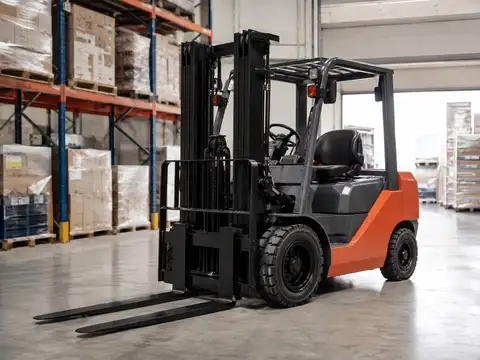
For a common 5,000-lb warehouse forklift, use these current planning bands:
New: roughly $25,000–$50,000 · Used: roughly $12,000–$22,000Current new listings around $32,000–$35,000 confirm the middle of that range for several 5,000-lb electric and LP trucks. Premium brands, lithium batteries, high masts, heavy capacities and specialized attachments can push the budget higher.
“How much does a forklift cost?” sounds like a single-equipment question, but the U.S. market contains machines ranging from a $3,000 powered pallet jack to specialized heavy-duty trucks costing hundreds of thousands of dollars. The first job is therefore to define what the warehouse means by “forklift.”
OSHA divides powered industrial trucks into seven broad classes. Warehouse buyers most often encounter Class I electric rider trucks, Class II electric narrow-aisle trucks, Class III powered pallet trucks, and Class IV/V internal combustion forklifts with cushion or pneumatic tires.
2026 U.S. market map
“Forklift cost” spans several completely different equipment classes
Current Toyota online-shop examples.
2026 dealer planning range.
Useful planning zone for common 5,000-lb trucks.
Capacity, mast, application and attachments drive the jump.
Electric quotes can exclude the battery or charger. Attachments, mast, freight and commissioning can change the acquisition budget materially.
Current 5,000-lb new-forklift pricing
The 5,000-lb counterbalance truck is a useful benchmark because it is one of the most common general-purpose warehouse capacities. Current public listings show that real new-truck prices sit in the low-to-mid $30,000s for several mainstream configurations.
Eliftruck currently lists a new 2026 Heli 5,000-lb lithium electric forklift at $35,000. ForkliftTrader currently shows new 5,000-lb electric and LP examples in roughly the $32,000–$33,000 range. Another current UniCarriers 5,000-lb LP listing is approximately $32,500.
These are individual market listings rather than a national average. Brand, local dealer support, battery chemistry, mast configuration, sideshift, tires and warranty can materially change the quote.
| Current example | Capacity | Power | Public price |
|---|---|---|---|
| 2026 Heli CPD25 | 5,000 lb | Lithium electric | About $35,000 |
| 2025 Zoomlion FB25 listing | 5,000 lb | Electric | About $32,188 |
| Current Tailift PFG25 listing | 5,000 lb | LP | About $32,900 |
| Current UniCarriers PF50N6-LE listing | 5,000 lb | Gas / propane | About $32,500 |
Taken together with dealer guides that place new warehouse forklifts broadly from $20,000 into six figures, these listings support using roughly $25,000–$50,000 as a practical starting band for a common new 5,000-lb truck—not as a promise that every major-brand quote will land there.
Used forklift cost in 2026
Eliftruck's current 2026 used-forklift pricing guide places a standard 5,000-lb warehouse forklift at approximately $12,000–$22,000, depending on age, condition and whether the unit is sold as-is or dealer-certified.
Live market listings broadly support that planning zone. ForkliftTrader currently shows several used Toyota 5,000-lb electric and LP forklifts around $15,000–$22,000, with price varying substantially by year, hours, mast and condition.
New vs used 5,000-lb truck
New truck: $34,000.
Dealer-ready used truck: $18,000.
Acquisition difference: $16,000.
That $16,000 is meaningful only after battery condition, hours, tires, upcoming service and expected downtime are considered. The used-forklift cost guide covers used-forklift economics separately.
Powered pallet jacks cost far less than sit-down forklifts
Toyota currently sells powered pallet jacks directly through its U.S. online store. The Tora-Max compact electric walkie pallet jack is listed around $3,405, while Toyota's 4,500-lb Electric Walkie Pallet Jack is currently about $6,405.
These Class III trucks are not substitutes for a counterbalanced forklift when loads need to be stacked high into pallet rack. They are inexpensive because they solve a narrower material-movement problem.
This is why a warehouse should define the task before buying a “forklift.” A $35,000 sit-down truck used only to move pallets horizontally may be over-equipment.
Heavy-duty forklifts are a different capital class
Toyota's current heavy-duty product guidance shows how dramatically capacity changes the market. It says models in the 15,000–20,000-lb range typically start around $350,000–$390,000.
Toyota places 30,000–50,000-lb heavy-duty trucks around $400,000–$650,000, while its largest 70,000–125,000-lb models can exceed $800,000–$1.2 million.
These machines belong in ports, heavy manufacturing, steel, lumber and other specialized applications. They should not influence the budget for a 5,000-lb distribution-center truck, but they explain why generic online forklift-price ranges often become absurdly broad.
Electric forklift price: confirm what is included
Electric forklifts are particularly easy to miscompare because one quotation may include the battery and charger while another lists only the truck.
Toyota's current pricing guidance warns buyers to consider battery and charger costs when evaluating electric equipment. Raymond similarly notes that electric trucks can have a higher initial purchase cost than propane but may reduce fuel, maintenance and repair expense over the ownership period.
Ask whether the truck price includes the traction battery, charger, battery watering equipment where applicable, charging connector, installation and any electrical work. A lower “forklift price” may simply exclude the equipment required to operate it.
Lead-acid vs lithium changes the acquisition budget
A traditional lead-acid electric truck may need a separate industrial battery, charger and battery-maintenance process. Multi-shift operations can require battery changing or additional battery capacity.
Lithium-ion changes the economics because the battery is commonly integrated more closely into the truck and can support opportunity charging, but the purchase price can be higher.
The correct comparison is therefore not “electric truck A costs $3,000 more.” Compare a complete energy package capable of supporting the required shift pattern.
Propane can have a lower initial equipment bill
Propane counterbalance trucks do not require a large traction battery and industrial charger, which can make the initial equipment package simpler.
Raymond currently states that electric forklifts can cost more upfront than propane trucks but may have lower ownership costs because of savings in fuel, maintenance and repairs.
That distinction is important: this article focuses on acquisition. A cheaper propane purchase is not proof of lower five-year cost.
Mast height can change price and usable capacity
A forklift is sold with a specific mast configuration. Two otherwise similar 5,000-lb trucks can have materially different prices if one uses a basic two-stage mast and another needs a high-lift three- or four-stage mast.
The mast also changes practical warehouse value. A truck that cannot reach the top pallet level forces the facility to leave rack capacity unused.
Compare the required maximum fork height, lowered mast height and free-lift requirement against doorways, trailers, sprinklers and rack levels before treating mast price as an optional upgrade.
Capacity should be selected from the real load center
Buying by the nominal 5,000-lb badge alone can be misleading when loads are unusually long, attachments move the load center forward or high lifts reduce available capacity.
OSHA requires operators to understand vehicle capacity and attachment adaptation as part of powered-industrial-truck training. From a procurement standpoint, the lesson is to specify the actual load, dimensions, lift height and attachment before comparing truck prices.
A lower-capacity truck that needs to be replaced after commissioning is the most expensive quote in the bid set.
Attachments can materially change the purchase
Common forklift attachments and options include:
- sideshifters;
- fork positioners;
- paper-roll clamps;
- carton clamps;
- rotators;
- push-pull attachments;
- special forks;
- integrated scales;
- cameras and pedestrian-warning systems.
Attachments add equipment cost and can also affect the truck's residual capacity. They should be included in the original application review instead of added after the truck is selected.
Tires are an application decision, not cosmetic trim
Cushion-tire forklifts are common indoors on smooth floors and can help achieve tighter turning envelopes. Pneumatic or solid-pneumatic tires are better suited to mixed indoor/outdoor and uneven operating environments.
The choice affects acquisition cost, aisle planning and usable application. A cheap cushion truck cannot economically replace a pneumatic truck if it spends part of every shift crossing rough outdoor pavement.
The cheapest truck can create a more expensive rack layout
Counterbalance forklifts generally require wider aisles than reach trucks or dedicated narrow-aisle equipment. A warehouse choosing trucks and rack independently can therefore save $10,000 on equipment while giving up hundreds of pallet positions.
$10,000 of forklift savings vs 150 lost pallet positions
If the cheaper truck forces aisles wide enough to remove 150 pallet locations, the warehouse should value those lost positions before approving the equipment saving. Forklift CAPEX and storage-density economics are linked.
Reach trucks and order pickers follow different pricing curves
A Class II reach truck is optimized for narrow warehouse aisles and higher pallet placement. An order picker lifts the operator to case- or item-pick locations. They may share electric power with a counterbalanced forklift, but they solve different tasks and should not be priced as equivalent machines.
Current ForkliftTrader listings show new reach trucks and order pickers in the mid-$30,000 range for some brands, but premium equipment, lift height and options can move significantly higher.
Dedicated cost guides cover these equipment categories separately rather than turning this pillar page into an unreliable master price sheet.
Quote normalizer
Forklift Acquisition Cost Builder
Enter the actual figures from a dealer quote. This calculator does not estimate operating cost; it shows the complete acquisition budget so two quotes can be compared on the same basis.
- Equipment subtotal
- $33,500
- Freight & setup
- $1,700
- Calculated tax
- $0
Use the same input categories for every quote. Confirm whether battery, charger and attachments are already included before entering them separately.
Why the calculator uses your quote instead of market defaults
The calculator above is deliberately a quote normalizer. It does not claim that every electric forklift needs a $9,000 battery or that every propane truck costs $30,000.
Enter the actual dealer values. If battery and charger are included in the truck price, leave those fields at zero. If one vendor charges freight and another quotes delivered pricing, the result exposes that difference.
This is a more defensible tool than generating a precise purchase recommendation from capacity alone.
Freight and delivery are easy to overlook
A forklift is several thousand pounds of industrial equipment. Moving it between states or from a distant dealer can add meaningful freight.
Used trucks are particularly sensitive because the lowest advertised price may be hundreds or thousands of miles from the warehouse. A local truck at a higher sticker price can be cheaper delivered and easier to service.
Ask whether the quoted price is FOB dealer, delivered to dock, delivered and commissioned, or something between those points.
Dealer support has financial value
Two trucks with similar specifications can carry very different ownership risk if one local dealer has technicians and parts nearby while the other requires long waits for service.
Downtime value rises with utilization. A backup truck in a 20-unit fleet can absorb one failure; a small warehouse with exactly one forklift can have part of the operation stop when that truck is down.
Procurement should therefore record service response time, parts availability, warranty coverage and loaner/rental support alongside purchase price.
Operator training belongs in the commissioning budget
OSHA 29 CFR 1910.178 requires powered-industrial-truck operators to be trained and evaluated by their employers. OSHA's current training guidance says only trained and competent operators may operate powered industrial trucks.
A new truck can require equipment-specific familiarization even when operators already have forklift experience, particularly when controls, attachments or operating characteristics differ.
Training cost is small compared with truck CAPEX, but it should not be omitted from go-live planning.
New forklift vs used forklift
| Decision factor | New | Used |
|---|---|---|
| Acquisition price | Higher | Lower |
| Warranty | Strongest | Varies |
| Configuration choice | High | Inventory-dependent |
| Immediate availability | Can involve lead time | Can be strong if local stock exists |
| Unknown wear | Minimal | Must be assessed |
| Best fit | High-utilization / exact spec | Lower-use / budget-sensitive applications |
When buying new is easier to justify
New equipment deserves stronger consideration when:
- the forklift runs multiple shifts;
- downtime is expensive;
- the application needs an exact mast and attachment configuration;
- electric battery strategy is being designed around the fleet;
- the warehouse expects to keep the truck for many years;
- standardization across multiple trucks has maintenance value.
When used can be financially stronger
Used equipment can make more sense when:
- annual operating hours are low;
- the truck is backup capacity;
- the application is simple and common;
- a recent dealer-certified unit is available locally;
- capital needs to be preserved for other warehouse improvements;
- the buyer can assess service history and battery condition properly.
Do not buy solely from engine hours
Hours are useful but incomplete. An electric truck with moderate hours and a failing battery can require a large immediate energy-system investment. A propane truck with similar hours can have very different engine, transmission and brake wear depending on environment and maintenance.
Evaluate service records, duty cycle, tires, mast, chains, leaks, brakes, steering, forks and battery condition where applicable.
Forklift purchase price is not total cost of ownership
Acquisition is only the first cost layer. Over several years the warehouse also pays for:
- electricity or fuel;
- planned maintenance;
- unscheduled repairs;
- tires;
- battery replacement;
- charger maintenance;
- operator labor;
- downtime and rental replacement;
- insurance / internal risk costs;
- eventual disposal less residual value.
The acquisition calculator on this page estimates purchase costs. For a multi-year budget, use the forklift operating cost per hour guide to estimate recurring costs, then add them to acquisition and disposal costs and subtract the expected residual value.
Three quotes are not comparable until they use the same specification
Before requesting prices, define:
- maximum load weight;
- load dimensions and load center;
- required lift height;
- lowest overhead clearance;
- indoor / outdoor duty;
- floor condition;
- minimum aisle width;
- hours per shift and shifts per day;
- required attachments;
- energy preference;
- desired battery / charging strategy;
- operator environment and ergonomics;
- service-response expectations.
Dealers can then quote the same application instead of proposing three fundamentally different trucks at three fundamentally different prices.
A practical forklift budget ladder
| Warehouse requirement | Equipment to investigate first | Current acquisition context |
|---|---|---|
| Horizontal pallet movement | Powered pallet jack | About $3,400–$6,400 in current Toyota examples |
| Occasional 5,000-lb stacking | Used counterbalance | Roughly $12,000–$22,000 planning range |
| General-purpose full-time warehouse duty | New 5,000-lb counterbalance | Roughly $25,000–$50,000 planning zone |
| Narrow aisles / tall rack | Reach truck | Quote by lift height and configuration |
| Case picking at elevation | Order picker | Quote by platform / lift specification |
| Very heavy industrial loads | Heavy-duty forklift | Can run hundreds of thousands of dollars |
The practical recommendation
For a normal U.S. warehouse budgeting a 5,000-lb forklift in 2026, start with $25,000–$50,000 for new and $12,000–$22,000 for used.
Then stop using the generic range. Define the lift height, aisle, load, duty cycle and energy package and obtain application-specific quotes.
Most expensive forklift mistakes are not caused by paying $2,000 too much. They are caused by purchasing a truck that is wrong for the rack, cannot support peak duty, requires an unexpected battery investment or creates avoidable aisle width.
Frequently asked questions
How much does a new forklift cost in 2026?
A standard 5,000-lb warehouse forklift is reasonably budgeted around $25,000–$50,000 new. Current public listings for several 5,000-lb electric and LP trucks sit around $32,000–$35,000.
How much does a used forklift cost?
Eliftruck's current 2026 guide puts a standard 5,000-lb used warehouse forklift around $12,000–$22,000, with current market listings broadly supporting that range.
How much is an electric pallet jack?
Toyota currently lists a compact electric walkie pallet jack at $3,405 and its 4,500-lb Electric Walkie Pallet Jack at $6,405.
Are electric forklifts more expensive than propane?
They can have higher initial acquisition cost because the energy package includes a traction battery and charging equipment. Raymond states that electric forklifts can cost more upfront but may reduce fuel, maintenance and repair costs over ownership.
Does a new electric forklift include the battery?
Not always. Quote structure varies. Confirm explicitly whether battery and charger are included before comparing electric-forklift prices.
What is the most important forklift cost factor?
Application fit. Capacity, lift height, power source, tire type and attachments determine both purchase price and whether the truck can perform the required work.
How much can a heavy-duty forklift cost?
Toyota currently says 15,000–20,000-lb heavy-duty models typically start around $350,000–$390,000, with its largest ultra-high-capacity trucks potentially exceeding $1 million.
Do forklift operators need certification?
OSHA requires employers to train and evaluate powered-industrial-truck operators under 29 CFR 1910.178. Only trained and competent operators should be permitted to operate these trucks.
Powertrain changes both acquisition and operating context. If outdoor duty, emissions, runtime or refueling are major constraints, compare the dedicated electric vs diesel forklift guide.
A base-truck budget can materially understate the installed fleet cost when the application needs specialized handling. Use the forklift attachment cost guide to scope sideshifters, clamps, positioners and other attachment requirements separately.
Sources and methodology
Warehouse Fieldbook reviewed current August 2026 live equipment listings, current dealer pricing guides, manufacturer pages and OSHA powered-industrial-truck guidance. Price bands are deliberately framed as planning ranges rather than national averages. Individual listings validate current market order of magnitude but are not treated as statistically representative transactions.
- Eliftruck — 2026 used forklift price guide
- Eliftruck — current new 5,000-lb lithium-electric Heli listing
- ForkliftTrader — current new-forklift listings
- ForkliftTrader — current used Toyota forklift listings
- Toyota Material Handling — current Tora-Max electric pallet-jack price
- Toyota Material Handling — current 4,500-lb electric walkie pallet-jack price
- Toyota Material Handling — forklift pricing factors and broad market context
- Toyota Material Handling — current heavy-duty forklift pricing context
- Raymond — electric vs internal-combustion ownership-cost context
- OSHA — powered industrial truck classes
- OSHA — 29 CFR 1910.178 Powered Industrial Trucks
- OSHA — powered-industrial-truck operator training requirements