
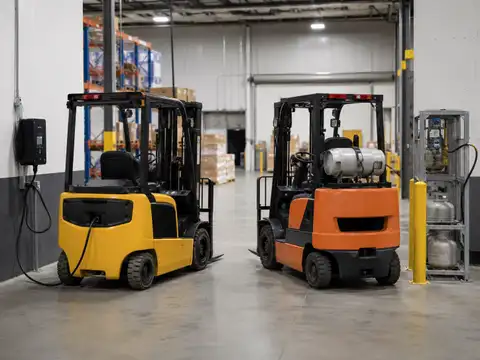
Electric generally deserves the advantage in a high-use indoor warehouse where charging can be integrated into the operation.
Propane is harder to beat when rapid refueling and operating flexibility matter more than lowest lifetime cost.The purchase-price gap is real, but so are years of fuel and internal-combustion maintenance. Compare both power sources over the same operating-hour horizon.
Electric versus propane is not primarily a question of which forklift is “better.” Both can move the same ordinary warehouse pallet. The decision is about where the warehouse wants to place cost and operational complexity.
Propane stores energy in inexpensive replaceable cylinders and puts an engine on the truck. Electric moves more of the energy investment forward into the battery, charger and facility electrical system while removing much of the internal-combustion maintenance from every future operating hour.
Ownership trade-off
Electric pays more up front. Propane pays more while it works.
Battery, charger and electrical infrastructure can increase day-one CAPEX.
- Lower routine maintenance
- Lower onsite emissions
- Quiet indoor operation
- Charging strategy matters
Simple cylinder refueling avoids traction-battery and charger CAPEX.
- Fast refueling
- Strong multi-shift flexibility
- Indoor/outdoor versatility
- Fuel + IC maintenance repeat
At low utilization, the electric premium has fewer hours over which to pay back. At high utilization, recurring fuel and maintenance differences become more important.
The cleanest public acquisition comparison is still a 2025 dealer guide
Conger Industries published a detailed apples-to-apples comparison in November 2025 for a 5,000-lb cushion-tire truck:
| Configuration | Published acquisition range |
|---|---|
| 5,000-lb propane cushion forklift | $24,000–$30,000 |
| Equivalent electric forklift | $35,000–$40,500 |
| Battery included in electric range | $7,000–$9,000 component reference |
| Charger included in electric range | $3,000–$5,000 component reference |
Those are dealer-published planning ranges, not 2026 national averages. Warehouse Fieldbook retains the original date because it is more credible to use a transparent slightly older comparison than to invent a fresh-looking market number without a comparable dataset.
Current 2026 Toyota guidance still confirms the underlying direction: electric forklifts may have higher upfront cost but typically provide lower lifetime operating expense through lower fuel and maintenance costs.
Midpoint-to-midpoint comparison
Propane midpoint: $27,000.
Electric midpoint: $37,750.
Illustrative acquisition premium: $10,750.
That premium is the amount future energy, maintenance and operating benefits have to recover before electric becomes cheaper on a simple cash-cost basis.
Do not compare an electric chassis with a complete propane truck
One of the easiest ways to make an electric quote appear cheaper is to omit the battery or charger. The opposite mistake is to count a battery twice when it is already bundled in the dealer's truck price.
Normalize every electric proposal into:
- truck;
- traction battery;
- charger;
- battery connector / cables;
- watering equipment for lead-acid where relevant;
- battery-change equipment where relevant;
- electrical installation;
- charging-area modifications;
- freight and commissioning.
Then compare that complete working package with the delivered propane truck and its cylinder/fuel arrangement.
The electrical system can be the hidden conversion cost
Conger's comparison notes that an electric conversion can require an electrician, charger installation and potentially a higher-voltage electrical line if the existing facility cannot support the charging equipment.
Toyota likewise tells facilities considering an IC-to-electric conversion to confirm that building space, electrical power and layout can support the fleet.
For one forklift, that may be a small infrastructure project. For 30 trucks, electrical capacity can become a facility-level capital decision.
Ask an electrical contractor or qualified facility engineer to verify service capacity, panels, charger circuits and charging locations. A forklift dealer's equipment quote is not automatically the full electrification budget.
Propane moves more of the cost into recurring fuel
A propane forklift avoids the large traction battery and charger purchase. Instead, the operation continuously consumes LP fuel.
The correct annual fuel calculation is straightforward:
Use your own delivered fuel cost
Annual LP cost = tanks consumed per year × delivered cost per tank
Or measure gallons per operating hour and multiply by the warehouse's actual propane price and annual truck hours.
Toyota recommends using hour-meter readings around cylinder changes to establish the fleet's own fuel cost per operating hour rather than relying on a generic internet consumption figure.
Electric energy cost should also come from the facility's bill
Electricity pricing varies by utility, tariff, demand charges and time of use. Battery and charger efficiency also affect the energy pulled from the grid.
The warehouse should use:
Measure charger input where possible
Annual electric energy cost = annual charging kWh × effective facility $/kWh
Include incremental demand charges or charging-management costs if they are material under the facility's tariff.
This is much more useful than applying a national electricity average to a warehouse that may have a completely different commercial tariff.
Maintenance is where electric repeatedly earns back CAPEX
Toyota's March 2026 electric-forklift guidance states that electric trucks require less routine maintenance than internal-combustion models. Their core tasks center on battery care, brakes and electrical systems rather than engine oil, filters, ignition, cooling and fuel-system maintenance.
Raymond's current IC-to-electric calculator uses the following internal assumptions:
| Raymond calculator assumption | LP / IC | Electric |
|---|---|---|
| Estimated service hours/year | 60 | 30 |
| Estimated truck parts replacement/year | $2,200 | $1,100 |
| Modeled truck life | 7 years | 11 years |
These are manufacturer calculator assumptions—not universal industry benchmarks. Raymond explicitly says its tool is for general guidance and does not assure a particular outcome.
A maintenance-only break-even shows why utilization matters
Conger's November 2025 comparison cites approximately $1.25 per operating hour of maintenance for electric and $2.00 per hour for propane in its example. That is a $0.75/hour difference.
2,000 hours per year
2,000 h × $0.75/h =$1,500/year of modeled maintenance difference.
Against the illustrative $10,750 acquisition premium above, maintenance savings alone would need more than seven years to recover the premium. Energy savings are therefore a major part of any faster electric payback.
Conger says many operations can recover the electric premium within about two years when all operating costs are considered. Treat that as a dealer claim, not a universal payback promise. The warehouse should model its own energy and hours.
Low-hour operations weaken the electric payback case
Suppose a forklift runs only 400 hours per year. Every operating-cost advantage is multiplied by 400 instead of 2,000.
A backup truck or small-business forklift may therefore need many years to recover a large battery/charger premium. A used propane forklift can be economically rational even if its cost per operating hour is higher.
This is one of the most important reasons not to make “electric always cheaper” the conclusion of the article.
High-hour indoor duty strengthens electric economics
The opposite happens in a distribution center running one or two heavy shifts. Fuel and maintenance savings repeat thousands of times every year.
If the truck runs 2,500 hours annually, a relatively small per-hour difference can outweigh a five-figure purchase premium over the ownership period.
High utilization is where total-cost analysis matters most.
Lead-acid runtime makes shift design important
Toyota's March 2026 FAQ says a fully charged electric forklift battery can typically support approximately 6–8 hours of moderate operation, depending on battery type, size and duty.
Toyota also says a traditional lead-acid battery typically takes around 8 hours to fully charge.
A one-shift warehouse can often charge during the off shift. A 24-hour operation cannot assume one battery will work continuously without additional planning.
Propane wins the simplest refueling comparison
Toyota's energy-source guidance notes that changing a propane cylinder is faster and requires less facility space than swapping and charging traditional batteries.
The operational advantage is straightforward: an empty cylinder can be replaced with a full one in minutes and the truck can return to work.
This is especially valuable in an operation where the truck cannot pause long enough to charge and where building electrical capacity is limited.
Lithium-ion changes the multi-shift equation
Toyota's current March 2026 guidance says lithium-ion forklift batteries can charge in as little as 1–2 hours with the appropriate charger and can support opportunity charging.
Toyota specifically says lithium-ion can make electric forklifts suitable for multi-shift operations without traditional battery swaps between shifts.
That does not make lithium the automatic winner. Lithium battery and charger CAPEX can be higher, and the charging schedule still needs to match breaks, shifts and available electrical capacity.
A modern electric proposal can use lead-acid, fast charge, opportunity charge or lithium-ion. The battery strategy can change the answer as much as the forklift chassis.
Propane still has an advantage where the truck moves indoors and outdoors
Toyota's July 2026 truck-class guidance places IC pneumatic equipment primarily in outdoor and uneven-surface applications and highlights immediate refueling as an IC advantage.
Electric riders can operate outside when their design and environmental rating permit it, but Toyota's March 2026 FAQ says they are best suited to indoor or covered environments and smooth, dry outdoor surfaces rather than rough terrain or extreme weather.
For a warehouse truck that spends every shift crossing a rough yard, propane pneumatic equipment may be the stronger application even if the energy economics favor electric indoors.
Indoor air quality favors electric at the point of use
Electric forklifts have no tailpipe combustion emissions during operation. That makes them particularly attractive in enclosed warehouses, food operations and cold storage.
Propane forklifts can be used indoors in appropriate applications, but combustion introduces exhaust and ventilation considerations that electric trucks avoid at the point of use.
The environmental comparison should still distinguish onsite emissions from total electricity-generation emissions. This article is about warehouse ownership economics and operations rather than a full lifecycle carbon assessment.
Ventilation has a cost even when it is not on the forklift invoice
Raymond's current conversion calculator includes a modeled ventilation-cost assumption of $0.08 per truck-hour for IC and $0.01 per truck-hour for electric.
Again, these are Raymond calculator assumptions rather than universal HVAC costs. They illustrate a broader point: power-source economics can affect the building, not just the truck.
A facility with significant exhaust-related ventilation should include that operating cost when modeling an LP-to-electric conversion.
Battery rooms can consume expensive warehouse space
Traditional multi-shift lead-acid fleets can require battery storage, change-out equipment, chargers and designated charging areas.
Toyota notes that batteries are larger and heavier than propane cylinders and that battery storage can be more cumbersome in a conventional swap-based operation.
That floor area has an occupancy cost. A high-rent warehouse should value the space consumed by energy infrastructure just as it values rack aisles and staging.
Propane cylinder storage uses space too
Propane avoids the battery room but requires safe cylinder handling and storage. The actual storage arrangement depends on cylinder inventory, delivery frequency and facility rules.
OSHA 29 CFR 1910.178 requires LP-gas storage and handling to follow the referenced liquefied-petroleum-gas requirements. The same standard also requires battery charging installations to be located in areas designated for that purpose.
Neither energy source is infrastructure-free.
OSHA does not say “electric is safe, propane is unsafe”
OSHA 1910.178 recognizes multiple powered-industrial-truck designations, including electric E/ES/EE/EX and LP/LPS trucks, and matches truck types to the hazards of the operating location.
The facility needs the approved truck type appropriate for the environment. Hazardous atmospheres, fuel handling and battery charging can all impose additional requirements.
Energy selection should therefore be coordinated with the actual operating location rather than reduced to an emissions slogan.
Noise and vibration can affect productivity
Raymond and Conger both highlight quieter operation and reduced vibration as electric-forklift advantages.
Those characteristics may have limited direct dollar value in a low-use dock truck, but they can matter in high-hour operations where operators spend most of the shift on the equipment.
Operator comfort is difficult to price precisely, so it should be evaluated during a trial rather than assigned an arbitrary ROI number.
Cold storage often favors electric—but the battery needs to be designed for it
Electric trucks are common in cold storage because there is no internal-combustion exhaust at the point of use and fewer engine-related components.
Battery performance and charging strategy can change at low temperature, however. A freezer fleet needs equipment and batteries specified for the actual temperature and duty cycle.
The future forklift-battery guides will treat cold-temperature battery economics separately rather than forcing a generic assumption into this comparison.
Propane can be the simpler resilience strategy
Propane fuel can be stored onsite and trucks do not depend on the building's charging system for each operating cycle.
That can be valuable where electrical capacity is constrained or outages are operationally significant.
Electric fleets can mitigate the same risk with charger redundancy, managed charging, backup power and sufficient battery state-of-charge, but those controls belong in the infrastructure plan.
Do not ignore the residual value of the battery
An electric forklift chassis can have useful life beyond one traction battery. Raymond's current conversion calculator, for example, models battery life at three years and electric truck life at eleven years within its assumptions.
That means a long ownership model needs at least one future battery-replacement event in some lead-acid applications.
Omitting battery replacement makes electric TCO look artificially strong. Assuming every electric truck needs a new battery every three years makes it artificially weak. Use the battery chemistry, duty and actual supplier warranty.
Propane powertrain repairs tend to arrive later in life
Internal-combustion forklifts contain engines, cooling systems, fuel components and transmissions that electric trucks either eliminate or simplify.
As the fleet ages, those systems can create larger unscheduled repairs.
Ownership economics should therefore track not only annual planned maintenance but also downtime and major repairs by age band.
A five-year comparison should have nine cost buckets
| Cost bucket | Electric | Propane |
|---|---|---|
| Truck acquisition | Usually higher | Usually lower |
| Battery | Material cost | Not applicable as traction energy |
| Charger / infrastructure | Material | Minimal electrical charging infrastructure |
| Energy / fuel | Electricity | LP cylinders |
| Routine maintenance | Generally lower | Generally higher |
| Major repairs | Battery / electronics / drive components | Engine / transmission / fuel / cooling + common truck systems |
| Energy-handling labor | Charging / watering / battery change depending chemistry | Cylinder changes |
| Building cost | Charging area / electrical capacity | Cylinder storage / ventilation context |
| Residual value | Truck + remaining battery value | Truck value |
The most important spreadsheet input is annual truck hours
Most recurring ownership costs are functions of operating time. That makes annual hours the bridge between equipment selection and economics.
Track actual hour-meter data by truck for at least several months before converting a fleet. If possible, separate:
- productive loaded hours;
- idle time;
- charging / refueling downtime;
- maintenance downtime;
- seasonal peaks.
A fleet average can hide a truck that runs 3,000 hours and another that runs 300. Those two units may deserve different power-source decisions.
A mixed fleet can be more rational than an all-or-nothing conversion
A warehouse does not have to declare itself “electric” or “propane.”
High-hour indoor trucks can move to electric where operating savings repeat frequently. Low-hour outdoor or emergency trucks can remain propane where charging infrastructure provides little payback.
10-truck fleet, three different jobs
Six indoor production trucks run 2,200 h/year.
Two dock/yard trucks move between indoor and outdoor areas.
Two backup trucks run 300 h/year.
Converting the six high-use indoor trucks first can capture most of the economic opportunity without paying to electrify every low-use application.
When electric usually deserves the first quote
Electric is a strong baseline when:
- the truck operates mainly indoors;
- annual hours are high;
- the facility can install charging infrastructure economically;
- noise and onsite emissions matter;
- maintenance downtime is expensive;
- cold storage or food handling favors zero tailpipe emissions;
- shift breaks create opportunity-charging windows;
- the company expects to retain the truck long enough to recover higher CAPEX.
When propane usually deserves the first quote
Propane remains strong when:
- the truck moves frequently between indoor and outdoor work;
- rapid refueling is essential;
- electrical capacity is constrained;
- annual hours are low enough that electric payback is weak;
- the fleet must operate through long continuous periods;
- heavy-duty or rugged applications favor IC equipment;
- the company wants a lower initial equipment investment.
What to ask both dealers for
Give electric and propane bidders the same application:
- actual load and load center;
- maximum lift height;
- aisle width;
- indoor / outdoor percentage;
- hours per truck per year;
- shifts per day;
- break schedule;
- peak seasonal hours;
- attachments;
- ambient temperature;
- expected ownership years;
- required service response.
For electric, also ask for battery chemistry, charger size, required electrical service and infrastructure scope. For propane, ask for expected fuel use and cylinder supply assumptions.
Do not accept a vendor ROI without seeing its assumptions
Raymond does this correctly on its current conversion calculator: it exposes several assumptions and explicitly warns that the tool is guidance rather than assurance of an outcome.
Every electric-vs-propane proposal should expose at least:
- annual hours;
- propane cost;
- electricity cost;
- fuel / energy consumption;
- maintenance labor rate;
- annual parts cost;
- battery replacement timing;
- charger life;
- truck life;
- residual value;
- discount rate if present value is used.
If the vendor will not show the assumptions, the payback period is not auditable.
Why the comparison depends on facility-specific inputs
A useful electric-versus-propane model needs facility-specific energy prices, annual hours, maintenance, battery replacement and infrastructure. A shallow estimator on this comparison page would create false precision.
Keeping those assumptions explicit also makes the comparison easier to audit across ownership scenarios without duplicating inconsistent formulas.
The practical recommendation
For a normal high-use indoor warehouse, electric should be the first power source to model because current manufacturer guidance consistently points toward lower maintenance and lifetime operating cost.
Propane remains a rational and sometimes superior solution where trucks work across indoor/outdoor environments, refueling speed matters, charging infrastructure is expensive or annual utilization is too low to recover the electric premium.
The answer should come from one spreadsheet using the site's real propane invoice, real electricity tariff, real annual truck hours and actual dealer quotes. If those inputs are wrong, a sophisticated TCO model is still wrong.
Frequently asked questions
Are electric forklifts more expensive than propane forklifts?
Usually at purchase. Conger's November 2025 comparison places a 5,000-lb propane cushion truck around $24,000–$30,000 and an equivalent electric truck around $35,000–$40,500 including battery and charger.
Are electric forklifts cheaper to operate?
Manufacturer and dealer guidance generally says yes because electric trucks avoid fuel combustion and require less routine maintenance. The amount of savings depends on electricity, propane, hours, battery strategy and maintenance conditions.
How long does an electric forklift battery run?
Toyota's March 2026 guidance says a fully charged battery typically supports about 6–8 hours of moderate operation, depending on battery type, size and duty.
How long does a forklift battery take to charge?
Toyota currently says conventional lead-acid batteries typically require about 8 hours for a full charge, while lithium-ion can charge in as little as 1–2 hours with the correct charger.
Is propane better for multi-shift forklifts?
Propane remains simple because cylinders can be swapped rapidly. Modern lithium-ion electric fleets can also support multi-shift operation through fast and opportunity charging, so the answer depends on break schedules and charging infrastructure.
Can electric forklifts work outdoors?
Some can. Toyota's 2026 guidance says electric rider forklifts are best suited to indoor or covered conditions, although suitable models can work outside on smooth dry surfaces. Confirm the exact truck's environmental rating.
Can propane forklifts be used indoors?
Appropriate approved LP forklifts can be used in many indoor warehouse applications. Combustion exhaust, ventilation, fuel handling and the classification of the operating location still need to be considered.
Does OSHA require a special battery charging area?
OSHA 29 CFR 1910.178 states that battery-charging installations must be located in areas designated for that purpose and includes additional battery-changing and charging requirements.
Which has lower maintenance, electric or propane?
Electric. Toyota's March and July 2026 guidance says electric forklifts generally require less routine maintenance than internal-combustion forklifts because they eliminate many engine-related service items.
Propane is not the only combustion alternative to battery power. Operations with heavy outdoor duty should also compare electric and diesel forklifts before narrowing the fleet specification.
Choosing electric power still leaves an important chassis decision. Indoor operations with tight turning constraints should compare 3-wheel and 4-wheel electric forklifts before selecting the truck class.
Sources and methodology
Warehouse Fieldbook used the latest transparent comparable acquisition-cost example found from Conger and preserves its November 2025 date rather than presenting it as a 2026 national average. Current 2026 Toyota guidance supports runtime, charging and maintenance discussion. Raymond's current IC-to-electric calculator is used only where its assumptions are clearly labeled as provider modeling inputs rather than market benchmarks. OSHA is used for fuel-handling, battery-charging and powered-industrial-truck requirements.
- Conger Industries — November 2025 electric vs propane cost and maintenance comparison
- Toyota Material Handling — March 2026 electric forklift runtime, charging and maintenance
- Toyota Material Handling — July 2026 electric vs IC application guidance
- Toyota Material Handling — facility requirements for IC-to-electric conversion
- Toyota Material Handling — shift-cycle and propane-refueling considerations
- Toyota Material Handling — measuring actual forklift fuel cost per operating hour
- Raymond — current LP-to-electric cost calculator and disclosed modeling assumptions
- Raymond — electric forklift ownership and maintenance context
- OSHA — 29 CFR 1910.178 Powered Industrial Trucks