
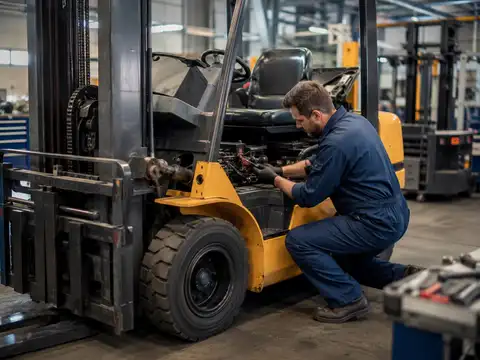
For maintenance only, a practical first-pass budget is:
Operating hours × roughly $1–$3.50/hourAt 1,000 hours that is about $1,000–$3,500/year. At 2,000 hours it is about $2,000–$7,000/year. Conger publishes this as a broad maintenance planning range and uses roughly $4/hour as a point where replacement economics deserve investigation. Treat those figures as a provider heuristic—not a universal industry rate.
Forklift maintenance budgeting works better when it starts with the hour meter instead of the calendar.
A truck running 2,200 hours every year reaches service milestones more than four times as quickly as a backup forklift adding only 500 hours. Giving both assets the same annual maintenance allowance hides the actual workload.
The most useful maintenance budget therefore combines three things: annual operating hours, truck/application type and the fleet's own repair history.
Maintenance-only planning
Hours turn a vague maintenance budget into a usable number
Derived from a $1–$3.50/h provider planning range.
Useful for lighter one-shift or secondary-duty equipment.
Budget begins to depend strongly on power source and environment.
High-use trucks reach hour-based service intervals much faster.
Use the range only as a first maintenance reserve. Replace it with the fleet's actual planned-service and repair history as soon as enough data exists.
What counts as forklift maintenance cost?
A maintenance budget should normally capture the cost of keeping the truck in safe working condition and restoring ordinary wear-related failures.
Depending on the company's accounting system, that can include:
- planned preventive-maintenance visits;
- technician labor;
- filters and fluids;
- lubricants;
- mast-chain service;
- brake service;
- hydraulic hoses and seals;
- electrical diagnostics;
- engine or motor service;
- ordinary wear parts;
- unplanned mechanical repairs;
- service-call travel or shop charges where applicable.
The key is consistency. If tires, batteries or forks are tracked in separate fleet accounts, keep them separate every year rather than moving them in and out of the maintenance KPI.
What should not be hidden inside maintenance?
Keep several cost categories separate where practical:
- propane, diesel or electricity;
- truck purchase / depreciation;
- lease payments;
- accident or abuse damage;
- rental replacement;
- operator labor;
- facility charging infrastructure;
- insurance;
- major capital upgrades.
Those costs matter to total ownership. Mixing them into maintenance makes it harder to tell whether the forklift itself is mechanically becoming expensive.
A truck repeatedly hitting rack can show terrible “maintenance” economics even when the machine is mechanically healthy. Track impact/abuse repairs separately so operations can see the behavioral or layout problem.
Annual maintenance budget by operating hours
Applying the current $1–$3.50/hour Conger planning range gives:
| Annual truck hours | Low planning case | High planning case |
|---|---|---|
| 250 h | $250 | $875 |
| 500 h | $500 | $1,750 |
| 1,000 h | $1,000 | $3,500 |
| 1,500 h | $1,500 | $5,250 |
| 2,000 h | $2,000 | $7,000 |
| 2,500 h | $2,500 | $8,750 |
These figures are arithmetic derived from one provider's broad benchmark. They are not national averages and are not suitable for pricing a service contract.
Their purpose is to answer a useful planning question: is the current annual budget even in the right order of magnitude?
A 10-truck fleet can justify a very different budget from a 10-truck headcount
Ten forklifts, 15,000 total annual hours
Fleet operating hours: 15,000.
Planning at $1/hour: $15,000/year.
Planning at $3.50/hour: $52,500/year.
The wide range tells the fleet manager what to investigate next: truck age, power source, application severity and actual historical spend.
Replace the external benchmark with your own fleet benchmark
Once the company has 12–24 months of usable maintenance data, calculate:
Fleet maintenance cost per hour
planned maintenance + ordinary mechanical repairs + service labor ÷ fleet operating hours
Then break it down by:
- electric vs IC;
- counterbalance vs reach/order picker;
- age band;
- hour band;
- facility;
- clean vs harsh application.
The company's own peer-group benchmark becomes far more useful than a national internet number.
Toyota's current 2026 maintenance framework: 250, 500 and 2,000 hours
Toyota's July 2026 maintenance-plan guide says standard recommended service intervals usually follow approximately:
| Service point | Current Toyota framework |
|---|---|
| 250 hours / about 6 weeks | Basic lubrication, fluid checks, air-filter cleaning and visual inspection |
| 500 hours / about 3 months | Oil/filter changes where applicable, hydraulic checks, mast-chain lubrication and brake inspection |
| 2,000 hours / about 12 months | Deeper system service, hydraulic-filter replacement and major component testing |
Toyota explicitly says exact intervals vary by model, fuel type and operating environment. The operator/service manual for the specific truck controls.
A 2,000-hour truck reaches the 250-hour point eight times per year
This is why calendar budgeting can fail in high-use fleets.
2,000 annual hours
2,000 ÷ 250 = 8 250-hour increments.
2,000 ÷ 500 = 4 500-hour increments.
2,000 ÷ 2,000 = 1 major annual milestone.
Actual service events may combine tasks and follow model-specific schedules; do not simply order 13 separate dealer visits from this arithmetic.
A 500-hour backup truck follows a different maintenance rhythm
A low-use forklift may only accumulate one-quarter as many meter hours, but calendar age still matters.
Batteries, hoses, tires, fluids and corrosion can deteriorate while the truck sits. Low-hour equipment therefore should not be maintained solely by dividing the meter by 250 indefinitely.
Follow any calendar-based requirements in the model-specific maintenance schedule.
Why service schedules differ between manufacturers
Raymond's current maintenance quick tips describe a typical manufacturer service schedule around every 90 days or 100 hours, while Toyota's 2026 guide uses the 250/500/2,000-hour framework above.
That apparent conflict is exactly why a generic web interval should never replace the manual.
Truck design, duty, power source and manufacturer service philosophy differ.
Internet maintenance intervals are planning context. The actual truck's operator/service manual and authorized service guidance determine the real schedule.
What a preventive-maintenance visit should inspect
Toyota's current 2026 maintenance guide says a technician PM checklist typically includes:
- mast;
- lift chains;
- forks;
- hydraulic cylinders;
- running system;
- braking system;
- controls;
- electrical panels;
- IC engine or electric motor components;
- vehicle body;
- overhead guard;
- horns, lights and alarms.
Toyota recommends requesting the provider's PM inspection form before the engagement.
That is useful procurement practice because it turns “preventive maintenance” from a vague service description into a defined scope.
Daily inspection is not preventive maintenance
OSHA 29 CFR 1910.178 requires powered industrial trucks to be examined before being placed in service at least daily. Round-the-clock operations must examine trucks after each shift.
OSHA also says a truck that is unsafe or needs repair must be removed from service until restored to safe condition.
The daily operator examination is an operational safety control. It does not replace scheduled technician maintenance.
The daily check protects the maintenance budget too
Operators can detect small problems before they become large ones:
- hydraulic leaks;
- damaged tires;
- fork damage;
- chain issues;
- low fluids;
- warning lights;
- horn/alarm failure;
- battery connector damage;
- unusual noise or vibration.
Raymond's maintenance guidance specifically emphasizes daily operator checklists, hydraulic hoses and tire wear as ways to identify conditions before breakdown.
Preventive maintenance is cheaper to schedule than emergency downtime
Planned service can be arranged around:
- shift changes;
- low-volume periods;
- weekends;
- scheduled shutdowns;
- available spare equipment.
Unplanned repair chooses its own timing.
That scheduling difference is part of the economic value of preventive maintenance even when the repair invoice itself would eventually have been similar.
Electric forklift maintenance usually costs less than IC maintenance
Conger's electric-vs-propane comparison uses approximately $1.25/hour for electric maintenance and $2.00/hour for propane maintenance.
Toyota's 2026 electric-forklift guidance likewise says electric trucks generally require less routine maintenance because they eliminate many internal-combustion service items.
Electric equipment still needs substantial forklift maintenance:
- mast and chains;
- hydraulics;
- brakes;
- tires / load wheels;
- forks;
- drive components;
- electrical controls;
- battery and charger attention.
At 2,000 hours, the provider example produces a $1,500 maintenance gap
Electric vs propane maintenance only
Electric: 2,000 × $1.25 = $2,500/year.
Propane: 2,000 × $2.00 = $4,000/year.
Difference: $1,500/year.
This is based on Conger's provider benchmark and excludes fuel/electricity, batteries, CAPEX and downtime.
Internal-combustion maintenance has more engine-related line items
Depending on truck type, IC maintenance can include:
- engine oil and filters;
- air filters;
- spark plugs / ignition components on relevant engines;
- cooling system;
- fuel system;
- belts;
- exhaust-related components;
- engine diagnostics;
- transmission service.
The exact list differs between LPG, gasoline and diesel trucks.
Electric shifts maintenance attention toward the battery system
Lead-acid battery fleets can require:
- watering;
- connector inspection;
- cable inspection;
- equalization according to battery instructions;
- charger inspection;
- cleaning;
- corrosion control;
- battery-change equipment maintenance where applicable.
Raymond's maintenance guidance recommends disciplined battery charging and notes that charging routine affects battery life.
Lithium removes some battery labor, not truck maintenance
Lithium-ion systems normally remove lead-acid watering and battery-change routines, but the truck still has:
- tires;
- mast;
- forks;
- hydraulics;
- brakes;
- electrical controls;
- battery-management diagnostics.
Do not model a lithium forklift at zero maintenance merely because the battery is lower-touch.
Tires can become one of the largest recurring wear costs
Raymond's current maintenance guidance tells fleets to watch for chunking, cracking and flat spots.
Tire life is strongly affected by:
- floor condition;
- debris;
- turning behavior;
- travel distance;
- load weight;
- heat;
- alignment;
- indoor vs outdoor duty.
Track installed tire cost and the meter hours at replacement. That converts an irregular invoice into a stable wear-cost metric.
Harsh environments push maintenance above clean-warehouse experience
Conger's useful-life guidance specifically notes that dirty and harsh environments require more frequent maintenance.
Higher-cost applications can include:
- lumber and sawdust;
- metal / scrap;
- foundries;
- construction materials;
- freezers;
- outdoor yards;
- dust-heavy manufacturing;
- wet or corrosive operations.
A warehouse should not judge a yard forklift against the maintenance cost of an indoor clean-floor truck.
Dust changes more than air-filter frequency
Dirt and debris can affect:
- radiators;
- filters;
- cooling performance;
- mast channels;
- wheels;
- connectors;
- moving joints;
- sensors.
Raymond specifically recommends keeping dirt and debris away from the truck, including radiator cleaning and filter replacement where needed.
Cold storage needs its own maintenance history
Freezer applications can add:
- condensation;
- temperature cycling;
- battery-performance changes;
- special fluids;
- corrosion;
- door / cab heater components;
- additional electrical stress.
Compare freezer trucks with freezer trucks. Fleet averages across ambient and subzero applications can hide useful cost signals.
Age changes maintenance cost even when annual hours stay constant
A new truck and an 8,000-hour truck may both run 1,500 hours this year, but the older truck is more likely to encounter aging hoses, bearings, electrical components and major assemblies.
Build age/hour bands:
- 0–2,500 hours;
- 2,500–5,000 hours;
- 5,000–7,500 hours;
- 7,500–10,000 hours;
- 10,000+ hours.
Then compare rolling maintenance cost/hour inside each equipment class.
Rolling 12-month maintenance cost is more useful than lifetime average
Lifetime average is pulled down by the truck's inexpensive early years.
A rolling 12-month number reveals whether cost is accelerating now.
Lifetime $2.10/hour, last 12 months $4.40/hour
The lifetime average looks ordinary. The current cost trend has more than doubled.
That truck deserves a repair/replacement review even though its lifetime KPI still appears healthy.
One major repair can distort a single year
A transmission, mast or battery event can produce an unusual spike.
Before replacing the truck, distinguish:
- a one-time component reset;
- several unrelated aging failures;
- repeated repair of the same system;
- impact damage;
- poor prior maintenance.
The forklift repair cost guide covers repair-versus-replace economics in detail.
$4/hour is a warning line, not an automatic retirement rule
Conger's current useful-life guidance says maintenance over roughly $4 per operating hour should trigger replacement consideration.
Whether replacement actually makes sense depends on:
- replacement truck price;
- remaining useful life;
- downtime;
- specialty application;
- residual value;
- availability of parts;
- capital constraints.
A $4/hour specialized VNA truck and a $4/hour low-value pallet truck do not have the same replacement economics.
Downtime should be tracked alongside maintenance spend
A fleet can have modest invoices and poor reliability.
Track:
- unscheduled downtime hours;
- service response time;
- waiting-for-parts time;
- repeat failures;
- rental replacement days;
- missed production where measurable.
Toyota's current maintenance-plan material emphasizes uptime as the main purpose of routine maintenance programs.
A fixed maintenance plan buys predictability, not necessarily the lowest expected invoice
Toyota currently offers customized maintenance plans through authorized dealers rather than one standardized public price.
A maintenance agreement can provide:
- scheduled visits;
- defined inspection scope;
- trained technicians;
- parts support;
- more predictable budgeting;
- service records;
- faster problem escalation.
The dedicated maintenance-contract article later in Warehouse Fieldbook will compare full-service and preventive-only agreements without overloading this cost guide.
Ask for the service scope before comparing contract prices
Two providers can both call a product “planned maintenance” while including different work.
Normalize:
- inspection points;
- labor;
- filters / fluids;
- travel charges;
- wear parts;
- after-hours labor;
- emergency callouts;
- battery service;
- tires;
- documentation;
- service response target.
A lower monthly contract can simply exclude the expensive work.
In-house maintenance is not free maintenance
If the company uses internal technicians, include:
- technician wages / loaded labor;
- training;
- diagnostic tools;
- shop space;
- parts inventory;
- fluids / waste handling;
- service software;
- supervision;
- outside specialist work.
Dealer service should be compared with the true internal cost, not only with the technician's hourly wage.
Mixed-brand fleets can increase maintenance complexity
A fleet with Toyota, Crown, Raymond, Hyster, Yale and several low-volume brands may require:
- more diagnostic systems;
- more parts inventory;
- more technician training;
- more supplier relationships;
- less interchangeability.
Standardization can therefore lower support complexity even when one non-standard truck is cheaper to purchase.
But do not standardize into the wrong application
Fleet commonality has value only after the truck fits the work.
A warehouse should not force one counterbalance platform into a narrow-aisle job or one reach-truck platform into rough outdoor duty simply to simplify parts.
Application fit comes first; maintenance standardization comes second.
Telematics can make maintenance scheduling more accurate
Toyota's current fleet-management material emphasizes using actual vehicle data to identify maintenance needs and underutilized assets.
Hour-based scheduling becomes stronger when fleet systems automatically capture:
- meter hours;
- motion hours;
- fault codes;
- impacts;
- battery data;
- utilization;
- service due dates.
Manual meter collection can work for five trucks. Fifty trucks benefit much more from automated data.
Utilization data prevents over-maintaining idle equipment and under-maintaining busy equipment
Calendar-only schedules can make a rarely used truck receive the same service attention as a heavily used truck.
Pure hour-only schedules can ignore calendar deterioration.
A good fleet program respects both the manufacturer's hour milestones and any calendar requirements in the service schedule.
Maintenance budget should be built by asset, then rolled to fleet level
For each truck, record:
- asset ID;
- truck class;
- power source;
- model year;
- current hours;
- forecast annual hours;
- planned service events;
- historical repair $/hour;
- known upcoming wear items;
- current battery / tire condition;
- downtime trend;
- service-plan status.
Sum those asset budgets only after each truck has been evaluated.
Known upcoming work should override the generic hourly reserve
1,500-hour truck with known $4,000 work
Generic planning range: $1,500–$5,250.
Known upcoming mast-chain / tire / service work: $4,000.
Do not budget $1,500 simply because it is the low end of the range. Known asset condition is stronger information than an external benchmark.
A maintenance reserve is not a spending target
Setting aside $5,000 does not mean the department should spend $5,000.
Maintenance management should aim to:
- perform required PM on time;
- repair safety defects immediately;
- prevent secondary damage;
- replace wear items at appropriate condition;
- avoid unnecessary parts replacement;
- plan retirement before reliability collapses.
The budget is a financial capacity plan, not a maintenance quota.
Deferred maintenance can make one year's budget look artificially good
A site can reduce current maintenance spend by postponing work.
That does not create a lower-cost fleet. It transfers cost and risk into future periods.
Monitor overdue PM count alongside maintenance dollars so a “good” financial year cannot be created simply by missing service.
Track preventive vs corrective spend separately
A useful maintenance dashboard can divide spend into:
- scheduled PM;
- wear replacement;
- unplanned mechanical repair;
- impact / abuse repair;
- battery / energy-system service;
- tires;
- major component rebuild.
Rising corrective spend while PM stays stable can reveal an aging fleet.
Do not compare maintenance dollars without hours
Truck A spends more dollars and is still cheaper
Truck A: $4,000 maintenance / 2,500 h =$1.60/h.
Truck B: $3,000 maintenance / 1,000 h =$3.00/h.
Truck A has the larger annual invoice and the lower maintenance intensity.
Annual hours also matter when evaluating a new maintenance contract
A $300/month plan costs $3,600/year.
At 2,000 truck hours, that equals $1.80/hour before excluded work. At 500 hours, it equals $7.20/hour.
The figures are illustrative. The lesson is that fixed monthly service cost must be evaluated against expected utilization and scope.
High-use trucks deserve priority in PM scheduling
When service resources are limited, high-hour mission-critical trucks create more exposure because:
- they reach service intervals quickly;
- failure removes more productive hours;
- wear accumulates faster;
- downtime can disrupt peak operations.
Fleet-management systems or a basic meter-hour report can help prioritize upcoming PM.
Backup trucks need condition discipline too
A spare forklift is valuable only if it starts and works when the primary truck fails.
Low-use spares can suffer:
- discharged batteries;
- tire aging;
- corrosion;
- fluid leaks;
- stale fuel / fuel-system issues depending on equipment;
- missed calendar service.
Backup status is not an exemption from maintenance.
Forklift maintenance and operator behavior are connected
Operators influence:
- impact damage;
- tire wear;
- fork damage;
- overheating;
- battery charging;
- load handling;
- early defect reporting.
OSHA requires operators to receive training on vehicle inspection and maintenance tasks they are expected to perform, as well as refueling and battery charging.
Maintenance cost control therefore partly depends on operator training and reporting.
Near misses can have a maintenance signal
Repeated impacts, hard braking, rack hits and damaged forks can indicate:
- poor aisle geometry;
- excessive speed;
- visibility problems;
- wrong truck type;
- operator training gaps;
- congestion.
Repairing the truck without correcting the workplace cause simply resets the damage cycle.
Maintenance records add value when the truck is sold
Complete records can help a future buyer understand:
- service consistency;
- major repairs;
- component replacement;
- battery history;
- hours at service;
- recurring problems.
That documentation can make a used truck easier to value than a similar machine with unknown history.
Build a 12-month maintenance forecast, not just an annual lump sum
Maintenance expenses are uneven.
A truck may need:
- routine PM in January;
- tires in March;
- major service in June;
- battery work in September.
Mapping known service events by month improves cash planning and helps operations schedule truck availability.
The practical maintenance-budget method
- Forecast annual hours for each truck. Use recent meter history rather than a fleet-wide average.
- Map manufacturer service milestones. Follow the model-specific schedule.
- Add known wear items. Tires, chains, battery or other condition-based work.
- Add rolling mechanical repair history. Prefer the last 12–24 months.
- Keep damage separate. Do not hide operational impacts inside aging-fleet cost.
- Track downtime. Dollars alone do not measure reliability.
- Compare against peers. Same truck class, environment and age band.
- Review replacement candidates. Investigate trucks whose cost and downtime trend rise materially.
The practical recommendation
If no internal maintenance history exists, start with roughly $1–$3.50 per operating hour as a broad planning reserve.
For a 2,000-hour forklift, that gives approximately $2,000–$7,000 per year of maintenance-only budget.
Then replace the generic range with the truck's actual service schedule, known condition and the fleet's own rolling cost per hour.
The strongest maintenance program is not the one with the smallest annual invoice. It is the one that keeps safe trucks available at the lowest sustainable cost while identifying aging equipment before downtime becomes expensive.
Frequently asked questions
How much does forklift maintenance cost per year?
Using Conger's broad $1–$3.50/hour maintenance planning range, a 1,000-hour truck implies roughly $1,000–$3,500/year, while a 2,000-hour truck implies roughly $2,000–$7,000/year. Actual cost varies strongly with truck type, age and environment.
How much does forklift maintenance cost per hour?
Conger's current useful-life guidance uses approximately $1–$3.50 per operating hour as a broad maintenance reference. The fleet's own maintenance invoices divided by meter hours are more useful once enough history exists.
Is $4 per hour high forklift maintenance cost?
Conger treats roughly $4/hour as a point where replacement economics should be investigated. It is not a universal retirement rule.
How often should a forklift be serviced?
Toyota's July 2026 guide uses a general framework around 250, 500 and 2,000 hours for progressively deeper service. Exact intervals depend on the truck and its environment; follow the specific manual.
Are electric forklifts cheaper to maintain?
Usually. Conger's comparison uses roughly $1.25/hour for electric maintenance versus $2/hour for propane, while Toyota says electric forklifts generally require less routine maintenance because they eliminate many IC-engine service items.
Does preventive maintenance include repairs?
Not necessarily. A PM visit normally covers scheduled inspection and service. Parts, wear items and breakdown repairs depend on the maintenance agreement. Compare the written scope before comparing prices.
Can an unsafe forklift stay in service until the next maintenance visit?
No. OSHA states that a powered industrial truck found unsafe or in need of repair must be removed from service until it has been restored to safe operating condition.
Should forklift tires be included in maintenance cost?
They can be, but consistency matters more than classification. Many fleets track tires separately because floor conditions and operator behavior make them a useful wear KPI.
Should battery replacement be included in maintenance?
For ownership analysis it must be budgeted somewhere. Many fleets keep battery replacement separate from ordinary truck maintenance because it is a large energy-system lifecycle expense.
Should accident damage count as forklift maintenance?
Track it separately if the goal is measuring mechanical aging. Damage still belongs in total fleet cost, but separating it helps identify operator, traffic and layout problems.
Is a maintenance contract cheaper than paying per repair?
Not automatically. A contract can improve predictability, PM compliance and service support. Its economics depend on utilization, included work, truck age and the provider's scope.
Sources and methodology
Warehouse Fieldbook uses Conger's current broad maintenance-cost-per-hour guidance only as a planning heuristic and derives annual examples arithmetically. Toyota's July 2026 maintenance guide provides the current 250/500/2,000-hour service framework and PM inspection scope. Raymond is used for current manufacturer maintenance practices around daily checks, hoses, tires, cleanliness and battery routine. OSHA is used for mandatory inspection, removal-from-service and repair requirements. No universal dealer service-call price or maintenance-contract price is presented because current public like-for-like pricing is not sufficiently standardized.
- Conger Industries — current forklift maintenance cost/hour and economic-life guidance
- Conger Industries — electric vs propane maintenance-cost comparison
- Toyota Material Handling — July 2026 maintenance intervals and PM checklist scope
- Toyota Material Handling — current customized planned-maintenance programs
- Toyota Material Handling — current electric-forklift maintenance context
- Raymond — current maintenance best practices for service, hoses, tires and batteries
- OSHA — 29 CFR 1910.178 powered industrial truck maintenance and inspection requirements
- OSHA — pre-operation inspection and removal-from-service guidance
- OSHA — sample daily powered-industrial-truck inspection checklists