
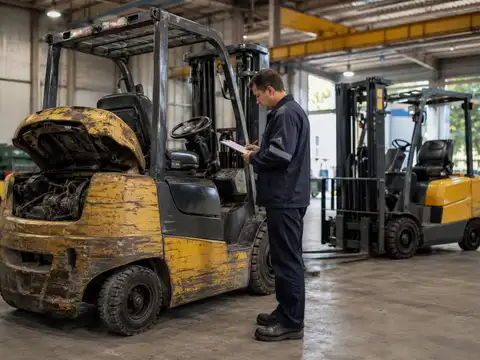
Repair when the truck still fits the application, the failure is isolated and the repaired asset should deliver enough reliable future hours to justify the invoice.
Replace when repair cost is becoming a pattern, not an event.A $6,000 repair can be rational on a valuable low-hour truck. A $2,000 repair can be irrational on a 12,000-hour truck that already has rising downtime, weak parts support and another major failure approaching.
Forklift repair cost is difficult to price from the internet for a good reason: repair invoices are specific to model, component, labor market, access, diagnostic time and the extent of secondary damage.
That does not make the question unanswerable. It changes the correct question from “What does forklift repair cost?” to “What does this repair event cost, and should this truck receive the money?”
Repair-event economics
A $7,000 repair can be sensible. A $2,000 repair can be the last straw.
Current Carolina Handling average parts + labor example for a Raymond 4250.
Current provider average example for a Raymond 5600 orderpicker.
Current provider average example for a Raymond 7520 reach truck.
Compare the repaired truck's expected future cost and downtime with the replacement truck's net acquisition cost over the same decision horizon.
Three current public major-repair examples
Carolina Handling, a Raymond Sales and Service Center, currently publishes unusually transparent examples through its RepairShare warranty program.
| Repair event | Example truck | Published average parts + labor |
|---|---|---|
| AC lift motor replacement | Raymond 7520 reach truck | $6,966.60 |
| Freelift cylinder assembly replacement | Raymond 5600 orderpicker | $6,216.95 |
| Control assembly replacement | Raymond 4250 stand-up counterbalance | $3,280.50 |
These are valuable because they are actual published provider averages tied to specific equipment examples. They are not national repair-price benchmarks and should not be applied to an unrelated Toyota, Crown, Hyster, Yale or generic truck.
A lift motor on one truck can differ substantially from a lift motor on another. Ask for parts, labor, freight, diagnostic time and expected completion date separately before using an online repair example as a budget.
Why forklift repair invoices become expensive
A repair bill is rarely just one part.
It can include:
- diagnostic labor;
- technician travel;
- OEM or aftermarket parts;
- parts freight;
- disassembly;
- installation labor;
- fluids and consumables;
- shop supplies;
- software / calibration;
- load testing;
- follow-up diagnostics;
- rental replacement while the truck is down.
A $2,500 component can therefore become a $4,000 repair event once the truck is restored to service.
Ask for the complete repair-event cost
Repair-event cash cost
parts + labor + freight + diagnosis + fluids/consumables + outside services + temporary replacement equipment
Keep lost productivity separate unless the warehouse can support a credible downtime value.
Do not confuse repair cost with maintenance cost
The maintenance-cost guide uses roughly $1–$3.50 per operating hour as one broad provider planning reference for recurring planned and unplanned mechanical work.
A major repair is different. One $7,000 lift-motor failure can consume several years of an ordinary maintenance reserve in one event.
This is why fleet budgeting should keep:
- routine PM;
- ordinary repairs;
- major component events;
- damage / abuse;
- battery lifecycle;
- tires;
in identifiable categories.
The largest repair invoice is not automatically the worst repair decision
$7,000 repair on a 3,500-hour truck
Current truck value before failure: $24,000.
Repair: $7,000.
Truck has good service history, strong battery and no other known major issues.
If repair restores several years of reliable service, replacing the whole truck could destroy more capital than fixing it.
A small repair can be irrational on a truck that is already aging out
$2,000 repair on an 11,500-hour truck
Current truck needs $2,000 of hydraulic work.
Tires are near replacement.
Maintenance cost/hour has been climbing.
Parts availability is weakening.
Another $4,500 powertrain repair is considered plausible in the next year.
The current invoice is not the real decision. Expected future cost is.
Repair vs replace is a forward-looking decision
Money already spent on the forklift is sunk.
Do not say: “We already spent $20,000 repairing it, so we have to keep it.”
Do not say: “We already spent $20,000 repairing it, so we must replace it.”
Both statements look backward.
The useful comparison is:
Keep-vs-replace decision
expected future cost of repaired truck vs expected future cost of replacement truck
Use the same decision horizon
Compare both options over 12, 24 or 36 months—not a one-time repair invoice against the full purchase price of a new truck.
Example:
24-month keep cost
current repair + expected maintenance + expected additional repairs + downtime/rental − expected resale value after 24 months
24-month replacement cost
replacement acquisition/lease + expected maintenance + energy difference + financing/implementation − trade-in/current-truck value − future residual value
Finance can refine the analysis with present value where appropriate.
Toyota distinguishes economic life from useful life
Toyota's published framework makes a critical distinction: a forklift can remain mechanically capable of running after it stops being economically sensible to keep.
Toyota describes useful life as how long the forklift can continue operating and economic life as the period during which maintaining the truck remains financially sensible.
Repair decisions should maximize economic life, not mechanically force every asset to its final possible hour.
10,000 hours is a planning reference, not a retirement clock
Toyota says that, on average, many forklifts will need replacement around 10,000 hours, with certain unique or severe applications reaching that point around 8,000 hours or less.
That does not mean:
- replace every truck at 10,000 hours;
- repair every truck below 10,000 hours;
- a 7,000-hour freezer truck is younger economically than a 10,500-hour clean-warehouse truck.
Hours are one variable in the economic-life decision.
Application severity can matter more than the meter
Trucks age faster in:
- scrap and metal operations;
- lumber yards;
- foundries;
- freezers;
- wet/corrosive applications;
- rough outdoor surfaces;
- multi-shift production;
- high-impact traffic environments.
Compare repair history with a peer truck in the same duty rather than with an abstract age benchmark.
Maintenance cost per hour reveals the pattern behind repair invoices
Conger's current useful-life framework uses approximately $4 per operating hour of maintenance as a point where replacement deserves investigation.
That is useful because it converts irregular invoices into a normalized trend.
A $6,000 repair on a high-hour truck may push rolling maintenance cost/hour sharply upward. A similar repair on a lightly repaired younger truck can still leave the rolling metric reasonable.
Use rolling 12-month repair cost, not lifetime average alone
Lifetime cost hides current deterioration
Lifetime maintenance: $2.10/hour.
Last 12 months: $5.25/hour.
Unscheduled downtime: doubled.
The lifetime average is diluted by inexpensive early years. The rolling number is a stronger replacement signal.
Repeated repair of different systems is a stronger signal than one large repair
One AC lift motor failure can be a discrete event.
In contrast, this sequence is more concerning:
- hydraulic leak in January;
- steering repair in March;
- brake work in May;
- control failure in July;
- mast-chain issue in September.
Multiple unrelated aging failures suggest the truck is moving into a higher-cost stage of economic life.
Repeated repair of the same system is another warning
A component that fails repeatedly can indicate:
- incorrect diagnosis;
- secondary damage not addressed;
- poor-quality replacement parts;
- application mismatch;
- operator misuse;
- electrical or hydraulic root cause elsewhere in the system.
Paying for the same symptom three times should trigger root-cause analysis, not a fourth identical work order.
Downtime can be worth more than the repair
Toyota emphasizes that downtime cost goes beyond parts and labor because lost equipment availability affects product movement and operator productivity.
A warehouse should capture the costs it can support with real data:
- rental replacement;
- overtime;
- idle operator time;
- missed dock appointments;
- lost production;
- expedited shipping caused by delays.
If the site cannot credibly monetize throughput loss, keep downtime hours as a separate KPI instead of inventing a dramatic dollar amount.
Rental replacement makes downtime easy to price
The current rental-cost guide uses roughly $1,600–$2,000 per four-week period as a transparent 5,000-lb warehouse-forklift reference from one 2026 dealer schedule.
If a repair keeps a truck down for five weeks and the warehouse requires a rental, that rental becomes a real line in the repair-event cost.
$6,200 repair + temporary truck
Repair invoice: $6,200.
Temporary rental / logistics: $2,000.
Total cash event: $8,200.
The replacement decision should use $8,200, not only the technician's invoice.
Parts availability can decide replacement before mechanical life ends
A forklift can remain mechanically repairable while parts become:
- obsolete;
- backordered;
- available only used;
- available from one supplier;
- expensive to ship internationally;
- unsupported electronically.
The repair cost then includes waiting time.
A common mainstream truck with local parts support can justify repairs later into life than an orphan model whose controller takes six weeks to source.
Carolina Handling illustrates why service network matters
Carolina Handling currently says it stocks more than 11,000 forklift parts and accessories and maintains a 93% same-day parts fill rate within its service network.
Those are provider-specific capabilities, but they show the economic value of parts availability: shorter repair lead time can matter as much as a modest difference in parts price.
Repairing an obsolete control system can create recurring risk
Older electric forklifts may rely on:
- controllers no longer produced;
- display modules with limited availability;
- legacy sensors;
- special diagnostic software;
- older charger interfaces.
A successful $3,000 electronics repair today may not solve the risk of the next obsolete module.
Battery condition can change an electric repair decision dramatically
Suppose the truck needs a $6,000 lift repair and the traction battery is also approaching replacement.
The correct decision includes both expected events:
Repair plus battery
Mast / lift repair: $6,000.
Expected battery work in 12 months: $7,000.
Tires expected: $1,500.
Near-term capital exposure: $14,500.
A $6,000 repair is not really a $6,000 keep decision when other known lifecycle costs are immediately behind it.
But a new battery can make the truck more worth repairing
The reverse also occurs.
If a truck received a high-value new battery six months ago, scrapping the entire forklift can strand that battery investment.
Evaluate whether the battery:
- can transfer to another truck;
- has meaningful resale value;
- is proprietary to the current unit;
- is covered by warranty;
- changes the current truck's residual value.
Forks, tires and chains are not automatically reasons to replace a forklift
These are wear items.
Toyota's common-replacement-parts guidance emphasizes that many forklift parts require periodic replacement throughout the truck's life.
Replacing a worn chain on an otherwise healthy truck can be normal lifecycle maintenance.
The replacement question becomes more serious when ordinary wear coincides with large major-component risk and rising downtime.
Toyota publishes periodic replacement guidance for several wear components
Toyota's replacement-parts material gives model-family examples such as:
- certain rubber parts and hoses at time/hour intervals;
- wheel-cylinder / master-cylinder rubber components on recurring schedules;
- lift-chain inspection during PM;
- periodic chain replacement based on model guidance and condition.
These schedules are Toyota-specific examples and do not replace the maintenance manual for another manufacturer or model.
Impact damage is a different repair category
If a forklift hits:
- rack;
- columns;
- dock doors;
- other trucks;
- guardrails;
- trailers;
damage expense should normally be tracked separately from age-related mechanical repair.
Otherwise management can mistakenly replace a healthy truck while leaving the traffic or training problem unchanged.
Repair history can expose an application mismatch
Repeated tire, wheel or suspension failures may indicate rough floors.
Repeated overheating may indicate a duty cycle or environment beyond the truck's design.
Repeated mast impacts may indicate aisle clearance or visibility problems.
Replacing the forklift with the same configuration can simply restart the same repair pattern.
Before approving a major repair, ask whether the truck still fits the warehouse
The warehouse may have changed since the forklift was purchased:
- rack is taller;
- aisles are narrower;
- loads are heavier;
- the truck now goes outdoors;
- shift count increased;
- charging strategy changed;
- attachments were added;
- production volume doubled.
A major repair is a natural point to reconsider application fit.
A correct repair can still be a bad investment if the truck is underspecified
Repair the wrong mast?
Current truck reaches 216 in.
New rack requires 276 in.
Major mast repair costs $5,500.
Repairing the truck restores a capability the warehouse no longer needs. Replacement may solve both the failure and the application gap.
OSHA changes the repair decision when the truck is unsafe
OSHA 29 CFR 1910.178 says a powered industrial truck that is not in safe operating condition must be removed from service.
OSHA also states that repairs must be made by authorized personnel.
This means the warehouse does not have a third option called: “keep using it until the budget is approved.”
If the condition makes the truck unsafe, it stays out of service until restored to safe operating condition.
Some defects require immediate removal from service
OSHA's powered-industrial-truck guidance includes:
- unsafe vehicle condition;
- fuel-system leaks;
- hazardous overheating;
- hazardous sparks or flames from exhaust;
- other defects adversely affecting safe operation.
Safety status and economic replacement analysis are separate questions.
First make the truck unavailable if required. Then decide whether to repair or replace it.
OSHA also constrains how repairs are performed
The current standard requires, among other things:
- repairs by authorized personnel;
- battery disconnection before certain electrical-system repairs;
- replacement parts equivalent in safety to original design;
- no unauthorized changes that alter the truck from its approved configuration;
- manufacturer approval for certain modifications affecting capacity or safe operation.
A low-cost field modification is not automatically an acceptable repair.
Field welding and structural repair require particular caution
Mast, forks, overhead guards and structural truck components carry load and safety functions.
Do not authorize improvised welding or straightening because it appears cheaper than replacement.
Follow manufacturer and qualified repair guidance, and preserve capacity / safety markings where the standard requires them.
Warranty changes the repair economics
Carolina Handling's current RepairShare examples illustrate this clearly.
In its examples:
- a $6,966.60 lift-motor event becomes a $750 customer deductible;
- a $6,216.95 lift-cylinder event becomes a $500 deductible;
- a $3,280.50 control-assembly event becomes a $250 deductible.
The customer decision is completely different when warranty or service coverage transfers most of the repair invoice.
Do not replace a covered truck because you looked only at gross repair cost
If the warranty absorbs a $6,000 repair, compare the actual customer cash exposure and downtime with replacement—not the gross repair value.
Also consider whether the repaired component receives additional warranty coverage.
Full-service maintenance can transfer repair-budget volatility
Raymond and Carolina Handling offer maintenance structures where broader repair and parts coverage can be incorporated into service programs.
The economics are similar to insurance:
- the fleet pays a more predictable amount;
- the provider accepts more repair-cost variability;
- coverage exclusions determine how much risk actually transfers.
A full-service agreement is not automatically cheaper than self-insuring repairs. It can still be valuable where budget predictability and uptime support matter.
Repair quotes should show scope clearly
Ask for:
- diagnosis;
- failed component;
- root cause where known;
- parts numbers;
- OEM vs aftermarket / remanufactured status;
- labor hours;
- labor rate;
- freight;
- shop / travel charges;
- expected completion date;
- warranty on parts and labor;
- additional recommended work;
- what happens if further damage is found.
This makes competing repair proposals comparable.
Remanufactured parts can change the economics
Some motors, controllers, transmissions and other assemblies can be sourced as remanufactured components.
Compare:
- price;
- warranty;
- availability;
- core charge;
- lead time;
- supplier reputation;
- compatibility with the truck's approved configuration.
The cheapest component can lose quickly if it creates another extended downtime event.
A fast repair can be worth more than a cheaper repair
Dealer A vs Dealer B
Dealer A: $5,800 repair, parts available tomorrow.
Dealer B: $5,000 repair, part arrives in three weeks.
If three weeks of rental costs $1,500, Dealer B's nominally cheaper repair is already more expensive in cash terms.
Trade-in value should be obtained before authorizing a major repair
A failed truck can still have:
- parts value;
- battery value;
- core value;
- dealer trade-in value;
- auction value;
- scrap value.
Ask at least one dealer what the truck is worth as-is and what it could be worth after repair.
The difference helps reveal how much of the repair cost is actually recovered in asset value.
Repair value created is not the same as repair invoice
$7,000 repair creates only $3,000 of resale value
As-is value: $8,000.
Repaired value: $11,000.
Repair cost: $7,000.
The repair creates $3,000 of asset value but costs $7,000. The remaining $4,000 must be justified by future operating usefulness.
Do not repair solely to improve trade-in value
Dealers may prefer receiving a running truck, but major repairs immediately before trade can destroy value if the trade allowance rises by less than the repair bill.
Ask for both offers first.
Compare replacement against suitable used equipment too
The replacement alternative does not have to be a $40,000 new forklift.
Warehouse Fieldbook's current used-forklift guide places a standard 5,000-lb used warehouse forklift roughly around $12,000–$22,000.
A $7,000 repair on an aging ordinary truck can therefore represent a material percentage of a suitable dealer-ready used replacement.
Used replacement carries its own inspection and future-repair risk, so compare delivered first-year cost rather than sticker price.
Compare repair against lease and rental when capital is constrained
A business may know replacement is economically stronger and still lack cash for an outright purchase.
Alternatives include:
- equipment financing;
- FMV lease;
- $1 buyout lease;
- long-term rental;
- dealer-certified used equipment.
Capital availability affects implementation; it should not make a failing truck look mechanically healthier than it is.
A repair approval matrix can improve consistency
| Truck condition | Repair posture |
|---|---|
| Low hours, good history, isolated repair | Repair usually deserves strong consideration |
| Moderate hours, one major repair, good parts support | Compare 24–36-month future cost |
| High hours, rising rolling $/h, repeated downtime | Replacement deserves strong consideration |
| Truck no longer fits application | Do not repair before solving the specification gap |
| Major repair covered by warranty | Use actual deductible/cash exposure in the decision |
| Unsafe condition | Remove from service first; then repair or replace |
Use five questions before approving any large repair
- What is the complete repair-event cash cost? Include temporary equipment and logistics.
- What other major costs are likely within 24 months? Battery, tires, chains, transmission, controls, mast.
- How much downtime has the truck created recently? Use rolling data.
- Does the truck still fit the application? Capacity, height, aisle, terrain and energy strategy.
- What are the real replacement alternatives? New, used, lease and rental.
When repair usually makes sense
Repair deserves stronger consideration when:
- the failure is isolated;
- truck hours are moderate;
- maintenance history is otherwise stable;
- battery / powertrain condition is strong;
- parts are readily available;
- the truck still fits the application;
- repair restores several years of likely useful work;
- warranty absorbs much of the repair cost;
- replacement lead time is long.
When replacement usually deserves stronger consideration
Replacement deserves stronger consideration when:
- multiple unrelated systems are failing;
- rolling maintenance cost/hour is rising rapidly;
- downtime is increasing;
- the truck is approaching or beyond its economic-life zone;
- parts support is deteriorating;
- the current truck no longer fits the application;
- a battery or another major lifecycle cost is also imminent;
- the repair is a large percentage of a suitable replacement's net cost;
- new equipment materially improves energy or labor economics.
Why there is no universal “50% rule”
Rules such as “replace when the repair costs 50% of the truck value” are attractive because they are simple.
They can also be wrong.
A $10,000 repair on a specialized $100,000 VNA truck can be rational. A $3,000 repair on a low-value truck with repeated failures can be irrational.
Repair percentage is one input. Future operating cost is the decision.
Why repair-versus-replace needs a full lifecycle model
A defensible repair-versus-replace model needs full lifecycle inputs rather than a simplified repair percentage.
A repair/replace calculator that asks only repair cost, current value and replacement price would create false precision by ignoring:
- future repairs;
- downtime;
- annual hours;
- energy difference;
- residual value;
- application fit;
- battery / powertrain lifecycle.
The formulas on this page are deliberately transparent instead.
The practical recommendation
Treat the repair quote as the beginning of the decision, not the answer.
For every major repair, build a 24-month view of:
repair now + likely next repairs + maintenance + downtime/rental − future resale value
Then compare that with:
net cost of the best realistic replacement + its expected 24-month operating cost
Repair the truck when the event is isolated and the asset still has valuable reliable work ahead.
Replace it when the invoices are no longer isolated failures but evidence that the truck has moved beyond its economic life.
Frequently asked questions
How much does forklift repair cost?
There is no reliable universal repair price. Current Carolina Handling examples show major parts-and-labor events around $3,280.50–$6,966.60 for specific Raymond control, cylinder and lift-motor repairs.
How much does a forklift lift motor replacement cost?
Carolina Handling currently publishes an average $6,966.60 parts-and-labor example for an AC lift motor replacement on a Raymond 7520 reach truck. Other models can differ substantially.
How much does a forklift lift cylinder repair cost?
Carolina Handling currently gives an average $6,216.95 parts-and-labor example for a freelift cylinder assembly replacement on a Raymond 5600 orderpicker.
How much does a forklift control assembly cost to replace?
Carolina Handling currently gives an average $3,280.50 parts-and-labor example for a control assembly replacement on a Raymond 4250 stand-up counterbalance truck.
When should I stop repairing a forklift?
Stop focusing on the individual invoice when rolling maintenance cost, downtime and multiple upcoming repairs make the future cost of keeping the truck higher than a realistic replacement alternative.
How many hours is too many for a forklift?
Toyota uses roughly 10,000 hours as an average replacement planning reference for many forklifts and notes that severe applications may reach economic replacement around 8,000 hours or less. Condition and duty matter more than the meter alone.
Is it worth repairing a 10,000-hour forklift?
It can be if the repair is isolated, parts support is strong and the truck still performs valuable work reliably. The same hours can justify replacement when maintenance and downtime are accelerating.
Should I repair a forklift before trading it in?
Get an as-is and repaired trade-in offer first. If a $6,000 repair increases the trade value by only $2,000, repairing solely for resale destroys value.
Does OSHA allow an unsafe forklift to keep operating until repairs are scheduled?
No. OSHA requires powered industrial trucks that are not in safe operating condition to be removed from service until restored to safe condition.
Who can repair a forklift under OSHA rules?
OSHA 29 CFR 1910.178 states that repairs to powered industrial trucks must be made by authorized personnel.
Should accident damage count toward repair-vs-replace?
It belongs in total fleet cost, but track it separately from aging-related mechanical repairs. Otherwise operator or traffic problems can make a healthy truck appear economically old.
Does downtime belong in the repair decision?
Yes. Include rental replacement, overtime and other directly supportable costs. If lost throughput cannot be priced credibly, track downtime hours separately instead of inventing a dollar value.
Sources and methodology
Warehouse Fieldbook uses current publicly disclosed Carolina Handling repair examples only as model-specific parts-and-labor references and does not present them as national averages. Toyota is used for economic-life, replacement and TCO methodology. Raymond / Carolina Handling sources provide current service, warranty and parts-support context. OSHA is used for mandatory removal-from-service and repair requirements. Repair/replace scenarios are illustrative arithmetic and should be replaced with the truck's actual quote, service history and realistic replacement options.
- Carolina Handling — current RepairShare major repair cost examples
- Carolina Handling — current forklift repair and service support
- Carolina Handling — current parts inventory and same-day fill-rate context
- Raymond — current forklift repair, full-service and asset-cost management programs
- Toyota Material Handling — forklift replacement planning around economic life
- Toyota Material Handling — economic life vs useful life
- Toyota Material Handling — repair and downtime indicators for replacement
- Toyota Material Handling — May 2026 forklift TCO cost categories
- Toyota Material Handling — common periodic replacement components
- Conger Industries — current maintenance cost/hour and economic-life heuristic
- OSHA — 29 CFR 1910.178 powered industrial truck repair and maintenance requirements
- OSHA — removal from service and authorized repair guidance