
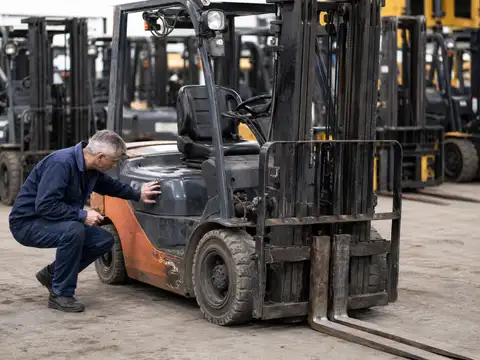
For a standard 5,000-lb warehouse forklift, a useful current planning range is:
About $12,000–$22,000 usedEliftruck's 2026 pricing guide uses that range for 5,000-lb trucks depending on condition and whether the unit is sold as-is or dealer-certified. Current Toyota listings show why inspection matters: similar-capacity trucks can range from the mid-teens into the mid-$20,000s based on hours, age and specification.
Buying a used forklift is not difficult because the machines are mysterious. It is difficult because two forklifts that look almost identical can have dramatically different remaining economic life.
A 2021 LP truck with 8,000 hours, a 2016 truck with 5,500 hours and a 2020 electric truck with a weak battery can all occupy roughly the same advertised price band. The buyer is therefore purchasing a combination of remaining machine life, application fit and future maintenance risk.
Used-truck decision
The sticker price is only one layer of the purchase
Service records, compatible mast, sound battery or powertrain, local parts support.
Higher hours, older battery, worn tires, weak records or upcoming service.
Cannot reach the rack, wrong tires, wrong capacity or unsuitable aisle geometry.
A newer truck with poor battery health or a harsh duty history can be worse value than an older machine with documented maintenance and the right specification.
What used 5,000-lb forklifts cost right now
Eliftruck's current 2026 guide places a standard 5,000-lb used warehouse forklift at approximately $12,000–$22,000. It distinguishes lower-cost as-is equipment from dealer-certified machines that may include powertrain coverage.
Current ForkliftTrader inventory provides a useful live-market check. Recent listings include several Toyota 5,000-lb LP and electric forklifts from roughly $13,900 to $24,950, depending on model year, hours, tires, mast and configuration.
| Current market example | Hours | Power | Listed price |
|---|---|---|---|
| 2021 Toyota 8FGU25, 5,000 lb | About 8,107 | LP | About $17,950–$24,875 depending on listing / configuration |
| 2016 Toyota 8FGU25, 5,000 lb | About 5,600–8,700 | LP | About $21,450–$23,950 in current examples |
| 2019 Toyota 8FBCU25, 5,000 lb | About 7,222 | Electric | About $19,950 |
| 2021 Toyota 8FBCHU25, 5,000 lb | About 6,843 | Electric | About $21,450 |
| Older Toyota 5,000-lb units | Varies | LP / electric | Some current examples around $13,900–$15,750 |
Listings move constantly, so those examples are market snapshots rather than appraisal values. They are useful because they demonstrate how little model year alone explains the final asking price.
Start by pricing the exact truck you actually need
A bargain 5,000-lb forklift is not a bargain if it has the wrong mast, tires, fuel type or aisle requirement.
Define the application before browsing inventory:
- maximum actual load weight;
- load dimensions and load center;
- maximum fork height;
- minimum doorway / trailer clearance;
- indoor or outdoor operation;
- floor condition;
- required aisle width;
- hours per shift;
- shifts per day;
- required attachments;
- electric, propane, gasoline or diesel preference.
Used inventory tempts buyers to redesign the requirement around what is available. Resist that. The forklift should fit the warehouse, not the other way around.
$14,000 truck, wrong mast
A warehouse needs 218 inches of lift height. A clean used truck is available for $14,000 but reaches only 189 inches. Buying it saves $6,000 versus the correct truck and permanently leaves the top rack level unusable. The equipment discount can be much smaller than the value of the lost pallet positions.
Hours are important—but not an odometer
Forklift hours are one of the first numbers buyers see because industrial trucks record operating time rather than road mileage.
Toyota's published economic-life guidance says most forklifts may need replacement around 10,000 hours on average, with some harsh applications reaching that point around 8,000 hours or earlier.
That does not mean a 10,001-hour Toyota is finished or a 5,000-hour truck is automatically healthy. Environment, duty cycle, maintenance and equipment type can move useful life substantially.
Higher hours should trigger stronger questions about maintenance, major component work and expected future use. They should not replace inspection or service-history review.
Annual hours tell you whether used equipment fits the job
A truck with 7,500 hours used 300 hours per year as emergency backup has a very different economic future from the same truck assigned to a 2,000-hour annual production duty.
Estimate how quickly the warehouse will add hours:
7,500-hour truck in two applications
Backup use at 400 hours/year: five years adds only 2,000 hours.
Full-time use at 2,000 hours/year: five years adds 10,000 hours.
The same purchase can therefore be sensible backup capacity and a poor primary-fleet investment.
Electric used forklifts are partly battery purchases
The traction battery can be one of the largest hidden liabilities in a used electric truck. Conger Material Handling's October 2025 pricing guidance says buyers should pay close attention to runtime and battery age, particularly as lead-acid batteries approach roughly four to five years.
Conger gives approximately $1,000–$5,000 as a used forklift battery price range depending on size and capacity. Its separate buying guide places a new battery and charger package around $2,500–$5,000 in its current broad planning example.
Those figures vary by voltage, amp-hour capacity, chemistry and truck type. The practical lesson is that battery health can consume a large part of the apparent used-truck discount.
Ask for an actual battery test
Do not accept “battery takes a charge” as proof of useful capacity. Ask for:
- battery age;
- voltage and amp-hour specification;
- measured runtime under representative duty;
- condition of cells and connectors;
- watering / maintenance history for lead-acid;
- charger compatibility;
- recent battery-service records;
- whether battery capacity is warranted.
Toyota notes that proper maintenance materially affects battery life, while Raymond recommends scheduled battery service and disciplined charging practices. Used battery condition is therefore partly a record of how the previous owner operated the truck.
A weak battery can turn a cheap electric forklift into the expensive option
$15,000 truck + immediate battery spend
Used electric forklift: $15,000.
Battery / charger work: $5,000.
Freight and initial service: $1,500.
Real first-day budget: $21,500.
A dealer-certified $22,000 truck with tested battery condition can now be financially competitive even though its sticker price looked much higher.
Lithium trucks need battery-health data too
Lithium-ion equipment avoids watering and can support opportunity charging, but lithium battery packs are not condition-free. State of health, remaining capacity, fault history, charger compatibility and battery-management-system data matter.
A lithium truck sold without useful battery-health information should not receive the same valuation as one with documented pack performance.
Propane and gas trucks shift the risk to the powertrain
Internal-combustion trucks do not have a traction battery as the main energy asset, so inspection attention shifts toward:
- engine condition;
- transmission behavior;
- cooling system;
- fuel-system leaks or issues;
- exhaust condition;
- brakes;
- steering;
- hydraulic leaks.
A short no-load drive around a dealer yard is not enough to reveal how the truck behaves warm, loaded and under repeated lifting.
Service records can be worth thousands
A stack of maintenance invoices looks less exciting than fresh paint, but it tells the buyer whether scheduled service occurred and which major components have already been replaced.
Toyota's July 2026 maintenance guidance describes recurring service intervals at approximately 250, 500 and 2,000 hours for different levels of inspection and maintenance on relevant trucks.
When reviewing a used forklift, compare the hour meter with the maintenance history. A truck at 6,500 hours with no records since 3,000 deserves a different price from one with documented service through the present.
What “dealer-certified” should actually mean
Certification has value only if the buyer knows what was inspected and repaired. Raymond currently markets certified used forklifts as equipment that has gone through a rigorous quality inspection.
Ask the seller for the certification checklist, not just the badge. Useful certification should identify:
- powertrain checks;
- hydraulic operation;
- mast / chain condition;
- fork condition;
- brakes and steering;
- tires;
- battery test for electric trucks;
- safety devices;
- known repairs completed before sale;
- warranty scope and duration.
“Reconditioned” and “certified” are commercial descriptions; compare the work behind them rather than assuming every dealer uses the same standard.
Inspect the mast under load
The mast is one of the highest-value assemblies on the forklift. Check:
- smooth raising and lowering;
- unusual mast-channel play;
- chain wear and adjustment;
- roller condition;
- hydraulic cylinder leakage;
- hose condition;
- carriage movement;
- sideshift / fork-positioner operation;
- mast tilt operation.
A truck that lifts smoothly with empty forks can still behave differently with a representative load. A professional pre-purchase inspection should test the machine in conditions closer to its intended duty.
Forks are structural components, not disposable accessories
Inspect forks for visible bending, cracking, heel wear, mismatched pairs and altered or repaired areas. The fork locking system should operate correctly.
The buyer should also confirm fork length and class fit the actual pallets and attachments used in the warehouse.
Replacing worn forks may be straightforward, but it belongs in the first-year budget rather than being discovered after delivery.
Tires can expose the previous duty cycle
Raymond's current maintenance guidance tells operators to watch for tire chunking, cracking and flat spots. On a used truck those conditions are both a replacement cost and evidence of how the machine was operated.
Uneven or unusually rapid tire wear can also point toward alignment, floor, loading or operating issues.
Confirm that the tire type matches the new application. A cushion-tire truck may be attractive indoors and completely wrong for rough outdoor surfaces.
Check for leaks after the truck is warm
Freshly cleaned forklifts can hide small hydraulic or powertrain leaks during a five-minute inspection. Operate the truck long enough to warm it, cycle the hydraulics repeatedly and then inspect the floor and components.
Look around cylinders, hoses, fittings, transmission areas and cooling systems. The goal is not to reject every machine with a minor seep; it is to know which repairs belong in the acquisition budget.
Hour-meter credibility matters
A low-hour reading is valuable only if it makes sense with the truck's age, pedals, seat, steering wheel, mast wear and service history.
If a 12-year-old warehouse truck shows 1,500 hours but looks heavily worn, ask why. The meter may have been replaced, the truck may have spent years idle, or the reading may be accurate but incomplete as a picture of condition.
The more important question is not whether the seller can prove every historic hour. It is whether the price appropriately reflects uncertainty.
Paint can hide repair history
Repainting a used forklift is normal reconditioning. It should not substitute for inspecting structural areas, counterweight condition, overhead guard, mast components and signs of collision or welding.
Fresh paint can improve resale appearance without improving mechanical life. Place more weight on service records and measured condition than cosmetics.
Check the data plate and residual capacity
A forklift's rated capacity can change when attachments or mast configurations change the load center and effective geometry.
OSHA requires powered industrial trucks with approved front-end attachments to be marked to identify the attachment and show the approximate combined truck-and-attachment weight at maximum elevation with the load laterally centered.
From a buying perspective, confirm that the capacity plate reflects the actual configuration being sold. A clamp or fork positioner added later should not leave the buyer guessing about usable capacity.
Measure the mast against the building before making an offer
Record:
- maximum fork height;
- lowered mast height;
- free lift;
- overall truck height;
- overhead-guard height;
- overall length and width;
- turning radius.
Then compare those dimensions with rack levels, dock doors, trailers, tunnels and aisle width.
Used inventory is only valuable if the physical machine fits the operating envelope.
Freight can move a bargain out of range
Used forklifts are a national market. Eliftruck and ForkliftTrader aggregate machines across many dealers and states, which increases choice but creates transport cost.
Compare delivered price rather than asking price:
Local $19,000 truck vs distant $17,000 truck
Local machine: $19,000 + $500 delivery =$19,500 delivered.
Distant machine: $17,000 + $3,000 freight =$20,000 delivered.
The “cheaper” listing is already more expensive before considering local service support or pre-purchase inspection travel.
Build a first-year reserve before deciding what you can afford
The used-truck budget should include more than purchase and freight. A practical acquisition reserve may need to cover:
- initial full service;
- tires;
- forks;
- battery or charger work;
- hoses and minor hydraulic repairs;
- brake work;
- mast chains;
- safety devices;
- unexpected diagnostic work.
Do not use a generic percentage if the truck has been inspected. Use the inspection to build a specific reserve.
A $4,000-cheaper truck can easily lose the comparison
Truck A vs Truck B
Truck A: $15,000 purchase + $2,500 tires + $3,500 battery work =$21,000 before freight.
Truck B: $19,000 purchase + $700 initial service =$19,700 before freight.
The lower asking price loses once known near-term work is included.
Maintenance cost per operating hour is useful after purchase
Conger's current useful-life guidance places ordinary forklift maintenance around $1.00–$3.50 per operating hour as a broad benchmark, with harsh environments and aging equipment pushing costs higher.
A buyer should not simply multiply that range by future hours and assume accuracy. It is more useful as a warning threshold: if one used truck begins accumulating unusually high maintenance cost per hour, its low acquisition price may no longer matter.
Low purchase price matters most when annual utilization is low
A warehouse using a forklift only 300 hours per year has fewer opportunities to recover the premium for new equipment through lower downtime and maintenance. Used equipment can therefore be especially attractive for:
- backup trucks;
- seasonal operations;
- small warehouses;
- occasional loading / unloading;
- secondary buildings;
- simple applications with common parts.
The same machine can be a weak choice for a three-shift production line where every breakdown stops material flow.
Dealer support can justify paying more
A used truck from a local dealer can provide:
- pre-sale inspection;
- known parts support;
- warranty;
- service technicians;
- rental replacement;
- trade-in options;
- easier return or commercial recourse if the truck arrives misrepresented.
A private-sale truck may be cheaper because the buyer is accepting more of those risks.
Private sale vs dealer-certified
| Factor | Private / as-is | Dealer-certified |
|---|---|---|
| Purchase price | Usually lower | Usually higher |
| Inspection documentation | Varies | Typically stronger |
| Warranty | Often none | May be included |
| Known repairs before sale | Buyer must verify | Often part of reconditioning |
| Service support | Separate arrangement | Often available through dealer |
| Best buyer | Experienced / risk-tolerant | Buyer prioritizing uptime |
When an older forklift can still be a strong purchase
Age alone should not disqualify a forklift when:
- annual hours were low;
- maintenance records are complete;
- major wear items have been replaced;
- parts remain readily available;
- the specification fits the new application;
- the buyer's expected annual use is modest.
An older common Toyota, Hyster, Yale, Crown or similar mainstream truck with excellent local support can be economically preferable to a newer obscure model with weak parts availability.
When the bargain should probably be rejected
Be cautious when several of these appear together:
- no service history;
- unknown battery age;
- visible mast or fork damage;
- significant hydraulic leaks;
- hour reading inconsistent with wear;
- data plate missing or inconsistent with attachments;
- obsolete model with weak parts support;
- seller will not permit load testing;
- fresh paint over obvious repair areas;
- wrong mast / tires / dimensions for the warehouse.
One issue may be priceable. Several unknowns compound each other and should demand a much larger discount or a walk-away decision.
A practical pre-purchase inspection sequence
- Verify identity and specification. Model, serial number, capacity, mast, fuel type and attachment.
- Review records. Service history, major repairs and battery information.
- Inspect cold. Look for leaks, structural damage, tire wear and signs of repair.
- Start and operate. Listen, steer, brake and cycle all hydraulics.
- Test under representative load. Confirm lifting, mast behavior and power.
- Inspect warm. Look again for leaks, noises and heat-related issues.
- Test the battery where applicable. Do not rely on voltage alone.
- Build the first-year repair list. Price known work before making the offer.
- Add delivered cost. Freight, tax and commissioning.
How to decide what to offer
Start from the market value of a comparable machine in good working condition. Then deduct costs you know the buyer will incur soon:
Comparable value minus known defects
Comparable dealer-ready value: $20,000.
Tires due: -$1,800.
Battery allowance: -$2,500.
Initial service / minor leaks: -$700.
Risk allowance for missing records: -$1,000.
Indicative economic offer: $14,000.
This is a negotiation framework, not an appraisal formula. Unknown defects cannot always be priced precisely, so uncertainty itself deserves a discount.
Used forklift vs new forklift: the economic break
The previous cost guide places a common new 5,000-lb forklift roughly around $25,000–$50,000 and a used one around $12,000–$22,000.
If a well-inspected used machine costs $18,000 and the appropriate new machine costs $34,000, the $16,000 acquisition saving is substantial.
But if the used truck needs $7,000 of work, has weak service support and will be run 2,500 hours every year, the effective discount is much smaller than the sticker gap.
Use expected annual hours as the final filter
| Expected use | Used-forklift posture |
|---|---|
| Under 500 hours/year | Used can be very attractive if condition is sound |
| 500–1,500 hours/year | Compare condition, warranty and maintenance carefully |
| 1,500–2,500 hours/year | Remaining life and dealer support become much more important |
| Multi-shift / mission-critical | Certified late-model used or new deserves stronger consideration |
Those bands are planning categories, not manufacturer limits. Different forklift types and applications age differently.
The practical recommendation
In 2026, a standard 5,000-lb used warehouse forklift around $12,000–$22,000 can be excellent value when the truck is correctly specified, inspected and matched to moderate annual use.
Do not shop for the lowest hour meter or newest model year. Shop for the lowest delivered first-year cost for a truck with enough remaining useful work to serve the intended duty.
A $3,000 premium for tested battery capacity, recent tires, documented service and local dealer support can be cheaper than discovering those needs in the first month after purchase.
Frequently asked questions
How much should I pay for a used forklift?
For a standard 5,000-lb warehouse forklift, Eliftruck's current 2026 guide suggests approximately $12,000–$22,000. Live dealer listings can sit below or above that range depending on year, hours, condition and specification.
How many hours is too many on a used forklift?
There is no universal cutoff. Toyota says many forklifts reach replacement planning around 10,000 hours on average, with harsher applications potentially reaching economic end-of-life earlier. Maintenance history and future annual utilization matter as much as the current hour count.
Is 5,000 hours high for a forklift?
Not necessarily. A well-maintained mainstream truck at 5,000 hours can have substantial useful life remaining. Inspect its duty history, maintenance, battery or powertrain, mast and expected future use.
How much does a used forklift battery cost?
Conger's current pricing guidance gives roughly $1,000–$5,000 for used forklift batteries depending on size and capacity. Battery condition should be tested rather than inferred from age alone.
Is dealer-certified used worth paying more for?
It can be when uptime matters. Raymond, for example, markets certified used forklifts that undergo a rigorous quality inspection. Compare the actual inspection, repairs and warranty included rather than relying only on the label.
Should I buy a used electric or propane forklift?
Buy the power source that fits the operation first. For electric, battery condition is a major purchase variable. For propane, inspect engine, transmission, cooling and fuel systems carefully.
Should I buy a used forklift with no maintenance records?
Only at a price that compensates for the uncertainty and after a strong independent inspection. Missing records increase the probability that upcoming maintenance or prior damage is not reflected in the asking price.
What is the biggest used-forklift buying mistake?
Buying a cheap machine that does not fit the application. Wrong lift height, capacity, tires, power source or aisle geometry can destroy more value than a modest difference in purchase price.
Sources and methodology
Warehouse Fieldbook reviewed current August 2026 U.S. used-equipment listings, a current 2026 dealer pricing guide, current manufacturer maintenance guidance and certified-used equipment information. Live asking prices are treated as market snapshots rather than completed-sale values. Hour-life figures are used as planning context rather than hard replacement limits.
- Eliftruck — 2026 used forklift price guide
- Eliftruck — current used-forklift buyer pricing context
- ForkliftTrader — current Toyota used-forklift listings
- ForkliftTrader — current U.S. used-forklift inventory
- Raymond — current certified used and refurbished forklift program
- Toyota Material Handling — forklift economic-life planning
- Toyota Material Handling — July 2026 forklift maintenance intervals
- Conger Material Handling — current used-battery and used-forklift price context
- Conger Material Handling — current forklift buying and battery/charger context
- Conger Material Handling — current maintenance-cost and useful-life guidance
- Raymond — tire and battery maintenance indicators
- OSHA — 29 CFR 1910.178 powered industrial truck requirements