
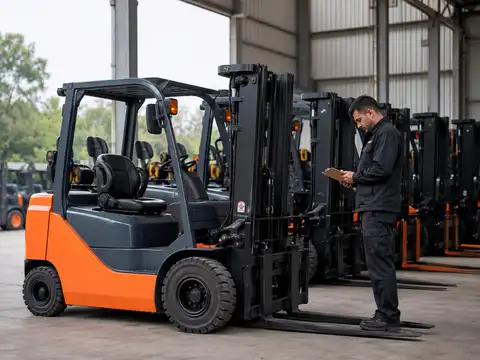
For a common 5,000-lb warehouse forklift, current published examples are:
$249–$311/day · $639–$793/week · $1,610–$1,995/4 weeksThose figures come from Conger's January 2026 rate schedule across common electric, IC cushion and IC pneumatic configurations. They are a transparent dealer reference, not a national average.
Forklift rental is expensive on a monthly basis because the rental company owns the truck, absorbs idle-fleet risk and commonly carries routine maintenance responsibility. What the customer buys is flexibility.
That flexibility is valuable when a warehouse needs one extra truck for peak season, a breakdown, inventory count, temporary customer contract or a project that will end before ownership can pay back.
2026 rental economics
Flexibility gets cheaper as the rental term gets longer
Current 5,000-lb Conger examples across common warehouse truck classes.
40-hour usage allowance in Conger's current rental program.
160-hour usage allowance before overtime in the cited program.
Add delivery, pickup, fuel, overtime and damage exposure. Electric rentals may include the battery and charger; propane fuel is typically separate.
Current 5,000-lb warehouse forklift rental rates
Conger Industries publishes one of the clearest current U.S. forklift-rental schedules. Its January 2026 guide gives the following 5,000-lb examples:
| Truck type | Day | Week | 4 weeks / month |
|---|---|---|---|
| 4-wheel electric, 5,000 lb | $311 | $793 | $1,995 |
| IC cushion, 5,000 lb | $259 | $639 | $1,654 |
| IC pneumatic, 5,000 lb | $249 | $643 | $1,610 |
The table is particularly useful because the same nominal 5,000-lb capacity produces different rental prices depending on truck class and configuration.
It also shows why asking only for “a 5,000-lb forklift rental” is incomplete. The dealer still needs to know whether the truck will work indoors, outdoors, in narrow aisles and at what lift height.
Monthly does not mean unlimited use
Conger's current rental program defines its standard periods as:
- 1 day: up to 8 operating hours;
- 1 week: up to 40 operating hours;
- 4 weeks: up to 160 operating hours.
The company states that overtime applies when actual usage exceeds those limits.
A forklift sitting in the warehouse for four weeks is not necessarily priced for two-shift operation during those four weeks. Confirm the meter-hour allowance before the truck is delivered.
A two-shift warehouse can burn through 160 hours quickly
A truck operating eight hours per day for 20 workdays uses roughly 160 hours. That fits neatly inside Conger's cited four-week allowance.
Run the same rental 12 productive hours per day for 20 workdays and usage reaches roughly 240 hours. The warehouse is now 80 hours above the example allowance.
The monthly base price therefore cannot be compared with lease or ownership without the expected duty cycle.
The same four-week rental, two different workloads
Single-shift use: 8 h/day × 20 days = 160 h.
Extended use: 12 h/day × 20 days = 240 h.
The second application needs 50% more meter time even though both customers keep the forklift for the same number of calendar weeks.
Reach truck rental can cost less than a counterbalance truck
Conger's current schedule lists a 4,500-lb reach truck at approximately $150/day, $500/week and $1,350/month.
That can be below the current 5,000-lb counterbalance examples even though reach trucks are specialized warehouse equipment.
The reason to rent one is not the lower price; it is that the truck can work in narrow aisles and reach higher rack positions that an ordinary counterbalance truck may not serve.
Order picker rental is another separate market
Conger's January 2026 schedule lists a 3,000-lb order picker at approximately $130/day, $380/week and $1,220/month.
Order pickers raise the operator to elevated pick locations and solve a different warehouse task from pallet stacking. A low rental quote is only useful if the machine matches the work.
Powered pallet jack rental can be under $1,000 per month
The same schedule lists a 4,500-lb electric walkie pallet jack at approximately $129/day, $406/week and $962/month.
That is significantly cheaper than renting a sit-down forklift because the pallet jack performs a narrower job: horizontal pallet movement rather than full-height pallet-rack placement.
A warehouse should not pay counterbalance-forklift rental rates if the temporary workload can be handled by a pallet jack.
Heavy capacity changes rental cost fast
Conger's current IC pneumatic schedule rises with capacity:
| Capacity | Day | Week | Month |
|---|---|---|---|
| 5,000 lb | $249 | $643 | $1,610 |
| 10,000 lb | $403 | $1,032 | $2,755 |
| 15,000 lb | $631 | $1,703 | $3,950 |
| 25,000 lb | $952 | $2,722 | $7,004 |
| 30,000 lb | $1,049 | $2,916 | $6,963 |
Current pricing is not perfectly linear because fleet availability and specific equipment configurations influence the schedule. The broad message is more important: renting excess capacity can be very expensive.
Rent the capacity you need—not the biggest machine available
The forklift must still have adequate capacity at the actual lift height and load center. But specifying a 15,000-lb truck for a verified 5,000-lb application because “bigger is safer” can triple the monthly rental rate in the cited schedule.
Oversized trucks can also require wider maneuvering space and create a poor fit inside an ordinary warehouse.
Telehandlers are not warehouse forklifts
Rough-terrain telehandlers use telescoping booms and are common on construction sites and outdoor industrial projects.
Conger's current 5,000-lb, 19-foot telehandler example is approximately $411/day, $1,056/week and $2,460/month.
A 10,000-lb telehandler with roughly 42–48 feet of lift height is listed around $689/day, $1,854/week and $4,368/month.
United Rentals also maintains a large telehandler rental category, confirming that variable-reach trucks should be treated as a separate outdoor/jobsite equipment class rather than used to benchmark warehouse forklift pricing.
Delivery can materially change a one-day rental
Conger's current cost guide says local one-way transportation should be expected to cost at least about $100, with longer deliveries potentially rising into the hundreds or even $1,000 or more.
That has limited effect on a six-month rental but can materially change the economics of a single day.
$249 forklift, $449 minimum movement
One-day 5,000-lb rental: $249.
Minimum example outbound delivery: $100.
Minimum example pickup / return movement: $100.
Equipment + two one-way moves: $449 before fuel, tax or other fees.
This is why a one-day rental should always be quoted delivered and picked up, not compared from the base rate alone.
Ask whether pickup is a separate transportation charge
Dealers can describe transport in different ways. One proposal may quote a round-trip delivery charge; another may price outbound and return movements separately.
Ask for:
- delivery charge;
- pickup charge;
- fuel surcharge;
- after-hours delivery charge;
- ground-load vs dock-load requirements;
- waiting-time charges where applicable.
A low rental rate located far from the facility can lose to a higher local rate once transportation is normalized.
Routine maintenance is commonly included
Conger's current rental program says maintenance is included excluding damage. Its pricing guide lists routine items such as oil changes, light bulbs and fuel filters as examples it covers.
Toyota likewise identifies the lack of ordinary maintenance responsibility as one of the financial advantages of short-term rental.
That is one reason rental rates are higher than the monthly ownership cost of a truck already sitting on the balance sheet.
A dealer servicing the truck does not mean collision damage, abuse, punctures or misuse are automatically covered. Read the damage terms separately.
Rental damage is normally the customer's problem
Toyota's rental guidance is direct: the customer can be charged for damage just as with a rental car, and using the truck in an application for which it was not intended may itself create damage exposure.
That makes application specification particularly important. If the rental was quoted for indoor smooth-floor duty, using it outdoors on rough pavement can create tire and equipment problems that were never priced into the rental.
Inspect the rental at delivery
Before putting the forklift into operation:
- photograph all sides;
- record existing body damage;
- record hour-meter reading;
- inspect forks;
- inspect tires;
- check the data plate;
- test lights, horn and alarms;
- confirm mast and attachment operation;
- document battery / charger supplied;
- have the rental company acknowledge pre-existing damage.
This protects both sides when return condition is evaluated.
Electric rental often includes battery and charger
Conger's current rental page says battery and charger are included with electric forklift rentals when needed.
Its current price guide similarly notes that electric rental rates often include these items, which helps explain why the 5,000-lb electric example is higher than the comparable IC cushion and pneumatic rates.
Confirm charger voltage, connector and facility electrical compatibility before delivery. A charger included in the rental is not useful if the building cannot power it.
Propane rental usually does not include your fuel
Conger says an LP tank can be rented if the customer does not have one, but the user generally remains responsible for fuel consumption and refilling.
When comparing electric and propane rental quotes, therefore, normalize:
- base rental;
- battery / charger inclusion;
- electricity;
- LP tank rental where applicable;
- propane consumption;
- charging downtime or tank-change workflow.
Insurance can be a prerequisite
Conger's current rental terms require business customers to provide proof of liability insurance before renting equipment.
Other rental providers may use different insurance or rental-protection structures. Ask whether the customer's existing business policy satisfies the contract and what physical damage to the rented truck is covered.
Do not assume “we have general liability” automatically resolves every equipment loss scenario.
Operators still need OSHA-compliant training
Renting equipment does not change operator requirements. Toyota's current rental guidance specifically reminds customers that a trained operator is required.
OSHA 29 CFR 1910.178 requires employers to train and evaluate powered-industrial- truck operators. A temporary rental truck may also have controls or operating characteristics different from the company's normal fleet.
Include familiarization before the truck begins productive work.
Rental is strongest for uncertain demand
Raymond describes short-term rental fleets as useful for:
- business spikes;
- inventory counts;
- temporary facility needs;
- seasonality;
- bridging until another equipment or building decision is made.
The common thread is uncertainty. Rental transfers the risk of owning an idle truck back to the rental company.
Peak-season rental can be cheaper than permanent fleet capacity
Three extra forklifts for eight weeks
Assume three 5,000-lb IC pneumatic rentals at the current Conger four-week rate of $1,610.
3 trucks × 2 periods × $1,610 =$9,660 base rental.
If those three trucks are only needed during peak season, buying permanent fleet capacity could leave expensive assets idle for ten months of the year.
Replacement rentals can protect uptime
When an owned forklift suffers a major breakdown, the economic choice is not “rent or do nothing.” It is:
rental cost versus the cost of operating without the truck.
A $1,600 monthly rental can be trivial if the missing forklift would otherwise reduce dock throughput, delay shipments or force overtime across several employees.
Long-term rental deserves a different negotiation
Raymond notes that rental companies may discount rates when a customer commits to a longer minimum term because the provider faces less idle-fleet risk.
Conger currently states that customers renting for more than six months can receive a discount, subject to its program.
Do not automatically multiply the published four-week rate by twelve when budgeting a year. Ask for a long-term rental quote.
But long-term rental eventually collides with purchase economics
Consider the current $1,610 four-week rate for a 5,000-lb pneumatic truck.
Base-rental accumulation
6 periods: $9,660.
12 periods: $19,320.
24 periods: $38,640.
This simple multiplication ignores long-term discounts, freight, fuel, maintenance differences, financing and resale. It demonstrates why a stable multi-year need should be compared with buying or leasing rather than renewed indefinitely at short-term rates.
One year of rental can approach used-forklift purchase price
Warehouse Fieldbook's current used-forklift guide places a standard 5,000-lb used truck around $12,000–$22,000.
Twelve four-week periods at the cited $1,610 rental rate equal $19,320 before other costs and before any long-term discount.
The conclusion is not “always buy after one year.” The used truck also requires maintenance, carries repair risk and ties up capital. The conclusion is that a one-year rental should trigger an ownership comparison.
Two years can approach new-forklift acquisition cost
The current new-forklift guide uses roughly $25,000–$50,000 as a planning range for a standard new 5,000-lb warehouse truck.
At $1,610 per four-week period, 24 periods total approximately $38,640 before long-term discounts and other costs.
Conger's separate electric-forklift rental guidance makes the same strategic point: it gives a mid-sized electric example around $1,500 per month where two years of rent totals $36,000 and may exceed outright purchase economics.
Rental vs lease
| Factor | Rental | Lease |
|---|---|---|
| Commitment | Lowest | Multi-year |
| Monthly cost | Usually higher | Usually lower |
| Maintenance | Often included | Depends on service package |
| Hour allowance | Rental-period limits common | Lease-hour limits common in FMV structures |
| Best fit | Temporary / uncertain need | Predictable multi-year need |
| Fleet flexibility | Highest | Moderate |
Rental vs used purchase
Used purchase is financially strongest when the requirement is stable enough to justify owning the truck but capital must remain below the cost of new equipment.
Rental remains stronger when the duration is unknown, the specification may change or the customer needs the rental provider to absorb maintenance and availability risk.
A useful decision point is expected utilization over the next 12–24 months, not today's cash balance alone.
Rental can be a trial before purchase
Toyota explicitly identifies trying a forklift before buying as one reason customers rent.
This can be particularly useful when evaluating:
- reach truck vs counterbalance;
- electric vs propane;
- a new mast height;
- an attachment;
- operator ergonomics;
- a narrow-aisle layout;
- an unfamiliar forklift brand.
A one-month rental can be cheaper than purchasing a truck and discovering the application assumptions were wrong.
Availability changes during peak periods
Rental fleets are finite. Raymond notes that provider willingness to discount can depend partly on available equipment and busy-season demand.
Seasonal operations should therefore reserve forklifts before the peak begins, especially when the requirement is unusual:
- high lift;
- special attachment;
- large capacity;
- electric with specific battery / charger;
- VNA or reach equipment;
- cold-storage configuration.
Do not accept a “similar” rental without checking the application
When the exact requested truck is unavailable, the rental house may offer another model.
Confirm:
- rated and residual capacity;
- maximum fork height;
- lowered mast height;
- overall truck width;
- turning radius;
- tire type;
- fuel / battery requirement;
- attachment compatibility.
A substitute truck that cannot enter the required aisle or clear a door is not equivalent simply because its capacity label is higher.
What to put in a rental RFQ
Give every rental company the same information:
- rental start and expected end date;
- capacity required;
- maximum lift height;
- load dimensions;
- indoor / outdoor application;
- floor condition;
- aisle width;
- hours per day;
- days per week;
- attachments required;
- power source preference;
- delivery address;
- dock-load or ground-load capability;
- proof-of-insurance requirements;
- whether maintenance is included;
- overtime rate;
- damage / rental-protection terms.
This turns three rental quotes into comparable proposals rather than three different assumptions.
Normalize the total rental bill
Use this cost stack
Base rental + delivery + pickup + overtime + fuel / electricity + attachments + insurance / protection fees + damage + taxes
Routine maintenance may be included, but verify the contract before setting it to zero in the budget.
When renting is usually the right answer
Rental is particularly strong when:
- the need lasts days or months rather than years;
- peak season creates temporary fleet demand;
- an owned forklift is down for repair;
- the business is moving facilities;
- a short customer contract creates uncertain future demand;
- the warehouse wants to test equipment before purchase;
- an unusual one-time job needs specialized capacity.
When rental is usually the expensive answer
Repeated rental deserves scrutiny when:
- the same truck is needed every month;
- annual utilization is predictable;
- the truck is core production equipment;
- the operation routinely exceeds rental-hour limits;
- the company can maintain owned equipment efficiently;
- rental spend is approaching the delivered price of suitable used equipment.
At that point, leasing or ownership usually deserves a formal TCO comparison.
The practical recommendation
For a standard 5,000-lb warehouse forklift in 2026, start with roughly $250–$310 per day, $640–$795 per week and $1,600–$2,000 per four weeks as a transparent current reference.
Then obtain a local quote that includes the actual truck class, usage hours, delivery, pickup and fuel/battery arrangement.
If the requirement remains temporary, the rental premium buys valuable flexibility. If the same forklift is still needed after many months, stop renewing automatically and compare long-term rental, lease, used purchase and new purchase on the same horizon.
Frequently asked questions
How much does it cost to rent a 5,000-lb forklift?
Conger's January 2026 schedule puts common 5,000-lb warehouse forklifts around $249–$311 per day, $639–$793 per week and $1,610–$1,995 per four weeks depending on truck class.
How much is a forklift rental per month?
A common 5,000-lb warehouse truck is roughly $1,600–$2,000 for a four-week period in the cited current schedule. Specialized reach trucks, telehandlers and heavy capacities have different rates.
How many hours are included in a forklift rental?
Conger's current program allows up to 8 hours per day, 40 hours per week or 160 hours per four-week period before overtime. Other rental companies can use different terms.
Is forklift maintenance included in rental?
Often. Conger includes routine maintenance excluding damage, and Toyota identifies reduced maintenance responsibility as a key rental benefit. Confirm the exact coverage in the contract.
Does an electric forklift rental include the battery and charger?
It often can. Conger's current program says battery and charger are included with electric rentals if needed. Verify voltage, charger and electrical compatibility.
Who pays for forklift rental fuel?
The customer generally pays for fuel consumed. Conger says propane customers can rent an LP tank if needed but remain responsible for fuel/refilling.
How much does forklift delivery cost?
Conger's current guide says local one-way shipping should be expected to start around $100, with longer deliveries potentially reaching hundreds of dollars or $1,000-plus. Local market and distance determine the actual charge.
How long should I rent before buying a forklift?
There is no universal cutoff. Toyota says a typical forklift rental can last around two months. Once a temporary requirement becomes a stable 12–24-month need, compare rental spend against lease and ownership rather than renewing automatically.
Do I need forklift operator training for a rental truck?
Yes. Rental does not change OSHA operator-training requirements under 29 CFR 1910.178.
Sources and methodology
Warehouse Fieldbook used Conger's January 2026 published rental schedule as the main transparent U.S. price reference, plus current rental terms from Conger, Toyota's rental guidance and Raymond's rental-economics discussion. Provider prices are identified as provider-specific examples rather than represented as national averages. All crossover scenarios are arithmetic illustrations and intentionally exclude variables that require a project-specific TCO analysis.
- Conger Industries — January 2026 forklift rental prices by class and capacity
- Conger Industries — current rental hours, maintenance, battery/charger and insurance terms
- Conger Industries — electric forklift rental economics and long-term crossover example
- Toyota Material Handling — current short- and long-term rental availability
- Toyota Material Handling — rental damage, training and typical rental duration
- Raymond — rental flexibility, maintenance and longer-term rate economics
- Raymond — current short-, seasonal and long-term rental fleet availability
- United Rentals — current warehouse forklift rental category
- United Rentals — current telehandler rental category
- OSHA — 29 CFR 1910.178 Powered Industrial Trucks