
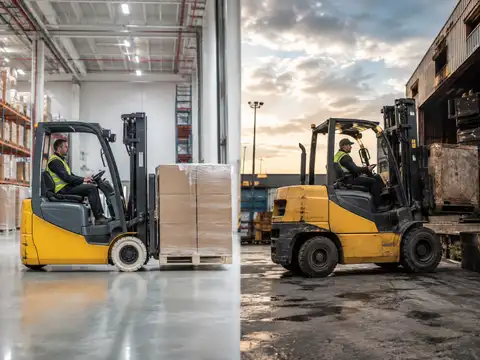
For warehouse, manufacturing and moderate-capacity mixed indoor/outdoor work, electric deserves a serious first quote in 2026.
Diesel becomes harder to replace as terrain, continuous duty and load capacity become more extreme.Toyota currently offers lithium-powered electric pneumatic models from 8,000 to 17,500 lb for demanding environments, while its heavy-duty diesel lineup extends from 30,000 to 125,000 lb.
Electric versus diesel used to be an easy shorthand. Electric meant a clean, flat warehouse floor. Diesel meant the yard.
That distinction is becoming less useful. Current electric forklifts use pneumatic tires, lithium-ion batteries, thermal management and weather-rated electrical systems to perform jobs that were historically dominated by internal-combustion equipment.
The important question has shifted from “Can electric go outside?” to “Does electric satisfy this specific outdoor duty cycle at a lower total cost than diesel?”
2026 application boundary
Electric has moved outdoors. Diesel still owns the extreme end.
Low noise, no tailpipe exhaust, lower routine maintenance and strong energy efficiency.
Modern pneumatic lithium electric trucks now compete directly with traditional IC applications.
Ports, steel, container handling and loads extending into tens of thousands of pounds.
Define load, terrain, annual hours, weather exposure and shift duration. Then compare the electric and diesel trucks that can actually perform that job.
Electric now competes in real outdoor forklift applications
Toyota's January 2026 outdoor-electric guidance explicitly says electric forklifts can operate both indoors and outdoors when the specific truck's environmental protection rating is suitable.
Toyota's current Integrated Electric Forklift line goes further. The company markets the trucks for lumber yards, construction sites and manufacturing facilities—applications historically associated with internal combustion.
Its integrated lithium-ion systems are designed around rugged outdoor operation, temperature management and performance comparable to IC trucks.
Current electric capacity reaches well beyond ordinary warehouse pallets
Toyota's March 2026 Integrated Electric Forklift FAQ lists:
- 8,000–11,000 lb for the Integrated Mid Electric Pneumatic;
- 13,500–17,500 lb for the Integrated Large Electric Pneumatic.
Those are serious industrial capacities. They overlap applications in building materials, lumber, manufacturing and outdoor freight handling rather than only indoor distribution.
Power source no longer determines outdoor suitability by itself. Tire type, IP rating, weather protection, ground conditions, battery thermal management and the manufacturer's approved operating environment all matter.
Toyota's 2026 diesel model shows where diesel still fits naturally
Toyota's current Core Diesel Pneumatic Forklift covers 4,000–6,500 lb and is explicitly positioned for demanding environments including lumber, construction materials, gravel, dirt and uneven surfaces.
The company emphasizes diesel torque, pneumatic-tire traction and long-term durability rather than warehouse compactness.
This is an important reminder: diesel does not survive simply because electric technology is unavailable. It survives because rugged outdoor duty remains an excellent fit for a simple fuel-and-engine architecture.
The far end of capacity still belongs to diesel
Toyota's current High-Capacity IC Pneumatic Forklift is diesel-powered and spans approximately 30,000–125,000 lb.
These trucks work in ports, construction, heavy manufacturing and container handling where the loads themselves can weigh tens of thousands of pounds.
Electric technology is moving upward in capacity, but an operation handling 60,000-lb steel or 100,000-lb industrial loads is still shopping in a different equipment class from an ordinary battery-powered warehouse forklift.
17,500 lb electric vs 125,000 lb diesel
Toyota's current integrated electric range demonstrates that electric has entered serious outdoor material handling. Toyota's high-capacity diesel range demonstrates that the highest-capacity end of the market still has a very different power requirement.
Do not compare purchase prices until the trucks are application-equivalent
Warehouse Fieldbook did not find a sufficiently transparent current U.S. dataset for a defensible 2026 “electric premium versus diesel” across comparable trucks.
That is partly because the product families do not line up neatly. A 5,000-lb diesel pneumatic truck, an 11,000-lb integrated lithium truck and a 50,000-lb diesel heavy-duty truck are fundamentally different assets.
The correct acquisition comparison starts after both dealers have quoted equipment capable of the same load, lift height, terrain, duty cycle and attachment.
Electric usually asks for more infrastructure up front
The electric truck is only one part of the energy system. Depending on battery strategy, the project can require:
- traction battery or integrated lithium pack;
- charger;
- charger circuits;
- panel or electrical-service upgrades;
- charging bays;
- cable management;
- battery-changing equipment for traditional swap systems;
- energy-management controls for larger fleets.
Toyota's current 80V Electric Pneumatic page specifically recommends a power study and says its energy consultants typically collect operating data for two to four weeks on heavier-use trucks before recommending a solution.
That is the right approach: measure the duty cycle before designing the charging system.
Diesel infrastructure is simpler at the truck—but not absent
Diesel forklifts need fuel storage, delivery or access to a fueling location. Toyota's May 2026 diesel-refueling guidance recommends defined fueling areas, ventilation where appropriate, spill-response equipment and fuel-handling practices suited to the operation.
State and local requirements can also affect fuel storage, secondary containment and spill reporting.
Diesel therefore avoids chargers but can create its own site infrastructure around tanks, pumps, spill control and fuel management.
Refueling speed remains one of diesel's strongest advantages
A diesel truck can be refueled and returned to service quickly.
Battery-powered trucks need energy to be transferred over time. Lithium-ion and high-rate charging have shortened that constraint substantially, but charging still needs to fit the operation's break and shift structure.
For an isolated outdoor operation running long continuous shifts with no natural charging windows, diesel can remain operationally simpler.
Charging downtime is not automatically productive downtime
The useful electric question is not “how long does a full charge take?” It is “does the truck need to be working during that time?”
If operators have scheduled meal breaks, shift changes and idle periods, opportunity charging can use time that was already nonproductive.
If the truck is genuinely required nearly continuously, the battery and charger strategy needs enough capacity to avoid becoming the constraint.
16 hours of daily work can produce two different answers
Operation A has several predictable breaks and two shift changes where opportunity charging is available.
Operation B uses one truck continuously with almost no planned idle windows.
Both operate 16 hours. Their electric feasibility can be completely different.
Electric maintenance is structurally simpler
Toyota's March 2026 electric-forklift guidance says electric trucks require less routine maintenance than internal-combustion models.
Electric equipment still needs:
- tires;
- brakes;
- mast chains;
- hydraulic hoses;
- forks;
- attachments;
- battery and electrical-system checks.
What disappears is much of the engine-related maintenance associated with oil, filters, cooling, exhaust and fuel-system components.
Integrated electric does not mean maintenance-free
Toyota's March 2026 Integrated Electric FAQ explicitly reminds users that normal forklift wear items remain.
This matters because some electric sales pitches imply that removing the diesel engine removes forklift maintenance. It does not.
Electric typically reduces maintenance intensity; it does not remove tires, hydraulics, mast wear or impact damage.
Diesel maintenance can be predictable in mature fleets
Diesel adds engine and fuel-system maintenance, but many heavy industrial operators already have technicians, filters, fluids and diagnostic experience built around IC equipment.
A fleet with strong in-house diesel maintenance may experience a lower incremental ownership burden than a facility converting from an entirely electric warehouse fleet.
Internal capability is therefore part of the TCO comparison.
Maintenance savings matter more as annual hours increase
The more a truck runs, the more frequently hour-based maintenance events occur.
That is why high-use applications are usually where electric's maintenance advantage has the greatest opportunity to recover charging and battery CAPEX.
A diesel backup truck running 250 hours per year may take a very long time to justify replacement purely from reduced service expense.
Electric avoids diesel exhaust inside the work area
OSHA's powered-industrial-truck standard specifically identifies closed environments where insufficient ventilation or poor vehicle maintenance can allow carbon monoxide or diesel exhaust to build up as a workplace condition that operators must understand.
OSHA's powered-industrial-truck eTool likewise warns that internal-combustion forklifts can create hazardous carbon-monoxide concentrations in enclosed work areas.
Electric eliminates tailpipe exhaust at the point of use. That can materially strengthen the case for electric where trucks spend substantial time inside warehouses.
Diesel makes more sense when most of the duty is genuinely outside
An operation that spends nearly the entire shift outside has less reason to pay for indoor-emissions benefits.
Examples include:
- lumber yards;
- building-material yards;
- construction sites;
- ports;
- steel yards;
- large outdoor manufacturing storage;
- heavy-equipment staging areas.
In these environments, surface condition, drawbar performance, gradeability and refueling logistics can outweigh warehouse noise and exhaust considerations.
But outdoor electric now deserves to be tested rather than dismissed
Toyota's January 2026 guidance says operators should use the truck's IP rating to determine its protection from solids and liquids before outdoor use.
The same guidance identifies electric pneumatic and integrated electric pneumatic products specifically as outdoor-capable equipment.
The procurement rule should therefore be: verify the rating and application, not the stereotype.
Rain is an equipment-rating question
Some electric forklifts can operate in rain; others should not. Toyota says the relevant IP code on the rating plate indicates the equipment's protection against solid objects and water.
A fleet manager should confirm the specific model's rating and operating instructions instead of assuming that “electric equipment cannot get wet.”
Diesel electrical systems and electronics also have environmental limits. Weather suitability is never determined by fuel alone.
Terrain can favor diesel—but tire and chassis design are the real variables
Toyota's 2026 Core Diesel product emphasizes pneumatic tires for gravel, dirt and uneven surfaces.
Modern electric pneumatic trucks use the same broad tire concept to enter similar terrain categories.
Compare:
- tire type and size;
- ground clearance;
- gradeability;
- traction control;
- vehicle weight;
- weather enclosure;
- manufacturer-approved terrain.
Those specifications reveal more than the word “diesel” or “electric.”
Gradeability deserves attention on yards and ramps
Yard operations may include ramps, trailer approaches and sloped surfaces. A truck's ability to start, stop and travel under load on grade is an application requirement—not a brochure afterthought.
Modern electric trucks can deliver strong low-speed torque, but the specific model still needs to satisfy the required grade at the actual load.
Ask both suppliers to provide loaded gradeability for the quoted configuration.
Cold weather is now less of an automatic diesel advantage
Toyota's current integrated-electric line uses custom lithium-ion batteries with thermal management designed for both hot and cold conditions.
That does not mean every battery forklift performs identically in winter. Battery chemistry, thermal controls and charging behavior at low temperature remain equipment-specific.
For a cold outdoor yard, require the electric supplier to document usable capacity and charging behavior at the facility's actual minimum temperature.
Extreme heat also deserves specification
Battery thermal management, motor cooling and electronics can all be affected by high ambient temperatures. Diesel engines also rely heavily on cooling systems under high-load hot-weather work.
Neither platform should receive an assumed advantage without checking the manufacturer's temperature limits and derating guidance.
Noise is a real operational difference
Toyota's integrated-electric guidance highlights reduced vibration and noise compared with internal combustion.
In a port yard, that may be secondary. In a building-material facility where trucks repeatedly enter an enclosed warehouse, lower noise can improve communication and operator comfort.
It is difficult to assign a generic dollar value, so treat noise as an application and workforce factor rather than fabricate an ROI number.
Idle time penalizes diesel differently
An internal-combustion engine can continue burning fuel while idling. Electric drive systems consume much less traction energy when the vehicle is stationary.
Toyota's current power-study process specifically measures runtime and idling because duty-cycle data helps determine the correct energy solution.
A yard truck that spends long periods waiting at a dock or production machine can therefore have a different power-source economics from a continuously moving truck.
Measure idle percentage before modeling diesel fuel
2,000 meter hours are not necessarily 2,000 productive hours
Truck A spends 5% of its recorded time idling.
Truck B spends 30% idling while waiting at production queues.
The second operation gives electric more opportunity to reduce energy waste even if both hour meters increase by the same amount.
The facility should use measured diesel consumption
Do not use a universal gallons-per-hour assumption if the fleet already exists.
Record:
- fuel gallons dispensed;
- hour-meter change;
- average load;
- idle percentage;
- season and temperature;
- truck class.
Then calculate actual diesel cost per meter hour or productive hour.
Electric should use measured charger input
The equivalent electric measurement is charger energy consumed from the facility, not battery nameplate capacity.
A useful operating metric is:
Compare energy at the facility boundary
Diesel: gallons delivered × all-in $/gal.
Electric: charger kWh × effective facility $/kWh.
Divide each by comparable operating output: truck-hours, pallets moved or another workload metric.
Demand charges can change electric fleet economics
A large fleet plugging into high-power chargers simultaneously can create a different utility bill from the same fleet charging in staggered windows.
Facilities on commercial tariffs should review demand charges, time-of-use periods and managed-charging opportunities before assuming that average cents-per-kWh captures the full electricity cost.
This is another reason Toyota recommends a power study for heavier-use electric fleets.
Diesel fuel price volatility shifts operating cost
Diesel is a commodity whose local delivered price can move significantly over an ownership period.
Electricity rates can change too, but the two energy sources may move differently. A five- or ten-year TCO model should therefore test multiple energy-price scenarios instead of assuming today's prices remain fixed.
Use three energy cases, not one forecast
A robust decision model can contain:
- low diesel / high electricity case;
- current-price base case;
- high diesel / low electricity case.
If electric wins in all three, the decision is relatively robust. If the answer flips with small price changes, operational factors deserve more weight.
Battery replacement belongs in long-term electric TCO
A multi-year electric analysis must include the battery's expected service life, warranty and replacement cost.
Integrated lithium systems can have different economics from traditional lead-acid packs, so do not insert one generic replacement interval.
Use the battery manufacturer or forklift OEM's warranted throughput, years or cycle assumptions for the quoted system.
Engine overhaul risk belongs in long-term diesel TCO
A diesel truck avoids traction-battery replacement but carries engine, transmission, cooling, exhaust and fuel-system aging.
High-hour heavy-duty equipment should therefore include a realistic allowance for major mechanical repairs later in life.
Maintenance history from the fleet's existing diesel trucks is a better input than a generic internet repair percentage.
Electric can change preventive-maintenance staffing
A large electrification project can reduce engine-related PM work and potentially change technician workload, oil/filter inventory and waste handling.
The value is larger in fleets with many high-hour trucks than in a business with two lightly used forklifts.
Include internal technician hours in the TCO model even if maintenance labor does not appear as an outside invoice.
Diesel can leverage existing fueling and service infrastructure
A lumber or construction-material operation may already maintain diesel loaders, yard trucks and other equipment.
In that case, forklift diesel can share:
- fuel storage;
- fuel delivery;
- technician skills;
- filters and fluids;
- diagnostic processes;
- maintenance schedules.
Electric conversion has to beat that mature infrastructure, not an imaginary facility starting from zero.
Electric can leverage existing warehouse charging infrastructure too
The opposite situation occurs in distribution centers that already operate large fleets of reach trucks, pallet jacks and electric counterbalance equipment.
Adding an outdoor electric pneumatic truck may reuse electrical knowledge, charging management and technician capability already present.
The incremental conversion cost can therefore be much lower than a first-time electric installation.
Mixed fleets are often economically rational
A company does not need one power source across every material-handling task.
It can use:
- electric for indoor warehouse production;
- electric pneumatic for moderate outdoor work;
- diesel for extreme-capacity yard and heavy industrial applications.
Standardization has maintenance value, but forcing one energy source into every application can create much larger inefficiencies.
One useful way to segment the fleet
| Application | First power source to model |
|---|---|
| Indoor warehouse, 3,000–6,500 lb | Electric |
| Indoor/outdoor mixed duty | Electric pneumatic and diesel / IC side by side |
| Lumber / building materials, moderate capacity | Electric pneumatic vs diesel based on duty cycle |
| Long continuous outdoor shifts | Diesel plus high-duty electric feasibility study |
| 8,000–17,500 lb outdoor industrial work | Modern integrated electric deserves a real quote |
| 30,000–125,000 lb extreme heavy duty | Diesel remains a primary current solution |
Calculate conversion economics at the truck level first
Do not begin with “replace 40 diesel forklifts.”
Rank the fleet by:
- annual hours;
- indoor percentage;
- idle time;
- fuel cost;
- maintenance cost;
- capacity;
- terrain;
- remaining economic life.
The trucks with high hours, high idle time and substantial indoor use are often the strongest first electric candidates.
A staged conversion reduces infrastructure risk
Convert the six best candidates, not all 20 trucks
Suppose six medium-capacity trucks run high hours and regularly enter the building, while fourteen diesel trucks mostly work remote outdoor storage.
A six-truck electric pilot can test charger utilization, weather performance, energy cost and operator acceptance before the company commits to facility-wide conversion.
Do not electrify a truck that is about to be retired anyway
The decision should align with normal replacement timing.
If a diesel forklift has two years of useful life remaining, the business case should compare:
keep existing diesel for two years vs replace now with electric.
Comparing a fully depreciated truck with a brand-new electric truck without recognizing the remaining service life can distort the payback calculation.
Conversely, a major diesel repair can accelerate the conversion case
If an aging forklift needs a costly engine, transmission or exhaust repair, the avoided repair becomes part of the electric replacement economics.
This is where asset-level maintenance history becomes valuable. Electrification can be timed around naturally occurring replacement events rather than treated as a separate sustainability project.
Safety requirements apply to both power sources
OSHA 29 CFR 1910.178 governs powered industrial trucks across electric and internal-combustion types.
Operator training, truck condition, workplace hazards and approved equipment remain central regardless of energy source.
Electric adds battery-charging requirements. Diesel adds fuel-handling, exhaust and refueling considerations. Neither energy source removes the need for a disciplined powered-industrial-truck program.
What to send dealers before requesting comparable quotes
Provide:
- load weight and dimensions;
- load center;
- maximum lift height;
- annual operating hours;
- shift schedule;
- idle percentage if known;
- indoor vs outdoor percentage;
- surface type;
- maximum grade;
- temperature range;
- rain / weather exposure;
- attachments;
- current diesel consumption;
- existing electrical service;
- expected ownership horizon.
Ask both bidders to design the truck around the same workload.
Normalize the financial comparison
| Cost bucket | Electric | Diesel |
|---|---|---|
| Truck CAPEX | Quote | Quote |
| Energy equipment | Battery + charger | Fuel storage / dispensing where applicable |
| Facility work | Electrical infrastructure | Fuel / spill infrastructure where applicable |
| Annual energy | Measured kWh × tariff | Measured gallons × delivered price |
| Routine maintenance | Generally lower | Engine + common truck maintenance |
| Major lifecycle event | Battery / electrical | Engine / transmission / emissions system |
| Downtime | Charging + repairs | Refueling + repairs |
| Residual value | Truck + battery condition | Truck / powertrain condition |
The practical recommendation
In 2026, do not rule out electric merely because the forklift goes outside. Current electric pneumatic and integrated lithium trucks are explicitly designed for outdoor industrial work and now reach capacities that overlap a meaningful portion of traditional IC applications.
Choose diesel when the operation genuinely benefits from fast liquid-fuel refueling, mature diesel infrastructure, severe continuous outdoor duty or lifting capacity beyond the practical electric range available for the application.
Choose electric when annual hours, indoor exposure, idle time, maintenance expense and charging opportunities create enough recurring value to recover the higher energy-system investment.
The best answer comes from a measured duty cycle—not an indoor/outdoor rule that modern equipment has already outgrown.
Frequently asked questions
Are electric forklifts as powerful as diesel forklifts?
In many moderate-capacity applications, yes. Toyota's current integrated electric pneumatic range covers 8,000–17,500 lb and is designed to deliver performance comparable to internal-combustion equipment in demanding environments. Diesel still extends much farther into extreme heavy capacity.
Can electric forklifts work outside?
Yes, when the specific model is designed and rated for outdoor use. Toyota's January 2026 guidance recommends checking the truck's IP code for protection against solids and water.
Can electric forklifts operate in rain?
Some can. Outdoor suitability depends on the specific forklift's environmental protection rating. Check the manufacturer's IP rating and operating instructions.
What capacity are diesel forklifts available in?
Toyota's current Core Diesel Pneumatic covers 4,000–6,500 lb, while its high-capacity diesel IC pneumatic line extends from 30,000 to 125,000 lb. Other manufacturers offer different capacity ranges.
What capacity are outdoor electric forklifts available in?
Toyota's current Integrated Mid Electric Pneumatic covers 8,000–11,000 lb and its Integrated Large version covers 13,500–17,500 lb. Other electric product families cover additional capacities.
Which costs more to maintain, electric or diesel?
Electric generally requires less routine maintenance because it removes many engine-related service items. Tires, hydraulics, brakes, mast components and attachments still need maintenance on both.
Is diesel better for continuous shifts?
Diesel has a simple advantage because refueling is quick. Modern lithium electric fleets can also support long or multi-shift duty when battery capacity and opportunity charging are correctly designed.
Are diesel forklifts safe indoors?
Internal-combustion equipment can be used only where the truck type and workplace conditions are appropriate. OSHA specifically highlights the risk of carbon monoxide or diesel exhaust buildup in enclosed areas with insufficient ventilation or poor vehicle maintenance.
When should a company switch diesel forklifts to electric?
Start with high-hour trucks that spend meaningful time indoors, have measurable fuel and maintenance costs, and operate on terrain that a current electric model can handle. Replace them near normal asset-replacement events where possible.
Sources and methodology
Warehouse Fieldbook used current 2026 Toyota product specifications and manufacturer guidance to define the present-day overlap between electric pneumatic and diesel forklifts. Because transparent like-for-like U.S. purchase pricing is not consistently published across comparable diesel and electric models, the available evidence does not support fabricating an acquisition-price gap. OSHA sources are used for powered-industrial-truck, ventilation and enclosed-area safety context.
- Toyota Material Handling — March 2026 Core Diesel Pneumatic applications and capacity
- Toyota Material Handling — current Core Diesel Pneumatic product
- Toyota Material Handling — March 2026 integrated electric capacity and outdoor-duty guidance
- Toyota Material Handling — current 8,000–11,000-lb integrated electric specifications
- Toyota Material Handling — current integrated electric technology and applications
- Toyota Material Handling — January 2026 outdoor electric / IP-rating guidance
- Toyota Material Handling — current outdoor 80V electric pneumatic performance and power studies
- Toyota Material Handling — current 30,000–125,000-lb diesel heavy-duty range
- Toyota Material Handling — May 2026 diesel refueling and site considerations
- Toyota Material Handling — March 2026 electric maintenance guidance
- OSHA — 29 CFR 1910.178 powered industrial trucks
- OSHA — enclosed-area carbon monoxide and IC forklift hazards