
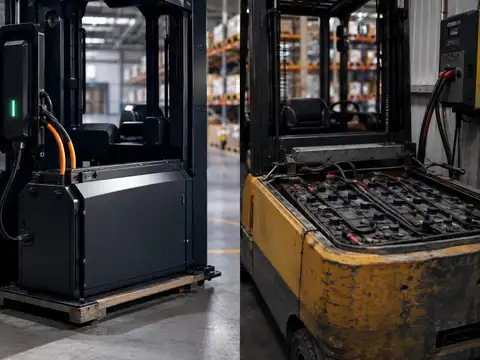
Forklift charger cost ranges from sub-$1,000 portable equipment to quote-only industrial systems—but installed project cost depends more on power and infrastructure than the box alone.
Crown's official U.S. store currently lists a 36V / 25A / 120V Eagle portable lead-acid charger at $784.94. By contrast, Crown's industrial V-Force lead-acid charger listings are quote-only. That difference is exactly why a single internet “forklift charger price” is not a reliable budgeting number.
Current official-store price anchors
Crown's official U.S. store currently lists the Eagle Performance Series Portable Charger at 36V / 25A / 120V input for flooded/AGM lead-acid batteries.
Crown's official store currently shows a V-Force 72V conventional lead-acid industrial charger as “Request Quote for Price.”
Crown's official store currently lists a 55-in single-side charger stand at $560.72; the page notes that the stand anchors to the floor.
Crown currently lists its V-Force Battery Monitoring Identification Device at $583.33, showing how monitoring hardware can become a separate charger-system cost.
Installed charger budget
Forklift Battery Charger Installed Cost Calculator
Build the charger project from actual quotes. No industrial charger price, electrical-install rate, demand-management cost or contingency is preloaded.
Charger quote × quantity.
Freight, mounting, accessories and monitoring.
Per-charger branch circuit, installation labor and physical protection.
Panel/service, engineering, network/controls, decommissioning and other scope.
Complete modeled project before the user-entered reserve.
Applied only at the entered percentage.
Modeled project total.
Total project ÷ charger quantity.
Charger nameplate/input data, manufacturer instructions, adopted electrical code, AHJ requirements and a qualified electrical design/installation control the final system.
Why industrial chargers often do not publish one price
Industrial charger configuration depends on:
- battery chemistry;
- output voltage;
- battery Ah / energy requirement;
- charging method;
- output current;
- AC input voltage;
- single-phase vs three-phase service;
- communication / battery identification;
- indoor vs outdoor enclosure;
- network / demand management;
- charger quantity and concurrency.
A quote-only industrial charger can therefore be a more honest commercial structure than a generic web price.
Crown's current V-HFM3 line shows how wide charger power configurations can be
| Current model | AC input | Battery / output capability |
|---|---|---|
| FS1 | 100–277V single phase | 12/24/36/48V; output options from 48A to 240A; lead-acid or lithium-ion capable. |
| FS3 | 208–600V three phase | 24/36/48/72/80/96V; up to 300A; lead-acid or lithium-ion capable. |
| FS4 | 480–600V three phase | 24/36/48/72/80/96V; up to 400A; lead-acid or lithium-ion capable. |
| FS6 | 480–600V three phase | 24/36/48/72/80/96V; up to 600A; Crown positions it for lead-acid fast charging. |
This is why a 120V portable charger and a 480V three-phase fast charger are different capital projects.
Toyota's current lithium chargers are also high-current system components
Toyota's current lithium-ion battery page lists:
- lithium-compatible chargers from 120 to 540 amps;
- Battery Management System control for optimized charging;
- plug-and-play compatibility with Toyota lithium batteries;
- wall, post or rack mounting;
- modular design;
- dual-cable charger options for the 5/35 battery.
Therefore a lithium conversion should price charger hardware as part of the battery technology project.
See Lithium-Ion vs Lead-Acid Forklift Batteries.
EnerSys shows why communication can be part of charger cost
EnerSys' current NexSys+ charger page lists:
- 2–21 kW power output range;
- 12–80V range;
- CAN bus;
- Ethernet;
- RS-485;
- wireless / Wi-Fi.
EnerSys says the NexSys+ charger supports profiles for:
- NexSys TPPL;
- NexSys iON;
- flooded battery technologies.
That means fleet charger projects can include more than power conversion.
They can include networking / monitoring / charge management.
Charger efficiency can affect operating cost—but do not hard-code a universal percentage
EnerSys currently advertises up to 94% efficiency for its IMPAQ and NexSys+ charger lines.
This is manufacturer product data, not a universal forklift-charger efficiency.
Actual facility energy cost depends on:
- charger model;
- battery throughput;
- charge profile;
- state of charge;
- utility energy rate;
- demand charges;
- concurrent charging.
Electrical installation can cost more than charger accessories
Voltage / phase / current determine electrical scope.
A charger can need a new breaker, disconnect, conduit/raceway, conductors and local electrical installation.
The panel or transformer may not have spare capacity.
Adding several high-current chargers can require distribution or service changes before any charger can be energized.
The charger needs a physical home.
Crown currently offers floor-anchored charger stands, rail stops, retractors and related charging-station hardware.
Large charger groups can add monitoring or demand management.
Crown's current Demand Response Management feature groups connected chargers to manage specified energy-consumption limits.
Crown's current demand-management feature shows why peak electrical demand matters
Crown says its Demand Response Management can group chargers and respond to:
- spot pricing limits;
- target peak loads;
- limited electrical infrastructure;
- utility-supplied triggers.
This is a manufacturer feature, but the broader cost lesson is charger quantity × individual charger power does not automatically equal acceptable simultaneous facility demand.
Do not size electrical infrastructure from battery voltage
A 48V battery charger can have very different AC input requirements depending on charger power / phase / design.
Crown's own current line demonstrates the same family can include:
- 100–277V single-phase input;
- 208–600V three-phase input;
- 480–600V three-phase input.
Do not derive breaker size, conductor size or transformer/service capacity from the charger output amps shown in this article. Use the charger's actual AC input nameplate/specification and qualified electrical design under the adopted code.
Opportunity and fast charging can change charger quantity
Toyota's July 20, 2026 charging guide says charger selection depends on:
- fleet size;
- shifts;
- available charging space;
- available charging time;
- uptime goals;
- battery-management strategy.
Toyota says opportunity charging can reduce battery-change requirements in appropriate multi-shift operations.
But Toyota also warns when three-shift demand becomes too heavy, one-battery-per-truck fast/opportunity architecture may not keep up.
Charger count is therefore an operational sizing decision, not “one charger per forklift” by default.
A power study should come before a large charger purchase
Toyota's current guidance says power studies can help evaluate:
- run-time;
- available charge time;
- shift schedules;
- charging requirements;
- battery needs;
- charging infrastructure.
The right sequence is demand → battery strategy → charger strategy → electrical design → quote.
OSHA requires a designated battery-charging area
OSHA 1910.178(g)(1) says battery charging installations shall be located in areas designated for that purpose.
OSHA 1910.178(g)(2) includes:
- electrolyte flushing/neutralizing facilities;
- fire protection;
- protecting charging apparatus from truck damage;
- adequate ventilation for fumes from gassing batteries.
Physical protection belongs in installed cost
OSHA explicitly requires charging apparatus to be protected from truck damage under 1910.178(g)(2).
Crown currently offers rail stops specifically to help prevent damage to chargers and surrounding area.
Therefore protection hardware is not merely cosmetic.
OSHA 1910.178(g)(1) sets the designated-area requirement.
OSHA 1910.178(g)(2) expressly addresses protecting charging apparatus from truck damage.
OSHA 1910.178(g)(10) and (11) address smoking, flames, sparks and electric arcs.
Do not assume changing chemistry eliminates all charging-area, electrical or fire requirements.
Crown's current official accessory prices demonstrate scope creep
On the current Crown charger/stand pages separate accessories include:
- 55-in single charger stand — $560.72;
- Heavy Duty Pogo Stick + Tender Kit — $166.67;
- cable retractor — $225.00;
- Battery Monitoring Identification Device — $583.33;
- tower light — $425.00;
- remote switch — $475.00.
These are Crown-specific current accessory prices, not universal charging-station requirements.
The lesson is
the cabinet price can be only the first line of the charging-station bill of materials.
Do not automatically buy every accessory
A wall-mounted charger may not need a floor stand.
A one-truck operation may not need charger pooling or demand-response software.
A complex battery room may benefit greatly from battery ID / queuing.
Price accessories from the operational need.
Charger replacement versus new charging architecture
If one failed conventional charger is replaced like-for-like, the project can be relatively contained.
If the operation changes:
- lead-acid → lithium;
- conventional → opportunity;
- conventional → fast;
- central battery room → decentralized charging;
- single chargers → networked demand-managed group
then treat it as a facility energy project.
Battery replacement and charger replacement are separate decisions
The Forklift Battery Replacement Cost guide prices the battery event.
This article prices the charger / electrical project. Do not bury charger capital inside the battery quote.
Installed charger cost audit
- Truck make/model/serial.
- Battery chemistry.
- Battery voltage.
- Battery Ah / energy requirement.
- Approved charge profile.
- Conventional / opportunity / fast charging method.
- Measured daily battery energy throughput.
- Available charging windows.
- Required charger quantity.
- Required simultaneous charging.
- Charger model.
- Charger output voltage/current.
- Charger AC input voltage.
- Single-phase / three-phase.
- Input nameplate current / kW.
- Connector/cable.
- Battery/charger communication requirement.
- Indoor/outdoor environmental rating.
- Charger equipment quote.
- Freight.
- Stand/wall/post mounting.
- Cable support/retractor.
- Battery ID / monitoring.
- Local control / tower light if required.
- Network / demand-management licenses if required.
- Branch-circuit design.
- Disconnect / overcurrent-protection scope.
- Conduit/raceway / conductors.
- Electrical installation labor.
- Panel spare capacity verified.
- Transformer capacity verified.
- Service capacity verified.
- Panel/transformer/service upgrade budgeted if needed.
- Designated charging area.
- Truck-impact protection.
- Fire/ventilation/electrolyte controls as applicable.
- Ignition-control requirements.
- Electrical permit / inspection.
- Old charger removal/decommissioning.
- Commissioning / charger programming.
- Battery/charger compatibility verification.
- Installed project total.
- Contingency only after known scope is priced.
Model installed charger and electrical CAPEX
The lithium-vs-lead-acid battery guide's TCO model needs a charger/infrastructure CAPEX input.
This article creates that installed number. It separates:
- charger equipment;
- hardware/accessories;
- electrical branch/install;
- facility upgrades;
- controls/network;
- decommissioning;
- contingency.
It deliberately:
does not:
- preload a generic industrial charger price;
- size breakers/conductors;
- assume every charger needs a stand;
- assume a panel/service upgrade;
- assume a demand-management system;
- invent an electrical labor rate.
The decision rule
Match the charger to the exact battery chemistry, voltage, duty and charging method first. Then price the AC side: charger quantity, input voltage/phase, branch circuits, disconnects, mounting, physical protection and any distribution upgrade. Add only the monitoring, networking and demand-management features the operation actually needs. For a large fleet, use measured energy demand and a charging strategy before buying chargers. The installed charger cost—not the cabinet price—is the number that belongs in the battery TCO model.
Frequently asked questions
How much does a forklift battery charger cost?
It depends strongly on charger type and power. Crown's official U.S. store currently lists one 36V/25A/120V portable lead-acid charger at $784.94, while an industrial V-Force 72V charger is quote-only. Installed industrial charging systems can also require mounting, protection and electrical infrastructure.
Why do industrial forklift chargers often require a quote?
Because chemistry, battery voltage/Ah, charge profile, output current, AC input voltage/phase, communication and optional controls change the charger configuration.
How much does a forklift charger stand cost?
Crown's official store currently lists one 55-in single-side charger stand at $560.72. That is a Crown-specific current product price, not a universal stand budget.
Can a forklift charger run on 120V?
Some smaller chargers can. Crown's current Eagle 36V/25A portable charger uses 120V input. Crown's industrial V-HFM3 line also includes single-phase 100–277V and much larger three-phase 208–600V or 480–600V configurations.
Do industrial forklift chargers need three-phase power?
Many high-current chargers do, but not all. Crown's FS1 is single phase while its current FS3/FS4/FS6 examples are three phase. Use the exact charger input specification.
Can one charger handle several battery voltages?
Some can. Crown's current V-HFM3 line includes multi-voltage models, and EnerSys NexSys+ supports a range of battery technologies/voltages depending on model and configuration.
Does lithium need a different charger?
Use a charger explicitly approved for the lithium battery system. Toyota's current lithium chargers use Battery Management System control and are designed for its lithium batteries.
Does the charger need protection from forklifts?
OSHA 1910.178(g)(2) includes protection of charging apparatus from truck damage. The actual guard/placement design should fit the facility traffic risk.
Should charger monitoring be included in the budget?
When the operation needs battery identification, charging-pool management, fleet visibility or demand control, yes. Crown and EnerSys both currently offer charger/ battery communication and monitoring features.
Can charger demand create a panel or service upgrade?
Yes if the existing electrical distribution lacks sufficient capacity for the selected charger group. Have a qualified electrical professional evaluate actual nameplate loads and concurrency.
How should charger cost be used in a lithium-vs-lead-acid analysis?
Use the complete installed charger/infrastructure project as the CAPEX input in the technology TCO model rather than comparing battery prices alone.
Charger selection can change the infrastructure decision itself. For facilities comparing a traditional charging room with a fleet conversion, see the battery room vs lithium conversion analysis.
The charger quote should match the operating strategy rather than being selected in isolation. Compare conventional, fast and opportunity approaches in the forklift charging methods guide.
Sources and methodology
Warehouse Fieldbook separates current published product prices from quote-only industrial equipment. Crown's official U.S. store supplies the current $784.94 Eagle 36V/25A/120V portable charger price, the quote-only status of a V-Force 72V industrial charger, the $560.72 charger stand and the $583.33 Battery Monitoring Identification Device price. These examples are explicitly not generalized into a national charger-cost range. Crown's current V-HFM3 page supplies the FS1/FS3/FS4/ FS6 input-voltage/phase, battery-voltage and output-current examples, plus its current charging-station and Demand Response Management features. Toyota's current lithium page supplies the 120–540A charger range and Battery Management System control. Toyota's July 20, 2026 charging-method guidance supplies current charger- strategy/power-study context. EnerSys' current NexSys+ page supplies its 2–21 kW, 12–80V and communication-capability examples; current EnerSys pages supply the up- to-94%-efficiency manufacturer data. OSHA 1910.178(g) supplies the designated-area, charger-protection, gassing/electrolyte and ignition-control boundaries. The installed-cost calculator is Warehouse Fieldbook methodology and preloads no industrial charger, electrical installation, facility-upgrade or contingency cost.
- Crown official store — current Eagle Performance Series Portable Charger
- Crown official store — current quote-only V-Force 72V industrial charger
- Crown official store — current charger stand / accessory pricing
- Crown — current V-HFM3 forklift charger specifications
- Toyota Material Handling — current lithium-ion charger specifications
- Toyota Material Handling — July 20, 2026 charging-method guidance
- EnerSys — current NexSys+ charger specifications
- EnerSys — current IMPAQ charger efficiency / communications
- OSHA — 29 CFR 1910.178 Powered Industrial Trucks