
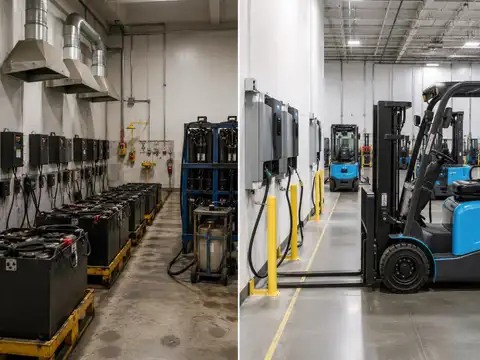
Lithium can make a centralized battery-changing room unnecessary—but it does not make charging infrastructure disappear.
Crown currently says lithium-ion batteries can be opportunity charged on the truck and charging stations can be distributed throughout an operation rather than concentrated in a central battery room. Toyota's July 2026 charging guide similarly says opportunity charging can reduce battery changes and potentially eliminate battery rooms and changing equipment. Both are manufacturer operational claims; whether your facility can do this depends on measured energy demand, truck compatibility and charging infrastructure.
Facility architecture
Central battery room or distributed lithium charging?
The decision changes space, material handling, electrical distribution, maintenance work and operator behavior. It does not remove the need for designated charging locations or project-specific safety review.
- Battery handling equipment and swap labor can be central cost drivers.
- Flooded batteries can add electrolyte, watering, corrosion and gassing controls.
- Centralization can simplify supervision, maintenance and charger management.
- Can reduce or eliminate routine battery swapping when the power study supports it.
- Charging points can move closer to breaks and operating zones.
- More distributed chargers can increase branch-circuit, protection and demand-management scope.
What a traditional lead-acid battery room actually does
In a multi-battery lead-acid operation, the central room / area can combine:
- battery changing;
- charging;
- cooling / ready-battery storage;
- water / electrolyte-related maintenance;
- battery inspection;
- charger management;
- damage / repair isolation;
- battery handling equipment.
Centralization can be operationally useful even when it consumes valuable floor area.
OSHA's current lead-acid charging framework explains much of the room infrastructure
OSHA 1910.178(g)(2) says facilities shall be provided for:
- flushing / neutralizing spilled electrolyte;
- fire protection;
- protecting charging apparatus from truck damage;
- adequate ventilation for dispersal of fumes from gassing batteries.
OSHA 1910.178(g)(4) says a conveyor, overhead hoist or equivalent material-handling equipment shall be provided for handling batteries.
These requirements help explain why a flooded lead-acid battery-change area can become a substantial facility system.
OSHA defines adequate ventilation around hydrogen accumulation
OSHA's 1976 interpretation defines adequate ventilation under 1910.178(g)(2) as sufficient natural or mechanical ventilation to keep hydrogen below the 4.1% lower explosive limit cited in that OSHA interpretation.
Do not turn the 4.1% interpretation into a generic exhaust-fan sizing formula. Ventilation design depends on the actual battery population, charging behavior, room geometry and applicable code/design requirements.
OSHA's eTool shows the broader operating controls around a charging area
OSHA's current Powered Industrial Trucks eTool lists a properly equipped battery charging area as including:
- no-smoking controls;
- warning signs;
- fire protection;
- water / neutralization provisions;
- eyewash;
- communication;
- ventilation for hydrogen gas;
- neutralizing material;
- fire extinguisher;
- protection of charging apparatus from truck damage.
The eTool is OSHA educational guidance. The enforceable requirements come from the applicable OSHA standards and other governing requirements.
What lithium conversion can remove from the workflow
Crown currently says:
lithium-ion batteries:
- can be charged on the truck;
- can use short opportunity-charge windows;
- do not require watering;
- do not expose employees to flooded-battery chemicals during routine servicing;
- do not emit charging gas in the way flooded lead-acid batteries do;
- can reduce battery swapping.
Crown's current charging-station article says lithium charging stations can be spread throughout the operation rather than centralized in a battery room.
Crown gives breaks as short as 5–10 minutes as opportunity-charging examples.
Toyota's July 2026 guidance explicitly connects opportunity charging with battery-room elimination
Toyota's July 20, 2026 charging-method article says opportunity charging can reduce battery-change requirements, eliminating battery rooms and changing equipment in suitable applications.
But Toyota also says this method requires:
- compatible chargers;
- consistent charging schedules.
The same article says very heavy three-shift demand can exceed one-battery-per-truck fast/opportunity capability.
That is why the Conventional vs Fast vs Opportunity Charging decision belongs before the room-removal decision.
Lithium can release space—but only released usable space has economic value
Do not monetize the full battery-room footprint if some of it remains needed for:
- electrical equipment;
- chargers;
- maintenance;
- fire / egress clearance;
- other facility functions.
And do not assign rent savings unless released space actually avoids rent / expansion / overflow cost.
Battery-room value is not always storage value
A former battery room might be poorly located for high-velocity storage.
It might be excellent for:
- maintenance;
- packing;
- returns;
- staging;
- tooling;
- value-added services.
Value the use the space can realistically support.
Central battery room vs distributed lithium charging
| Facility function | Central lead-acid room / area | Distributed lithium conversion |
|---|---|---|
| Routine battery swaps | Can be central to multi-shift conventional architecture. | Can be reduced/eliminated if one in-truck battery plus opportunity charging supports duty. |
| Battery-change equipment | Can include hoists, extractors, roller stands or other approved handling equipment. | Routine swap equipment can become unnecessary if batteries remain in trucks. |
| Flooded-battery maintenance | Watering, cleaning, electrolyte/spill controls and gassing ventilation can be relevant. | Sealed lithium removes flooded-battery watering/equalization workflow but adds BMS/charger diagnostics. |
| Charger location | Often centralized. | Can be distributed near breaks/operating zones to capture opportunity windows. |
| Electrical distribution | Concentrated branch circuits / charger loads. | Potentially more branch circuits and broader distribution, depending on charger layout. |
| Truck traffic | Traffic converges at battery room for changes/charging. | Charging traffic can be distributed but creates more local charging interfaces. |
| Operator behavior | Battery change often follows a defined central process. | Opportunity strategy depends on reliable operator plug-in compliance. |
| Released floor area | Room remains dedicated to motive-power functions. | Potentially reusable after decommissioning and facility review. |
Lithium does not mean “no charging area” under OSHA
OSHA 1910.178(g)(1) remains the general designated-area rule.
It says battery charging installations shall be located in areas designated for that purpose.
So distributed lithium chargers should not become random outlets anywhere in the warehouse.
OSHA's charging-only directive is highly relevant to on-truck charging
OSHA Directive STD 01-11-004 says charging areas where:
- batteries are charged only;
- no maintenance is performed;
- batteries are not removed from trucks;
- no electrolyte is present
are not subject to 1910.178(g)(2) under the conditions described in that directive.
OSHA says those charging-only areas still must comply with 1910.178(g)(1) and (g)(8)–(12).
It does not say “lithium is exempt from OSHA charging rules.” It applies to the described charging-only conditions. Maintenance, electrolyte presence, battery removal or other hazards can change the applicable controls. Other OSHA, electrical, fire, manufacturer and insurer requirements can also apply.
OSHA's eyewash interpretation also depends on electrolyte exposure
OSHA's 1976 interpretation says quick drenching/flushing under 1910.151(c) is relevant where battery caps are removed and electrolyte acid is added, removed or spilled.
OSHA says if a battery is simply undergoing charge, quick drenching/flushing is not necessary on that basis.
That distinction matters when converting from flooded-battery maintenance to sealed on-truck charging.
Lithium changes the hazard profile; it does not remove battery fire risk
NFPA's current lithium-ion battery safety resources emphasize safe:
- use;
- charging;
- storage;
- disposal.
Lithium-ion removes flooded lead-acid watering / acid / routine gassing issues from the normal workflow, but damaged / defective lithium batteries have a different fire / thermal hazard profile.
Therefore conversion should include:
- manufacturer emergency guidance;
- damaged-battery isolation / response procedure;
- fire-code / insurer review;
- approved charging equipment.
Distributed charging creates more physical interfaces
Crown's current cable-management article says lithium opportunity charging can create more connection / disconnection cycles and therefore more cable / connector wear than traditional charging.
This is a useful counterweight to “lithium = no maintenance.”
Charging-point placement determines whether opportunity charging works
Crown recommends locating charging stations where operators naturally pause.
Examples include:
- near break rooms;
- near restrooms;
- other convenient parking / operating zones.
Toyota similarly emphasizes opportunity charging during breaks / lunches / shift changes.
The hidden facility question is how much electrical distribution is needed to put chargers where the operation needs them.
Distributed charging can trade room CAPEX for electrical CAPEX
Moving from one central charging room to many charging points can add:
- branch circuits;
- disconnects;
- charger stands / wall mounting;
- physical impact protection;
- cable management;
- networking;
- demand management;
- panel / transformer / service upgrades.
Use the Forklift Battery Charger Cost calculator to price the complete distributed charger project.
The lithium battery itself is only part of conversion CAPEX
Battery quote, approved voltage/energy, physical dimensions, weight/counterbalance and connectors.
Charger quantity, output, AC input, locations, mounts, cables and controls.
Branch circuits, panels, transformers, service capacity and demand management.
Old batteries/chargers, room equipment, floor repair, training, commissioning and temporary mixed-fleet complexity.
Truck compatibility can block a conversion before economics matter
Toyota's current lithium systems illustrate the integration variables:
- Battery Management System (BMS);
- truck connector;
- lithium-compatible charger;
- battery weight / built-in counterweight on some products;
- adjustable spacers / compartment fit on some products.
A facility should not decommission its lead-acid infrastructure until the actual truck fleet is validated for the replacement system.
Run the power study before assigning a value to the room
Toyota's current electric-equipment guidance says a power study can collect approximately 2–4 weeks of heavily used truck data.
It can measure:
- runtime;
- idle time;
- available charge;
- amp-hours;
- shift volume.
Until one-battery-per-truck opportunity charging is validated, battery-room elimination is a hypothesis.
The TCO model should include the value of released space—but only once
Use the Lithium-Ion vs Lead-Acid Forklift Batteries TCO calculator for battery / charger / maintenance / energy / handling economics.
Then add a released-space benefit only when the business can actually use or monetize that space.
Do not count both avoided warehouse expansion and rent savings if they represent the same economic benefit.
Keep the battery room when it is already solving the problem efficiently
Lead-acid infrastructure is compliant, paid for and operationally disciplined.
If swaps, watering and charging do not constrain throughput, lithium may remove costs that are already small.
Trucks have long overnight charge windows.
The battery room may be simple charging/maintenance space rather than a high-cost multi-battery swapping operation.
The battery-room location is not useful for storage/process expansion.
“Reclaimed square feet” create little financial benefit if the business has no productive use for them.
Evaluate lithium conversion when the battery room is an operating bottleneck
Battery changes consume labor and truck availability every day.
Opportunity-charged lithium can become valuable when eliminating swaps releases measurable productive time.
The battery room blocks a higher-value operation.
A validated conversion can release facility area for a use that avoids overflow, expansion or creates contribution.
Watering, corrosion, cleanup and battery service are meaningful recurring costs.
Sealed lithium removes flooded-battery tasks, though charger/BMS/cable inspection and damaged-battery response remain.
Frequent short idle windows exist close to useful charging locations.
This is the architecture in which distributed opportunity charging can replace centralized battery changes most effectively.
Transition risk is real when the fleet converts in phases
Chargers, connectors, procedures and operator instructions must prevent cross-connection or wrong charging.
Panel, transformer or service work can control the conversion schedule.
Training, charger placement and charging compliance become operational controls.
Remove equipment, repair floor/walls, resolve obsolete electrical/ventilation systems and prepare the area for its new use.
Do not remove the lead-acid room before the lithium system proves itself
A safer conversion sequence:
- measure existing fleet duty;
- validate compatible lithium battery / truck / charger configuration;
- design electrical / charging locations;
- install and commission a pilot;
- measure opportunity-charge compliance and battery state-of-charge performance;
- expand the fleet conversion;
- retire redundant lead-acid batteries / chargers / handling equipment;
- decommission / repurpose battery-room area after operational validation.
This avoids creating a one-way facility change before the new power architecture is proven.
Battery-room vs lithium conversion audit
- Current truck fleet by make/model/serial.
- Current lead-acid batteries per truck.
- Current chargers / charge method.
- Current battery changes per truck/day.
- Battery-change labor time.
- Truck downtime per change.
- Battery-room gross ft².
- Battery-room ft² realistically reusable.
- Credible alternative use of released space.
- Annual value of that alternative use.
- Current watering / cleaning labor.
- Current battery maintenance / repair cost.
- Current ventilation / room equipment maintenance.
- Current handling-equipment maintenance.
- Power study / measured daily Ah or kWh.
- Peak-day duty.
- Actual idle / break / shift-change windows.
- Actual likely connected charging minutes.
- Candidate lithium battery compatibility.
- Battery voltage / energy capacity.
- Battery weight / truck range.
- Compartment / restraint / spacers.
- Battery Management System / truck integration.
- Connector / polarity.
- Lithium-compatible charger model.
- Charger quantity.
- Charger locations.
- OSHA-designated charging locations.
- Charger impact protection.
- Branch circuits.
- Panel capacity.
- Transformer capacity.
- Service capacity.
- Peak-demand / demand-management review.
- Electrical / fire / insurer review.
- Damaged-lithium-battery response.
- Lithium battery + charger CAPEX.
- Electrical project CAPEX.
- Lead-acid decommissioning cost.
- Room remediation / repurpose cost.
- Old battery recycling / core value.
- Old charger disposal / reuse value.
- Mixed-chemistry transition controls.
- Operator opportunity-charging training.
- Pilot / commissioning plan.
- Lead-acid TCO.
- Lithium TCO.
- Released-space benefit added once.
- Downtime / labor benefit double-count check.
- Final conversion payback / NPV reviewed by finance.
Use the existing power-and-charging cost tools
The required arithmetic already exists in the prior Power & Charging tools.
Use:
- The forklift battery replacement guide for battery replacement cost;
- The lithium-vs-lead-acid battery guide for lead-acid vs lithium TCO;
- The forklift battery charger cost guide for installed charger/electrical CAPEX;
- The forklift charging-methods guide for charging-method selection.
A fifth calculator would mostly duplicate those inputs.
The unique value here is deciding whether the battery-room function can actually disappear and what new infrastructure replaces it.
The decision rule
Keep the centralized lead-acid room when it is compliant, paid for, operationally efficient and occupies space with little alternative value. Evaluate lithium conversion when battery swaps, watering/maintenance, room space or truck downtime create measurable cost and when a power study proves that in-truck opportunity charging can support the duty. Price the full conversion: batteries, compatible chargers, electrical distribution, protection, controls, training and decommissioning. Treat released floor area as a benefit only when it has a real productive use. Lithium can eliminate a battery-changing room; it does not eliminate charging design, safety or operational discipline.
Frequently asked questions
Do lithium forklift batteries eliminate the battery room?
They can make a centralized battery-changing room unnecessary when batteries stay in trucks and distributed opportunity charging supports the measured duty. Crown and Toyota both currently describe this operating model. It is application-specific.
Does OSHA require a separate battery room?
OSHA 1910.178(g)(1) requires battery charging installations to be located in areas designated for that purpose. The text does not impose a universal requirement that every charging installation be a separate enclosed room.
Does lithium eliminate the OSHA designated charging-area requirement?
No. OSHA 1910.178(g)(1) still requires designated charging areas. A separate OSHA directive provides narrower treatment for charging-only areas under specified conditions, but does not eliminate the designated-area rule.
What does OSHA require in a lead-acid battery charging area?
1910.178(g)(2) addresses electrolyte flushing/neutralizing, fire protection, charger protection and ventilation for gassing batteries. Other paragraphs address battery handling, charging procedures and ignition controls.
Does a lithium charging station need ventilation for hydrogen gas?
The hydrogen-gassing provision in 1910.178(g)(2) addresses fumes from gassing batteries and is closely associated with flooded lead-acid charging. Do not infer from that that lithium charging has no ventilation, fire or electrical design requirements; evaluate the actual battery/charger system and governing requirements.
Can lithium chargers be placed around the warehouse?
They can be distributed when the electrical/safety design permits it. Crown currently recommends convenient charging-station placement to support opportunity charging rather than requiring all chargers to remain in a central battery room.
How short can a lithium opportunity charge be?
Crown currently gives 5–10-minute breaks as opportunity-charging examples. That is manufacturer guidance, not a universal minimum. Use the actual battery/charger charge profile and measured energy balance.
How much battery-room space can lithium release?
Measure the net area that can actually be repurposed after chargers, electrical equipment, egress/fire clearances and remaining facility uses are accounted for. Do not value the room's gross square footage automatically.
Should I convert to lithium just to gain warehouse space?
Only if the released space has a credible economic use and the full conversion TCO is supportable. The value can come from avoided overflow/expansion or productive operations, but should not be invented from generic rent-per-square-foot assumptions.
Can lithium reduce battery-change labor?
Yes when one in-truck battery plus opportunity charging can support the operation. Validate that assumption with measured duty and actual charging windows before removing spare batteries or change equipment.
What costs are easy to miss in a lithium conversion?
Lithium-compatible chargers, distributed branch circuits, panel/transformer/service upgrades, charger stands/protection, network/demand controls, operator training, mixed-chemistry transition, lead-acid decommissioning and room remediation.
Should the battery room be removed before the lithium rollout?
Prefer operational validation first. Pilot the battery/charger architecture, measure charging compliance and energy balance, then retire redundant lead-acid equipment and repurpose the room after the new system is proven.
Sources and methodology
Warehouse Fieldbook separates regulatory requirements from manufacturer operating claims. OSHA 1910.178(g) supplies the designated-area, electrolyte, fire, charger- protection, gassing-ventilation and battery-handling requirements. OSHA Directive STD 01-11-004 supplies the charging-only-area clarification, and OSHA's 1976 interpretations supply the hydrogen lower-explosive-limit ventilation context and electrolyte-dependent drenching/flushing distinction. Crown's current charging- station guidance supports distributed lithium charging and its 5–10-minute opportunity-charge example; Crown's current lithium materials support on-truck charging and the removal of flooded-battery watering/gassing workflow. Crown's cable-management article provides the counterpoint that more frequent opportunity charging can increase cable/connector cycling. Toyota's July 20, 2026 charging- method guidance supports the manufacturer claim that suitable opportunity-charging operations can reduce battery changes and eliminate battery rooms/changing equipment, while also warning that very heavy three-shift duty can exceed one-battery-per-truck charging capacity. Toyota's current electric-equipment guidance supplies the 2–4-week power-study example. NFPA's current lithium-ion safety resources are used only to establish that lithium creates a different charging/storage/fire-safety profile rather than “no battery risk.” No universal room cost, space value or conversion ROI is invented.
- OSHA — 29 CFR 1910.178 Powered Industrial Trucks
- OSHA — Directive STD 01-11-004 charging-only areas
- OSHA — adequate ventilation / hydrogen interpretation
- OSHA — quick drenching/flushing interpretation for battery charging
- OSHA — Powered Industrial Trucks eTool battery charging guidance
- Crown — current forklift charging-station configuration guidance
- Crown — current lithium-vs-lead-acid fleet guidance
- Crown — current opportunity-charging cable/connector wear guidance
- Toyota Material Handling — July 20, 2026 charging-method guidance
- Toyota Material Handling — current lithium battery / BMS / charger integration
- NFPA — current lithium-ion battery safety resources