
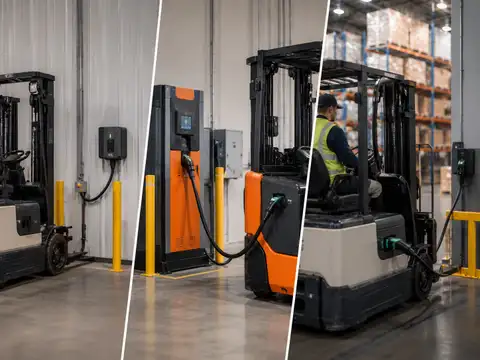
Long off-shift recharge.
Toyota currently defines conventional charging as charging at the end of a shift and returning the battery to service after charging is complete.
Strong fit when enough uninterrupted off-shift time exists—or when spare batteries support heavy multi-shift duty.Lower-rate charging during planned idle windows.
Toyota's July 20, 2026 guidance describes opportunity charging during breaks and shift changes, at lower charging rates than fast charging.
Strong fit when idle windows are frequent, reliable and long enough to restore the measured daily energy requirement.Higher-rate partial charging.
Toyota currently describes fast charging as partial charging throughout the day at higher rates, commonly for multi-shift operations that need high uptime.
Strong fit when the operation can support the charger power and the battery's approved high-rate charging program.24-hour operating view
The charging method is a schedule architecture.
These strips are conceptual—not charge curves. They show when charging tends to occur. Actual current, state-of-charge limits, taper, cooling and equalization come from the approved battery/charger system.
Best when a long uninterrupted off-shift window exists or multiple battery sets support heavy multi-shift duty.
Uses planned idle windows. Lead-acid systems still need the full-charge/equalization/cool-down practices required by their approved program.
Higher charging rate can recover more energy in the same window but increases charger/electrical demand and, for flooded lead-acid, can increase battery wear.
Conventional vs opportunity vs fast charging
| Decision factor | Conventional | Opportunity | Fast |
|---|---|---|---|
| When charging occurs | Typically after the operating shift in a long block. | During breaks, lunches, shift changes and other reliable idle windows. | During planned idle windows, using higher charging rates to restore energy faster. |
| Typical operational fit | Single shift or operations with enough spare batteries / off-shift time. | Multi-shift operations with moderate daily energy demand and frequent charge opportunities. | High-utilization multi-shift operations where charger/battery system supports aggressive recovery. |
| Battery swaps | Can require multiple batteries per truck in heavy multi-shift duty. | Can reduce battery-change requirements when charging windows meet demand. | Can reduce spare batteries and downtime when high-rate charging keeps pace. |
| Lead-acid battery care | Full recharge, cooling and periodic equalization under the approved program. | Periodic full charge, equalization and cooling remain important; watering demand can increase. | Periodic full charge/equalization/cooling remain important; Toyota warns accelerated use can shorten service life. |
| Charger / facility power | Lower charging rate can reduce instantaneous charger demand, subject to actual system. | Higher than conventional in some lead-acid implementations; more charging points may be distributed near work areas. | Highest power demand of the three in comparable lead-acid guidance; electrical capacity becomes a major design input. |
| Scheduling discipline | Protect the full off-shift charge/cooling window. | Operators must plug in consistently at the intended opportunities. | Consistent charging opportunities plus approved battery-temperature/maintenance controls are critical. |
| Best selection input | Measured daily Ah/energy use + actual charging windows + approved battery/charger limits + required uptime. | ||
Toyota's current 2026 guidance gives a useful operational starting point
Toyota's July 20, 2026 charging guide says conventional charging is commonly used in one-shift operations with overnight downtime.
It also gives an important heavy-duty exception if one-battery-per-truck fast/opportunity charging cannot keep up, a heavy three-shift application may use three batteries per truck—one in use, one charging and one cooling.
Toyota's current opportunity-charging example
Toyota says opportunity charging is commonly used where average usage is approximately 1.5 times the battery's usable daily capacity.
Toyota says this method can:
- reduce battery-change requirements;
- potentially eliminate battery rooms / changing equipment;
- improve uptime;
when compatible chargers and consistent charging schedules are available.
The 1.5× figure is Toyota's current application guidance, not an ANSI/OSHA limit and not a universal sizing formula. Different batteries, chemistries, chargers, temperatures and duty profiles can support different daily energy throughput.
Crown publishes lead-acid start-rate examples for the three methods
Crown's current charging-method article says conventional lead-acid charging uses this slower start-rate range and generally follows a full-charge/cooling approach.
Crown's opportunity-charging guidance uses this higher lead-acid start-rate example for charging at breaks, lunches and shift changes.
Crown's fast-charging guidance uses this still-higher lead-acid start-rate example for selected multi-shift applications.
Crown's 16–20, 25–30 and 35–50 A/100 Ah figures are manufacturer-published lead-acid charging-method examples. They are not Warehouse Fieldbook setpoints. Use the approved charger profile and battery manufacturer's limits for the actual battery, temperature and duty.
Crown's conventional “8-8-8” is a planning concept, not a universal law
Crown's conventional-charging article says the method generally follows an 8-8-8 rule:
- about 8 hours discharge/work;
- about 8 hours recharge;
- about 8 hours cooling.
This is Crown lead-acid guidance, not an OSHA requirement or a universal battery-manufacturer charge curve.
Crown's opportunity rules are also battery-program-specific
Crown's current opportunity-charging article says charging opportunities can include downtime of at least ten minutes.
For the lead-acid application described, Crown says:
- 24-hour battery requirement should not exceed 125% of the battery's 80% rated capacity;
- at least 12 hours cumulative charge time should be achieved in a 24-hour period;
- weekly equalization remains required;
- watering requirements can increase.
Crown's fast-charging rules show the higher-throughput trade-off
Crown's current fast-charging article says its referenced lead-acid fast-charge program uses 35–50 A/100 Ah start rates.
It also says:
- 24-hour battery requirement should not exceed 160% of the battery's 80% rated capacity;
- minimum cumulative charge time should be 6 hours per 24 hours;
- weekly equalization remains required;
- increased watering should be expected.
Again these are Crown-specific lead-acid application rules, not generic limits.
Toyota's 2026 guidance adds a battery-life warning for high-rate lead-acid use
Toyota says lead-acid fast charging can increase battery wear over time.
Its current guidance says fast-charge lead-acid operations typically need:
- periodic full charging;
- weekly equalization;
- weekly cool-down up to 24 uninterrupted hours.
Toyota also states a lead-acid battery used more than one cycle per day will inherently have shorter service life than a properly maintained conventional application at no more than one discharge cycle/day.
This is current Toyota manufacturer guidance, not a quantified universal life penalty.
Lithium changes the charging constraints—but not the need for a power study
Toyota says lithium batteries do not require the same charging / cool-down practices as lead-acid.
But lithium still has:
- charger power limits;
- BMS limits;
- temperature limits;
- state-of-charge strategy;
- truck/charger compatibility;
- facility electrical demand.
Chemistry does not eliminate energy balance. See Lithium-Ion vs Lead-Acid Forklift Batteries.
TPPL is another reason charging method and chemistry should not be conflated
EnerSys currently markets NexSys TPPL as a thin-plate-pure-lead technology developed for fast and opportunity charging.
That matters because the real decision is not “lead = conventional; lithium = opportunity.”
The real decision is
which approved battery + charger + charging method supports the measured duty at the lowest lifecycle cost?
How to choose the charging method by duty profile
Conventional is the natural baseline.
If the battery can complete the work period and has enough uninterrupted time to fully charge/cool, higher-rate charging may add cost without solving a real operational constraint.
Opportunity charging deserves evaluation.
Break/lunch/shift-change windows can recover energy without a dedicated battery change, provided the battery's approved program and daily energy balance work.
Fast charging can be a candidate.
Crown's current guidance identifies back-to-back two-shift or selected medium-duty three-shift applications as fast-charge candidates.
Do not force one-battery-per-truck charging if energy demand outruns recharge opportunities.
Toyota explicitly says very heavy three-shift demand can make conventional multiple-battery architecture more feasible.
Available charging time must be reliable—not theoretical
A 30-minute lunch is not 30 minutes of charge time if:
- the truck travels five minutes to the charger;
- the operator queues for a charger;
- the battery is connected late;
- the truck leaves early;
- the charger is already occupied.
Track actual connected minutes.
Charger location is part of charging strategy
Opportunity charging works better when plugging in is easy.
A centralized battery room may add travel time that destroys a short charging opportunity.
Decentralized chargers can reduce travel, but can increase:
- branch-circuit count;
- charger protection requirements;
- electrical distribution scope;
- traffic-design constraints.
Price that using Forklift Battery Charger Cost.
Fast charging can move the bottleneck to facility power
Higher charging rate can mean higher instantaneous AC demand.
With many simultaneous chargers, the project can need:
- larger panel capacity;
- transformer upgrades;
- service upgrades;
- demand-management controls;
- utility coordination.
Do not select fast charging from battery uptime alone.
OSHA still requires a designated charging area
OSHA 1910.178(g)(1) says battery charging installations shall be located in areas designated for that purpose.
OSHA also requires charging precautions including:
- truck positioned properly with brake applied;
- vent caps functioning / battery covers open where applicable under the standard;
- smoking prohibition;
- controls against open flames, sparks and electric arcs.
OSHA has a useful charging-only-area clarification
OSHA's 1978 directive clarifies that a battery charging area where:
- only charging occurs;
- batteries are not removed from the trucks;
- no maintenance is performed;
- no electrolyte is present
is not subject to 1910.178(g)(2) under that directive.
OSHA says those charging-only areas must still comply with 1910.178(g)(1) and (g)(8)–(12).
The clarification depends on the described charging-only conditions. Battery removal, maintenance, electrolyte handling, gassing hazards or other facility conditions can change which controls apply. Evaluate the actual charging operation rather than assuming every decentralized charging point is exempt from 1910.178(g)(2).
Battery replacement cost belongs in the charging-method decision
Faster lead-acid cycling can change service life. Multiple conventional batteries change battery count.
Therefore compare replacement economics using Forklift Battery Replacement Cost.
Four ways the wrong charging strategy can destroy the business case
Uptime falls or spare batteries proliferate.
Shorter battery life can erase the savings from fewer battery changes.
Panel, transformer, service or demand costs can dominate charger economics.
A mathematically valid opportunity strategy fails operationally.
Measure these before changing charging methods
- daily Ah or kWh consumed by truck;
- highest-utilization day;
- runtime by shift;
- actual idle windows;
- actual connected charge minutes;
- battery temperature;
- state of charge at start/end of shift;
- battery change frequency;
- charger utilization / queues;
- electricity / peak-demand profile;
- watering / maintenance labor;
- battery replacement history.
Power study first; charging method second
Both Toyota and Crown currently recommend power-study / utilization analysis as the basis for charging-method selection.
Crown says the study can reveal:
- forklift utilization;
- energy consumption;
- charging opportunities.
Toyota says studies can help understand:
- runtime;
- available charge time;
- shift schedules;
- charging requirements;
- battery needs;
- charging infrastructure.
Charging-method audit
- Truck make/model/serial.
- Battery chemistry.
- Battery model / manufacturer.
- Battery voltage.
- Battery Ah / energy capacity.
- Approved charging profile.
- Current charger model.
- Current charging method.
- Daily Ah / kWh per truck.
- Peak-day energy use.
- Truck runtime by shift.
- Idle windows by truck.
- Actual plug-in minutes.
- Charger travel / queue time.
- Current batteries per truck.
- Battery changes per day.
- Battery-change labor/downtime.
- Battery service-life history.
- Watering / equalization / cooling requirements.
- Required weekly maintenance windows.
- Candidate charger output/profile.
- Battery acceptance / temperature limits.
- Candidate charger quantity.
- Charging-point locations.
- Concurrent charging demand.
- AC input voltage / phase.
- Panel / transformer / service capacity.
- Utility demand implications.
- OSHA designated charging areas.
- Impact / ignition controls.
- Electrolyte/gassing controls where applicable.
- Installed charger project cost.
- Battery replacement cost impact.
- Lead-acid vs lithium / TPPL alternative considered.
- Operator charging-compliance plan.
- Pilot / monitored validation.
Choose charging methods from measured operations
It would be easy to build a “charge-rate × hours = Ah” tool.
It would also be misleading if users treat charger nameplate current as actual battery energy accepted across the full charge window.
Real charging depends on:
- charge profile;
- state of charge;
- taper;
- temperature;
- battery acceptance limits;
- BMS controls;
- equalization/cooling requirements;
- actual connected time.
The forklift battery charger cost guide already calculates installed charger cost. The lithium-vs-lead-acid battery guide already calculates chemistry-level TCO.
The value here is method selection from measured operations, not a false-precision charging calculator.
The decision rule
Use conventional charging when the operation has a long reliable off-shift charge/cooling window or when multiple battery sets are the only practical way to support very heavy duty. Use opportunity charging when frequent planned idle windows can recover the measured daily energy requirement without disrupting work. Use fast charging when still-higher recharge rates are necessary and the battery, charger, maintenance program and facility electrical capacity are designed for them. Do not choose from labels or shift count. Measure energy use, connected minutes and charging demand, then validate the approved power system.
Frequently asked questions
What is conventional forklift battery charging?
It is a charging strategy that generally completes a full recharge during a long off-shift window. Toyota's current guidance describes it as end-of-shift charging before returning the battery to service.
What is opportunity charging?
Opportunity charging uses breaks, lunches, shift changes and other planned idle windows to add energy throughout the day at lower charging rates than fast charging in Toyota's current definition.
What is fast charging?
Fast charging uses higher charging rates during available downtime to restore energy more quickly. It generally requires dedicated high-rate charger/battery configurations and greater electrical capacity.
Is opportunity charging the same as fast charging?
No. Toyota's July 2026 guide explicitly distinguishes them: fast charging uses higher charging rates, while opportunity charging uses lower rates during breaks and shift changes.
Can lead-acid batteries be opportunity charged?
Yes when the battery/charger system is designed for it. Crown currently publishes lead-acid opportunity-charging guidance, and Toyota's current charging-method article also describes lead-acid opportunity charging.
Can lead-acid batteries be fast charged?
Yes with compatible systems. Crown currently supports lead-acid fast charging and publishes a higher start-rate example. Toyota warns that higher daily cycling can shorten lead-acid service life and still requires periodic full charge, equalization and cooling.
What is the Crown 8-8-8 charging rule?
Crown's conventional lead-acid guidance describes roughly eight hours of discharge/work, eight hours of charging and eight hours of cooling. It is manufacturer planning guidance, not an OSHA requirement or universal charge curve.
How long does an opportunity charge need to be?
Crown's referenced lead-acid guidance says opportunities of at least ten minutes can be used. Other battery technologies and approved charge programs may have different requirements, so use the actual manufacturer's instructions.
Is fast charging always better for three-shift warehouses?
No. Toyota explicitly says very heavy three-shift demand can exceed what a one-battery-per-truck fast/opportunity strategy can replenish, making multiple batteries per truck more feasible.
Does opportunity charging eliminate the battery room?
It can reduce or eliminate battery-changing infrastructure when the power study proves one-battery-per-truck operation works, but charging locations and electrical infrastructure are still required.
Does OSHA require a designated charging area?
Yes. OSHA 1910.178(g)(1) requires battery charging installations to be located in areas designated for that purpose.
Does every charging-only station need all of OSHA 1910.178(g)(2)?
OSHA's 1978 directive says a charging-only area where batteries remain in trucks, no maintenance is done and no electrolyte is present is not subject to (g)(2) under the described conditions, though (g)(1) and (g)(8)–(12) still apply. Evaluate the actual operation before relying on that clarification.
Sources and methodology
Toyota's July 20, 2026 charging-method article is the primary current source for the operational definitions of conventional, opportunity and fast charging, the approximately 1.5× usable-daily-capacity opportunity example, the heavy three-shift exception, and the current lead-acid full-charge/equalization/cool-down warnings. Crown's current charging-method articles supply manufacturer-specific lead-acid examples: conventional 16–20 A/100 Ah and the 8-8-8 framework; opportunity 25–30 A/100 Ah, ten-minute opportunities, 125%-of-80%-rated-capacity / 12-hour cumulative-charge framework; and fast 35–50 A/100 Ah, 160%-of-80%-rated-capacity / six-hour cumulative-charge framework. Warehouse Fieldbook explicitly labels those Crown figures as product/application guidance rather than universal settings. EnerSys' current NexSys TPPL page is used to demonstrate that lead-based TPPL technology can be designed for fast and opportunity charging. OSHA 1910.178(g) and OSHA Directive STD 01-11-004 supply designated-area and charging-only-area regulatory context. No calculator is provided because battery acceptance, taper, temperature and approved charging profiles make simple charger-current arithmetic insufficient for method validation.
- Toyota Material Handling — July 20, 2026 Assessing Forklift Charging Methods
- Crown — current conventional charging guidance
- Crown — current opportunity charging guidance
- Crown — current fast charging guidance
- Crown — current lead-acid conventional / opportunity / fast charging support
- EnerSys — current NexSys TPPL fast/opportunity-charging application
- OSHA — 29 CFR 1910.178 Powered Industrial Trucks
- OSHA — Directive STD 01-11-004 battery charging-only areas