
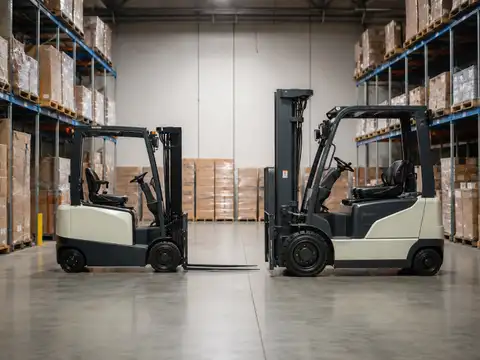
A 3-wheel electric forklift is usually the stronger fit for tight indoor warehouses handling ordinary 3,000–4,000 lb loads.
3-wheel = maneuverability · 4-wheel = capacity and versatilityToyota's July 2026 aisle guidance places 3-wheel electrics among the equipment suited to narrow aisles around 8.5–10.5 ft, while 4-wheel counterbalance trucks are the standard recommendation at about 10.5 ft and wider. Final aisle width still depends on the exact truck, pallet and clearance.
The third wheel is not a cheaper substitute for the fourth. It changes the steering geometry of the truck.
That geometry can recover meaningful warehouse space when the forklift must turn ninety degrees into pallet rack. But the compact package usually comes with a narrower capacity range than full-size four-wheel counterbalance equipment.
The decision is therefore less about “which is better?” and more about which constraint is expensive in this warehouse: aisle space or truck capability?
Counterbalance geometry
Three wheels buy turning room. Four wheels buy operating envelope.
Best fit when 3,000–4,000 lb loads and compact warehouse geometry drive the decision.
- Shorter right-angle stack
- Narrower-aisle fit
- Indoor maneuverability
Best fit when capacity, attachments, longer travel and general-purpose work matter more.
- Higher capacity options
- Broader duty range
- Strong dock / transport fit
Compare the exact truck's right-angle stacking dimension, residual capacity, load length, aisle clearance and duty cycle. “3-wheel” and “4-wheel” are categories, not final engineering specifications.
The current Toyota comparison is unusually clean
Toyota currently sells both categories in overlapping warehouse applications, which allows a useful same-manufacturer comparison.
| Current Toyota specification | 3-Wheel Electric | Core Electric 4-wheel |
|---|---|---|
| Capacity range | 3,000–4,000 lb | 3,000–6,500 lb |
| Length to fork face | 69–77.2 in | 79.9–93.1 in |
| Overall width | 41.5 in | 37–41.9 in depending model |
| Electrical system | 36 / 48 V | 36 / 48 V |
| Basic Right Angle Stack | 68.9–77.2 in | 82.1–100 in |
| Primary advantage | Compact turning geometry | Broader capacity / application range |
Those specifications make the central trade-off visible: the 3-wheel truck is not necessarily narrower across the body, but it can require much less room to complete the turning-and-stacking maneuver.
Body width is not the aisle-width number that matters most
Toyota's current 3-wheel truck is listed at approximately 41.5 in overall width. Some Core Electric 4-wheel configurations are actually narrower across the body.
Yet the 3-wheel truck has the stronger aisle advantage because the key dimension is the turning envelope.
When selecting a forklift for rack aisles, focus on:
- Basic Right Angle Stack / right-angle stack dimension;
- load length;
- load center;
- manufacturer-recommended clearance;
- rack / guard protrusions;
- actual pallet overhang.
A 42-inch-wide truck can still require a much wider aisle because its head length and steering geometry determine how much room it needs to turn a pallet ninety degrees into rack.
The same 3,000-lb capacity shows the geometry advantage clearly
Toyota's current short 3,000-lb 8FBES15U lists a 68.9-in Basic Right Angle Stack.
Toyota's current 3,000-lb Core Electric 8FBC15U lists 82.1 in.
Difference: 13.2 inches before load length and clearance are added.
3,000 lb: 68.9 in vs 82.1 in
That difference does not automatically mean the final aisle can shrink by exactly 13.2 inches. Pallet length, clearance and rack geometry still apply.
It does show why three-wheel steering can materially change a rack layout.
The 4,000-lb comparison tells the same story
Toyota's 4,000-lb 3-wheel 8FBE20U lists a Basic Right Angle Stack of 77.2 in.
Its compact 4,000-lb Core Electric 8FBC20U-COMP lists 85.2 in, while the standard 8FBC20U lists 87.2 in.
Even Toyota's compact four-wheel package therefore needs more turning room in this like-capacity comparison.
Raymond provides independent confirmation of the same pattern
Raymond's current 4460 three-wheel sit-down counterbalance truck covers 3,000–4,000 lb and lists turning radii of approximately 55.1–62.8 in, depending on capacity.
Raymond's current 4750 four-wheel sit-down truck extends from 3,000 to 12,000 lb and lists turning radii around 68.5–78.6 in.
The exact specification framework differs from Toyota's Basic Right Angle Stack, so the numbers should not be mixed directly. The pattern is consistent: the three-wheel product is optimized for a shorter turn, while the four-wheel family expands much farther in capacity.
Toyota's July 2026 aisle guide puts the categories in context
Toyota currently describes:
| Aisle category | Width in Toyota's guide | Recommended equipment examples |
|---|---|---|
| Standard aisle | 10.5 ft or wider | 4-wheel counterbalance |
| Narrow aisle | 8.5–10.5 ft | 3-wheel electric, reach truck, stand-up rider |
| Very narrow aisle | 5–7 ft | Order picker / turret truck |
This is planning guidance, not permission to place every 3-wheel forklift in an 8.5-ft aisle.
Toyota specifically explains that the single rear wheel creates the tighter turning radius. The final aisle still has to be checked against the actual right-angle stack requirement.
A 3-wheel electric is not a reach truck
This distinction matters.
A 3-wheel electric remains a counterbalance forklift. It approaches the pallet directly and does not use the outriggers and reach mechanism of a reach truck.
That makes the 3-wheel truck attractive when a warehouse wants:
- better maneuverability than a conventional 4-wheel sit-down truck;
- trailer/dock capability associated with counterbalance geometry;
- a seated operator;
- ordinary pallet handling;
- less specialization than a reach-truck fleet.
But reach trucks still win when the warehouse needs true high-bay narrow-aisle storage around 8–10 ft with much taller lift.
The 3-wheel truck is a useful middle ground
Warehouse equipment often forms a density ladder:
- 4-wheel counterbalance;
- 3-wheel counterbalance;
- stand-up counterbalance;
- reach truck;
- VNA / turret equipment.
Moving down that ladder generally increases specialization as aisle dimensions shrink.
A 3-wheel sit-down can recover meaningful room without requiring the warehouse to operate a dedicated reach-truck system.
4-wheel electric wins clearly when capacity exceeds 4,000 lb
Toyota's current 3-wheel line tops out at 4,000 lb.
Toyota's Core Electric 4-wheel family continues to 6,500 lb.
Crown's current FC 5700 4-wheel electric also covers 4,000–6,500 lb.
Raymond's 4750 family goes farther, with current configurations from 3,000 to 12,000 lb.
If the application regularly handles 5,000- or 6,000-lb loads, the purchasing decision may therefore end before aisle economics are even modeled.
5,000-lb standard pallet load
The warehouse would benefit from 3-wheel maneuverability, but the routine load is 5,000 lb.
Toyota's current 3-wheel family is outside the required nominal capacity. The application needs a higher-capacity 4-wheel truck or a different narrow-aisle solution.
Do not use nominal capacity without checking residual capacity
The truck's data plate and capacity chart—not the model-family headline—decide what it can safely handle at the required mast and attachment configuration.
Residual capacity can be affected by:
- lift height;
- load center;
- side shifter;
- fork positioner;
- clamp;
- longer forks;
- mast configuration.
A truck nominally rated at 4,000 lb may have a lower usable capacity in the final working configuration.
Attachments push the decision toward the broader 4-wheel capacity envelope
A warehouse handling only standard 48 × 40 pallets may need little beyond a side shifter.
Operations using:
- carton clamps;
- paper-roll clamps;
- push-pulls;
- fork positioners;
- double forks;
- long forks
should pay more attention to attachment weight, load-center shift and residual capacity.
Crown's current four-wheel FC line specifically offers a broad attachment range, including carton clamp, push-pull, fork positioner, double fork and side shifter.
3-wheel does not mean “unstable”
This is one of the most misleading simplifications in forklift comparisons.
Modern 3-wheel counterbalance forklifts are designed as 3-wheel trucks and use stability-management systems appropriate to that geometry.
Toyota's System of Active Stability uses speed reduction during cornering on its 3-wheel electric configuration. Toyota's current 3-wheel product also uses load- and height-sensing turn-speed control and Active Mast Control.
The correct conclusion is not “three wheels are unsafe.”
The correct conclusion is that the stability architecture differs.
4-wheel trucks use a different stability strategy
Toyota's SAS material explains that on applicable four-wheel forklifts the system can lock the rear swing axle when it senses an unstable turning condition.
Four-wheel models also dominate the higher-capacity end of the sit-down electric market, where vehicle size, wheelbase and truck structure increase accordingly.
Stability should be evaluated from the engineered truck, rated capacity, load position and operating environment—not from wheel count alone.
A forklift can tip with three or four wheels if the combined center of gravity moves outside its stability area. Operators still need training in load handling, cornering, slopes and elevated-load behavior.
Turning speed is especially important on compact trucks
The advantage of a tight-turning truck can tempt operators to turn sharply at higher speed.
Toyota's current 3-wheel machine includes controls that reduce travel speed while turning based on operating conditions.
The technology supports the operator; it does not convert tight spaces into permission for aggressive cornering.
4-wheel can be the stronger long-travel truck
A warehouse with long dock-to-production or dock-to-storage runs may value:
- larger truck platform;
- higher travel-speed configurations;
- larger battery compartment;
- higher capacities;
- broader attachment options;
- more general-purpose duty.
Raymond's current 4750 4-wheel family reaches travel speeds up to 12 mph depending on capacity and voltage.
Toyota's Core Electric current specifications extend up to 12.1 mph on several 48V configurations.
3-wheel can still be a very capable dock-to-stock truck
Toyota describes its 3-wheel electric as a multi-purpose counterbalance machine, not a rack-only specialty truck.
Raymond's 4460 3-wheel sit-down truck is explicitly positioned for:
- trailers;
- ramps;
- stacking areas;
- confined spaces.
If the loads stay inside the capacity envelope, a 3-wheel machine can provide an attractive dock-to-rack compromise.
Trailer work can reward the shorter head length
Inside a trailer, the operator has little room to turn.
A compact 3-wheel truck can reduce maneuvering space and alignment corrections, particularly with standardized pallet dimensions.
Verify:
- collapsed mast height;
- overhead guard height;
- dock plate / leveler capacity;
- trailer floor condition;
- load weight;
- truck manufacturer's approved operating conditions.
Outdoor work is not decided by wheel count either
Three-wheel electrics are most commonly associated with indoor smooth-floor warehouse work because maneuverability is their main advantage.
Toyota's current 3-wheel line can be configured with cushion or pneumatic tire options on certain models, and some electric 3-wheel products can handle light outdoor work when specifically designed for it.
Four-wheel electric product families extend farther into pneumatic-tire and outdoor applications.
But the correct outdoor check is:
- tire type;
- ground clearance;
- surface;
- gradeability;
- weather / IP protection;
- manufacturer approval.
“Four wheels = outdoor” is as unreliable as “electric = indoor.”
Floor condition can erase the compact-truck advantage
If a facility has potholes, severe joints, gravel or broken concrete, the lowest turning radius may not be the most important specification.
A more robust pneumatic-tire configuration may create:
- better ride;
- more traction;
- less load disturbance;
- more operator confidence;
- lower impact stress.
Truck geometry should follow the actual floor.
The warehouse layout can make 3-wheel economics much larger than the truck-price difference
Suppose a 3-wheel solution allows a rack redesign that recovers enough width for another meaningful storage row.
The value can come from:
- additional pallet positions;
- avoided overflow storage;
- delayed building expansion;
- shorter travel distances;
- less offsite shuttling.
In that situation, a modest difference in forklift acquisition price is not the dominant business number.
Eight aisles recover 10 inches each
8 × 10 in = 80 inches, or 6 ft 8 in of building width.
That alone may not create another rack row. Combined with compact frames, revised clearances or a broader layout redesign, however, small aisle savings can accumulate into useful building capacity.
Do the layout in CAD before ordering the truck
Compare at least:
- current 4-wheel layout;
- proposed 3-wheel layout;
- reach-truck layout if density pressure is high.
For each, calculate:
- clear aisle width;
- usable pallet positions;
- cross-aisle loss;
- dock/staging space;
- travel distance;
- truck fleet count;
- required rack height.
The highest-density option is not automatically the highest-throughput option.
A 3-wheel layout may be the wrong optimization if space is cheap
If the warehouse has abundant unused floor area, the aisle advantage may have little economic value.
A 4-wheel electric could provide:
- capacity headroom;
- more attachment flexibility;
- better fit for future heavier loads;
- broader truck-sharing across departments.
Do not purchase compact geometry that the building does not need.
Future load growth is an important reason to choose 4-wheel
A facility handling 3,500-lb pallets today may expect:
- denser pallet builds;
- new customers;
- heavier raw materials;
- attachments;
- larger reusable containers.
A truck operating near its capacity ceiling can become obsolete quickly if the business changes.
Capacity headroom has value when growth is credible.
Do not buy excessive capacity “just in case”
Larger trucks can require:
- more turning room;
- larger battery;
- higher acquisition cost;
- larger tires;
- more floor space;
- higher rack-impact energy.
The right amount of capacity headroom is application-specific.
Purchase price does not follow wheel count cleanly
Current live U.S. listings make this clear.
A new 2026 Noblelift FE3C32 3-wheel electric is currently advertised around $37,750 with a lithium battery/charger package in the listing.
A new 2026 Viper FB25 4-wheel electric pneumatic truck is currently advertised around $28,900.
These are different brands, capacities, tires, batteries and specifications. They are not an apples-to-apples price comparison.
Their value is precisely that they disprove a simplistic pricing rule: three wheels are not automatically cheaper, and four wheels are not automatically more expensive.
Normalize truck, battery, charger, mast, side shift/attachment, freight, setup and sales tax before comparing acquisition cost.
Used 3-wheel electrics can be a strong warehouse-value category
Eliftruck's 2026 used-forklift pricing guide puts used 3-wheel warehouse electrics broadly around $12,000–$18,000 in its current planning table.
That is marketplace guidance, not an appraisal for a specific truck.
Battery condition can move the real delivered cost substantially.
A used 3-wheel electric deserves inspection of:
- battery state of health;
- charger compatibility;
- steer wheel / rear assembly;
- drive motors;
- mast and chains;
- tires;
- hour meter credibility;
- data plate and residual capacity;
- service history.
Battery economics are similar across both categories
Both current Toyota families use 36/48V electric systems and can be paired with different energy strategies depending on configuration.
The important energy questions are:
- lead-acid or lithium-ion;
- battery capacity;
- charger;
- annual truck hours;
- shift pattern;
- opportunity-charging windows;
- electrical infrastructure;
- battery replacement reserve.
Wheel count does not remove the need for an energy study.
A larger 4-wheel truck can carry a larger battery—but that does not automatically make it more efficient
Battery size affects runtime and truck packaging.
Energy consumption also depends on:
- truck mass;
- load;
- travel distance;
- lift cycles;
- speed settings;
- operator behavior;
- charger efficiency.
Compare measured kWh per productive truck-hour or per pallet move when energy cost matters materially.
Maintenance is more similar than different
Both categories are electric counterbalance trucks and share major maintenance areas:
- mast;
- forks;
- hydraulics;
- brakes;
- tires;
- steering;
- drive motors;
- battery / charger;
- controls and sensors.
Four-wheel trucks add a conventional rear steering axle architecture; 3-wheel models use a different steering assembly. Actual maintenance cost should come from model-specific fleet data rather than assuming one design is always cheaper.
Tire wear can differ with turning behavior
Compact trucks may execute more frequent sharp turns in congested warehouse work.
Tire wear depends on:
- floor;
- turning speed;
- load;
- tire compound;
- travel distance;
- alignment;
- debris.
Track installed tire cost per operating hour if the fleet is comparing real ownership economics.
Operator comfort may favor different trucks in different workflows
Both 3-wheel and 4-wheel sit-down electrics are designed for seated operation.
Comfort differences come from:
- seat;
- legroom;
- entry step;
- steering effort;
- visibility;
- vibration;
- reverse-travel posture;
- controls.
A truck trial using the site's real operators is more reliable than deciding comfort from wheel count.
Frequent on/off work may point to a stand-up truck instead
Toyota's April 2026 sit-down versus stand-up buying guide says stand-up equipment is generally stronger where the operator repeatedly enters and exits the truck, while sit-down trucks fit longer periods of seated travel.
That means a warehouse comparing 3-wheel and 4-wheel sit-down trucks should first ask whether sit-down is the correct operator format at all.
A fast dock cycle with repeated scanning and walking may favor a stand-up rider more than either sit-down option.
Very tight aisles may point to a reach truck instead
Toyota's current narrow-aisle guidance places 3-wheel electric in the 8.5–10.5-ft narrow-aisle category.
If the building needs:
- 8–9-ft aisles consistently;
- very tall rack;
- deep-reach storage;
- high-density reserve pallet work;
a reach truck may provide a stronger system-level solution.
Do not force a 3-wheel counterbalance into a layout that really needs narrow-aisle specialist equipment.
Very narrow aisle requires a different class again
Toyota currently defines 5–7 ft as VNA territory and points to order pickers and turret equipment.
Neither a conventional 3-wheel nor 4-wheel sit-down counterbalance is the right answer for that geometry.
How to choose in an existing warehouse
Measure first:
- narrowest working aisle;
- longest actual pallet/load;
- heaviest routine load;
- highest lift;
- attachments;
- dock/trailer work;
- indoor/outdoor percentage;
- annual hours;
- travel distance;
- future capacity needs.
Then request both categories only if both genuinely satisfy the application.
How to choose in a new warehouse
In a new build or full rack redesign, equipment and layout should be modeled together.
Compare:
| System variable | 3-wheel layout | 4-wheel layout |
|---|---|---|
| Required clear aisle | Exact truck calculation | Exact truck calculation |
| Usable pallet positions | Calculate | Calculate |
| Maximum required capacity | Confirm ≤ chosen configuration | Confirm ≤ chosen configuration |
| Attachments | Residual-capacity check | Residual-capacity check |
| Fleet quantity | Model throughput | Model throughput |
| Truck + battery + charger | Quote complete package | Quote complete package |
| Future flexibility | Evaluate | Evaluate |
When 3-wheel is usually the stronger choice
- loads stay within the 3-wheel model's capacity envelope;
- aisle width is economically valuable;
- the operation is mainly indoors on suitable floors;
- the truck must work in tight trailers or congested areas;
- the operator remains seated for substantial periods;
- the warehouse wants counterbalance versatility without full reach-truck specialization;
- future load growth is unlikely to exceed the compact truck's capacity.
When 4-wheel is usually the stronger choice
- loads regularly exceed 4,000 lb;
- capacity headroom matters;
- attachments are frequent or heavy;
- the truck performs broad dock, transport and production work;
- aisle space is not the primary building constraint;
- the facility expects heavier future loads;
- a broader product family simplifies fleet standardization.
When neither is the strongest choice
Consider another truck class when:
- operators repeatedly get on/off → stand-up counterbalance may be stronger;
- high rack + narrow aisles → reach truck;
- 5–7-ft VNA → turret/order picker;
- rough outdoor terrain → purpose-designed pneumatic equipment;
- very heavy loads → higher-capacity electric or IC equipment;
- horizontal pallet transport dominates → rider pallet truck may be more efficient.
The practical recommendation
Start with the load requirement.
If the operation exceeds the available 3-wheel capacity, choose the suitable 4-wheel or another higher-capacity truck class.
If both truck types can safely handle the work, move to geometry.
Compare their exact Basic Right Angle Stack / turning specifications using the warehouse's real pallet length and clearance.
Then put both resulting aisle layouts into the building and count usable pallet positions.
The strongest choice is the truck that creates the best warehouse-level economics while still satisfying capacity, productivity and operating requirements—not the truck with one fewer wheel or the one with the lowest quote.
Frequently asked questions
Is a 3-wheel forklift better than a 4-wheel forklift?
Neither is universally better. Three-wheel electrics are optimized for tighter turning and ordinary warehouse capacities. Four-wheel electrics offer broader capacity and general-purpose capability.
What capacity can a 3-wheel electric forklift lift?
Toyota's current 3-wheel electric family covers 3,000–4,000 lb. Other manufacturers offer different ranges, so verify the exact model and residual capacity.
What capacity can a 4-wheel electric forklift lift?
Toyota's current Core Electric covers 3,000–6,500 lb. Crown's current FC 5700 covers 4,000–6,500 lb, while Raymond's broader current 4750 family extends to 12,000 lb.
Does a 3-wheel forklift turn tighter?
Generally yes. Toyota's July 2026 guide specifically says the single rear wheel allows a tighter turning radius than a four-wheel forklift. Its current same-brand specifications also show materially shorter right-angle-stack dimensions.
How wide does an aisle need to be for a 3-wheel forklift?
Toyota places 3-wheel electrics in its 8.5–10.5-ft narrow-aisle category and separately shows the truck working around 10–11-ft warehouse aisles in its aisle-width material. Final width must be calculated from the exact truck, pallet length and clearance.
How wide does an aisle need to be for a 4-wheel electric forklift?
Toyota's July 2026 planning guide classifies roughly 10.5 ft and wider as standard counterbalance territory. Its Core Electric is marketed for operation in spaces as small as approximately 11 ft. Exact models vary.
Are 3-wheel forklifts unstable?
No. They are engineered around three-wheel geometry. Toyota uses speed reduction while cornering and mast/load controls on its current 3-wheel electric. Operators still must follow rated capacity and safe cornering practices.
Is a 4-wheel forklift more stable?
Four-wheel trucks use a different stability architecture and dominate higher capacity classes. Stability cannot be reduced to wheel count: load position, capacity, speed, mast height, surface and the specific truck's engineered stability systems all matter.
Can a 3-wheel electric forklift load trailers?
Yes, appropriate models can. Raymond currently positions its 4460 3-wheel sit-down truck for trailers, ramps and stacking areas, while Toyota describes its 3-wheel electric as a multi-purpose counterbalance forklift.
Can a 3-wheel electric forklift go outside?
Some models can handle light outdoor duty when properly configured, but many 3-wheel electrics are optimized for smooth indoor warehouse surfaces. Verify tires, surface, gradeability and manufacturer-approved environment.
Which costs more, a 3-wheel or 4-wheel electric forklift?
Wheel count alone does not determine price. Current listings include a 2026 3-wheel Noblelift around $37,750 and a different 2026 4-wheel Viper around $28,900. Because the trucks differ in brand, capacity, tires and battery package, those listings demonstrate market variability rather than a direct price ranking.
Should I buy a 3-wheel forklift instead of a reach truck?
Choose 3-wheel when you need compact counterbalance versatility. Choose a reach truck when high rack and sustained narrow-aisle pallet storage are the dominant application. Model both layouts when space value is high.
Sources and methodology
Warehouse Fieldbook uses current Toyota 3-wheel and Core Electric specifications for the cleanest same-manufacturer geometry comparison. Current 2026 Toyota aisle guidance is used to frame standard vs narrow-aisle applications. Raymond and Crown provide independent current product context for turning radius, capacity and four-wheel use. Live Eliftruck listings are treated only as asking-price snapshots and are explicitly not averaged into a national purchase price. Final aisle, capacity and stability decisions must be verified against the exact truck, data plate, load and site conditions.
- Toyota Material Handling — current 3-Wheel Electric specifications
- Toyota Material Handling — current Core Electric 4-wheel specifications
- Toyota Material Handling — July 2026 standard, narrow and VNA aisle guidance
- Toyota Material Handling — current 3-wheel and 4-wheel warehouse aisle context
- Toyota Material Handling — April 2026 sit-down capacity and aisle comparison
- Toyota Material Handling — 3-wheel vs 4-wheel SAS stability architecture
- Raymond — current 4460 3-wheel counterbalance turning radius and capacity
- Raymond — current 4750 4-wheel counterbalance capacity and turning radius
- Crown — current FC 5700 4-wheel electric capacity and attachment range
- Eliftruck — current 2026 Noblelift 3-wheel asking-price snapshot
- Eliftruck — current 2026 Viper 4-wheel asking-price snapshot
- Eliftruck — 2026 used 3-wheel electric market planning range
- OSHA — 29 CFR 1910.178 powered industrial trucks