
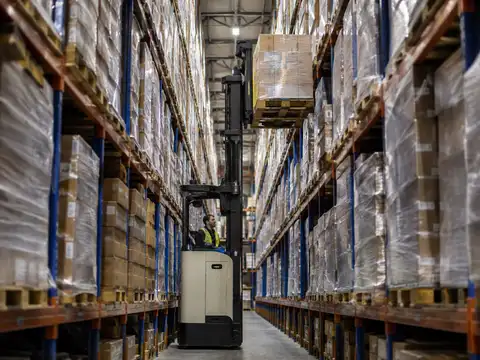
For planning purposes, separate the market into three equipment classes:
Reach truck: ~$35k–$65k current new examples · Turret/VNA: usually quote-basedUsed turret trucks currently span from roughly $6,000 to nearly $100,000 across the U.S. secondary market. That enormous range reflects age, mast height, guidance, battery condition and technology—not random pricing.
“Narrow-aisle forklift” is not one machine. It is a warehouse-design category.
A standard reach truck working in an 8- to 10-foot aisle, an articulated forklift working around 6 to 8 feet and a guided turret truck working in an aisle little more than 4.5 to 6 feet wide all solve the same broad problem: reduce travel-space width so the building can hold more inventory.
Their costs diverge because each additional step toward density requires more specialized truck geometry and more disciplined warehouse infrastructure.
Narrow-aisle cost ladder
As the aisle gets narrower, the warehouse becomes part of the machine
Lowest-complexity path into narrow-aisle pallet storage.
Turns through an articulated chassis and can serve wider operating areas too.
Highest density, tallest rack and strongest dependence on guidance and floor quality.
Very narrow aisle projects can add wire guidance, rack changes, high-flatness floor work, batteries, chargers, controls and commissioning. Budget the system, not just the forklift.
Current public reach-truck prices
Reach trucks are the easiest narrow-aisle category to price from current public U.S. inventory.
ForkliftTrader currently lists a new 2025 Tailift electric reach truck at approximately $35,000. Eliftruck currently shows a 2026 Hyundai 20BRP-X around $64,180, while a related 2026 Hyundai 23BRP-X 4,500-lb single-reach model is offered through the same Florida seller on a quote basis.
Those two examples are not directly equivalent. They differ in capacity, brand, mast, battery package and specification. Their value is to establish current order of magnitude:
a new narrow-aisle reach truck can readily be a mid-five-figure capital purchase.
| Current public example | Configuration | Published price |
|---|---|---|
| 2025 Tailift T-CQDH18C/20C | 2,200-lb electric reach truck | About $35,000 |
| 2026 Hyundai 20BRP-X | Electric narrow-aisle single reach | About $64,180 |
| 2026 Hyundai 23BRP-X | 4,500-lb, 299-in mast | Quote-based |
These are current public asking-price examples. Premium reach trucks, high-capacity trucks, double-reach configurations, lithium packages and extreme mast heights can move well beyond them.
Used reach trucks can reduce acquisition cost substantially
Current Eliftruck reach-truck inventory includes used Crown single-reach trucks around $13,990–$24,995 in some listings.
The same buying rules from the general used-forklift guide apply, but reach trucks add several specialized inspection points:
- reach mechanism wear;
- mast rollers;
- pantograph or moving-mast components where applicable;
- battery condition;
- guidance equipment;
- camera / height-positioning equipment;
- residual capacity at the intended lift height.
A used high-reach truck with tired batteries and worn mast components can consume much of its purchase discount during the first year.
Rental provides a useful narrow-aisle price reference too
Conger's January 2026 rental schedule lists:
- 3,500-lb reach truck: $140/day, $385/week, $1,250/month;
- 4,500-lb reach truck: $150/day, $500/week, $1,350/month.
A current Eliftruck Hyundai 4,500-lb single-reach listing also shows a $1,250 monthly rental reference.
Rental rates help verify the market value of ordinary reach equipment, but true VNA turret trucks belong to a much more specialized fleet category.
Very narrow aisle is a different project
Raymond's current Swing-Reach range illustrates how far VNA equipment departs from a conventional reach truck.
Current models include:
- 9600: 3,000 lb capacity, 394-in-plus elevated height;
- 9700: 3,000 lb capacity, 514-in-plus elevated height;
- 9800: 2,500 lb at 50 ft and 3,300 lb at 30 ft, 584-in-plus height;
- Transtacker TRT: 4,000 lb capacity and 708-in elevated height.
Raymond's Transtacker can operate in aisles as narrow as 54 inches while reaching approximately 59 feet.
At that point, the forklift is no longer merely turning inside the aisle. The entire aisle becomes a controlled high-bay operating environment.
Used turret-truck prices span almost $100,000
Eliftruck's current U.S. turret-truck marketplace contains more than 200 listings ranging from approximately $5,995 to $99,950.
One current featured example is a 2018 Crown TSP6500-33 at about $26,000.
LiftsToday's current Raymond swing-reach inventory reports an average asking price around $41,585 across its listed Raymond units.
None of those numbers should be used as a new-VNA budget. They show how wide the secondary market becomes once age, mast, battery, controls and guidance technology vary.
$6k used turret vs $100k used turret
A low-cost older machine may have short lift height, obsolete electronics, no compatible guidance, exhausted battery or limited parts support.
A late-model high-bay truck can contain positioning technology and a valuable battery system. “Used turret truck” is therefore too broad to price without a specification.
New turret-truck pricing is usually quote-based for a reason
Raymond, Crown and Yale currently present their VNA turret products through dealer-quote workflows rather than standardized online purchase prices.
Yale's current North American VNA line spans approximately 3,000–3,500 lb and offers lead-acid, thin-plate-pure-lead and lithium-ion battery options.
Crown's current TSP turret family combines very narrow aisle operation with high-level order picking and advanced positioning options.
The quote therefore includes much more configuration than “3,000-lb capacity.”
What drives the VNA truck quote?
- maximum lift height;
- capacity at maximum height;
- man-up vs man-down operation;
- fork / turret configuration;
- wire guidance or rail guidance;
- navigation / positioning;
- battery type and capacity;
- charger;
- cold-storage package;
- load-width requirements;
- operator-assistance systems;
- fleet-management integration;
- installation and commissioning.
Wire guidance is part of the VNA capital project
Raymond currently offers Intelliguide wire guidance for very narrow aisle order pickers and turret trucks.
The concept is straightforward: a wire installed in the floor creates an electromagnetic signal that guides the truck down the aisle. The operator can focus more attention on lift, load and location rather than continuously steering.
That guidance system requires:
- floor cutting / installation;
- wire and signal-generation equipment;
- truck guidance hardware;
- commissioning;
- aisle mapping;
- maintenance when floors are repaired or altered.
The narrowest forklift quote is therefore not complete if guidance is priced elsewhere.
Rail guidance can consume aisle width differently
Some VNA systems use physical guide rails rather than embedded wire. Rails can simplify certain forms of truck guidance but occupy physical space near the floor and interact directly with rack design.
Compare wire and rail guidance on:
- installed cost;
- floor modifications;
- rack geometry;
- wheel / guide equipment;
- future layout changes;
- maintenance;
- pedestrian access.
The slab becomes a major VNA specification
At 40, 50 or nearly 60 feet of lift height, small floor irregularities become more consequential than they are under a low-level counterbalance truck.
VNA projects may therefore need a detailed floor survey and corrective work before the equipment can achieve its intended performance.
The financial lesson is simple:
do not approve the forklift before confirming the building can support the forklift.
Excessive mast movement, restricted travel speed or poor operator confidence can erase the productivity assumptions used to justify the very narrow aisle layout.
Rack tolerances matter more as clearance disappears
Conventional warehouse aisles give trucks and loads room to tolerate small installation deviations.
VNA systems reduce that margin. Rack rows, aisle centerlines and truck guidance must work together as one geometric system.
A retrofit may therefore require:
- rack relocation;
- upright realignment;
- column-protection changes;
- cross-aisle redesign;
- new flue / pallet-clearance checks;
- high-level rack engineering.
Narrow aisle and very narrow aisle are not the same
Conger's current aisle-width guidance defines narrow-aisle trucks broadly as equipment operating below approximately 10.5 ft.
A reach truck at 9 ft is therefore already narrow-aisle equipment.
VNA typically means the next step: turret, articulated or guided equipment designed to work around 6 ft or below, with exact requirements dependent on truck and load.
Procurement should use actual clear aisle dimension rather than the vague phrase “we need a narrow forklift.”
Articulated forklifts create another path to six-foot aisles
Flexi's current North American narrow-aisle material describes articulated forklifts capable of working in aisles as narrow as approximately 6 feet.
Unlike a turret truck that rotates or swings the load-handling assembly inside a tightly controlled aisle, an articulated forklift bends at the chassis.
That can give the warehouse a useful middle ground:
- much narrower rack aisles than conventional counterbalance;
- less dependence on dedicated turret guidance;
- ability to travel outside the rack aisle;
- one truck potentially serving dock-to-rack tasks.
Articulated trucks can reduce the need for pallet handoffs
A classic VNA layout can use a general-purpose truck at the dock and a dedicated turret truck inside the high-density aisle.
The articulated-truck proposition is different: use one vehicle for broader warehouse movement and then articulate into a narrow rack aisle.
One truck vs two-zone handling
Turret architecture: counterbalance/reach truck unloads and stages; turret truck performs VNA putaway.
Articulated architecture: one articulated truck may perform a larger share of the dock-to-rack cycle.
The second approach may save a pallet handoff but usually gives up some of the extreme height/density available from dedicated VNA equipment.
Reach truck is usually the least disruptive retrofit
If a warehouse currently uses 12- to 14-foot counterbalance aisles, moving toward 8- to 10-foot reach aisles can recover substantial storage capacity without turning the building into a full VNA system.
This can be the strongest first step when:
- rack heights are moderate to high;
- the slab is ordinary warehouse quality;
- operators need flexibility between several rack zones;
- guidance infrastructure is not justified;
- the business wants density without a major building conversion.
Turret/VNA is strongest when building capacity is genuinely expensive
A guided turret truck has the strongest economic case when the value of recovering aisle space and using clear height is extremely high.
Typical conditions include:
- high land or occupancy cost;
- limited expansion options;
- large pallet inventory;
- high clear height;
- stable pallet dimensions;
- controlled indoor environment;
- high throughput inside reserve storage;
- long expected facility life.
A warehouse planning to relocate in two years has much less time to recover floor, guidance and rack conversion costs.
Measure the number of pallet positions created
Narrow-aisle ROI starts with a layout comparison, not a forklift quote.
Model at least:
- existing counterbalance layout;
- reach-truck layout;
- articulated layout if relevant;
- turret/VNA layout.
For each, calculate:
- rack rows;
- pallet positions;
- usable clear height;
- cross-aisle loss;
- staging area;
- dock interaction;
- truck fleet size;
- expected throughput.
Incremental cost per added pallet position is the key financial metric
Compare the system premium with capacity gained
(VNA truck + guidance + floor + rack conversion − conventional alternative) ÷ additional usable pallet positions
If a $300,000 incremental VNA project creates 1,500 genuinely usable pallet positions, the incremental capital cost is $200 per added position.
That $200 should then be compared with:
- warehouse expansion cost;
- overflow rent;
- offsite shuttle labor;
- third-party storage;
- inventory constraints created by insufficient capacity.
The $300,000 scenario is illustrative; it is not a market-price claim.
Usable capacity matters more than nominal rack count
A VNA layout can show an impressive theoretical pallet count and still deliver weak usable capacity when SKU fragmentation, lot separation or product dimensions leave locations empty.
Apply the same discipline used in high-density racking decisions:
- SKU count;
- pallets per SKU;
- seasonality;
- lot/date segregation;
- load dimensions;
- hazardous-material separation;
- blocked or reserved locations.
Higher rack can be more valuable than narrower aisles
Raymond's current VNA family reaches from the low 30-foot range to nearly 60 feet depending on model.
A building with abundant clear height may therefore gain more capacity vertically than it gains from removing two feet of aisle.
The forklift decision should model horizontal density and vertical cube together.
Extreme height creates a residual-capacity constraint
Raymond's current 9800 illustrates this directly: 2,500 lb at 50 ft versus 3,300 lb at 30 ft.
A warehouse storing 3,000-lb pallets cannot simply choose a 50-ft beam because the truck reaches 50 ft.
Final rack elevation must be checked against the truck's actual load chart at:
- load weight;
- load center;
- fork / turret configuration;
- mast height;
- attachment.
Positioning technology can add cost and productivity
Crown currently offers Auto Positioning System technology on its TSP turret family. Crown's published case study with Southern Glazer's Wine & Spirits says the customer believed the system reduced new-operator training time by approximately 50%.
Crown also markets APS as a way to guide the truck toward the next pick location.
Raymond offers zoning and positioning capabilities that can automatically adapt truck functions such as lift height and travel speed to mapped warehouse conditions.
These systems should be evaluated as productivity investments—not assumed to come free with the truck.
A case-study improvement is not a universal warehouse benchmark. Pilot the feature with the site's own operators, slotting and order profile before building ROI around it.
Operator training can be more demanding in VNA
Narrow clearance, high lift and specialized controls make VNA operation different from driving a conventional sit-down forklift.
OSHA 29 CFR 1910.178 requires training to address truck-related and workplace- related topics relevant to the equipment and environment.
A VNA go-live plan should therefore budget:
- formal operator training;
- practical evaluation;
- site-specific aisle familiarization;
- guidance-system training;
- high-level picking procedures where applicable;
- emergency / recovery procedures.
A disabled truck can block an entire VNA aisle
In a 12-foot aisle, another forklift may be able to pass or operators may maneuver around a disabled unit.
In a guided aisle around 5 feet wide, that may be impossible.
Maintenance response, truck recovery and redundancy therefore have more operational value in VNA systems.
Fleet quantity can increase after specialization
Reducing aisle width does not always reduce the number of forklifts.
A dedicated turret truck may spend most of its life inside storage aisles, while other trucks handle:
- receiving;
- trailers;
- staging;
- cross-dock;
- shipping;
- outdoor moves.
The business case should therefore compare total fleet architecture, not one VNA truck against one counterbalance truck.
Battery and charger can materially change the acquisition price
Narrow-aisle equipment is electric. The quote can include or exclude:
- lead-acid battery;
- thin-plate-pure-lead battery;
- lithium-ion battery;
- charger;
- watering equipment;
- battery-change equipment;
- charger installation;
- opportunity-charging controls.
Yale's current VNA product family explicitly offers several battery technologies, confirming that “battery included” is not one standardized package.
Cold storage can increase narrow-aisle complexity
High-density storage is attractive in freezers because refrigerated cube is expensive.
The equipment may need:
- cold-storage hydraulic fluids;
- heater / cab options;
- cold-rated electronics;
- battery thermal strategy;
- condensation protection;
- corrosion-resistant components.
Raymond's VNA materials include cold-storage configuration options, but the package should be quoted for the actual temperature and duty.
Long loads change the narrow-aisle category
Pipe, lumber, carpet and extrusion create a different turning problem because the load can be much longer than the truck.
An articulated or multidirectional truck may be more appropriate than a conventional reach or pallet turret truck.
Toyota's multidirectional reach truck uses articulating load wheels to travel parallel or perpendicular to the rack while handling bulky loads.
Do not select VNA equipment by pallet aisle width when the actual product is 12 or 20 feet long.
Used turret equipment can be attractive in an existing guided facility
If the building already has compatible guidance, rack geometry and floor conditions, used turret equipment can avoid much of the infrastructure conversion cost.
The used-market price range therefore becomes much more relevant.
Inspect:
- guidance compatibility;
- mast and turret wear;
- battery state of health;
- control-system support;
- software availability;
- parts support;
- actual lift-height capacity;
- cold-storage history;
- service records.
Used VNA equipment can be a poor retrofit shortcut
A $20,000 used turret truck does not create a VNA warehouse by itself.
If the facility needs:
- $40,000 of floor work;
- new guidance;
- rack relocation;
- battery and charger replacement;
- control-system updates;
the machine's sticker price becomes a small fraction of the real conversion cost.
Build the project budget in nine buckets
| Cost bucket | What belongs there |
|---|---|
| Truck | Reach, articulated, turret or VNA chassis |
| Energy | Battery, charger, watering / charging equipment |
| Guidance | Wire, rail, sensors, transmitter, commissioning |
| Floor | Survey, grinding, repair, wire installation |
| Rack | Relocation, taller rack, protection, alignment |
| Controls | Positioning, zoning, navigation, fleet software |
| Safety | Pedestrian controls, gates, aisle access, signage |
| Implementation | Freight, installation, testing, operator training |
| Transition | Temporary storage, lost capacity during conversion, rental equipment |
Do not forget the transition period
A retrofit can temporarily remove rack and aisle capacity while floors, guidance and new rack rows are installed.
The warehouse may need:
- temporary offsite storage;
- rental forklifts;
- night / weekend installation;
- phased rack moves;
- extra labor;
- temporary staging.
These costs do not appear on the forklift purchase order but belong in the project ROI.
What to request from every narrow-aisle supplier
- Minimum clear aisle. For the exact pallet and load dimensions.
- Basic Right Angle Stack or VNA clearance data. Do not accept only overall truck width.
- Capacity at maximum planned height.
- Battery and charger scope.
- Floor requirements.
- Guidance requirement and installed price.
- Rack / clearance requirements.
- Operator-assistance options.
- Service response and recovery plan.
- Training and commissioning.
When a standard reach truck is usually enough
Start with a conventional reach truck when:
- 8–10 ft aisles create enough additional capacity;
- the building does not need extreme high-bay storage;
- the company wants minimal floor modification;
- truck flexibility matters;
- the operation has standard pallets and ordinary indoor floors;
- VNA conversion costs are difficult to recover.
When articulated equipment deserves a quote
Articulated equipment deserves serious consideration when:
- 6–8 ft aisles materially improve capacity;
- one truck needs to travel outside the rack aisle;
- the business wants to avoid a separate dock-to-VNA pallet handoff;
- guidance infrastructure is undesirable;
- extreme turret-truck lift height is unnecessary.
When turret/VNA is usually justified
A true VNA project becomes stronger when:
- every pallet position has high economic value;
- building expansion is extremely expensive or impossible;
- clear height is substantial;
- inventory is stable enough for dense storage;
- the facility has a long remaining lease / ownership horizon;
- high-level pallet and case handling is central to the operation;
- the company can support specialized maintenance and training.
The practical recommendation
Begin with the least specialized equipment that solves the space problem.
If 9-foot reach-truck aisles create enough capacity, the warehouse may not need the infrastructure burden of a 5-foot guided turret system.
If expansion is impossible and a VNA layout creates thousands of additional usable locations, a much more expensive truck and guidance project can still be the cheaper building decision.
The correct narrow-aisle budget is therefore not: “How much is the forklift?”
It is: “How much will the complete system cost per additional usable pallet position and per pallet move at peak?”
Frequently asked questions
How much does a narrow-aisle forklift cost?
Current public new reach-truck examples range from roughly $35,000 to $64,000 across different brands and capacities. Premium high-reach and VNA/turret equipment is commonly quote-based and can cost substantially more once guidance and building integration are included.
How much does a used turret forklift cost?
Eliftruck's current turret-truck marketplace spans approximately $5,995–$99,950. A current featured 2018 Crown TSP6500-33 is listed around $26,000. Age, height, battery and guidance create the wide spread.
How much does it cost to rent a reach truck?
Conger's January 2026 schedule lists a 4,500-lb reach truck at approximately $150/day, $500/week and $1,350/month.
What aisle width does a narrow-aisle forklift need?
Reach trucks commonly operate around 8–10 ft. Articulated and VNA/turret equipment can go substantially narrower, in some cases near 6 ft or below. Final width must be calculated from the exact truck and load.
How narrow can a VNA aisle be?
Raymond's current Transtacker can operate in aisles as narrow as 54 inches. Other turret trucks and warehouse configurations require different clearances.
How high can a turret truck lift?
Raymond's current VNA family reaches from roughly 394 inches to 708 inches—about 59 ft—depending on the model.
Does a VNA forklift need wire guidance?
Not every narrow-aisle truck does. Conventional reach and articulated trucks can steer normally. Many true VNA turret applications use wire or rail guidance because steering clearance becomes extremely small.
Does VNA require a special floor?
Very high lift and tight aisle clearances make floor quality more important. A serious VNA project should include a floor survey and verify the truck manufacturer's requirements before equipment is ordered.
Is an articulated forklift cheaper than a turret truck?
It can reduce overall system complexity because it may avoid dedicated VNA guidance and additional pallet handoffs, but public like-for-like pricing is not transparent enough to publish a reliable universal price difference.
What is the cheapest way to create narrower warehouse aisles?
Usually start by modeling a standard reach-truck layout. Moving from conventional counterbalance aisles to 8–10 ft reach aisles can create substantial capacity with less building modification than a full VNA conversion.
Sources and methodology
Warehouse Fieldbook reviewed current August 2026 U.S. equipment listings, current manufacturer VNA specifications and current rental pricing. Public truck prices are treated as market snapshots rather than national averages. Because new turret/VNA systems are configured around mast, guidance, battery, warehouse geometry and controls, the article deliberately treats those systems as quote-based rather than inventing a universal purchase range.
- ForkliftTrader — current new reach-truck price examples
- Eliftruck — current 2026 Hyundai narrow-aisle single-reach listing
- Eliftruck — current used Crown single-reach inventory and prices
- Conger Industries — January 2026 narrow-aisle reach-truck rental rates
- Conger Industries — November 2025 narrow-aisle width definitions
- Raymond — current 9600, 9700, 9800 and Transtacker VNA specifications
- Raymond — Transtacker 54-in aisle and 59-ft lift capability
- Raymond — current Intelliguide wire-guidance system
- Eliftruck — current U.S. turret-truck used-market price range
- LiftsToday — current Raymond swing-reach asking-price market
- Crown — current TSP very-narrow-aisle turret truck
- Crown — Southern Glazer's TSP / Auto Positioning customer case study
- Yale — current North American VNA turret capacity and battery options
- Narrow Aisle Inc. — current Flexi articulated six-foot-aisle capability
- Toyota Material Handling — multidirectional narrow-aisle handling for long loads
- OSHA — 29 CFR 1910.178 powered industrial trucks