
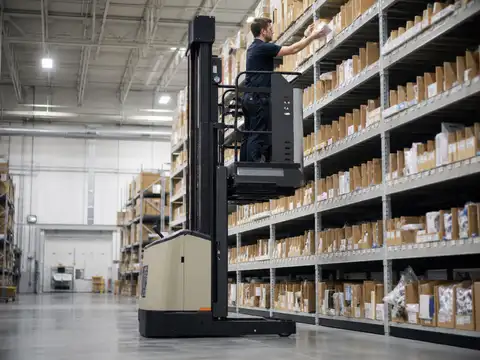
A practical current acquisition budget for a standard high-level electric order picker is:
New: roughly $28,000–$45,000+ · Used: often ~$9,000–$22,000Current public examples include a 2026 Clark 3,000-lb order picker around $33,700 and a new EKKO order picker around $45,065. Height, battery, guidance and controls can push specialized configurations higher.
An order picker is not a small reach truck. It raises the operator with the picking platform so individual cases, cartons or items can be retrieved directly from rack.
That changes both the economics and the safety requirements. The warehouse is paying for vertical worker access, load handling, narrow-aisle travel and, at high elevations, increasingly sophisticated truck controls.
Order picker cost ladder
Higher picking changes both the truck and the operating system
Compact equipment for lower pick heights, light loads and tight spaces.
Current market context for new high-level 3,000-lb warehouse equipment.
More lift height, guidance, batteries and positioning technology increase system cost.
A cheaper machine that cannot safely or efficiently serve the top pick levels can force slower replenishment, extra equipment or unused rack capacity.
What a new order picker costs in 2026
Conger Industries' current order-picker guide places new machines broadly from approximately $28,000 to more than $40,000.
Current U.S. listings provide useful validation:
- a new 2026 Clark OSX15, 3,000-lb electric order picker, is currently advertised around $33,700;
- a new EKKO EOP68 order picker is currently listed around $45,065.
These listings are not identical configurations and should not be averaged into a national market price. They establish a credible current order of magnitude for new high-level equipment.
| Current market reference | Capacity | Condition | Public price |
|---|---|---|---|
| Clark OSX15 | 3,000 lb | New / 2026 listing | About $33,700 |
| EKKO EOP68 | 2,200 lb | New | About $45,065 |
| Typical current new-order-picker guidance | Varies | New | About $28,000–$40,000+ |
Two 3,000-lb order pickers can have very different prices if one reaches 20 feet and the other reaches more than 30 feet, or if one includes lithium, wire guidance, positioning technology or a specialized platform.
Used order picker prices in the current market
Eliftruck currently carries hundreds of electric order-picker listings. Current examples show how a normal used purchase can fall well below new-equipment cost:
- used Crown SP3000: approximately $8,950;
- 2020 Toyota 8BPUE15: approximately $10,950;
- 2021 Crown SP3520-30: approximately $14,500;
- 2018 Crown SP3520-30: approximately $14,950;
- 2018 Jungheinrich EKS314: approximately $21,500.
The full Eliftruck marketplace extends far below and above those figures, but very old, unusually configured or specialized machines should not be used to define a normal used-equipment range.
For planning, the high four figures through low $20,000s is a more useful starting zone for ordinary used high-level order pickers that still deserve consideration.
Why some used order pickers cost under $5,000
Current listings include older machines around $4,000–$5,000. That can be attractive for very light use, but age changes the risk profile:
- obsolete electronics;
- battery replacement;
- mast wear;
- limited parts support;
- older controls;
- limited lift height;
- unknown harness / anchorage condition;
- outdated guidance equipment.
An inexpensive machine can still be a good backup asset, but it should not be valued like a recent high-throughput production truck.
$9,000 truck vs $15,000 truck
The $9,000 machine needs a battery, tires and mast work totaling $6,000. The $15,000 machine needs $1,000 of initial service.
First-year equipment cost becomes $15,000 vs $16,000. The lower sticker price no longer creates a meaningful advantage.
Current order picker rental cost
Conger's January 2026 published rental schedule lists a 3,000-lb order picker at approximately:
- $130 per day;
- $380 per week;
- $1,220 per four-week/month period.
The same rental schedule uses standard equipment-hour allowances, so the base rate should be checked against actual planned use.
Rental is particularly useful for seasonal case picking, inventory projects, warehouse relocations and temporary high-level picking requirements.
Rental can also be a smart pre-purchase trial
An order picker is highly operator-dependent. Platform visibility, mast vibration, control response and picking ergonomics are difficult to evaluate from a quote.
A short rental can validate:
- actual pick rate;
- operator comfort;
- top-level visibility;
- aisle clearance;
- battery runtime;
- guidance performance;
- platform compatibility with cartons and pallets.
That can be worth far more than negotiating another few percent off purchase price.
Low-level stock picker and high-level order picker are not the same machine
Toyota's current Tora-Max Stock Picker is a compact retail / stockroom product with a platform height of approximately 130 inches.
The standard Toyota Order Picker reaches up to approximately 390 inches.
Those products solve very different picking problems. A low-level stock picker can replace ladders in retail and stockrooms but cannot replace a high-level warehouse order picker in a 30-foot rack system.
Standard Toyota order pickers reach about 32.5 feet
Toyota's current standard Order Picker offers lift heights up to 390 inches, or roughly 32.5 feet.
Toyota explicitly positions the machine for picking above the second rack level and narrow-aisle case-picking applications.
The truck also supports optional wire and double-rail guidance.
High-capacity order pickers extend beyond 38 feet
Toyota's current High-Capacity Order Picker extends to approximately 456 inches, or 38 feet, while maintaining a 3,000-lb nominal lifting capacity.
Toyota says the additional span height can give operators access to another rack level compared with lower configurations.
That additional height has economic value when the building has usable clear height and the rack system can support another pick tier.
One extra pick level across 80 bays
If a higher-capacity order picker enables one additional usable level across 80 bays, the economic question becomes the value of those extra pick faces versus the incremental cost of truck, rack and fire-protection changes.
Crown currently reaches about 33.5 feet
Crown's current SP 1500 high-level order picker with fixed forks lists a maximum fork lift height of approximately 402 inches.
Crown offers 24V, 36V and 48V configurations across the SP family.
The product is available for free-ranging and guided VNA applications, demonstrating how a standard high-level picker can evolve into a more infrastructure-dependent truck as aisle width decreases.
Raymond's 5500 is a 3,000-lb high-throughput benchmark
Raymond's current 5500 Orderpicker lists:
- 3,000-lb capacity;
- 366-inch maximum elevated height;
- 24V battery system;
- AC drive and lift motors.
Raymond positions the model for higher-throughput order-picking applications.
Height affects price through more than mast steel
As pick height increases, equipment can require more:
- mast structure;
- platform stability;
- battery capacity;
- operator-assistance technology;
- guidance;
- speed control by elevation;
- height positioning;
- camera / visibility systems;
- floor quality.
The quote therefore does not increase only because the mast contains more steel.
Capacity at height deserves careful verification
An order picker can carry the operator plus load platform or pallet at elevation. The buyer needs the exact capacity chart for:
- intended platform;
- maximum pick height;
- load size;
- auxiliary lift where present;
- battery configuration;
- attachments.
Do not assume the headline 3,000-lb rating applies identically to every high-level configuration.
Fixed fork vs auxiliary lift changes picking ergonomics
Crown's current SP family is a useful example.
The fixed-fork version carries the load platform at a fixed relationship to the operator platform. The auxiliary-lift version allows the operator to adjust load height independently.
That can reduce repeated bending and reaching when picking into a pallet or container.
The feature can increase equipment cost, but it should be evaluated against labor productivity and operator ergonomics rather than treated only as an option line.
Furniture order pickers are their own category
Furniture and bulky-item picking creates longer and wider loads than ordinary cartons.
Toyota currently offers a dedicated Furniture Order Picker with platform and height-control features designed for this use.
A standard pallet-oriented order picker may be cheaper and still be the wrong machine for mattresses, furniture or oversized cartons.
Platform configuration can change the whole workflow
Order pickers may work with:
- standard pallets;
- cages;
- special picking platforms;
- industrial carts;
- furniture platforms;
- auxiliary lift tables.
The load platform determines how much product can be collected before the operator returns to consolidation.
Larger platforms can reduce trips but may increase aisle-space and clearance needs.
Batch size can matter more than travel speed
Suppose one picker carries enough container capacity for 20 order lines while another configuration requires returning after 10.
The first truck can be slower in pure travel speed and still produce more lines per labor hour because it makes fewer consolidation trips.
Evaluate the full picking cycle rather than brochure travel speed alone.
Wire guidance becomes valuable as aisles get tighter
Toyota's current order picker supports optional wire guidance and double rail guidance.
Crown and Raymond also offer guided VNA order-picking configurations.
Guidance can:
- reduce steering corrections;
- support tighter aisles;
- let operators focus on pick location and load;
- support repeatable travel paths.
The trade-off is infrastructure and reduced layout flexibility.
A guided order picker can cost more than the truck quote implies
Wire guidance can require:
- floor cutting;
- embedded guide wire;
- signal generator;
- truck sensors;
- commissioning;
- aisle calibration;
- future repair when the floor is cut or changed.
Add those costs to the forklift acquisition budget before comparing guided and free-ranging equipment.
Rack height and aisle width should be designed together
An expensive 38-foot order picker does not create value if the warehouse uses 22-foot rack.
Likewise, a narrow-aisle truck cannot deliver its density benefit if rack rows remain spaced for conventional counterbalance equipment.
The equipment business case should use the proposed final rack layout, not the current building configuration.
Floor quality becomes more important at high elevation
Small slab irregularities create greater mast movement as the operator platform rises.
High-level order-picking projects should inspect:
- floor joints;
- cracks;
- local unevenness;
- debris exposure;
- guidance-wire condition;
- rack alignment.
This is especially important when the equipment operates close to rack faces at high elevation.
Battery choice changes both acquisition and uptime
Order pickers are electric Class II trucks.
Toyota currently says many standard and high-capacity order pickers are compatible with lithium-ion batteries as well as conventional battery systems.
Battery strategy affects:
- truck purchase price;
- charger cost;
- runtime;
- watering labor;
- opportunity charging;
- multi-shift capability;
- battery replacement timing;
- charging-room design.
High-volume picking may justify a larger battery before a faster truck
If the picker already meets required travel and lift speed but repeatedly stops for energy, battery capacity or charging strategy may be the real constraint.
Measure:
- truck hours per shift;
- lift cycles;
- average pick elevation;
- opportunity-charging windows;
- battery state of charge at shift end.
Do not upgrade the entire truck when the energy package is the limiting component.
Operator fall protection is a core cost and operating requirement
Unlike a conventional sit-down forklift, an order picker elevates the operator.
Toyota's current Order Picker includes a full-body harness and energy-absorbing tether among its safety features.
OSHA 1910.140 states that anchorages for personal fall-protection equipment on mobile work platforms on powered industrial trucks must be attached to an overhead member of the platform, above and near its center.
Fall-protection equipment is therefore not optional fleet decoration. It is part of the operating system that has to be inspected, maintained and used correctly.
The truck can have the correct anchorage and still be operated incorrectly if harnesses, tethers, inspections, operator fit and training are poorly managed.
Fall-protection equipment has a lifecycle
Harnesses and tethers can be damaged, contaminated or involved in an event. The employer needs an inspection and replacement process consistent with the equipment manufacturer's instructions and applicable fall-protection requirements.
Large fleets should treat this as managed safety equipment rather than assigning one harness to a truck indefinitely.
Operator training remains an OSHA powered-industrial-truck requirement
Order pickers are powered industrial trucks. OSHA 29 CFR 1910.178 requires operators to be trained and evaluated for the equipment and workplace conditions.
High-level picking adds specific workplace topics:
- fall-protection use;
- platform loading;
- travel at elevation;
- rack clearances;
- wire / rail guidance;
- pedestrian control;
- load stability;
- emergency lowering and recovery procedures.
Picking height affects labor productivity
Higher storage creates more cube but also increases lift and lower time.
A fast-moving SKU stored 30 feet high can generate unnecessary vertical travel on every pick.
The most productive design usually keeps:
- A movers low and close to consolidation;
- B movers at intermediate heights;
- slow movers higher or farther away.
Buying a 38-foot order picker does not mean the warehouse should place high-volume items at 38 feet.
Slotting can produce a better return than a faster order picker
Reduce 200 unnecessary high lifts per shift
If poor slotting forces 200 extra high-level picks every shift, moving those SKUs lower may save more labor than upgrading to a truck with a slightly faster mast.
Equipment and slotting should be optimized together.
Travel is often the largest hidden order-picking cost
A picker can spend substantial time moving between locations rather than physically retrieving product.
Truck features that can reduce non-picking time include:
- faster acceleration;
- higher travel speed;
- guidance;
- location positioning;
- optimized aisle routing;
- batch picking;
- better slotting.
Evaluate cost per completed order line, not cost per mile-per-hour of top speed.
High-speed lowering can be economically meaningful
Crown's current SP 1500 platform offers optional Xpress Lower functionality. Crown says the option can substantially increase lowering speed on certain voltage configurations.
The value depends on how often operators travel to high elevations. A warehouse picking mainly at 8 feet will not recover the same benefit as one repeatedly moving from 30 feet to ground level.
Positioning technology can reduce search and alignment time
Modern order pickers can incorporate lift-height programming, navigation and zone control.
Toyota's Furniture Order Picker includes Auto Height Select with up to 25 programmable preset lift heights.
This type of feature can reduce repeated manual positioning where rack elevations are standardized.
It should be justified from actual pick frequency and labor savings rather than purchased simply because it is available.
Cold storage can raise the equipment budget
Order pickers can be configured for cold-storage applications, but the warehouse may need:
- cold-rated hydraulics;
- battery strategy for low temperatures;
- heated controls or operator provisions;
- condensation management;
- corrosion-resistant components;
- special maintenance intervals.
The additional equipment cost can be justified because refrigerated cube is expensive and high-density picking has greater space value.
Used order pickers need an elevated-platform inspection mindset
A used conventional forklift inspection focuses heavily on engine or battery, mast, tires and hydraulics.
Used order pickers add:
- operator platform condition;
- gates;
- anchorage point;
- harness / tether provision;
- pallet clamp;
- platform controls;
- emergency lowering;
- guidance sensors;
- high-level stability behavior.
The truck should be evaluated under representative lift conditions before purchase.
Battery condition can erase the used-equipment discount
High-level order pickers are highly dependent on reliable battery performance because the truck is repeatedly accelerating, traveling and lifting the operator platform.
Ask for:
- battery age;
- measured runtime;
- charger compatibility;
- cell condition;
- watering history;
- fault history;
- lithium state-of-health data where applicable.
Maintenance cost should be tracked per operating hour
Order picker maintenance normally includes:
- mast and chains;
- load wheels and drive tire;
- brakes;
- hydraulics;
- battery and charger;
- operator controls;
- gates and clamps;
- guidance hardware;
- fall-protection anchorage checks;
- safety-system diagnostics.
Track dollars per truck-hour and downtime hours separately. A machine with low repair spend but repeated production interruptions may still be the more expensive asset.
When renting makes more sense than buying
Rental is strong when:
- seasonal volume lasts only a few months;
- the warehouse is temporarily using higher rack;
- a permanent truck is under repair;
- a building relocation is pending;
- the business wants to test high-level picking before redesigning rack;
- a one-off inventory project needs elevated access.
When used equipment is usually the strongest value
Used order pickers can be attractive when:
- annual hours are moderate;
- the required lift height is common;
- a recent battery test is available;
- service history is documented;
- guidance technology is simple;
- the truck has strong local parts support;
- the warehouse does not need the newest positioning features.
When buying new is easier to justify
New equipment deserves stronger consideration when:
- order picking is mission-critical;
- the truck runs multiple shifts;
- the warehouse needs high lift;
- downtime is expensive;
- the battery strategy is being standardized;
- guidance / navigation is part of the design;
- the facility expects to retain the equipment for many years.
Calculate the cost per productive order line
Do not stop at equipment cost
Annual truck ownership cost ÷ annual productive order lines handled
Then compare that with an alternative truck or picking method.
Annual ownership cost can include depreciation/finance, energy, maintenance, battery expense and major repairs. Operator labor can be evaluated separately or incorporated into a broader fulfillment-cost model.
A more expensive truck can have lower cost per pick
$45,000 truck vs $32,000 truck
Truck A costs $32,000 and supports 85 productive picks per hour.
Truck B costs $45,000 and supports 110 picks per hour in the same operation.
If labor and throughput are valuable enough, the $13,000 equipment premium may be recovered quickly. The correct calculation requires the site's actual pick rate rather than a brochure productivity claim.
Order picker vs reach truck is really case picking vs pallet handling
A reach truck raises the load and keeps the operator at floor level. An order picker raises the operator to retrieve individual items or cases.
If the warehouse routinely ships full pallets, a reach truck is usually the more natural machine.
If orders frequently require one or two cartons from many pallet or shelf locations, an order picker can eliminate the waste of lowering an entire pallet for every case pick.
The order-picker-versus-reach-truck guide analyzes the workflow in more detail.
Order picker vs ladder is a labor and safety decision
Low-level stock pickers and compact work-assist vehicles can replace repeated ladder climbing in stockrooms and retail backrooms.
The equipment may look expensive compared with a ladder, but the relevant comparison includes:
- worker climbing time;
- moving ladders;
- carrying product while climbing;
- ergonomic strain;
- fall exposure;
- pick frequency.
Do not buy a high-level truck for a low-level problem
A warehouse picking mostly below 10 feet may be better served by:
- low-level order picker;
- stock picker;
- walkie stacker;
- portable work platform;
- better slotting.
A $35,000 high-level truck used as a mobile ladder at six feet is likely over-equipment.
What to send dealers before requesting a quote
Provide:
- maximum pick height;
- rack beam elevations;
- aisle width;
- load / pallet / platform type;
- maximum load weight;
- daily order lines;
- peak order lines/hour;
- hours per shift;
- shifts per day;
- battery preference;
- charging windows;
- wire / rail guidance requirements;
- cold-storage temperature where applicable;
- required safety equipment;
- desired maintenance coverage.
Normalize every order picker quote
| Cost bucket | What to confirm |
|---|---|
| Truck | Base chassis and mast |
| Platform | Fixed forks, aux lift, furniture or specialty platform |
| Battery | Chemistry, capacity, included or excluded |
| Charger | Voltage, installation, included or excluded |
| Guidance | Wire / rail truck hardware and floor installation |
| Controls | Height positioning, navigation, zoning, telematics |
| Safety | Harness, tether, gates, pallet clamp and related equipment |
| Implementation | Freight, setup, commissioning and training |
| Service | Warranty, PM and full-maintenance options |
The practical recommendation
For a standard high-level order picker in 2026, start with roughly $28,000–$45,000+ for new equipment and roughly $9,000–$22,000 as a useful current used-equipment planning zone.
Then stop shopping by price.
Match the truck to the actual highest pick face, platform/load, aisle width, shift pattern and battery strategy.
The financially strongest order picker is the machine that produces the lowest cost per safe, productive pick across the required height range—not the one with the lowest sticker price.
Frequently asked questions
How much does a new order picker cost?
Current market guidance puts a new high-level electric order picker at roughly $28,000–$40,000+. Current public listings include a 2026 Clark 3,000-lb unit around $33,700 and a new EKKO order picker around $45,065.
How much does a used order picker cost?
Current ordinary used examples run from approximately $8,950 to $21,500 for several Crown, Toyota and Jungheinrich machines. Age, battery, hours, mast and guidance can push the price outside this zone.
How much does it cost to rent an order picker?
Conger's January 2026 schedule lists a 3,000-lb order picker at approximately $130/day, $380/week and $1,220/month.
How high can an order picker go?
Toyota's current standard Order Picker reaches up to 390 inches, while its High-Capacity Order Picker reaches up to 456 inches. Crown's current SP 1500 reaches up to 402 inches depending on configuration.
What is the capacity of an order picker?
Many high-level warehouse models are around 3,000 lb nominal capacity. Exact capacity depends on configuration and must be verified at the required height.
Does an order picker need a harness?
High-level order picker operation involves elevated-person fall protection. Toyota's current Order Picker includes a full-body harness and energy-absorbing tether. OSHA 1910.140 includes anchorage criteria for personal fall protection on mobile work platforms on powered industrial trucks.
Are order pickers electric?
High-level warehouse order pickers are typically Class II electric powered industrial trucks. Battery and charger selection therefore form part of the purchase.
Can an order picker work in narrow aisles?
Yes. Toyota markets its current order pickers specifically for narrow-aisle case picking and offers optional wire and double-rail guidance systems.
What is the difference between an order picker and a stock picker?
A high-level order picker is industrial warehouse equipment designed to raise an operator to tall rack positions. A compact stock picker such as Toyota's Tora-Max has a much lower platform height and is aimed more at retail, stockroom and lower-level picking.
Should I buy new or used?
Used equipment can be attractive for moderate utilization and common pick heights. New deserves stronger consideration for multi-shift, high-level, mission-critical applications where battery reliability, guidance and downtime matter more.
Sources and methodology
Warehouse Fieldbook reviewed current August 2026 U.S. equipment listings, current manufacturer specifications, current rental pricing and federal fall-protection / powered-industrial-truck requirements. Public asking prices are treated as market snapshots rather than completed-sale averages. Specialized VNA, battery and guidance packages remain quote-based where current comparable public pricing is not sufficiently transparent.
- Conger Industries — current new and used order-picker pricing context
- Eliftruck — current 2026 Clark OSX15 price example
- Eliftruck — current new EKKO EOP68 price example
- Eliftruck — current U.S. electric order-picker marketplace
- Eliftruck — current 2020 Toyota 8BPUE15 used price
- Eliftruck — current Crown SP3000 used price
- Eliftruck — current 2021 Crown SP3520-30 used price
- Conger Industries — January 2026 order-picker rental rates
- Toyota Material Handling — current 390-in Order Picker and safety features
- Toyota Material Handling — current 456-in High-Capacity Order Picker
- Toyota Material Handling — current 130-in Tora-Max Stock Picker
- Raymond — current 5500 Orderpicker specifications
- Crown — current SP 1500 high-level order-picker specifications
- OSHA — 29 CFR 1910.140 personal fall protection systems
- OSHA — 29 CFR 1910.178 powered industrial trucks