
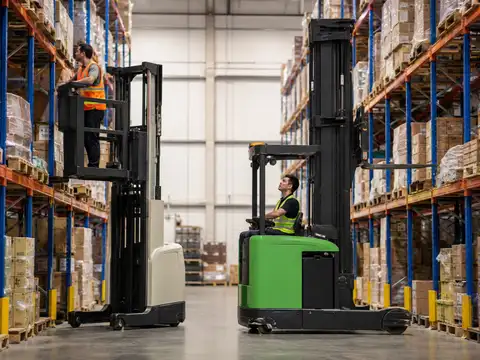
The decision is usually determined by the unit of work:
Full pallet → reach truck · Individual case or piece → order pickerToyota's current Reach Truck carries 2,500–4,500 lb and lifts up to 444 in, while its current Order Picker raises the operator to pick at heights up to 390 in. Raymond's current 5600 order picker extends to 456 in for high-level case and piece picking.
Reach trucks and order pickers are often grouped together because both are electric narrow-aisle warehouse trucks.
Operationally, however, they solve opposite sides of the same rack.
A reach truck keeps the operator near floor level and moves the pallet vertically. An order picker elevates the operator so product can be selected directly from the rack.
Workflow decision
Reach truck moves the pallet. Order picker moves the person to the product.
The operator stays at floor level while forks reach and lift the pallet into rack.
- Putaway
- Full-pallet retrieval
- Reserve storage
The operator platform rises so individual cartons or items can be selected at height.
- Case picking
- Split-case orders
- High-SKU fulfillment
Both machines can work high in narrow aisles. The right choice is determined by the unit being handled: full pallet versus individual case or piece.
The simplest distinction: pallet handling vs item picking
Raymond's current 2026 product-reference guide describes its reach-fork trucks primarily around pallet storage and retrieval.
The same guide describes its 5300, 5500 and 5600 order pickers specifically around case or piece picking.
Raymond's current order-picker product page says the same thing more directly: order pickers elevate the operator and platform to pick individual items or cases from rack instead of moving full pallets.
That functional distinction should usually settle the equipment class before capacity, price or battery options are discussed.
Order picker vs reach truck at a glance
| Decision factor | Order picker | Reach truck |
|---|---|---|
| Primary work unit | Cases / cartons / pieces | Full pallets |
| Operator elevation | Operator rises with platform | Operator remains near floor level |
| Typical capacity | Often around 2,000–3,000 lb | Often 2,500–4,500+ lb |
| Current Toyota max height | 390 in standard order picker | 444 in standard reach truck |
| Current Raymond high model | 456 in on 5600 | Up to ~45 ft on high-capacity reach family |
| Rack use | Direct access to pick faces | Reserve pallet storage / retrieval |
| Fall protection | Elevated-person system required by application/program | Operator not elevated with load |
| Best-fit inventory | High SKU, partial-pallet orders | Full-pallet movement / reserve inventory |
Why a reach truck is better for full pallets
Toyota's current Reach Truck is designed around pallet placement and retrieval, with:
- 2,500–4,500 lb capacity;
- single- and double-reach configurations;
- up to 444 in maximum lift height;
- high-rack visibility;
- dock-to-stock and stock-to-dock operation;
- configurable forks and attachments.
The operator does not need to travel upward to put away a pallet. The mast and reach mechanism perform the vertical movement.
That makes reach trucks a natural reserve-storage tool.
Why an order picker is better for partial-pallet orders
Suppose a pallet contains 40 cartons and today's order requires three.
A reach-truck workflow could:
- retrieve the entire pallet;
- lower it to floor level;
- remove three cartons;
- return the remaining 37 cartons to rack.
An order-picker workflow can raise the operator directly to the location, remove the three cartons and continue to the next pick.
The more frequently orders split pallets, the stronger the case for direct elevated picking.
Three cartons from a 40-carton pallet
Reach truck: move the entire pallet twice—down and back up.
Order picker: move the operator to the three cartons.
The equipment decision follows the fulfillment unit, not simply the rack height.
But do not use an order picker for a full-pallet warehouse
If 90% of outbound orders ship as full pallets, elevating an operator to pick individual cartons solves a problem the warehouse barely has.
A reach truck or counterbalance system will usually fit full-pallet workflows better.
Order pickers add:
- operator-elevation safety systems;
- picking platform requirements;
- slower high-level travel constraints;
- case-handling labor.
Those costs are justified only when direct case or piece access creates real value.
Both trucks can work high—but they use height differently
Toyota's current standard Order Picker reaches up to 390 inches.
Toyota's current Reach Truck reaches up to 444 inches.
Raymond's current 5600 high-capacity order picker reaches 456 inches, while Raymond's high-capacity reach-fork family reaches approximately 45 feet.
Lift height alone therefore cannot select the machine. Both classes can operate in high-rack environments.
A warehouse can have 35-foot rack and still need either machine—or both. Ask whether the task at 35 feet is retrieving a full pallet or picking individual product from a location.
Order pickers can actually exceed some ordinary reach-truck configurations
Raymond's 5600 order picker reaches 456 in, or 38 ft.
Raymond's standard 7200/7300 reach-fork families are commonly listed around 31 ft in current product-reference guidance, although higher-capacity reach families extend to 37–45 ft.
This reinforces why “reach truck goes higher” is not a universally useful rule.
Capacity generally favors reach trucks
Toyota's current standard Reach Truck spans 2,500–4,500 lb.
Raymond's current reach families include 3,500-, 4,000- and 4,500-lb configurations, with specialized variants extending the application further.
High-level order pickers commonly sit around a 3,000-lb nominal capacity.
Raymond's current 5500 and 5600 both list 3,000 lb.
The reason is structural: an order picker is elevating an operator and a picking platform with the load, rather than functioning only as a pallet-lift truck.
Do not treat 3,000 lb as usable capacity at every height
As with any powered industrial truck, final rated capacity depends on the configuration and load chart.
Raymond's product-reference material notes different capacity behavior by model and height.
Verify:
- platform type;
- load bed;
- maximum pick height;
- load center;
- pallet/cart dimensions;
- auxiliary carriage where applicable.
Order pickers can be VNA equipment
Toyota's July 2026 aisle guide classifies:
- 8.5–10.5 ft: narrow aisle, including reach trucks;
- 5–7 ft: very narrow aisle, including order pickers and turret trucks.
That general classification reflects the way guided order pickers can operate in very tight case-pick aisles.
It should not be used as a final aisle dimension for a particular truck.
Reach trucks typically need more turning geometry than guided VNA pickers
A reach truck must maneuver a pallet into the rack.
A guided order picker can travel parallel to the aisle while the operator reaches sideways to product locations, reducing the need for a full pallet right-angle stack maneuver.
That distinction can support tighter case-pick aisles.
Wire guidance changes order-picker economics
Toyota's current Order Picker offers optional wire guidance and double-rail guidance.
Raymond's current 5600 can use Intelliguide wire guidance to reduce steering requirements in the aisle.
Guided operation can add:
- floor wire installation;
- signal-generation equipment;
- truck sensors;
- commissioning;
- future floor-repair coordination.
A VNA order picker should therefore be budgeted as a truck-plus-building system.
Reach trucks can also use highly optimized narrow-aisle layouts without guidance
Most standard reach-truck applications remain free-steering.
That preserves more flexibility if:
- aisle geometry changes;
- the truck serves staging;
- dock-to-stock travel matters;
- the fleet must move between zones.
The trade-off is that free-steering pallet placement normally needs more aisle width than a tightly guided piece-picking aisle.
The operator position is fundamentally different
Reach-truck operators remain in the truck compartment near the floor while the load travels up the mast.
Order-picker operators travel upward with the platform.
That changes:
- fall-protection systems;
- operator training;
- high-level visibility;
- comfort at elevation;
- rescue / recovery planning;
- travel speed at height.
Toyota includes harness and tether equipment on its current order picker
Toyota's current standard Order Picker lists a full-body harness and energy-absorbing tether among its safety features.
Raymond's current 5500 and 5600 offer an integrated tether system capable of limiting truck operation when the operator connection is not detected.
This is a major operational difference from a reach truck.
Be precise about OSHA and order-picker fall protection
OSHA's powered-industrial-truck standard itself does not contain a simple line saying every order-picker operator must wear one particular harness under all circumstances.
OSHA has nevertheless stated that recognized fall hazards on elevated powered industrial truck platforms must be addressed and strongly encourages body-harness use. OSHA's general-industry personal-fall-protection criteria also define requirements for systems when personal fall arrest is used.
Employers should follow the truck manufacturer's instructions, applicable fall-protection requirements and their site-specific hazard assessment.
Training, elevated operator exposure, tether/harness inspection, platform use and high-level emergency procedures need their own controls.
The pick face—not reserve pallet count—drives order-picker value
Order pickers are strongest when the operation has many product locations that need direct human access.
Typical profiles include:
- e-commerce;
- parts distribution;
- retail distribution;
- pharmaceutical distribution;
- 3PL fulfillment;
- high-SKU B2B order assembly.
Raymond currently lists these types of case-, piece- and split-case workflows as core order-picker applications.
SKU count alone does not prove you need order pickers
A warehouse can have 20,000 SKUs and still ship many of them only as full pallets.
Measure:
- order lines/day;
- cases per line;
- full-pallet percentage;
- split-pallet percentage;
- pick locations per order;
- average pick height;
- travel distance;
- replenishment frequency.
The order profile matters more than the catalog SKU count.
Reserve storage and forward picking often need both machines
A common warehouse architecture separates:
- reserve pallets: reach-truck territory;
- forward pick locations: order-picker territory.
Reach trucks replenish the pick zone with full pallets. Order pickers retrieve cases or pieces for customer orders.
This is often more productive than asking either machine to perform both jobs poorly.
Reserve + forward pick
Reach truck moves one full pallet from reserve into a forward location.
Order picker then serves dozens of customer order lines from that inventory.
The machines form one replenishment system rather than competing substitutes.
Replenishment frequency is the hidden cost of case picking
Small forward-pick locations improve picker access but empty faster.
That can increase:
- reach-truck replenishment moves;
- aisle conflicts;
- stockout risk at the pick face;
- night-shift replenishment labor;
- WMS task volume.
The best forward-pick design balances picking productivity with replenishment cost.
A full-pallet pick can still belong in an order-picker aisle
Warehouse designs are not always pure.
Some SKUs may switch between:
- piece picks;
- case picks;
- full-pallet demand.
If full-pallet demand is frequent, consider whether the storage location should be accessible by reach truck or whether reserve pallet stock should be separated from the case-pick face.
Turret trucks can combine pallet handling and case picking in VNA
If a facility wants both functions inside a very narrow aisle, a turret truck can become another option.
Raymond's current 9600 Swing-Reach is explicitly designed for:
- case picking;
- high-level pallet handling;
- very narrow aisles;
- wire-guided operation.
Crown's current TSP turret family similarly supports both full-pallet handling and case picking in VNA.
That versatility comes with a more specialized and typically more expensive system than an ordinary reach truck or order picker.
Do not solve a mixed workflow with the wrong ordinary truck
If the requirement is genuinely:
5.5-ft aisle + high-level case picking + full-pallet storage,
the real comparison may be turret architecture versus separate equipment, not simply order picker versus reach truck.
Order-picker productivity is driven by travel and vertical movement
A case picker can spend time:
- traveling between locations;
- raising to pick height;
- searching for product;
- physically picking;
- placing product on pallet/cart;
- lowering;
- returning to consolidation.
Improving only mast speed may deliver a small benefit if poor slotting creates most of the travel.
Slotting can matter more than truck specification
High-volume SKUs placed near shipping and at ergonomic heights reduce:
- horizontal travel;
- vertical travel;
- operator reaching;
- replenishment complexity.
Buying a faster order picker cannot fully compensate for poor product-location design.
Fast mover at 28 ft vs 8 ft
If an A-item requires hundreds of picks per week, repeatedly raising the operator to 28 ft can waste more labor than the truck's maximum travel-speed specification can recover.
Equipment and slotting should be optimized together.
Reach-truck productivity is driven by pallet cycle time
A reach-truck cycle normally includes:
- travel to pallet;
- fork entry;
- travel to storage;
- mast lift;
- reach extension;
- pallet placement;
- reach retraction;
- lower / return.
Rack height, aisle traffic and pallet consistency can materially affect moves per hour.
Double-deep reach adds density and sequencing
Toyota's current Reach Truck line includes single- and double-reach models.
Double-deep storage can place one pallet behind another, increasing density.
It can also reduce direct pallet selectivity because the front pallet can block the rear position.
This is a reserve-storage issue, not an order-picker substitute.
Order-picking platforms change how much product moves per trip
The operator does not have to return after every case.
A pick platform, pallet or cart can collect multiple lines before consolidation.
Larger batch size can reduce:
- return travel;
- elevator cycles;
- consolidation frequency.
But larger loads also affect platform dimensions, aisle clearance and truck capacity.
Order picker is often the stronger high-SKU machine
If one order contains:
- one case from location A;
- two cartons from location B;
- three pieces from location C;
- one box from location D;
lowering full pallets repeatedly is highly inefficient.
The order picker lets the operator assemble the order directly from the rack.
Reach truck is usually the stronger low-SKU, pallet-deep machine
If inventory consists of:
- 60 SKUs;
- 50–200 pallets per SKU;
- full-pallet receipts;
- full-pallet shipments;
the warehouse has little reason to elevate people for fulfillment.
Pallet-handling equipment and high-density storage usually deserve priority.
Operator ergonomics differ dramatically
Reach-truck operators focus on:
- travel posture;
- mast visibility;
- load alignment;
- repetitive reach cycles;
- reverse travel.
Order-picker operators additionally:
- stand at elevation;
- bend and reach for product;
- handle cases manually;
- manage fall-protection equipment;
- organize picked product on the platform.
The ergonomic problem is therefore different even when both trucks use standing operator compartments.
Heavy cases can make high-level order picking a poor process
A machine can safely elevate the operator while the individual product remains ergonomically difficult to handle.
If cases are:
- very heavy;
- awkward;
- fragile;
- long;
- difficult to grip;
the warehouse may need lower pick faces, mechanical assist or full-pallet handling rather than simply a higher-capacity order picker.
Do not confuse truck capacity with safe manual handling
A 3,000-lb order picker can carry a substantial total platform load.
That does not mean an operator should manually lift one 150-lb carton at shoulder height.
Product ergonomics still require separate assessment.
Both equipment types are Class II narrow-aisle forklifts
Toyota's July 23, 2026 forklift-classification guide places both reach trucks and order pickers inside: Class II — Electric Motor Narrow Aisle Forklifts.
Shared Class II classification means they overlap in warehouse-density goals.
It does not make operator training interchangeable.
Training on one truck does not automatically qualify the operator on the other
Toyota's safety commentary explicitly notes that training on a sit-down counterbalance truck does not transfer automatically to a stand-up reach truck and emphasizes type-specific operator training.
OSHA's 1910.178 operator-training framework likewise requires training to address the truck-related and workplace-related topics applicable to the equipment being operated.
Order-picker elevation and reach-truck pallet-handling behavior create different training requirements.
Floor condition matters to both
Narrow-aisle equipment commonly uses small, hard wheels on smooth indoor floors.
Poor floors can cause:
- vibration;
- load instability;
- mast movement;
- operator discomfort;
- slower travel;
- wheel wear;
- guidance problems.
High-level order picking makes operator exposure to mast movement especially noticeable.
Battery strategy is similar at the system level
Both truck classes are electric.
Both therefore need:
- battery capacity matched to duty;
- charger;
- charging windows;
- lead-acid or lithium strategy;
- multi-shift planning;
- battery replacement reserve.
Raymond's current order picker and reach fleets both support modern lithium-ion options depending on model.
The duty cycle can still create different energy demand
An order picker repeatedly raises both operator and collected product.
A reach truck repeatedly raises heavier full pallets.
Energy use therefore depends on:
- average lift height;
- load weight;
- travel distance;
- lift cycles;
- lowering energy recovery where applicable;
- shift intensity.
Measure actual charger kWh by truck class if energy cost matters materially.
Maintenance overlaps, but order pickers add elevated-person systems
Both require attention to:
- mast;
- chains;
- hydraulics;
- drive system;
- brakes;
- wheels;
- battery and charger;
- controls.
Order pickers additionally need disciplined inspection of:
- operator platform;
- gates;
- pallet clamp;
- fall-protection attachment / tether system;
- high-level controls;
- emergency lowering systems.
Compare fleet maintenance from actual service records rather than assuming one class always costs less.
Purchase price should not decide the workflow
Warehouse Fieldbook's current cost guides place standard new order pickers in roughly the high-$20,000s through $40,000-plus zone and ordinary new reach trucks in a broadly similar mid-five-figure equipment category depending on model and configuration.
That overlap is useful because it prevents the wrong question:
“Which forklift is cheaper?”
The better question is:
“Which workflow produces the lower fulfillment cost?”
A cheaper machine can create much more labor
$5,000 equipment saving vs thousands of extra pallet touches
Suppose the reach truck costs $5,000 less but the warehouse must lower and restore 80 pallets per shift solely to extract partial quantities.
The equipment saving may disappear quickly in travel, pallet handling, congestion and labor.
Conversely, unnecessary order picking can create labor too
If a customer regularly orders 40 cases and the pallet contains 40 cases, manually picking 40 individual cases makes little sense.
Retrieve and ship the full pallet when the order and inventory rules allow it.
WMS logic should recognize when an order line crosses the economic threshold from case picking to full-pallet picking.
Dynamic allocation can let the WMS choose the handling unit
Strong fulfillment design can classify demand as:
- full pallet;
- case;
- piece;
and route each to the appropriate storage and equipment process.
That avoids forcing one machine to serve every order size.
Pick-face design should follow order-line velocity
Forward picking works best when high-frequency SKUs receive enough accessible quantity to reduce replenishment without consuming excessive prime space.
Slow movers can remain:
- higher;
- farther away;
- in reserve locations;
- in less ergonomic pick positions.
Order picker and reach truck economics are therefore connected to slotting.
Cold storage often strengthens the case for role specialization
Refrigerated cube is expensive.
Reach trucks can support dense high-bay reserve storage.
Order pickers can support high-density case-picking zones where direct product access is required.
Battery, operator warming, condensation and cold-storage equipment packages still need to be specified for the actual temperature.
Long horizontal travel can weaken both high-level specialists
If the dominant task is moving pallets 800 feet across a distribution center, a rider pallet truck may be more efficient than using either reach trucks or order pickers for transport.
High-level specialists should spend as much time as practical doing the task that justifies their specialization.
Fleet architecture can therefore use:
- pallet trucks for long horizontal movement;
- reach trucks for pallet storage;
- order pickers for high-level case picking.
Do not pay high-bay equipment to perform floor transport all day
A truck with sophisticated mast, guidance and high-lift capability can be an expensive way to perform a simple horizontal move.
Measure how much of each truck's operating time is actually spent using the capability that justified its purchase.
When the reach truck is usually the stronger choice
- full pallets dominate receipts and shipments;
- reserve storage is the primary function;
- loads exceed ordinary order-picker capacities;
- double-deep storage is useful;
- dock-to-stock flexibility matters;
- the operator should remain at floor level;
- the warehouse has relatively low case-pick complexity.
When the order picker is usually the stronger choice
- orders frequently split pallets;
- case / piece picking is central to fulfillment;
- SKU count is high and direct access matters;
- the warehouse wants VNA case-pick aisles;
- operators need access above lower rack levels;
- batch picking can reduce consolidation trips;
- full-pallet retrieval is handled by another fleet.
When the warehouse usually needs both
- reserve pallet storage feeds a forward-pick area;
- the same SKU can ship by pallet and by case;
- high-bay reserve and VNA picking coexist;
- different shifts focus on replenishment and fulfillment;
- pallet flow and case flow are separated operationally.
When neither ordinary machine is enough
Consider turret/VNA equipment when the operation needs:
- very narrow aisles;
- high-level case picking;
- full-pallet handling in the same aisle;
- extreme vertical storage density.
Raymond's current 9600 and Crown's current TSP family are examples of equipment that bridge those functions.
A practical workflow test before buying
Take one representative day of orders and classify every handling requirement:
- full-pallet receipts;
- full-pallet putaway;
- reserve replenishment;
- full-pallet customer picks;
- case picks;
- piece picks;
- horizontal transport.
Assign the lowest-complexity appropriate truck class to each.
Then calculate how many task handoffs the proposed design creates.
Too many handoffs can erase specialization gains
Four trucks touch one pallet
Counterbalance unloads → pallet truck transports → reach truck stores → another truck stages replenishment.
Specialization is useful only when the productivity gain exceeds the labor, staging and queue cost created by handoffs.
One truck doing everything can be equally inefficient
The opposite extreme is using one reach truck to:
- unload trailers;
- transport long distances;
- put away pallets;
- lower pallets for every case pick;
- reload trailers.
The fleet looks simple while the process accumulates unnecessary touches.
Measure cost per completed handling unit
Compare:
- cost per pallet put away;
- cost per full pallet retrieved;
- cost per case picked;
- cost per order line;
- replenishment moves per 1,000 picks.
Those metrics reveal whether the selected equipment actually improves fulfillment.
The practical recommendation
Do not start by comparing reach-truck and order-picker specifications.
Start with one question:
What exactly leaves the rack?
If the answer is a full pallet, start with a reach-truck workflow.
If the answer is one case, carton or piece from that pallet, start with an order-picker workflow.
If the answer changes by SKU and order, design reserve and forward-pick systems together and expect both truck types—or a specialized VNA alternative—to have a role.
The best warehouse does not make one forklift perform every task. It matches the movement unit, storage layout and equipment so each pallet or case is touched as few times as practical.
Frequently asked questions
What is the difference between an order picker and a reach truck?
A reach truck raises and moves full pallets while the operator remains near floor level. An order picker elevates the operator and platform so individual cases or pieces can be selected directly from rack.
Can an order picker move pallets?
Order pickers can carry pallets or specialized picking platforms as load beds, but their primary function is case or piece picking with the operator elevated. They are not normally the preferred truck for repeated full-pallet putaway.
Can a reach truck be used for order picking?
A reach truck can retrieve a full pallet so cases are picked at floor level, but it does not elevate the operator for direct high-level case picking. Repeatedly lowering pallets for partial quantities can add unnecessary handling.
Which lifts higher, a reach truck or order picker?
It depends on model. Toyota's current Reach Truck reaches up to 444 in while its standard Order Picker reaches 390 in. Raymond's current 5600 Orderpicker reaches 456 in, showing that high-level order pickers can exceed some ordinary reach-truck configurations.
Which can lift more weight?
Reach trucks generally have the stronger full-pallet capacity range. Toyota's current Reach Truck spans 2,500–4,500 lb, while many high-level order pickers are around 3,000 lb nominal capacity.
Which works in narrower aisles?
Toyota's July 2026 planning guide places reach trucks in the 8.5–10.5-ft narrow-aisle category and order pickers among 5–7-ft VNA equipment. Exact required width depends on the specific truck, load, rack and guidance system.
Does an order picker need a harness?
Current Toyota high-level order pickers include a full-body harness and energy-absorbing tether. Employers should follow manufacturer instructions, applicable fall-protection requirements and site-specific hazard controls.
Are order pickers and reach trucks the same OSHA forklift class?
Toyota's July 2026 classification guide places both within Class II electric motor narrow-aisle forklifts. Their operating tasks and training needs remain different.
Which is better for e-commerce?
Order pickers are usually stronger where e-commerce orders contain many individual pieces or cases from different SKUs. Reach trucks remain important for reserve-pallet storage and replenishment behind that picking process.
Which is better for a pallet warehouse?
Reach trucks are generally the stronger choice when the warehouse primarily receives, stores and ships full pallets.
Can one warehouse need both?
Yes. A common architecture uses reach trucks for reserve storage and replenishment and order pickers for forward case/piece picking.
When should I consider a turret truck instead?
Consider turret/VNA equipment when the same very narrow aisle needs both high-level case picking and full-pallet handling at extreme storage density.
Sources and methodology
Warehouse Fieldbook uses current Toyota, Raymond and Crown product specifications to separate workflow, height, capacity and narrow-aisle capability. Manufacturer aisle categories are planning guidance rather than universal final dimensions. OSHA sources are used cautiously for powered-industrial-truck and fall-protection context; the article does not claim that 29 CFR 1910.178 itself contains a blanket harness rule for every order-picker application. Equipment selection should be validated against actual order profile, load dimensions, rack design, safety program and the exact truck configuration.
- Toyota Material Handling — current Order Picker, 390-in height and harness/tether features
- Toyota Material Handling — current Reach Truck, 2,500–4,500 lb and 444-in lift height
- Toyota Material Handling — July 2026 narrow-aisle and VNA equipment guidance
- Toyota Material Handling — July 2026 Class II reach-truck/order-picker classification
- Raymond — current order-picker application, capacity and height range
- Raymond — current 5500 Orderpicker, 3,000 lb and 366-in height
- Raymond — current 5600 Orderpicker, 3,000 lb and 456-in height
- Raymond — 2026 product reference guide for reach-fork vs order-picker applications
- Raymond — current 9600 VNA truck combining case picking and pallet handling
- Crown — current U.S. order-picker and reach-truck capacities/heights
- Crown — current TSP VNA turret truck for pallet handling and case picking
- OSHA — 29 CFR 1910.178 powered industrial trucks
- OSHA — fall-protection interpretation for elevated powered-industrial-truck platforms
- OSHA — personal fall-protection-system criteria